2014 AUDI RS7 SPORTBACK clock
[x] Cancel search: clockPage 224 of 292
222 Checking and filling
pressure relief valve in the cap when the en
gine becomes hot.
.&_ WARNING
- The cooling system is under pressure and
can get
very hot. Reduce the risk of
sca lding from hot coolant by following
these steps .
- Turn off the eng ine and a llow it to cool
down.
- Protect your face, hands and arms from
escap ing flu id and steam by cover ing
the cap with a large , thick rag .
- Tu rn the cap slowly and
very carefully
in a counter -clockwise direction while
applying light, downward pressure on
the top of the cap .
- To avo id being burned, do not sp ill an
tifreeze or coolant on the exhaust sys
tem or hot engine parts. Under certain
conditions, the ethylene glycol in en
g ine coolant can catch fire.
- Antifreeze is poisonous. Always store an
t ifreeze in its original container and well
out of the reach of children.
- If you drain the coolant, it must be
caught and safely stored in a proper con
ta iner clearly marked "poison".
(D Note
- Coolant po llutes the environment and
could cause an engine fire. Excess coo l
ant will be forced out through the pres
sure relief valve i n the cap when the en
gine becomes hot .
- If, in an emergency, only water can be
added, the correct ratio between wate r
and antifreeze ~
page 220 must be re
stored as soon as possib le.
@) For the sake of the environment
Dra ined coolant should not be reused . Al
ways dispose of used coolant while
observ
ing all environmental regulations .
Radiator fan
The radiator fan switches on automatically by
itself .
An auxilia ry electric r adiator fan switches on
and off depending on coolan t tempera ture
and other vehicle operat ing condit ions .
After you switch the engine off, the aux iliary
fan can continue running for up to 10 minutes
- even w ith the ignition off . It can even swi tch
on aga in later by itself
c> .&. , if
- the temperature of the engine coo lant rises
due to the heat build-up from the engine in
the engine compartmen t, or
- the engine compartment heats up because
the vehicle is parked in intense sunlight.
.&_ WARNING ,_
- To reduce the risk of personal injury nev
er touch the radiator fan .
- The auxiliary electric fan is temperature
controlled and can sw itch on suddenly
even when the engine is not running .
- The auxiliary radiator fan sw itches on au
tomatically when the engine coo lant
reac hes a certain t emperature and wi ll
continue to run until the coolant temper
a ture drops.
Brake fluid
Checking brake fluid level
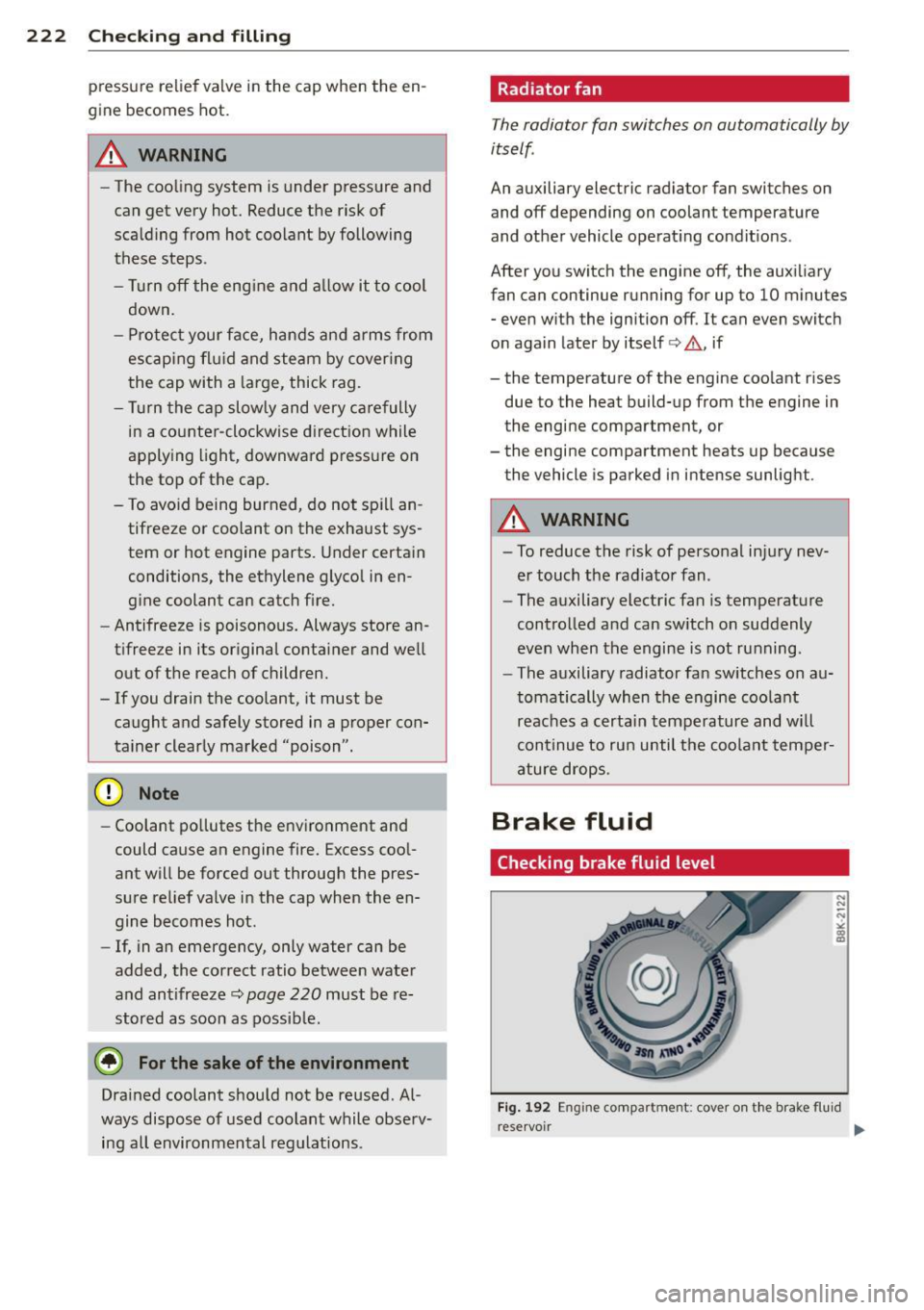
Fi g. 19 2 Engin e compart ment: cover on t he bra ke fluid
re servoir
Ill>
Page 237 of 292
-Turn the valv e stem cap counter-clockwise
to remove it from the tire valve.
- Place the air pressure gauge on the valve.
- The tire pressures should only be checked
and adjus ted when the tires are cold . The
s li ght ly raised p ressures of warm tires must
not be reduced .
- Adjust the tire pressure to the load you are
carrying .
- Re insta ll the va lve stem cap on the valve.
When should I che ck the tire pres sur e?
The correct tire pressure is espec ially impor
tant at high speeds. The pressure should
therefo re be checked at least once a month
and a lways before start ing a journey.
When should I adjust the tire p re ssure s?
Adjust the tire pressure to the load you are
carry ing . After changing a wheel
o r replacing
wheels you have to adjust the tire pressures
on all wheels. In addition , you must then
store the new ti re pressu res in the t ire pres
sure monitoring system
r::!.> page 246 .
A WARNING
Incorrect tire pressures and/or underinf la
tion can lead sudden tire failure, loss of contro l, collision, serious persona l injury
or even death.
- When the warning symbo l
[ti] appears in
the instrument cl uster, stop and inspect
the tires.
- Incorrect tire pressure and/or underinfla
t ion can cause increased tire wear and
can affect the handling of the veh icle and
stopp ing ability .
- Incorrect tire pressures and/or underin
flation can also lead to sudden tire fa il
ure, including a blowout and sudden de
flation, causing loss of vehicle control.
- The driver is responsible for the correct
tir e pressures fo r all t ires on the vehicle .
T he applicable pressu re va lues are locat
ed on a stic ker on the drive r's side B-pil
lar .
- Only when a ll t ires on the vehicle are fi l
led to t he cor rect pressure, the ti re p res-
Tire s an d wheel s 235
sure monitor ing system can work cor
rectly.
- The use of incorrect tire pressure va lues
can lead to acc idents or other damage.
Therefore it is essential that the driver
observe the spec ified t ire pressure values
for the tires and the correct pressures for
the function of the t i re p ress ure monito r
ing system .
- Always inf late t ires to the recommended
a nd correct t ire p ress ure before dr iv ing
off.
- Driving with unde rinflated tires bend
mo re, lett ing t hem get too hot resulti ng
in tread separation, s udden tire failure
and loss of cont ro l.
- Excess ive speed and/overloadi ng can
cause heat b uild- up, sudden tire failure
a nd loss of cont rol.
- If the tire pressure is too low or too high,
the t ires will wear prema turely and the
veh icle w ill not handle well.
- If the tire is not fla t and you do not have
to ch ange a wheel immedia tely, drive a t
red uced speed to the nearest service sta
tion to check the t ire p ress ure and add
air as requi red.
(D Note
Dr iving w it h out valve stem c aps can c ause
damage to the tire valves . To prevent this,
a lways make sure that factory insta lled
va lve stem caps on all whee ls are sec urely
mounted on the valve .
@ For the sake of the env ironment
Un derinflated tires wi ll also increase the
fuel consumption .
Tires and vehicle load limits
There are limits to the amount of load or
weight that any vehicle and any tire can carry.
A vehicle that is overloaded will not handle
well and is mo re d iff icult to stop. Overloading
can not o nly lead to loss of vehicle control,
but can also damage important parts of the
vehicle and c an le ad to sudden tire fa ilu re, .,..
•
•
Page 252 of 292
250 What do I do now?
What do I do now?
Emergency warning
triangle
App lies to vehicles: with emerge ncy warning triangle
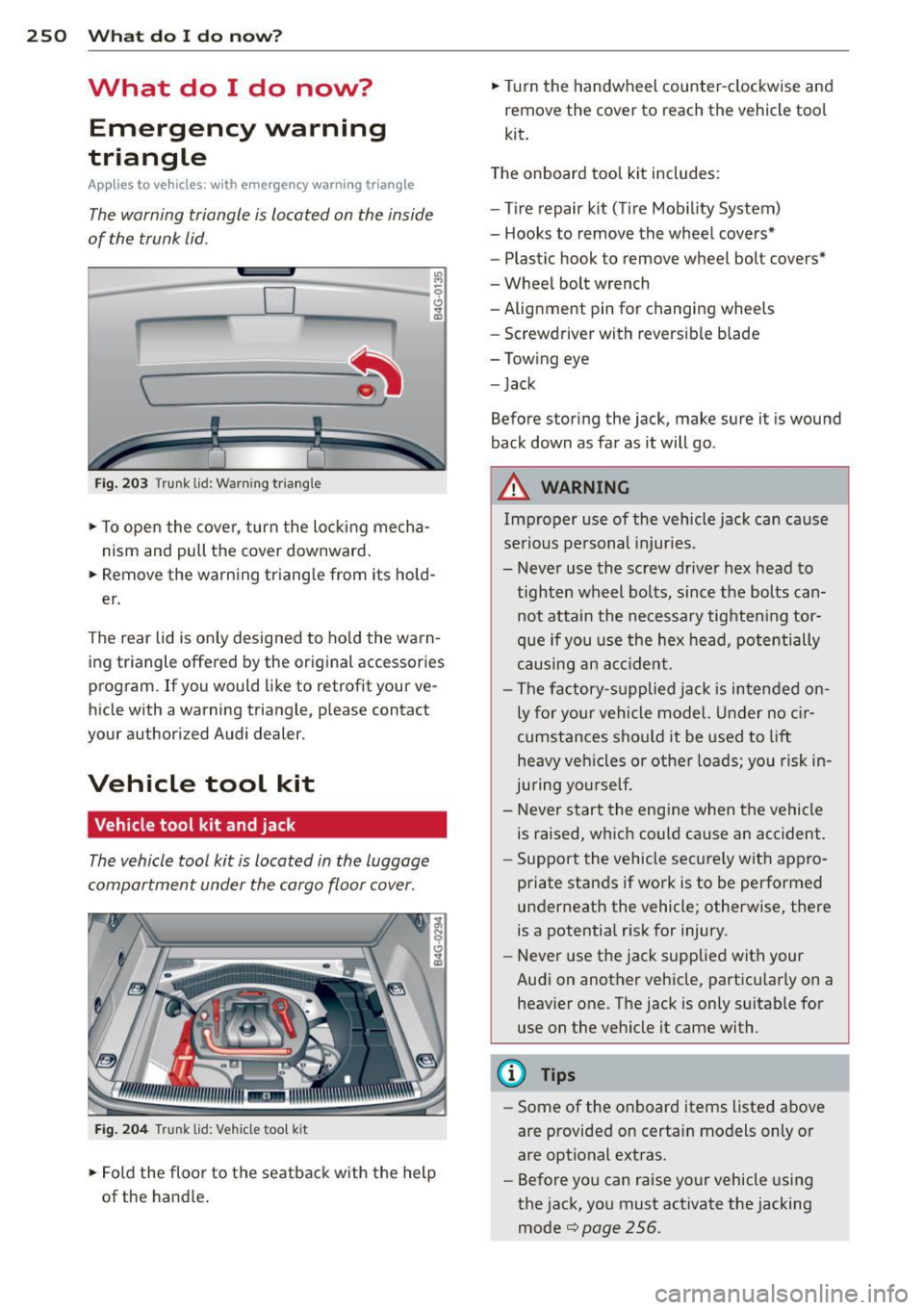
The warning triangle is located on the inside
of the trunk lid .
-
"' M ~ 0 6
~ ~
Fig. 203 Trunk lid: Warning triang le
.,. To open the cover, turn the locking mecha
nism and pull the cover downward .
" m
.,. Remove the warning triang le from its hold
er .
The rear lid is only designed to hold the warn
ing triangle offered by the original accessories
program. If you would like to retrofit your ve
hicle with a warning triangle, p lease contact
your authorized Audi dealer.
Vehicle tool kit
Vehicle tool kit and jack
The vehicle tool kit is located in the luggage
compartment under the cargo floor cover.
Fig. 204 Trunk lid: V ehicl e too l kit
.,. Fold the floor to the seatback with the help
of the handle . .,.
Turn the handwheel counter-clockwise and
remove the cover to reach the veh icle tool
kit.
T he onboard tool kit includes :
- Tire repair kit (Tire Mobility System)
- Hooks to remove the wheel covers*
- Plastic hook to remove wheel bolt covers*
- Wheel bolt wrench
- Alignment pin for changing wheels
- Screwd river with reversible bla de
-Towing eye
-J ack
Before storing the jack, make sure it is wound
back down as far as it will go .
A WARNING
Improper use of the vehicle jack can cause
serious personal injuries.
- Never use the screw driver hex head to
tighten wheel bolts, since the bolts can
not attain the necessary tighten ing tor
que if you use the hex head, potentially
causing an accident .
- The factory-supplied jack is intended on
ly for your vehicle model. Under no cir
cumstances should it be used to lift
heavy veh icles or other loads; you risk in
juring yourself.
- Never start the engine when the vehicle
is raised, which could cause an acc ident.
- Support the vehicle securely with appro
priate stands if work is to be performed
underneath the vehicle; otherwise, there
is a potential risk for injury.
- Never use the jack supplied with your
Audi on another vehicle, particularly on a
heav ier one. The jack is only suitable for
use on the veh icle it came with.
@ Tips
- Some of the onboard items listed above
are provided on certain models only or
are optional extras .
- Before you can raise your vehicle using
the jack, you must activate the jacking
mode¢
page 256 .
Page 258 of 292
256 What do I do now?
Loosening
.,. Slide the wheel wrench onto the wheel bolt
as far as it will go.
.,. Take tight hold of the
end of the wrench
handle and turn the wheel bolts
counter
clockwise
about one single turn in the direc
t ion of arrow
c:;, fig. 209.
Tightening
.,. Slide the wheel wrench onto the wheel bolt
as far as it will go .
.,. Take tight hold of the
end of the wrench
hand le and turn each wheel bolt
clockwise
until it is seated.
_& WARNING
- Do not use force or hurry when changing
a wheel -you can cause the vehicle to slip
off the jack and cause serious personal injuries.
- Do not loosen the wheel bolts more than
one turn
before you raise the vehicle with
the jack. -You risk an injury.
@ Tips
- Never use the hexagonal socket in the
handle of the screwdriver to loosen or
tighten the wheel bolts.
- If a wheel bolt is very tight, you may find
it easier to loosen by carefully pushing
down on the end of the wheel bolt
wrench with
one foot only. As you do so,
hold on to the car to keep your balance
and take care not to slip.
Ra ising the vehicle
The vehicle must be lifted with the jack first
before the wheel can be removed .
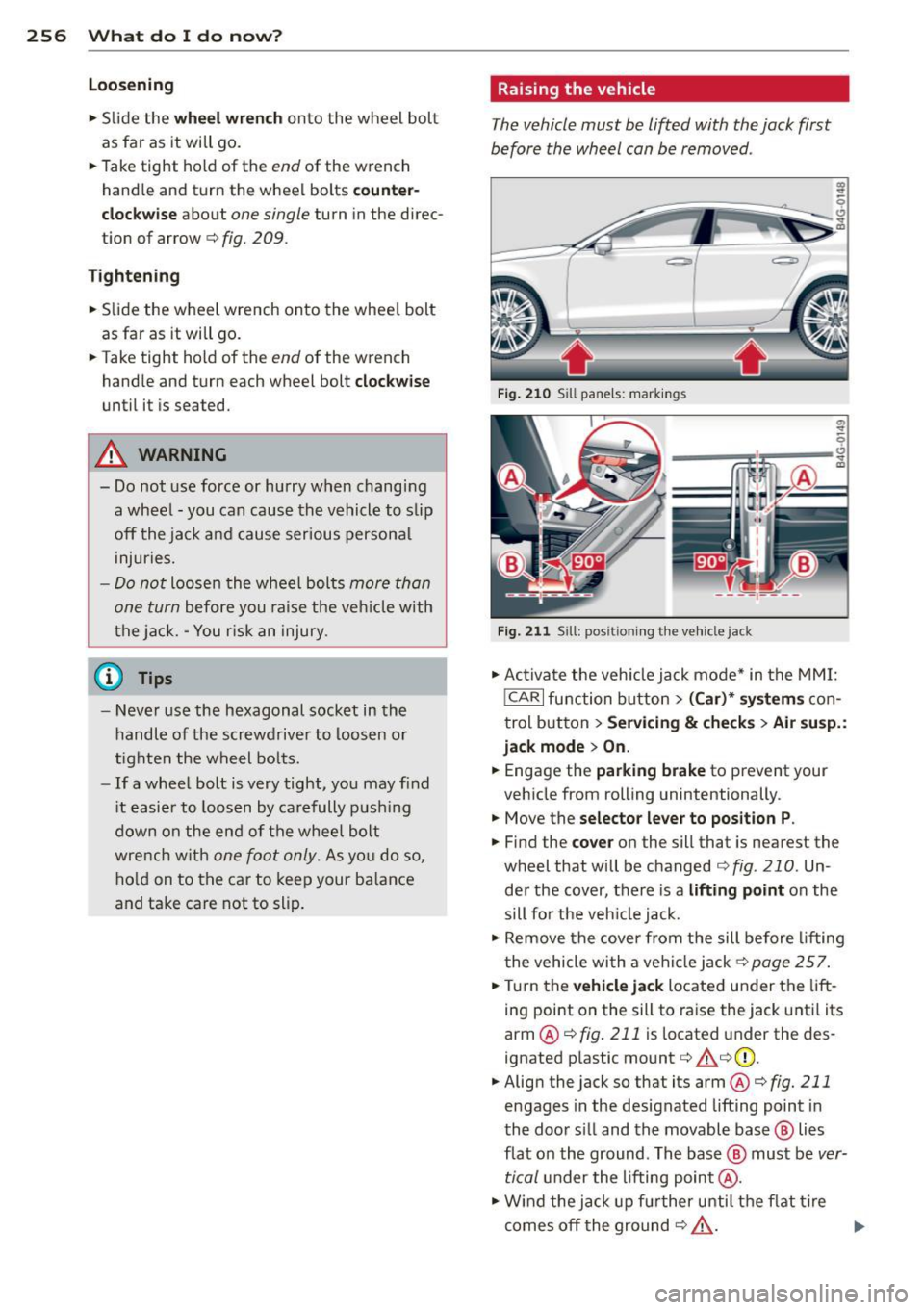
Fig. 210 Sill pane ls : markings
; q
--~~~~~-~
Fig. 211 Sill: posit ioning the Ve hicle jack
.,. Activate the vehicle jack mode* in the MMI:
!CARI function button> (Car)* systems con
trol button>
Servicing & checks> Air susp.:
jack mode
> On.
.,. Engage the parking brake to prevent your
vehicle from rolling unintentionally.
.,. Move the
selector lever to position P .
.,. Find the cover on the sill that is nearest the
wheel that will be changed
c:;, fig. 210 . Un
der the cover, there is a
lifting point on the
sill for the vehicle jack .
.,. Remove the cover from the sill before lifting
the vehicle with a vehicle jack
c:;, page 257 .
.,. Turn the vehicle jack located under the lift
ing point on the sill to raise the jack until its
arm @
c:;, fig. 211 is located under the des
ignated plastic mount
c:;, &c:;,(I) ,
.,. Align the jack so that its arm @ c:;, fig. 211
engages in the designated lifting point in
the door s ill and the movable base @ lies
flat on the ground . The base @ must be
ver
tical
under the lifting point @ .
.,. Wind the jack up further until the flat tire
comes off the ground
c:;, & . ..,.
Page 260 of 292
2 58 What do I do now ?
Taking the wheel off/installing a wheel
Follow these instructions step-by-step for
changing the wheel.
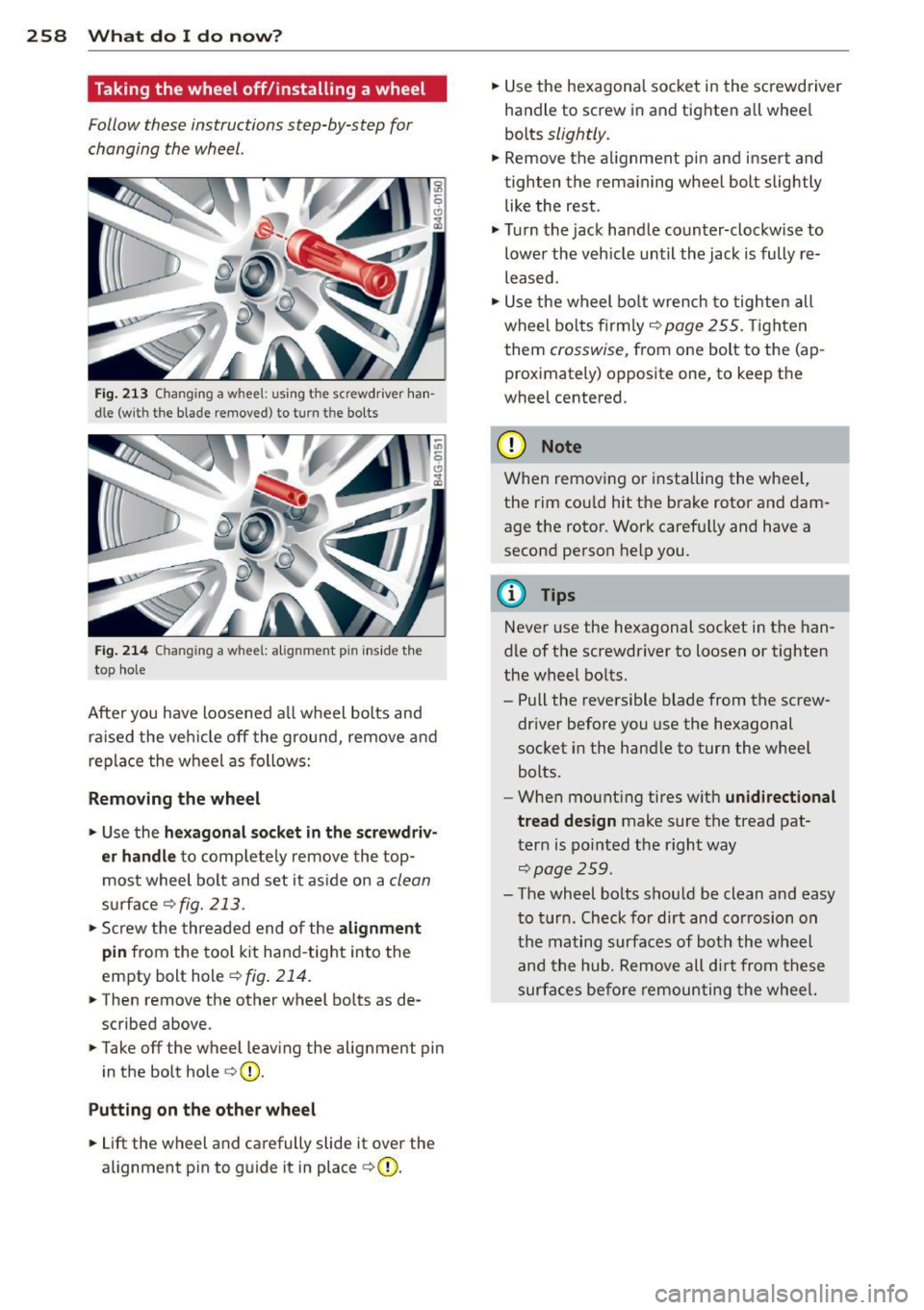
Fig. 213 Changing a whee l: u sing the screwdriver han
dle (w ith the blade removed } to turn t he bolts
Fig . 214 C hanging a w hee l: al ignm en t pi n inside the
top hole
Afte r you have loosened a ll wheel bolts and
raised the vehicle off the ground, remove and
replace the wheel as follows:
Removing the wheel
.. Use the hexagonal socket in the screwdriv
er handle
to comp letely remove the top
most wheel bolt and set it aside on a
clean
surface c:> fig. 213 .
.. Screw the threaded end of the alignment
pin
from the tool kit hand -tight into the
empty bolt hole
c:> fig. 214.
.. The n remove the other wheel bo lts as de
scribed above .
.. Take off the wheel leaving the alignment pin
in the bolt hole
c:> (D .
Putting on the other wheel
.. Lift the wheel and carefully slide it over the
alignment pin to guide it in place
c:>(D.
.. Use the hexagonal socket in the screwdriver
handle to screw in and tighten all whee l
bolts
slightly.
.. Remove the alignment pin and insert and
tighten the remaining wheel bolt slightly like the rest .
.. Turn the jack handle counter-clockwise to
lower the vehicle until the jack is fully re
leased .
.. Use the wheel bolt wrench to tighten all
wheel bolts fir m ly
c:> page 255 . Tighten
them
crosswise, from one bolt to the (ap
proximately) opposite one, to keep the
wheel centered.
(D Note
When remov ing or installing the wheel,
the rim cou ld hit the brake rotor and dam
age the rotor. Work carefu lly and have a
second person help you.
(D Tips
Never use the hexagonal socket in the han
d le of the screwdriver to loosen or tighten
the wheel bolts.
- Pull the reversible blade from the screw
driver before you use the hexagonal
socket in the handle to turn the wheel
bolts.
- When mounting tires w ith
unidirectional
tread design
make sure the tread pat
tern is pointed the right way
c:>page25 9.
-The wheel bolts should be clean and easy
to turn . Check for dirt and corrosion on
the mating surfaces of both the wheel
and the hub. Remove all dirt from these
surfaces before remounting the wheel.
Page 281 of 292
Child restraints
Dang er of using chi ld rest raints in th e
front seat . . . . . . . . . . . . . . . . . . . . . . . . 144
Where can I get addit ional information
about child restra ints and their use? . . 186
Ch ild restra int system anchors ... .. .. . 182
Ch ild safety .. ................ ... ... 168
Convertible locking retracto r . . . . . . . . . 179
I mportant safety instr uctions fo r using
ch ild safety seats ......... .. .. .. .. . 172
I mportant things to know when dr iv ing
with chi ld ren .... ..... ... .. .. .. ... 168
T ether anchors . . . . . . . . . . . . . . . . . . . . 185
Tether straps ............ .... .. .. . 185
C hild safety loc k
Rear doors ..... .. .... ... .. .. .. .... 4 0
Ch ild safety seats . . . . . . . . . . . . . . . . . . . 17 4
B ooste r seats . .. .. .... ... .. .. .. .. . 177
Conver tible c hild seats .... .. .. .. .. . 175
Conve rtible locking re tra cto r .. .. .. .. . 179
H ow do I properly ins tall a child safety
seat in my vehicle? ..... ... .. .. .. .. . 172
Infant seats . . . . . . . . . . . . . . . . . . . . . . 17 4
Instal ling .. ............. .... .. ... 179
Instal ling a child restraint us ing the
LATC H system ... .... ... .. .. .. .. .. . 184
LA TC H system ............... ... ... 184
L ower ancho rages ......... ... ... .. 183
M ount ing and releas ing the ancho rage
hook .. .. .. .. ............. .. .. ... 184
Safety ins truc tions ........ .. .. .. .. . 172
Unused safety belts on the rear seat .. 17 4
Cigarette lig hter . . . . . . . . . . . . . . . . . . . . . 59
C leaning ... . ............. .... .. .. . 203
Climate con trol (four-zone)
Operation . . . . . . . . . . . . . . . . . . . . . . . . . 70
Clock ..... ... ...... ............. ... 26
C losing
Rear lid . . . . . . . . . . . . . . . . . . . . . . . . . . . 38
Sliding/tilting su nroof ..... .. .. .. .. .. 42
Cold ti re inflat ion pressure ... .. .. .. .. . 23 2
Com ing home ..... .. ...... .. .. .. .. .. 4 6
Compartments . ........... .. .. .. .... 60
Com plian ce .. ............. .... .. .. . 276
Consume r Info rmation . . . . . . . . . . 131, 273
Consumption (fue l) . . . . . . . . . . . . . . . . . . 24
Contact ing N HTSA ......... .. .. .. .. . 13 1
Inde x 279
Controls
Cleaning . ... .. .... . ... ...... ... .. 205
Convenie nce key . . . . . . . . . . . . . . . . . . . . . 36
Star ting the engine ............ .. .. . 74
Stopping the eng ine (STAR T ENGIN E
STOP b utton) .. .... . ... ...... ... .. . 7S
Switching the ignition on .... ... .. .. . 74
U nlocking and loc king vehicle . ... .. .. . 36
Conve rtib le child sa fe ty seats ..... .. .. 17S
Convertib le locking retractor
Activati ng .... ... .. ..... .......... 181
Deact ivati ng .. ... .. ..... .......... 181
U sing to secure a child safety seat l.79, 181
Coolant
refer to Eng ine coolant ......... .. .. 220
Cooling mode (automatic climate control) 70
Cruise cont ro l
Changi ng speed .. ................. . 80
P rese tt ing your speed .......... .. .. . 80
S wi tching off .. .. .. . .. ... .... ... .. . 80
Switching on . . . . . . . . . . . . . . . . . . . . . . . 79
Warning/indicator lights ..... ... .. .. . 22
( upholder .. .. .. .. .... ........... .. . 60
Curve light .. .. .. .. .. ............... . 96
Cylinder on demand System ... ... .. .. . 26
D
Data recorde r . . . . . . . . . . . . . . . . . . . . . . 189
Date d isp lay .. .. .. .. . .. .. ..... ... .. . 26
Daytime running lights . ... .... ... .. .. . 44
Decla rat io n of compliance
Adaptive c ruise cont ro l ......... .. .. 276
A udi s ide ass ist ...... ......... .. .. 276
C e ll phone package ... ...... ... .. .. 276
Co nvenience key .... . .. ..... ... .. .. 276
E lectronic immobi lizer .. ..... ... .. .. 276
Homelink universal remote control . .. 276
Remote contro l key ............ .. .. 276
Tire pressure mo nitor ing system . .. .. 276
Decorative pa rts/trim
Cleaning . ... .... .. . .. .. ..... ... .. 205
D EF
Wh at does this mea n when it appears in
t h e tr ip odomete r display? ...... .. .. . 26
Defec tive light bu lb warni ng ......... .. 21
•
•
Page 286 of 292
284 Index
Opening Hood .. .... ................ ..... . 213
Power windows .................... 41
Rear lid . . . . . . . . . . . . . . . . . . . . . . . . . . . 38
Sliding/tilting sunroof ..... .. .. .... .. 42
Operate your vehicle economica lly and
minimize po llution .......... ... .... . 200
Other equipment (effic iency program) ... 25
Outlet .. .. .. ............. .. .. .. ... . 59
p
Paint damage
205
Paint No . .. .... ........... .. .. .... . 270
Parking . .. .... ........... .... .... .. 78
Automatic transmission ....... .. ... 106
Valet park ing .. ... ... .... .. .. .. .. .. 42
Parking brake ............. .. .. .. ... . 77
also refer to Electromechanical parking
br ake .. .. ................. .. .. .. .. 77
Parking system Adjusting the disp lay/warning tone . .. 120
C leaning sensors/came ra lenses . .... . 204
Cleaning the rear view camera .. .. .. .
Malfunc tion ......... ...... .. .. .. .
Parking system plus ........ ... .. .. . 112
120
111
Peripheral cameras ........ ... .. ... 115
Rear view camera ............. .. ... 11 2
o/sorefertoPark ingsystems . .. 111 ,112
Pa rking systems .. ......... .. .. .. .. . 110
Parts replacement .......... ... .... . 275
Pass-through with sk i sack ... .. .. .. .. . . 67
PASS ENG ER A IR BAG OF F light . . . . . . . . 155
Passenger protection ....... .. .. .. .. . 187
Passive safety system . . . . . . . . . . . . . . . . 123
Pedals .... .. ............... .. .... . 128
Physical principles of a frontal coll is ion 134
Plas tic parts
Cleaning . ...... .. ..... .... .. .. .. . 205
Polishing .... ................ ..... . 205
Pollen filter
refer to Pollutant filter . . . . . . . . . . . . . . 69
Pollutan t filter ............ .. .. .. .. .. 69
Power locking system . . . . . . . . . . . . . . . . . 34
Locking/unlocking the vehicle from in-
side ... .... ................ ..... .. 37
Selective unlock feature ... .. .. .... .. 35 Settings .
..... .. ............. ..... 35
Unlocking and locking vehicle ..... ... . 35
Power seat ad justment
Front seats . . . . . . . . . . . . . . . . . . . . . . . . 54
Power steer ing
refer to Electro -mechanical power as -
sist ......... ... .. ............... 194
Power windows .. ........ ....... .... . 41
malfunction . .. .. .... ... .. .. .. .. .. . 41
Pregnant women Special considerations when wearing a
safety belt .... .. ................ . 138
pre sense . .. .. .. . .. ... ..... ... ... .. 187
Preventative passenger pro tec tion . .. .. 187
Programming the Homelink universal re -
mote control . ..... ................. 121
Proper occupant seating positions . .. .. 124
Proper safe ty belt position .. .... .. .... 13 7
Proper seating position Front passenger .. ............. .... 125
Occupants ..... .. ................. 124
Rear passengers . . . . . . . . . . . . . . . . . . . 126
Protecting
Q
quattro
refer to All-wheel drive
Question What happens to unbelted occupants?
Why safety belts? ................ .
R
205
195
1 34
133
Radia tor fan .. .. .. ...... ..... .. .... 222
Radio clock . . . . . . . . . . . . . . . . . . . . . . . . . 26
Rain/light sensor Headlights .. .. .. ....... ..... ..... . 44
Inte rmittent (w indshield w ipers) . .... . 48
Sensor defective . . . . . . . . . . . . . . . . . . . . 22
Range (fuel level) . . . . . . . . . . . . . . . . . . . . 24
Reading lights ..... ............. ..... 47
Rear fog lights .. .. ... .. .. .. .. .. .. .. . 44
Rear lid
Automatic operation . . . . . . . . . . . . . . . . 38
Emergency release .................. 40