2014 AUDI Q5 warning light
[x] Cancel search: warning lightPage 245 of 316

The following WARNINGS ar e ver y
impo rtant when working on the batt ery:
Always heed th e fo llowin g WARN ING SYM ·
BOLS and saf ety pre caution s wh en working
on the batt ery.
®
Alw ay s w ear e ye prot ection .
&
Battery aci d contain s sulfuri c acid. Al-
w ays we ar g lo ve s and e ye protect ion.
@
No
• spark s
- fl ame s
• smokin g.
A
When a battery is charged , it produces
h y drogen gas whi ch i s ex plo sive and
could cause personal injury.
®
Al ways k eep the batte ry well out of
re ac h of children.
A WARNING
Whenever working on the battery or on
the electrical system, there is the r isk of
injury, ac cident and even fire. Read and
heed the following WARNINGS:
- Always wear eye protec tion. Do not let
battery acid or any lead particles ge t on
yo ur sk in or cloth ing. Sh ield your eyes.
Explosive gases can cause blindness o r
other injury.
- Battery acid contains sul furic acid. Sulfu
ric acid can cause blindness and severe
burns.
- Always wear gloves and eye p rotection.
Do not tilt the battery because ac id
could lea k out of the vent ilation open
ings.
- If you get batte ry acid in you r eyes or
on your sk in, immed iately r inse with
cold water for severa l m in utes and get
medical attention.
- I f you should inges t any battery acid,
see k med ica l attention immediately.
- Do not expose the battery to an open
flame, elec tric sparks o r an open light.
- Do not smoke.
-
Checkin g and fillin g 243
-Do not interchange the positive and neg
ative cables.
- When working on the battery, be sure
not to short-circuit the termina ls w ith
too ls or other metal objects. This would
cause the battery to heat up very quickly,
which could lead to damage or explosion and personal injury.
- When a battery is charged, it produces
hyd rogen gas which is explos ive and
could cause personal in jury.
- Always keep the battery well out of the
reach of children.
- Before work is done on the electrical sys
tem, disconnect the negat ive g round ca
b le.
- Before performing any work on the e lec
trical system, switch off the eng ine and
ignit ion as well as any electrical equip
ment. The negative cable on the battery
m ust be disconnected. If yo u are just go
ing to replace a light bulb, then it is
enough to switch off the lights .
- Before disconnec ting the battery, switch
off the anti -theft alarm system! Other
wise you wi ll set off the alarm.
- When d isconnecting the battery, first
disconnect the negative cab le and then
the positive cab le .
- Before reconnecting the batte ry, make
sure all e lectrica l consumers are sw itch
ed off . Reconnect the positive cable first
and then the negative cable. Never inter
change the cables -this could start a fire!
- Never charge a frozen or a thawed-out
battery. It could exp lode! If a battery has
frozen, then it must be replaced. A dis
charged battery can freeze over at 32°F
(QO().
- Make sure the vent hose is always attach
ed to the opening on the side of the bat
tery.
- Never use batteries which are damaged.
There is the danger of an explosion! Al
ways rep lace a damaged batte ry .
•
•
Page 248 of 316

246 Checking and filling
Windshield/headlight
washer container
M N
Fi g. 204 Engine compartme nt: cover on the w inds hield
and headlight * washer fluid rese rvoir
The washer flu id container is marked with t he
symbol Won its cap
Q fig. 204, ¢ page 233,
fig . 198 .
.. Before you check anyt hing in the engine
compartment,
always read and heed all
WARNINGS
¢ & in Working in the engine
compartment on page 2 31 .
.. Lift the filler cap tongue to add washe r flu
id . Yo u can fill the container to the top .
.. Press the cap back onto the fi ller neck after
fill ing t he containe r.
You can find the rese rvoi r
capacity in the tab le
in
Q page 290.
Clean water should be used when fill ing up . If
possib le, use soft wate r to prevent scal ing on
the washe r jets. Always add a glass cleaner
solu tion (w ith fros t protection in the w inte r) .
(D Note
D o not mix engine coo la nt an tifreeze or
a ny ot her ad ditives to fi ll u p t he wind
shie ld washer rese rv o ir.
Page 268 of 316

266 Tire s and wheels
When the malfunction indicator is illuminat
ed, the system may not be able to detect or
signal low t ire pressure as intended. TPMS
malfunctions may occur for a variety of rea
sons, including the installation of replace
ment or alternate tires or wheels on the vehi
cle that prevent the TPMS from funct ioning
properly . Always check the TPMS malfunct ion
tellta le after replacing one or more t ires or
wheels on your veh icle to ensure that the re
p lacement or a lternate tires and wheels allow
the TPMS to continue to function properly.
Tire pressure indicator appears
Applies to vehicles: with tire pressure monitoring system
The tire pressure indicator in the instrument
cluster informs you if the tire pressure is too
low or if there is a system malfunction.
N
I
Fig. 210 Display: underinflation warning
Using the ABS sensors, the tire pressure moni
toring system compares the tire tread circum
ference and vibration characteristics of the in
dividual tires. If the pressure decreases in one
or more tires, th is is indicated in the instru
ment cluster w ith a
IE warning symbol and a
message
¢fig . 210. The dr iver message in the
display goes out after 5 seconds. The driver
message can be displayed again by pressing
the
! SET ! button. If on ly one tire is affected,
the display will indicate its position.
The tire pressure monitoring system must be
reset via radio or MMI * each time the pres
sures are adjusted (e. g . when switching be
tween partia l and full load pressure) or after
changing or replacing a tire on your vehicle
¢
page 267. The TPMS indicator only moni
tors the tire pressure that you have prev iously stored
. You can find the recommended tire
pressures for your vehicle on the label on driv
er's side B-pillar ¢
page 251.
Tire tread circumference and vibration charac
teristics can change and cause a tire pressure
warning if:
- the tir e pressure in one or more tires is too
low,
- the tir e has structural damage,
- the tir e pressure was changed, wheels rotat-
ed or replaced but the TPMS was not reset
¢page 267.
Warning symbols
IE Loss of pressure in at least one tire¢ .&..
Check the tire or tires and replace or repa ir if
necessary. The
IE indicato r light in the inst ru
ment cluster als o illuminates
¢ page 14.
Check/correct the pressures of all four tires
and reset TPMS via radio or MMI*.
ffim (T ire Pressure Mon itor ing System) Tire
pressure: System malfunction!.
If@m appears after switching the ignition on
or while dr iving and the
IE indicator light in
the instrume nt cluster blink s for app rox i
mately one minute and then stays on, there is
a system malfunction.
Attempt to store the correct tire pressure
¢
page 267 . If the indicator light does not
tu rn
off or if it turns on shortly thereafter, im
mediately drive you r vehicle to an authorized
A udi dealer or authorized repair facility to
have the malfunction corrected.
A WARNING
=
- If the tire pressure indicator appears in
the instrument cluster display, one or
more of your tires is sign ificant ly under
inflated. Reduce your speed immediately
and avoid any hard steer ing or braking
maneuvers. Stop as soon as possible and
check the tires and their pressures. In
flate the tire pressure to the proper pres
sure as ind icated on the vehicle's tire
p ressu re lab el¢
page 251. Driving on a
significantly under-inflated tire causes
Page 274 of 316
272 What do I do now ?
Performing the repair
App lies to vehicles: with tire repair kit
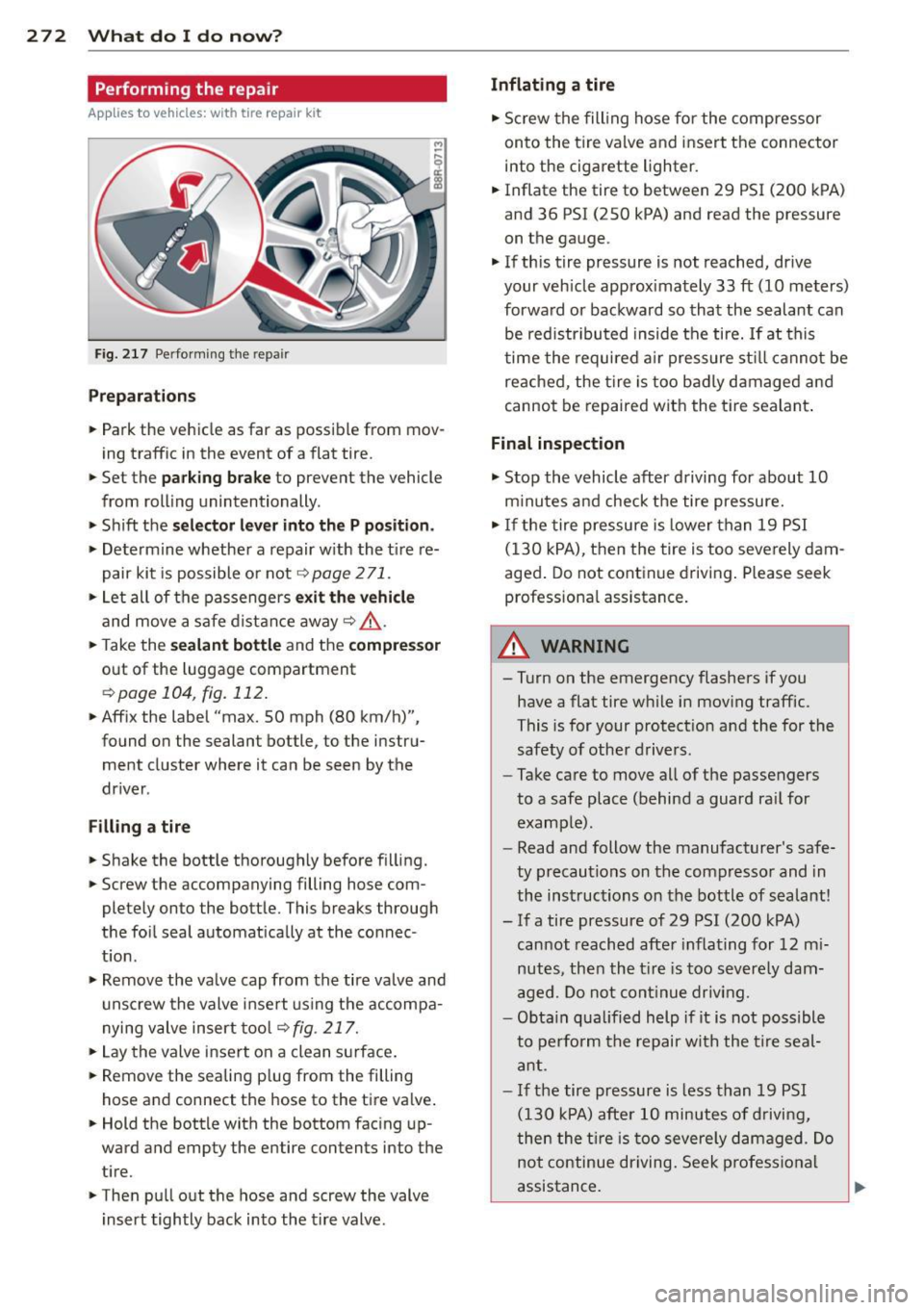
Fig. 217 Perform ing the rep air
Pre parati ons
.. Park the vehicle as far as possible from mov
ing traffic in the event of a flat tire.
.. Set the
parki ng brake to prevent the vehicle
from roll ing unintentionally .
.. Shift the
se lec tor le ver in to th e P po siti on.
.. Determine whethe r a repair w ith the tire re
pair kit is possible or not
¢ page 271.
.. Let all of the passengers ex it th e vehicle
and move a safe distance away ¢& .
.. Take the
sealant bottle and the compre ssor
out of the luggage compartment
¢ page 104, fig. 112.
.. Affix the label "max. 50 mph (80 km/h)",
found on the sealant bottle, to the instru
ment cluster where it can be seen by the
dr iver .
Fill ing a tire
.. Shake the bottle thoroughly before f il li ng.
.. Screw the accompanying filling hose com-
pletely onto the bottle. This breaks through
the foi l seal automatically at the connec
t ion.
.. Remove the valve cap from the tire va lve and
uns crew the valve inse rt using the accompa
nying valve insert too l¢
fig . 217.
.. Lay the valve insert on a clean s urface .
.. Remove the sealing p lug from the filling
hose and connect the hose to the tire va lve .
.. Hold the bottle with the bottom fac ing up
ward and empty the entire contents into the
tire.
.. Then pu ll out the hose and screw the valve
i nsert tightly back into the tire valve .
Inflating a tire
.. Screw the fill ing hose for the compressor
onto the tire valve and insert the connector
into the cigarette lighter .
.. Inflate the tire to between 29 PSI (200 kPA)
and 36 PSI (250 kPA) and read the pressure
on the gauge .
.. If this tire pressure is not reached, dr ive
your veh icle approximately 33 ft ( 10 meters)
forward or backward so that the sealant can be red istr ibuted inside the tire.
If at this
time the requi red a ir pressure st ill cannot be
reached , the tire is too badly damaged and
cannot be repaired with the tire sealant .
Final inspection
.. Stop the vehicle after driving for about 10
m inutes and check the tire pressure .
.. If the tire pressure is lower than 19 PSI
( 1 30 kPA), then the tire is too seve rely dam
aged. Do not continue driving . Please seek
professiona l assistance.
A WARNING
--
- Turn on the emergency flashers if you
have a flat tire while in moving traffic .
This is for your protect ion and the for the
safety of other drivers.
- Take care to move all of the passengers
to a safe place (behind a guard ra il for
example) .
- Read and follow the manufacturer's safe
ty precautions on the compressor and in
the instructions on the bottle of sealant!
- If a tire pressure of 29 PSI (200 kPA) cannot reached after inflating for 12 m i
nutes, then the t ire is too severe ly dam
aged. Do not cont inue driving.
- Obta in qualified help if it is not possible
to pe rform the repair w ith the tire seal
a nt .
- I f the tire pressure is less than 19 PSI
(130 kPA) afte r 10 minutes of d riving,
then the t ire is too severely damaged . Do
not continue dr iving. Seek p rofess ional
assistance .
Page 275 of 316

(D Note
Special care is required if you are repairing
the tire on a steep incline.
@ Tips
-Do not operate the compressor for more
than 12 minutes continuously, otherwise it can overheat. Once the compressor has
cooled, you can continue to use it.
- If sealant has spilled out, let it dry and
then you can remove it by peeling it away
like a foil.
- Remember to obtain a new bottle of
sealant from your authorized Audi dealer
after repairing a tire. After this, the func
tionality of the tire repair set is restored.
- Obey all laws.
Changing a wheel
Before changing a wheel
Observe the following precautions for your
own and your passenger's safety when chang
ing a wheel.
.,. After you experience a tire failure, pull the
car well away from moving traffic and try to
reach
level ground before you stop¢_& .
.. All passengers should
leave the car and
move to a safe location (for instance, behind
the guardrail) ¢
_&.
.. Engage the parking brake to prevent your
vehicle from rolling unintentionally¢_&.
.. Move
selector lever to position P ¢ _& .
.,. If you are tow ing a trai ler: unhitch the trail
er from your vehicle.
.,. Block the diagonally opposite wheel with
the folding chocks or other objects.
.. Take the
jack* and the inflatable spare tire*
out of the luggage compartment
¢page 268.
A WARNING
You or your passengers could be injured
while changing a wheel if you do not fol
low these safety precautions:
-
What do I do now? 273
- If you have a flat tire, move a safe dis
tance off the road. Turn off the engine,
turn the emergency flashers on and use
other warning devices to alert other mo
torists.
- Make sure that passengers wait in a safe
place away from the vehicle and well
away from the road and traffic.
- To help prevent the vehicle from moving
suddenly and possibly slipping off the
jack*, always fully set the parking brake
and block the wheel diagonally opposite
the wheel being changed with the fold
ing chocks or other objects. When one
front wheel is lifted off the ground, plac
ing the Automatic Transmission in P
(Park) will
not prevent the vehicle from
moving.
- Before you change a wheel, be sure the
ground is level and firm. If necessary,
use a sturdy board under the jack*.
- Always store the vehicle tool kit, the
jack* and the replaced tire in the luggage
compartment
¢page 145.
Changing a wheel
When you change a wheel, follow the se
quence described below step-by-step and in
exactly that order.
1. Remov e the decorative wheel cover*. For
more details see also
¢ page 274, Deco
rative wheel covers
or ¢ page 2 7 4,
Wheels with wheel bolt cops .
2. Loosen the wheel bolts¢ page 2 75 .
3. Locate the proper mounting point for the
jack* and align the jack* below that point
¢ page 275.
4. Lift the car with the jack* ¢ page 2 75 .
S. Remove the wheel with the flat tire and
then install the
inflatable spare tire*
¢page 276.
6. Tighten all wheel bolts lightly.
7.
Lower the vehicle with the jack*.
8. Use the wheel bolt wrench and
firmly
tighten all wheel bolts¢ page 2 75.
9. Replace the decorative wheel cover*.
•
•
Page 281 of 316

Fuses and bulbs
Electrical fuses
Replacing fuses
Fuses tha t have blown will have me tal s trips
that have burned through .
Fig . 225 Left cockp it : fu se pan el c over
The fuses are located at the front left and
r igh t of the cockpit and behi nd the trim on
the right side of the luggage compartment .
.. Turn
off the ignit ion a nd the affected electri
ca l consume rs .
.. Check the following table to see which fuse
belongs to the consumer .
.. Remove the appropriate cover .
.. To remove the purple plastic clip if necessa
ry
1 ), hold onto it at the small s ide and pull
it out of the fuse panel<=>
page 2 79,
fig . 226 .
.. Remove the clamp from the rear side of the
fuse cover
c> fig . 225 .
.. Remove the fuse using the clamp and re
place the blow n fuse w ith an identical new
one .
A WARNING
-
Do not repair f uses and never replace a
blown fuse w ith one t hat has a higher amp
rating. This can cause damage to the e lec
trical system and a fire.
(D Note
If a new fuse b urns o ut again after shortly
have you have installed it, have the electri-
11 You can dispo se of the pla stic cl ip aft er r emo vin g it.
Fu se s and bulb s 2 79
cal system checked by your authorized
Audi dealer .
a) Tips
- The followi ng ta ble d oes not list fuse lo
cations that are not used.
- Some of the equipment items liste d are
opt ional or only available on certain
mode l configurations .
Left cockpit fuse assignment
Fig . 226 Le ft coc kp it : fuse p anel w ith pla st ic cl ip
Fu se panel @ (black )
No . Consumer Amps
1 Dynamic steering 5
2 E SC control module 5
A/C system pressure sensor,
e lectromechanical pa rk ing
3
b rake, Homelink, automatic
5 d imm ing interior rea rview mir -
ror, air qua lity/outside air se n-
sor, ESC but ton
5 Exhaust sound tun ing 15
6
Headlights range cont ro l sys -
5/7,5 tem/Corner i ng light
Page 282 of 316

280 Fuses and bulbs
No. Consumer Amps Fuse panel
© (red )
7 Headlight (corner
ing light)
7,5 No. Consumer Amps
Contro l modu les (e lec trome-
3 Lum bar s upport 10
8
chanic al par king br ake, sho ck
5
absorber, q uatt ro Spor t, tra ile r
hitch), DCDC converter 4
Dynamic stee ring
35
5 Climat ized cu pholder 10
9
Adaptive cruise contro l or hig h
5/7,5
vo ltage battery (hybr id d rive) 6
W indshield w asher system,
35
h eadlamp washer sys tem
1 1 Side ass ist 5
7 Vehicle e
lectrical system control
20
module 1
12 H
eadlight range contro l, par k·
5
ing sys tem
8
Ve hicle e lec tric al syste m control
30
mod ule 1
13 Airbag
5
9 Panorama sunroof
20
1 4 Rear wiper 15
1 5 Aux
iliary fuse (instrument pan·
10
el)
16
Auxi liary fuse term inal 15 (en -
40
gine area) 10
Vehicle e
lectrica l system control
30
module 1
1 1 Sun shade (panorama s unroof) 20
1 2 Anti-theft alarm warning sys·
s
tern
Fuse panel
@ (brown)
No. Consumer Amps Right cockpit fuse assignment
1 Electric exhaust door
5/10
Brake lig ht sensor o r brake ped·
2 al movem ent s ensor (hybrid 5
dr ive)
3 Fuel pump 25
4 AdBl
ue p ump supp ly o r Br ake
5/25
booste r (hybr id drive)
5 Left seat heati
ng wit h/w ithout
15/30
seat vent ilation
6 ESC 5
7 Horn 15
Left front door (window regula ·
8 tor, central locking, m irror,
30
sw itch, light ing)
9 Wipe r moto r 30
10 ESC 25
11 Le
ft r ear do or (win dow regul a-
30
t o r, sw itch, lighting)
12 Rain and light se
nso r
5
Fig. 22 7 Right cockp it: fuse panel wit h plast ic clip
Fuse panel ® (black)
No. Consumer Amps
5 Steering column sw itch mod ule s
7
Terminal 15 diagnostic connec·
tor
5
Page 284 of 316

282 Fuses and bulb s
No. Consumer Amps
4 MMI 7,5
5
Radio 5
6 Rearview camera 5
7
Rear w indow heater 30
8 Rear Seat Enterta inment s
1 1 AdBlue hea ter 30
1 2
Ad Blue supply or High vo ltage 1 0/ 15
battery (hybrid dr ive)
Bulbs
Replacing light bulbs
F or your safety, we recommend that you have
your authorized Audi dealer replace burned
out bulbs for you.
It is becoming i ncreas ingly mo re and more
d iff icu lt to replace vehi cle lig ht bulbs s ince in
many cases, other parts of the car m ust first
be removed before yo u are ab le to get to the
bu lb. Th is app lies especia lly to the light bu lbs
in the front of your car which you can on ly
reac h throug h the engine compartment.
Sheet metal and bulb ho lde rs can have sharp
edges that can cause ser ious cuts, and parts
must be correctly taken apart and then prop·
erly put back together t o help prevent break
age of par ts a nd long term damage from wa
ter that ca n ente r hous ings that have not been
p roperly resealed.
For your safety, we recommend that you have
your author ized Audi dealer replace a ny bulbs
for you, since your dealer has the p roper tools,
the co rrect bu lbs and the expertise.
Gas d ischarge lamps (Xenon lights )*:
Due to the hig h electrical vo ltage, have the
bu lbs rep laced by a qualified technician.
Headlig hts with Xenon light can be identified
by the high voltage sticker.
A WARNING
Contact with high-voltage components of
t he electrical system and improper re
pl acement of gas dis charge (Xenon) head- light bulbs can cause ser
ious personal in·
j u ry and death.
- Xenon bulbs are pressur ized and can ex
plode when being changed.
- Changing Xenon lamps re quires the spe
cial tra ining, instructions and equip
ment.
- Only an auth orized A udi dealer or other
qualified wor kshop should change the
bu lbs in gas discharge lamps.
A WARNING
There are parts with sharp edges on the
openings and on the bulb holders that can
cause ser ious c uts.
- If you are uncertain about what to do,
have the work performed by an a uthor
ized Audi dealer or othe r qualified wo rk·
shop. Serious personal in jury may resul t
fr om imprope rly performed wo rk.
(D Tips
- If you must replace the light bulbs your ·
self, a lways remember tha t the eng ine
compar tment of any vehi cle is a hazard
ous area to work in. A lways read a nd
hee d all WARNI NGS
~page 231 ~ & .
-It is best to ask your authorized Audi
de aler whenever yo u need to c hange a
bulb .
-