2014 AUDI A7 belt
[x] Cancel search: beltPage 192 of 306

190 Child Safety
@ Tips
-In Canada, the terms "top tether" with
"lower universal anchorages" (or "lower
universal anchorage bars") are used to
describe the system.
- In other countries, the term "ISO FIX" is
used to describe the lower anchorages.
Location
Fig. 176 Schemat ic overview: LA TCH ancho rage point
l ocat ions
The illustration shows the seating locations in
your veh icle which are equipped with the low
e r anchorages system.
Description
The lower anchorage positions are marked
for quick locating .
Fig. 177 Lower a nch orages, covers marked
Fig. 178 Rear seats: lower anchorage bracket locations
Lower anchorages
The circular markings on the rear seat help
you to ident ify the location of lower anchorag
es for the two outboard seating positions
~ fig . 177-=* . The LAT CH lowe r universa l an
chorage attachmen t points are between the
rear seatback and rear seat cushion.
Remove the covers ~
fig. 177 to access the
lower anchorage attachment points.
The lower anchorage attachment points are
visible
c:> fig . 178.
Lower anchorages secure the chi ld restraint in
the seat without using the vehicle 's safety
belts. Anchorages provide a secure and easy
to -use attachment and minimize the possib ili
ty of improper child restraint installation .
All child restraints manufactured after Sep
tember 1, 2002, must have lower anchorage
attachments for the
LATCH system .
Please remember that the lower anchorage
po ints are only intended for installat ion and
attachment of child restraints spec ifically cer
tified for use with
LATCH lower anchorages .
Child restraints that are not equipped with the
lower anchorage attachments can still be in
sta lled in compliance w ith th e child restra int
manufactu rer's instr uctions on using veh icle
safety belts.
A WARNING
-
Improper use of LATCH lower anchorages
can cause serious personal injury in an ac
cident.
- Always carefully follow the child re
straints manufacturer's instructions for
Page 193 of 306
proper installation of the child restraint
and proper use of the lower anchorages
or safety belts in your vehicle.
- Never secure or attach any luggage or
other items to the LATCH lower ancho
rages.
- Always read and heed the important in formation about child restraints in this chapter and WARNINGS ¢
page 175,
Child Safety.
Installing a child restraint with LATCH
lower anchorages
Whenever you install a child restraint always
follow the child restraint manufacturer's in
structions.
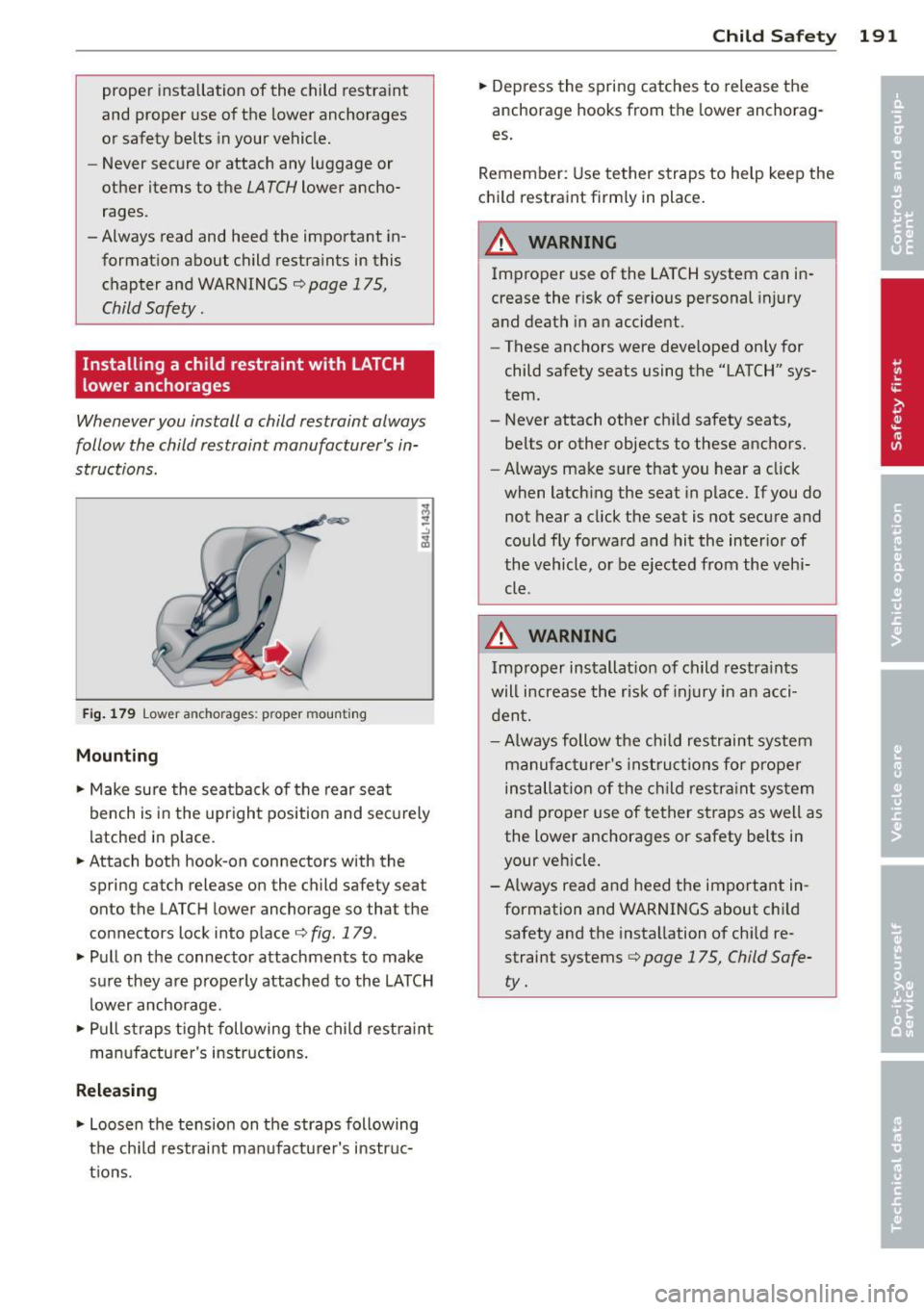
F ig . 179 Lower anchorages: p roper mount ing
Mounting
.. Make sure the sea tback of the rear sea t
bench is in the upr ight position and sec urely
latched i n place.
.. Attach both hook -on connectors with the
spring catch release on the ch ild safety seat
onto the LATC H lower anchorage so that the
connectors lock into p lace¢
fig . 179 .
.. Pull on the connector attachments to make
s u re they a re properly attached to the LATCH
lower anchorage .
.. Pull straps tight following the child restra int
manufacturer's instructions .
Releasing
.. Loosen the tension on the straps following
the ch ild restrai nt manufactu rer's instruc
tions .
Child S afety 191
.. Depress the spring catches to release the
anchorage hooks from the lower anchorag
es.
Remember: Use tether straps to help keep the
c h ild restra int firmly in place .
& WARNING ~
Improper use of the LATCH system can in-
crease the risk of serious personal injury
and death in an accident.
- These anchors were deve loped only for
child safety seats using the "LATCH" sys
tem.
- Never attach other ch ild safety seats ,
be lts or other objects to these anchors.
- Always make sure that you hear a click
when latch ing the seat in place. If you do
not hear a click the seat
is not secure and
could fly forwa rd and hit the interior of
the vehicle, or be e jected from the veh i
cle .
& WARNING
Imp roper installat io n of ch ild restra ints
will increase the risk of injury in an acci
dent.
- Always follow the child restraint system
manufac turer's in st ruc tions for prope r
installa tion of the c hild restr aint system
a nd p roper use of te ther s traps as well as
the lower anchorages or safety belts in
your veh icle .
-Always read and heed the important in formation and WARNINGS about chi ld
safety and the insta llation of ch ild re
straint systems¢
page 175, Child Safe
ty.
-
Page 194 of 306

192 Child Safe ty
Tether anchors and tether straps
Fig. 180 Tether ancho rs: attachment hook locations
behind the rear seatbacks
The tether anchors for the two/three* rear
seating positions are located o n the backside
of the rear seatbacks ¢
fig. 180. Vehicles with
two rear seating positions are equipped with
two tether anchors.
A tether is a straight or V-shaped strap that attaches the top part o f a child restraint to
specia l anchorage points in the veh icle.
The purpose of t he tether is to reduce the for
ward movemen t of the ch ild restra int in a
crash, in order to help reduce the risk of head
injury that could be caused by striking the ve
hicle interior.
F orward facing child rest ra ints manufactured
after September 1, 1999, are required by U.S.
federal regulations to comply with new child
head movement performance requirements .
These new performance requirements make a
tether necessary on most new child safety
seats.
A WARNING
Improper insta llation of chi ld restraints
w ill increase the risk of inju ry and death in
a crash.
- Always follow the instructions prov ided
by the manufacturer of the ch ild re
st rain t you intend to install in your Audi.
- Improper use of ch ild restra int anchors
(including tether anchors) can lead to in
jury in a co llision. The anchors are de
signed to w ithstand on ly those loads im
posed by corre ctly fitted ch ild restraints. -
Never mount two child restraint systems
on one LATCH lower anchor point.
- Never attach two child restraint systems
to one tether strap or tether anchorage.
- Never attach a tether strap to a tie-down
hook in the luggage compa rtment .
- Never use child restraint tether ancho
rages to secure safety belts or other
kinds o f occupant restraints.
- Never secure or attach any luggage or
other items to the LATCH lower ancho
rages or to the tether anchors.
- If you must install a rearward fac ing
child safety seat on the front passenger
seat because of exceptiona l circumstan
ces and t he
PA SSENGER AIR BAG OFF
light does not come o n and stay on, im
mediately install the rear-fac ing ch ild
safety seat in a rear seating position and
have the airbag system i nspe cted by your
Aud i deale r.
Installing the upper tether strap on the
anchorage
F ig. 181 Tether strap: proper routing and mou nting
Installing the tether st rap
• Release or deploy the tether strap on the
child restraint according to the child re
s traint manufacture r's instructions.
• Guide the upper te ther s trap
und er the rear
head restraint¢
fig. 181 (raise the head re
straint if necessary) .
• Attach the tether strap ancho rage hook into
the tether anchorage.
.,. Pull on the tether strap hook so that the
spring catch of the hook engages.
• Tighten the tether strap firmly follow ing the
child restraint manufacturer's instructions. ..,
Page 195 of 306

Relea sin g the teth er str ap
"' Loosen the tens ion following the child re
stra int manufac turer's instructions .
"' Depress the spring catch on the hook and re
lease it from the anchorage.
(D Note
I f you leave the child restraint with the
tether strap firmly insta lled for severa l
days, this cou ld leave a mark on the up
holstery on the seat cushion and backrest
in the area where the tether strap was in
stalled . The upholstery would a lso be per
manently stretched around the tether
strap. This applies especially to leat her
seats.
Using tether straps on rearward-facing
child restraints
Currently, few rear-facing child restraint sys
tems come with a tether. P lease read and
heed the child restraint system manufactur
er's instructions carefully to determ ine how to
p roperly install the tether.
A WARNING
-
A child in a rearward-facing child safety
seat insta lled on the front passenge r seat
w ill be se riously injured and can be killed if
t he fron t air bag inflates - even with an Ad
vanced Airbag System .
- T he inf lat ing airb ag w ill hit the child
sa fety seat or infant carrier w it h great
force and w ill smash the ch ild safety seat
and child against the backrest, center
armrest, or door.
- If you must install a rearward facing
child safety seat on the front passenger
seat because of exceptional circ umstan
ces and the
PASSENGER AIR BAG OFF
light does not come on and stay on, im
med iately install the rear-facing child
safety seat in a rear seating position and
have t he a irbag system inspected by you r
Audi de aler.
Child Sa fet y 193
Additional Information
Sources of information about child
restraints and their use
There are a number o f sources of additiona l
information abo ut child restraint se lection, in
stallation and use :
N HT SA advises t hat the bes t ch ild safety seat
is the one that fits your chi ld and fits in your
vehicle, and that yo u will use correct ly and
consistently.
T ry before yo u buy!
U.S National Highway Traffic Safety Admin
istration
Tel.: 1 -888 -3 27-4 236 (TIY: 1-800-424-9153)
www. n hts a .gov
National SAFE KIDS Campaign
Tel.: (202) 66 2-0600
www.safe kids.o rg
Safety Belt Safe U .S .A
Tel.: (800) 7 45-SAFE (English)
Te l.: (800) 747-SANO (Span ish)
www.carseat .org
Transpo rt Canada Information Centre
Tel.: 1-800-333-0371 o r ca ll
1-6 13-998-86 16 if yo u are in the Ottawa a rea
http://www .t c .gc. ca/eng/ roadsafety/
men u.h tm
Audi Cu stomer R elation s
Tel.: (800) 822-2834 •
•
Page 196 of 306

194 Audi pre sense
Audi pre sense
Preventative passenger
protection
A pp lies to veh icles: with Audi pre se nse
Audi pre sense can initiate steps to help pro
tect vehicle occupants in certain situations.
The functions described depend on equ ipment
installed in your vehicle:
Audi pre sense basic*
The following functions can be triggered in
certain driving situations:
- Tightening of the safety belts (for example,
during heavy braking) : the front safety belts
have reversible belt pretensioners. If a colli
sion does not occur, the safety belts loosen
slightly and are ready to be tightened again.
- Closing the windows and the sunroof*: the
windows and the sunroof* close leaving a
small open gap.
Audi pre sense basic functions can be trig
gered at speeds above 20 mph (30 km/h).
Vehicles with Aud i drive select*: the deploy
ment time is adapted in
Dynamic mode.
Audi pre sense front (vehicles with
adaptive cruise control*)
Audi pre sense front includes the functions in
Audi pre sense basic. In addition, within the
limits of the system, the likelihood of a colli
sion with the vehicle immediately ahead is al
so calculated . If the system senses an immi
nent collision the following functions can be
tr iggered :
- Braking guard
c::> page 92
- Tightening the safety be lts
- Closing the windows and the sunroof* (leav -
ing a small open gap)
Audi pre sense rear (vehicles with Audi
side assist*)
Audi pre sense rear includes the functions in
Audi pre sense basic. In addition, the likeli
hood of a rear-end collision with the vehicle
coming from behind is also calcu lated.
If the risk
of a co llision is detected, the following
functions can be triggered:
- Tig htening the safety belts
- Closing the windows and the sunroof* (leav-
ing a small open gap)
Audi pre sense plus*
Audi pre sense plus includes the functions in
Audi pre sense front and Audi pre sense rear.
Error message
Audi pre sense: not available
Preventative passenger protection is not avail
able. See your authorized Audi dealer immedi
ately to have the malfunction corrected.
_& WARNING
-=
Audi pre sense cannot overcome the laws
of physics. It cannot prevent a collision. Do
not let the increased safety provided
tempt you to take risks. This will increase
the r isk of a collis ion and serious personal
in juries .
- The sensors cannot always detect all ob
jects. This increases the risk of a colli
s10n.
-Aud i pre sense does not detect people or
an im als or objects that are crossing the
veh icle's path
c::> page 86.
-The radar sensor's vis ion can be reduced
by heavy rain, ice, snow, heavy road sp ray
and reflections from guard rails, tunnel
entrances, etc. These and similar condi
tions can prevent vehicles from being ac
curately detected and in some cases they
may not be detected at all.
(D Note
The sensors can be displaced by impacts or
damage to the bumper, wheel housing and
underbody. This can affect the function of
the Audi pre sense system. Have your au
thorized Audi dealer check to make sure
that the system is working properly.
Page 198 of 306

196 Intelligent technology
Intelligent technology
Notice about data
recorded by vehicle
control modules
Your vehicle is not equipped with an Event Da
ta Recorder (EDR), installed by some manu
facturers fo r the express purpose of capturing
data for retrieval after an accident or crash
event . EDR's are sometimes ca lled "crash re
corders".
Some state laws restrict the retr ieval or down
loading of data stored by EDR's that were in
stalled in a vehicle for the express purpose of
retrieving data after an accident or crash
event without the owner's consent.
A lthough your vehicle is not equipped with an
EDR, it is equipped with a number of electron
ic control modules for various vehicle systems
such as, for examp le, eng ine function, em is
sion control, as well as for the airbags and
safety belts.
These electronic contro l modules also record
vehicle-re lated data during normal vehicle op
eration for diagnostic and repair purposes.
The recording capacity of the electronic con
trol modules is limited to data (no sound is re
corded) and only a small amount of data is ac
tually recorded over a very limited pe riod of
time and stored when a system fault or other
condition is sensed by a control unit. Some of
the data then stored may relate to vehicle
speed, direction, braking as we ll as restraint
system use and performance in the event of a
crash or other condition. Stored data can only
be read and downloaded with special equip
ment.
Electronic Stabilization
Control (ESC)
Description
ESC helps to improve road holding and vehicle
dynamics to help reduce the probability of
skidd ing and loss of vehicle control. It works
only when the engine is running. ESC detects certain difficult driving situat
ions, including
when the vehicle is beginning to spin (yaw)
out of control and helps you to get the veh icle
back under control by se lectively braking the
wheels, and/or reducing engine power and
providing steering assistance to help hold the
vehicle on the driver's intended course. The in
dicator light
G) in the instrument cluster
blinks when ESC is taking action to help you
control the vehicle.
ESC has limitations.
It is important to remem
ber that ESC cannot overcome the laws of
physics. It wi ll not always be able to help out
under all conditions you may come up against.
For example, ESC may not always be able to
help you master situations where there is a
sudden change in the coefficient of friction of
the road surface. When there is a section of
dry road that is suddenly covered with water,
slush or snow, ESC cannot perform the same
way it wou ld on the dry surface . If the vehicle
hydroplanes (rides on a cushion of water in
stead of the road surface), ESC will not be
able to help you steer the vehicle because con
tact with the pavement has been interrupted
and the vehicle cannot be braked or steered.
During fast cornering, particularly on winding
roads, ESC cannot always deal as effectively
with difficult driving situations than at lower
speeds. When towing a trailer, ESC is not able
to help you regain control as it would if you
were not tow ing a trailer.
Always adjust your speed and driving style to road, traffic and weather condit ions. ESC can
not override the vehicle's physical limits, in
crease the available traction, or keep a vehicle
on the road if road departure is a result of
drive r inattention. Instead, ESC improves the
poss ibility of keeping the vehicle under con
trol and on the road during ex treme maneu
vers by using the driver's steering inputs to
help keep the vehicle going in the intended di
rection . If you are traveling at a speed that
causes you to run off the road before ESC can
provide any assistance, you may not experi
ence the benefits of ESC.
Page 217 of 306

Vehicl e ca re a nd cl eanin g 215
Component Situat ion Solution
Deco ra ti ve
Dirty Mild soap solutional, a cleaning solution suitab le for
p art s/ stainless steel, if necessary
tri m
P ai nt
Paint damage Refer to the paint number on the vehicle data label, re-
pair with touch up paint
c::> page 282
Spilled fuel Rinse with water immediately
Rust film Rust film1 remover, then protect with hard wax; for ques-
tions, refer to an authorized Audi dea ler or a qualified
workshop
Corrosion Have it removed by an authorized Audi dealer or a qua li-
fied workshop
Water no longer Protect with hard wax (at least twice per year)
beads on the surface
of clean paint
No shine even Treat
with suitable polish; then apply paint protectant if
though paint has the polish that was used does not contain any protec-
been protected/ tant
paint looks poor
Carbo n pa rts Dirty Clean the same way as pa inted parts c:>page 213, Car
washes
al Mild soap solut ion: max im um two tablespoons neutral soap in a lite r of water
C le aning int erio r
Component Situ ation Solution
W indo ws
Dirty Glass cleaner, then wipe dry
Deco rativ e Dirty Mi
ld soap solutional
parts/
trim
Pl as tic p art s
Dirty Damp cloth
Heavily soiled Mild soap solutional, solvent-free plastic cleaning solu -
tion, if necessary
Di sp lays Dirty Soft cloth with LCD cleaner
Cont rols Dirty Soft brush, then a soft cloth with a mild soap solutiona)
S af ety belts Dirty Mild soap solutional, allow to dry befo re letting them re -
tract
•
•
Page 219 of 306

-Never use abrasive cleaning materials
or alcohol to clean the camera lens.
Th is could cause scratches and cracks .
-Window s
-Remove snow and ice on w indows and
exterior mirrors with a plastic scraper.
To avoid scratches, move the scraper only in one direction and not back and
forth.
- Never remove snow or ice from w in
dows and m irrors using wa rm or hot
wate r because this cou ld cause crac ks
to form.
- To avoid damage to the rear window
defogger, do not apply any stickers on
the heating wires on the inside of the
w indow .
-Dec or ati ve p arts /trim
-Never use chrome care or cleaning
products.
-Paint
-To reduce the risk of scratches, the ve-
hicle must be free of dirt and dust be
fore polishing or waxing.
- To prevent paint damage, do not polish
or wax the veh icle in direct sunlight.
- To reduce the risk of paint damage, do
no t polish away rust film .
-Di splay s
-To avoid scratches, do not use dry
cleaning methods on displays .
-Controls
- Make sure that no flu ids enter the con-
trols, because this cou ld cause dam
age .
-Safet y belts
- Do not remove the safety belts to clean
t hem.
- Never clean safety belts or their com
ponents chemically or with cor ros ive
fluids or solvents and never a llow
sharp objects to come into contact
with the safety belts . This cou ld cause
damage to the belt webbing.
- If the re is damage to the webb ing, the
connections, the retractors or the buck
les, have them rep laced by an author-
V ehicl e ca re a nd cl eanin g 217
ized A udi dealer or a qualified work
shop.
- Te xtile s/Vin yl/ Alcant ara
- Never treat Vinyl/Alcantara w ith leath-
er care products, solvents, floor polish,
shoe polish, stain remover or s imilar
p rod ucts.
- To avoid damage, have stubborn stains
removed by an authorized Aud i deale r
or a qualif ied workshop.
- Never use steam cleaners, brushes,
hard sponges, etc. when cleaning.
- Objects w ith sharp edges such as zip
pers, rivets on clothing or be lts can
cause damage to the surface.
- Open hook and loop fastene rs, for ex
ample on cloth ing, can damage seat
covers. Make sure hook and loop fas
tene rs a re closed.
- Natural leather
- Neve r treat leather w ith solvents, floor
polish, shoe polish, stain remover or
similar products.
- Objects with sharp edges such as zip·
pers, rivets on clothing or be lts can
cause damage to the surface.
- Never use steam cleaners, brushes,
hard sponges, etc. when cleaning.
- To help prevent the leather from fad
ing, do not leave the vehicle in d irect
sunlight for long per iods of t ime. If
leaving the vehicle parked for long pe
riods of time, you should cover the
leather to protect it from d irect sun
light.
(D Tips
- Insects are easier to remove from paint
that has been freshly waxed.
- Regular waxing can prevent rust film
from forming.
•
•