Page 89 of 192
87
Bipper_en_Chap05_technologie_ed02-2014
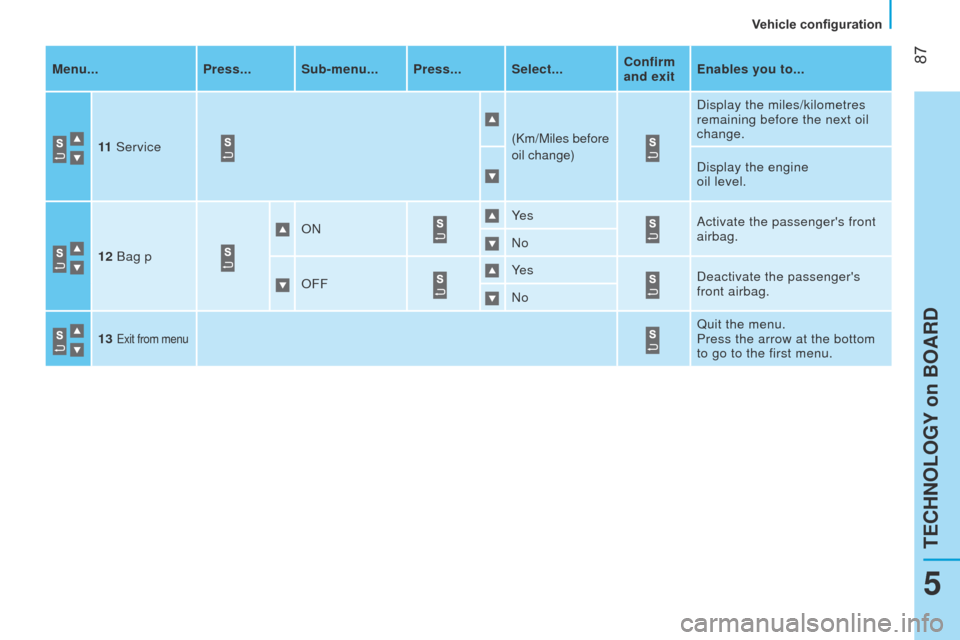
Menu...Press... Sub-menu... Press... Select... Confirm
and exitEnables you to...
11 Service (Km/Miles before
oil change)Display the miles/kilometres
remaining before the next oil
change.
Display the engine
oil level.
12 Bag p ON
Ye s
Activate the passenger's front
airbag.
No
OFF Ye s
Deactivate the passenger's
front airbag.
No
13
exit from menuQuit the menu.
Press the arrow at the bottom
to go to the first menu.
5
TECHNOLOGY on BOARD
Vehicle configuration
Page 90 of 192
88
Bipper_en_Chap05_technologie_ed02-2014
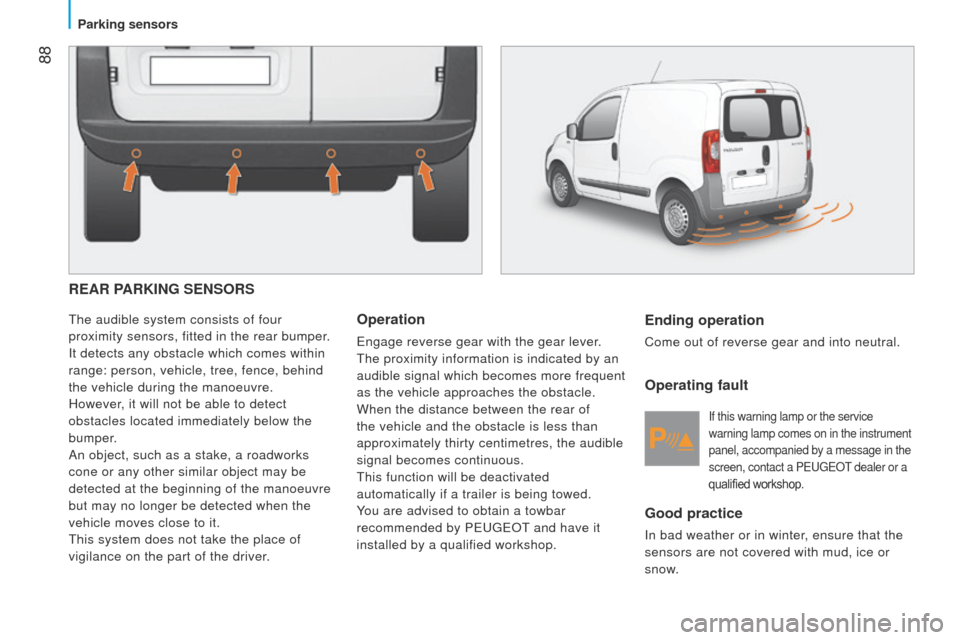
REAR PARKING SENSORS
the audible system consists of four
proximity sensors, fitted in the rear bumper .
It detects any obstacle which comes within
range: person, vehicle, tree, fence, behind
the vehicle during the manoeuvre.
However, it will not be able to detect
obstacles located immediately below the
bumper.
An object, such as a stake, a roadworks
cone or any other similar object may be
detected at the beginning of the manoeuvre
but may no longer be detected when the
vehicle moves close to it.
t
his system does not take the place of
vigilance on the part of the driver.Ending operation
Come out of reverse gear and into neutral.
Operating fault
If this warning lamp or the service
warning lamp comes on in the instrument
panel, accompanied by a message in the
screen, contact a P
euge O t
dealer or a
qualified workshop.
Good practice
In bad weather or in winter, ensure that the
sensors are not covered with mud, ice or
snow.
Operation
engage reverse gear with the gear lever.
t
he proximity information is indicated by an
audible signal which becomes more frequent
as the vehicle approaches the obstacle.
When the distance between the rear of
the vehicle and the obstacle is less than
approximately thirty centimetres, the audible
signal becomes continuous.
t
his function will be deactivated
automatically if a trailer is being towed.
You are advised to obtain a towbar
recommended by P
euge O t
and have it
installed by a qualified workshop.
88
Parking sensors
Page 151 of 192

149
Bipper_en_Chap08_verifications_ed02-2014
CHECKS
Bleeding water from the Diesel filter
If this warning lamp comes
on, you must bleed the filter;
otherwise bleed the filter
regularly, every time the engine
oil is changed.
to remove the water
, unscrew the bleed
screw or the water in Diesel sensor, located
at the base of the filter. Operate until all of
the water has flowed out.
t
hen tighten the
bleed screw or the water sensor.
Battery
At the start of winter, have your battery
checked by a P euge O t
dealer or a
qualified workshop.
Air filter and passenger compartment
filter
A blocked passenger compartment filter
may reduce the performance of the
air conditioning system and generate
undesirable odours.
t
he replacement
intervals for these components are indicated
in the warranty and maintenance record.
Depending on the environment (dusty
atmosphere...) and the use of the vehicle
(urban driving...), change them twice as
often if necessary.
Brake pads
Brake pad wear depends on the type of
driving, in particular for vehicles which are
used in town, over short distances. It may
be necessary to check the brake pad wear,
even between services.
u
nless there is a leak on the system, a drop
in the brake fluid level indicates that the
brake pads are worn.
Brake disc / drum wear
For all information on checking the brake
disc / drum wear, contact a P euge O t
dealer or a qualified workshop.
Parking brake
Where the parking brake travel is too great
or there is a reduction in the performance
of the system, the parking brake should be
adjusted, even between services.
Have the system checked by a P
euge O t
dealer or a qualified workshop.
Oil filter
Change the filter regularly, in accordance
with the manufacturer's servicing schedule.
t
he presence of this label, in particular
with the Stop & Start system, indicates the
use of a specific 12 V lead-acid battery
with special technology and specification.
t
he involvement of a P
euge
O
t
dealer
or a qualified workshop is essential when
replacing or disconnecting the battery.
Refer to the "Checks -
u
nder the
bonnet" section.
HDi engines use advanced
technology. All work requires
specialist knowledge, which all P
euge
O
t
dealers have.
8
CHECKS
Checks
Page 174 of 192
172
Bipper_en_Chap09_aide-rapide_ed02-2014
TOWING
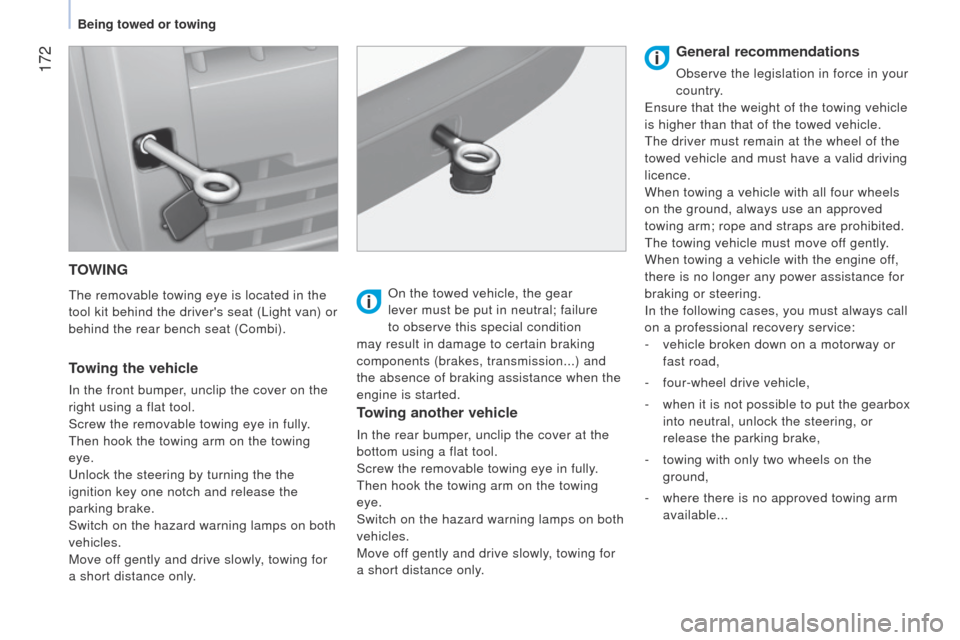
the removable towing eye is located in the
tool kit behind the driver's seat ( l ight van) or
behind the rear bench seat (Combi).
Towing the vehicle
In the front bumper, unclip the cover on the
right using a flat tool.
Screw the removable towing eye in fully.
t
hen hook the towing arm on the towing
eye.
u
nlock the steering by turning the the
ignition key one notch and release the
parking brake.
Switch on the hazard warning lamps on both
vehicles.
Move off gently and drive slowly, towing for
a short distance only. On the towed vehicle, the gear
lever must be put in neutral; failure
to observe this special condition
may result in damage to certain braking
components (brakes, transmission...) and
the absence of braking assistance when the
engine is started.
Towing another vehicle
In the rear bumper, unclip the cover at the
bottom using a flat tool.
Screw the removable towing eye in fully.
t
hen hook the towing arm on the towing
eye.
Switch on the hazard warning lamps on both
vehicles.
Move off gently and drive slowly, towing for
a short distance only.
General recommendations
Observe the legislation in force in your
country.
e
nsure that the weight of the towing vehicle
is higher than that of the towed vehicle.
t
he driver must remain at the wheel of the
towed vehicle and must have a valid driving
licence.
When towing a vehicle with all four wheels
on the ground, always use an approved
towing arm; rope and straps are prohibited.
t
he towing vehicle must move off gently.
When towing a vehicle with the engine off,
there is no longer any power assistance for
braking or steering.
In the following cases, you must always call
on a professional recovery service:
-
vehicle broken down on a motorway or
fast road,
-
four-wheel drive vehicle,
-
when it is not possible to put the gearbox
into neutral, unlock the steering, or
release the parking brake,
-
towing with only two wheels on the
ground,
-
where there is no approved towing arm
available...
Being towed or towing