Page 74 of 100
PERIODIC MAINTENANCE AND ADJUSTMENT
6-28
6
ECA10590
If any damage is found or the front
fork does not operate smoothly,
have a Yamaha dealer check or
repair it.
EAU23283
Checking the steering
Worn or loose steering bearings may
cause danger. Therefore, the opera-
tion of the steering must be checked
as follows at the intervals specified in
the periodic maintenance and lubrica-
tion chart.
1. Place a stand under the engine to
raise the front wheel off the
ground. (See page 6-35 for more
information.) WARNING! To
avoid injury, securely support
the vehicle so there is no dan-
ger of it falling over.
[EWA10751]
2. Hold the lower ends of the front
fork legs and try to move them
forward and backward. If any free
play can be felt, have a Yamaha
dealer check or repair the stee-
ring.
NOTICE
Page 76 of 100

EWA10760
�Electrolyte is poisonous and
dangerous since it contains
sulfuric acid, which causes
severe burns. Avoid any con-
tact with skin, eyes or clothing
and always shield your eyes
when working near batteries.
In case of contact, administer
the following FIRST AID.
•EXTERNAL: Flush with plenty
of water.
•INTERNAL: Drink large quan-
tities of water or milk and
immediately call a physician.
•EYES: Flush with water for 15
minutes and seek prompt
medical attention.
•Batteries produce explosive
hydrogen gas. Therefore,
keep sparks, flames, cigaret-
tes, etc., away from the bat-
tery and provide sufficient
ventilation when charging it
in an enclosed space.
�KEEP THIS AND ALL BATTE-
RIES OUT OF THE REACH OF
CHILDREN.
To charge the battery:
Have a Yamaha dealer charge the
battery as soon as possible if it seems
to have discharged. Keep in mind that
the battery tends to discharge more
quickly if the vehicle is equipped with
optional electrical accessories.
ECA16521
To charge a VRLA (Valve Regulated
Lead Acid) battery, a special (cons-
tant-voltage) battery charger is
required. Using a conventional bat-
tery charger will damage the bat-
tery.
To store the battery:
1. If the vehicle will not be used for
more than one month, remove
the battery, fully charge it, and
then place it in a cool, dry place.
NOTICE: When removing the
battery, be sure the key is tur-
ned to “OFF”, then disconnect
the negative lead before dis-
connecting the positive lead.
[ECA16302]
2. If the battery will be stored for
more than two months, check it
at least once a month and fully
charge it if necessary.
3. Fully charge the battery before
installation. NOTICE: When ins-
talling the battery, be sure the
key is turned to “OFF”, then
connect the positive lead befo-
re connecting the negative
lead.
[ECA16840]
4. After installation, make sure that
the battery leads are properly
connected to the battery termi-
nals.
ECA16530
Always keep the battery charged.
Storing a discharged battery can
cause permanent battery damage.
NOTICE
NOTICE
WARNING
PERIODIC MAINTENANCE AND ADJUSTMENT
6-30
6
Page 77 of 100

EAUS1930
Replacing the fuses
To replace the fuses (XT660Z):
The main fuse and fuse box 1 (for
individual circuits) are located under
the seat. (See page 3-16).
1. Main fuse
2. Spare main fuse1. Fuse box 1
2. Parking lighting fuse
3. Signaling system fuse
4. Headlight fuse
5. Ignition fuse
6. ECU fuse
7. Radiator fan fuse
8. Backup fuse
9. Spare fuseTo replace the fuses (XT660ZA):
The main fuse and fuse box 1 (for
ABS model only),which are in a diffe-
rent and hard-to-reach location, must
be replaced by a Yamaha dealer.
Fuse box 2 (for ABS model only) and
fuse box 3 (for individual circuits) are
located under the seat. (See page
3-16).
To access fuse box 2, pull it upward
and then open it.
1. Fuse box 2
2. ABS control unit fuse
3. Spare fuse
4. Fuse box 3
5. Parking lighting fuse
6. Signaling system fuse
7. Headlight fuse
8. Ignition fuse
9. ECU fuse
10. Radiator fan fuse
11. Backup fuse
12. Spare fuse
1. Turn the key to “OFF” and turn off
the electrical circuit in question.
2. Remove the blown fuse, and then
install a new fuse of the specified
amperage. WARNING! Do not
use a fuse of a higher ampera-
ge rating than recommended
to avoid causing extensive
damage to the electrical sys-
tem and possibly a fire.
[EWA15131]
PERIODIC MAINTENANCE AND ADJUSTMENT
6-31
6
Page 79 of 100
PERIODIC MAINTENANCE AND ADJUSTMENT
6-33
6
1. Headlight bulb holder
2. Headlight bulb
2. Unhook the headlight bulb hol-
der, and then remove the defecti-
ve bulb.
1. Do not touch the glass part of the bulb.
EWA10790
Headlight bulbs get very hot. The-
refore, keep flammable products
away from a lit headlight bulb, and
do not touch the bulb until it has
cooled down.
3. Place a new headlight bulb into
position, and then secure it with
the bulb holder.
4. Connect the coupler, and then
install the headlight bulb cover.
5. Have a Yamaha dealer adjust the
headlight beam if necessary.
EAU24181
Tail/brake light
This model is equipped with an LED-
type tail/brake light.
If the tail/brake light does not come
on, have a Yamaha dealer check it.WARNING
Page 82 of 100
EAU44790
Front wheelEWA14840
For the ABS model, have a Yamaha
dealer remove and install the whe-
el.
EAUB1441
To remove the front wheelEWA10821
To avoid injury, securely support
the vehicle so there is no danger of
it falling over.
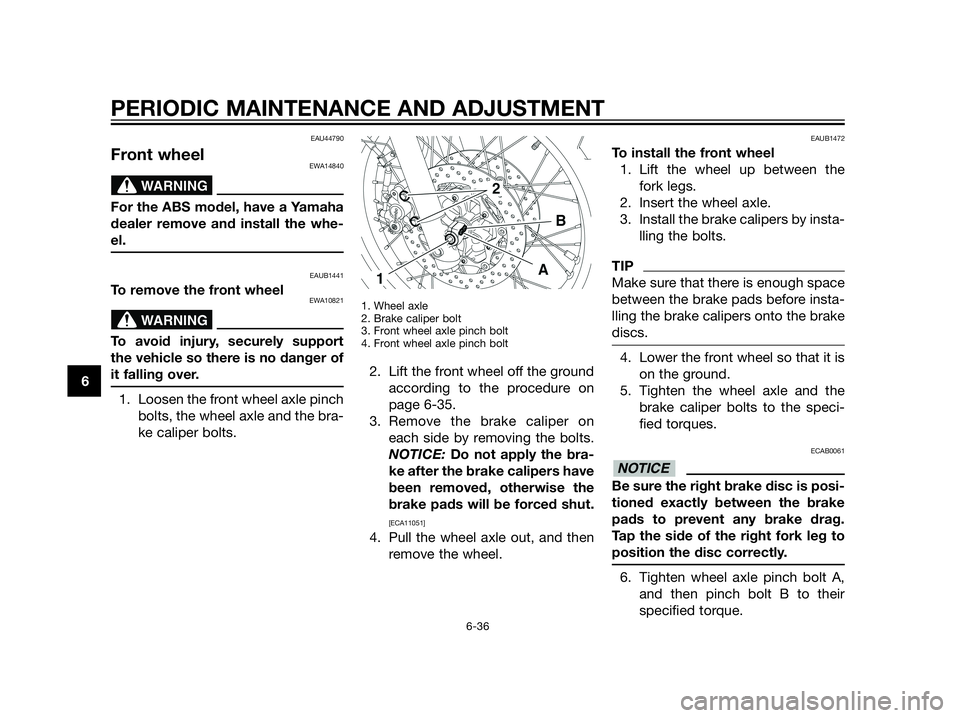
1. Loosen the front wheel axle pinch
bolts, the wheel axle and the bra-
ke caliper bolts.
1. Wheel axle
2. Brake caliper bolt
3. Front wheel axle pinch bolt
4. Front wheel axle pinch bolt
2. Lift the front wheel off the ground
according to the procedure on
page 6-35.
3. Remove the brake caliper on
each side by removing the bolts.
NOTICE: Do not apply the bra-
ke after the brake calipers have
been removed, otherwise the
brake pads will be forced shut.
[ECA11051]
4. Pull the wheel axle out, and then
remove the wheel.
EAUB1472
To install the front wheel
1. Lift the wheel up between the
fork legs.
2. Insert the wheel axle.
3. Install the brake calipers by insta-
lling the bolts.
TIP
Make sure that there is enough space
between the brake pads before insta-
lling the brake calipers onto the brake
discs.
4. Lower the front wheel so that it is
on the ground.
5. Tighten the wheel axle and the
brake caliper bolts to the speci-
fied torques.
ECAB0061
Be sure the right brake disc is posi-
tioned exactly between the brake
pads to prevent any brake drag.
Tap the side of the right fork leg to
position the disc correctly.
6. Tighten wheel axle pinch bolt A,
and then pinch bolt B to their
specified torque.
NOTICE
WARNING
WARNING
PERIODIC MAINTENANCE AND ADJUSTMENT
6-36
6
Page 83 of 100
7. Retighten pinch bolt A to the spe-
cified torque.
8. Apply the brake lever several
times, and then while holding the
brake lever in, push down hard
on the handlebar several times to
check for proper fork operation.EAU44800
Rear wheelEWA14840
For the ABS model, have a Yamaha
dealer remove and install the wheel.
EAU25314
To remove the rear wheelEWA10821
To avoid injury, securely support
the vehicle so there is no danger of
it falling over.
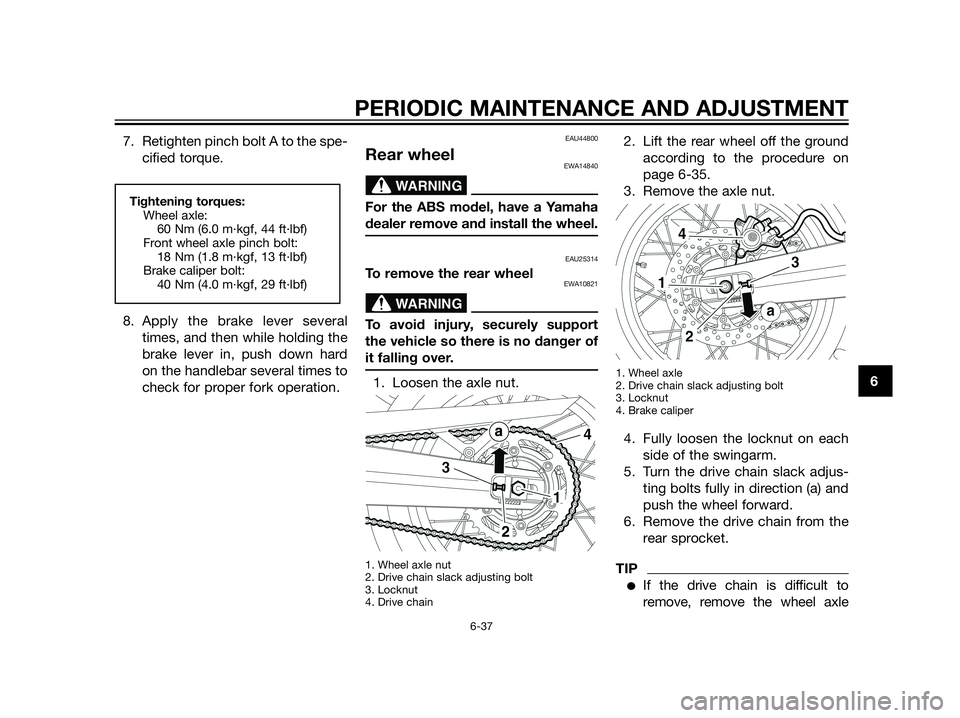
1. Loosen the axle nut.
1. Wheel axle nut
2. Drive chain slack adjusting bolt
3. Locknut
4. Drive chain
2. Lift the rear wheel off the ground
according to the procedure on
page 6-35.
3. Remove the axle nut.
1. Wheel axle
2. Drive chain slack adjusting bolt
3. Locknut
4. Brake caliper
4. Fully loosen the locknut on each
side of the swingarm.
5. Turn the drive chain slack adjus-
ting bolts fully in direction (a) and
push the wheel forward.
6. Remove the drive chain from the
rear sprocket.
TIP
�If the drive chain is difficult to
remove, remove the wheel axle
WARNING
WARNING
Tightening torques:
Wheel axle:
60 Nm (6.0 m·kgf, 44 ft·lbf)
Front wheel axle pinch bolt:
18 Nm (1.8 m·kgf, 13 ft·lbf)
Brake caliper bolt:
40 Nm (4.0 m·kgf, 29 ft·lbf)
PERIODIC MAINTENANCE AND ADJUSTMENT
6-37
6
Page 84 of 100

first, and then lift the wheel upward
enough to remove the drive chain
from the rear sprocket.
�The drive chain cannot be disas-
sembled.
7. While supporting the brake cali-
per bracket, pull the wheel axle
out, and then remove the wheel.
NOTICE: Do not apply the bra-
ke after the wheel has been
removed together with the bra-
ke disc, otherwise the brake
pads will be forced shut.
[ECA11071]
EAUB1450
To install the rear wheel
1. Install the wheel and the brake
caliper bracket by inserting the
wheel axle from the left-hand
side.
TIP
�Make sure that the slot in the bra-
ke caliper bracket is fit over the
retainer on the swingarm.
�Make sure that there is enough
space between the brake pads
before installing the wheel.
2. Install the drive chain onto the
rear sprocket.
3. Install the axle nut, and then
lower the rear wheel so that it is
on the ground.
4. Adjust the drive chain slack. (See
page 6-23).
5. Apply the rear brake several
times, and then tighten the axle
nut to the specified torque.EAU25871
Troubleshooting
Although Yamaha motorcycles recei-
ve a thorough inspection before ship-
ment from the factory, trouble may
occur during operation. Any problem
in the fuel, compression, or ignition
systems, for example, can cause poor
starting and loss of power.
The following troubleshooting charts
represent quick and easy procedures
for checking these vital systems your-
self. However, should your motorcy-
cle require any repair, take it to a
Yamaha dealer, whose skilled techni-
cians have the necessary tools, expe-
rience, and know-how to service the
motorcycle properly.
Use only genuine Yamaha replace-
ment parts. Imitation parts may look
like Yamaha parts, but they are often
inferior, have a shorter service life and
can lead to expensive repair bills.
EWA15141
When checking the fuel system, do
not smoke, and make sure there
are no open flames or sparks in the
WARNING
Tightening torque:
Axle nut:
105 Nm (10.5 m·kgf, 75 ft·lbf)
PERIODIC MAINTENANCE AND ADJUSTMENT
6-38
6
Page 87 of 100

Engine overheatingEWA10400
�Do not remove the radiator cap when the engine and radiator are hot. Scalding hot fluid and steam may be
blown out under pressure, which could cause serious injury. Be sure to wait until the engine has cooled.
�After removing the radiator cap retaining bolt, place a thick rag, like a towel, over the radiator cap, and then
slowly rotate the cap counterclockwise to the detent to allow any residual pressure to escape. When the his-
sing sound has stopped, press down on the cap while turning it counterclockwise, and then remove the cap.
TIP
If coolant is not available, tap water can be temporarily used instead, provided that it is changed to the recommended
coolant as soon as possible.
Wait until the
engine has cooled.Check the coolant level in the
reservoir and radiator.
The coolant level
is OK.
The coolant level is low.
Check the cooling system
for leakage.
Have a Yamaha dealer checkand repair the cooling system.
Add coolant. (See TIP.)
Start the engine. If the engine overheats again, have a
Yamaha dealer check and repair the cooling system.
There is
leakage.
There is
no leakage.
WARNING
PERIODIC MAINTENANCE AND ADJUSTMENT
6-41
6

