Page 44 of 118
INSTRUMENT AND CONTROL FUNCTIONS
3-29
3To reset the traction control system
Turn the key to “OFF”. Wait at least 1
second, then turn the key back to “ON”.
The “TCS” indicator/warning light
should go off and the system will be en-
abled. The engine trouble warning light
should go off after the motorcycle
reaches at least 20 km/h (12 mi/h). If
the “TCS” indicator/warning light and/or
engine trouble warning light still remain
on after resetting, the motorcycle may
still be ridden; however, have a
Yamaha dealer check the motorcycle as soon as possible.
EAU13074
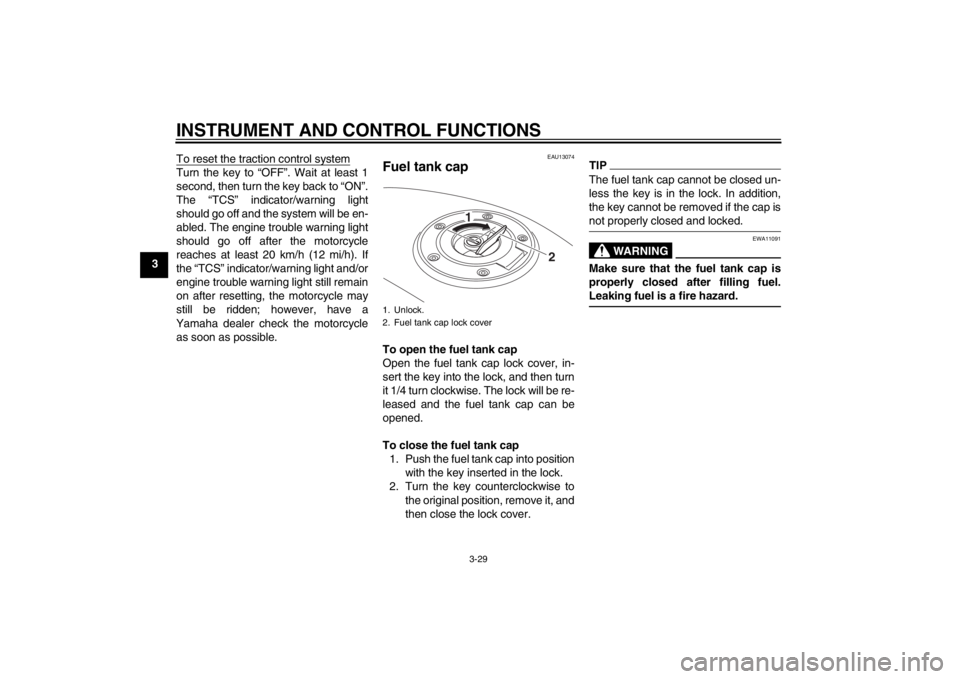
Fuel tank cap To open the fuel tank cap
Open the fuel tank cap lock cover, in-
sert the key into the lock, and then turn
it 1/4 turn clockwise. The lock will be re-
leased and the fuel tank cap can be
opened.
To close the fuel tank cap 1. Push the fuel tank cap into position with the key inserted in the lock.
2. Turn the key counterclockwise to the original position, remove it, and
then close the lock cover.
TIPThe fuel tank cap cannot be closed un-
less the key is in the lock. In addition,
the key cannot be removed if the cap is
not properly closed and locked.
WARNING
EWA11091
Make sure that the fuel tank cap is
properly closed after filling fuel.
Leaking fuel is a fire hazard.
1. Unlock.
2. Fuel tank cap lock cover
2
1
U1MCE0E0.book Page 29 Thursday, July 19, 2012 6:59 PM
Page 47 of 118
INSTRUMENT AND CONTROL FUNCTIONS
3-32
3
EAU39495
Seats Passenger seat
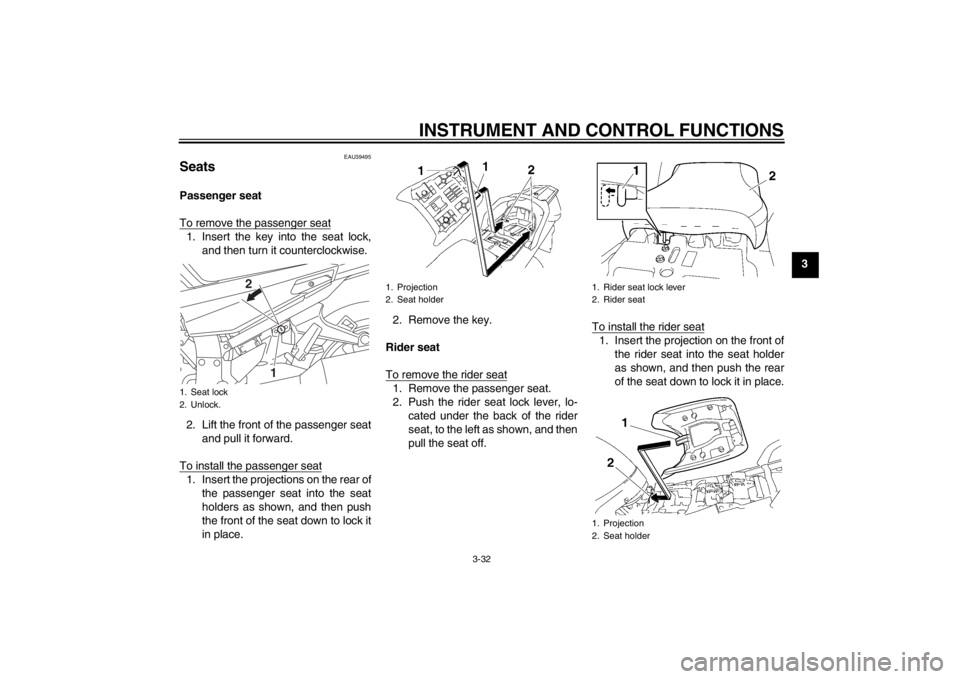
To remove the passenger seat1. Insert the key into the seat lock,and then turn it counterclockwise.
2. Lift the front of the passenger seat and pull it forward.
To install the passenger seat1. Insert the projections on the rear of the passenger seat into the seat
holders as shown, and then push
the front of the seat down to lock it
in place. 2. Remove the key.
Rider seat
To remove the rider seat
1. Remove the passenger seat.
2. Push the rider seat lock lever, lo- cated under the back of the rider
seat, to the left as shown, and then
pull the seat off. To install the rider seat
1. Insert the projection on the front of
the rider seat into the seat holder
as shown, and then push the rear
of the seat down to lock it in place.
1. Seat lock
2. Unlock.
1
2
1. Projection
2. Seat holder
1. Rider seat lock lever
2. Rider seat
1. Projection
2. Seat holder
U1MCE0E0.book Page 32 Thursday, July 19, 2012 6:59 PM
Page 99 of 118
![YAMAHA FJR1300A 2013 Owners Manual PERIODIC MAINTENANCE AND ADJUSTMENT
6-32
6
is turned to “OFF”, then con-
nect the positive lead before
connecting the negative lead.
[ECA16840]
4. After installation, make sure that
the battery le](/manual-img/51/49533/w960_49533-98.png "YAMAHA FJR1300A 2013 Owners Manual PERIODIC MAINTENANCE AND ADJUSTMENT
6-32
6
is turned to “OFF”, then con-
nect the positive lead before
connecting the negative lead.
[ECA16840]
4. After installation, make sure that
the battery le")
PERIODIC MAINTENANCE AND ADJUSTMENT
6-32
6
is turned to “OFF”, then con-
nect the positive lead before
connecting the negative lead.
[ECA16840]
4. After installation, make sure that
the battery leads are properly con-
nected to the battery terminals.NOTICE
ECA16530
Always keep the battery charged.
Storing a discharged battery can
cause permanent battery damage.
EAU54510
Replacing the fuses The fuse boxes and individual fuses are
located under panel A. (See page 6-8.)
If a fuse is blown, replace it as follows.1. Turn the key to “OFF” and turn off the electrical circuit in question.1. Main fuse 1
2. Spare fuse
3. Cruise control fuse
4. Brake light fuse
5. Fuse box
6. Main fuse 2
5
1
3
4
2
2
5
26
1. ABS motor fuse
2. ABS solenoid fuse
3. Fuel injection system fuse
4. Backup fuse (for clock and immobilizer sys-
tem)
5. Electronic throttle valve fuse
6. Headlight fuse
7. Spare fuse
8. Hazard fuse
9. Signaling system fuse
10.Auxiliary DC jack fuse
11.ABS control unit fuse
12.Ignition fuse
13.Right radiator fan fuse
14.Left radiator fan fuse
15.Windshield motor fuse
147
9101112
13
715
817
2
3456
7
U1MCE0E0.book Page 32 Thursday, July 19, 2012 6:59 PM
Page 101 of 118

PERIODIC MAINTENANCE AND ADJUSTMENT
6-34
6
EAU40361
Headlight bulb If a headlight does not come on, have a
Yamaha dealer check its electrical cir- cuit or replace the bulb.NOTICE
ECA16580
Do not affix any type of tinted film or
stickers to the headlight lens.
EAU54240
Front turn signal light This model is equipped with LED-type
front turn signal lights.
If a front turn signal light does not come
on, have a Yamaha dealer check it.
EAU27004
Replacing a rear turn signal
light bulb or a tail/brake light
bulb 1. Remove the passenger seat. (See
page 3-32.)
2. Remove the turn signal light bulb socket (together with the bulb) or
the tail/brake light bulb socket (to-
gether with the bulb) by turning it
counterclockwise.
3. Remove the burnt-out bulb by pushing it in and turning it counter-
clockwise.
4. Insert a new bulb into the socket, push it in, and then turn it clock-
wise until it stops.1. Turn signal light bulb socket
2. Tail/brake light bulb socket
U1MCE0E0.book Page 34 Thursday, July 19, 2012 6:59 PM
Page 102 of 118
PERIODIC MAINTENANCE AND ADJUSTMENT
6-35
65. Install the socket (together with the
bulb) by turning it clockwise.
6. Install the passenger seat.
EAU24313
Replacing the license plate
light bulb 1. Remove the license plate light unit by removing the screws.
2. Remove the license plate light bulb socket (together with the bulb) by
pulling it out. 3. Remove the burnt-out bulb by pull-
ing it out.
4. Insert a new bulb into the socket.
5. Install the socket (together with the bulb) by pushing it in.
6. Install the license plate light unit by installing the screws.1. Screw
2. License plate light unit
1. License plate light bulb
2. License plate light bulb socket
1
2
U1MCE0E0.book Page 35 Thursday, July 19, 2012 6:59 PM
Page 105 of 118

PERIODIC MAINTENANCE AND ADJUSTMENT
6-38
6
Engine overheating
WARNING
EWAT1040
●
Do not remove the radiator cap when the engine and radiator are hot. Scalding hot fluid and steam may be
blown out under pressure, which could cause serious injury. Be sure to wait until the engine has cooled.
●
Place a thick rag, like a towel, over the radiator cap, and then slowly rotate the cap counterclockwise to the de-
tent to allow any residual pressure to escape. When the hissing sound has stopped, press down on the cap
while turning it counterclockwise, and then remove the cap.
TIPIf coolant is not available, tap water can be temporarily used instead, provided that it is changed to the recommended coolant
as soon as possible.
Wait until the
engine has cooled.
Check the coolant level in the
reservoir and radiator.
The coolant level
is OK.The coolant level is low.
Check the cooling system
for leakage.
Have a Yamaha dealer checkand repair the cooling system.Add coolant. (See TIP.)
Start the engine. If the engine overheats again,
have a
Yamaha dealer check
and repair the cooling system.
There is
leakage.
There is
no leakage.
U1MCE0E0.book Page 38 Thursday, July 19, 2012 6:59 PM