2013 YAMAHA AEROX50 lock
[x] Cancel search: lockPage 28 of 74
INSTRUMENT AND CONTROL FUNCTIONS
3-12
3
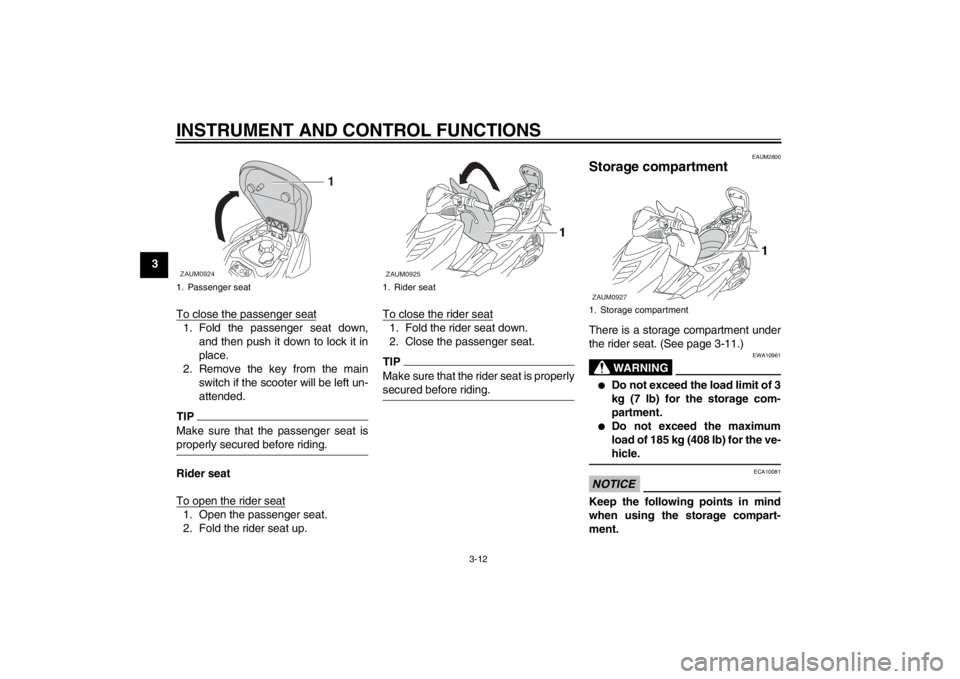
To close the passenger seat
1. Fold the passenger seat down,
and then push it down to lock it in
place.
2. Remove the key from the main
switch if the scooter will be left un-
attended.TIPMake sure that the passenger seat is
properly secured before riding.Rider seat
To open the rider seat1. Open the passenger seat.
2. Fold the rider seat up.To close the rider seat
1. Fold the rider seat down.
2. Close the passenger seat.TIPMake sure that the rider seat is properly
secured before riding.
EAUM2800
Storage compartment There is a storage compartment under
the rider seat. (See page 3-11.)
WARNING
EWA10961
●
Do not exceed the load limit of 3
kg (7 lb) for the storage com-
partment.
●
Do not exceed the maximum
load of 185 kg (408 lb) for the ve-
hicle.
NOTICE
ECA10081
Keep the following points in mind
when using the storage compart-
ment.
1. Passenger seatZAUM0924
1
1. Rider seatZAUM0925
1
1. Storage compartmentZAUM0927
1
U1PHE0E0.book Page 12 Wednesday, August 29, 2012 4:42 PM
Page 52 of 74
PERIODIC MAINTENANCE AND ADJUSTMENT
6-16
6
●
Insufficient brake fluid may al-
low air to enter the brake sys-
tem, reducing braking
performance.
●
Clean the filler cap before re-
moving. Use only DOT 4 brake
fluid from a sealed container.
●
Use only the specified brake flu-
id; otherwise, the rubber seals
may deteriorate, causing leak-
age.
●
Refill with the same type of
brake fluid. Adding a brake fluid
other than DOT 4 may result in a
harmful chemical reaction.
●
Be careful that water does not
enter the brake fluid reservoir
when refilling. Water will signifi-
cantly lower the boiling point of
the fluid and may result in vapor
lock.
NOTICE
ECA17640
Brake fluid may damage painted sur-
faces or plastic parts. Always clean
up spilled fluid immediately.
As the brake pads wear, it is normal for
the brake fluid level to gradually go
down. A low brake fluid level may indi-
cate worn brake pads and/or brake sys-
tem leakage; therefore, be sure to
check the brake pads for wear and the
brake system for leakage. If the brake
fluid level goes down suddenly, have a
Yamaha dealer check the cause before
further riding.
EAUM1360
Changing the brake fluid Have a Yamaha dealer change the
brake fluid at the intervals specified in
the periodic maintenance and lubrica-
tion chart. In addition, have the brake
hose replaced every four years or
whenever it is damaged or leaking.
U1PHE0E0.book Page 16 Wednesday, August 29, 2012 4:42 PM
Page 59 of 74

PERIODIC MAINTENANCE AND ADJUSTMENT
6-23
6 8. Connect the headlight coupler.
9. Install the cowling.
10. Have a Yamaha dealer adjust the
headlight beam if necessary.
EAU24133
Replacing the tail/brake light
bulb 1. Remove the tail/brake light lens by
removing the screws.
2. Remove the burnt-out bulb by
pushing it in and turning it counter-
clockwise.
3. Insert a new bulb into the socket,
push it in, and then turn it clock-
wise until it stops.
4. Install the lens by installing the
screws. NOTICE: Do not over-
tighten the screws, otherwise
the lens may break.
[ECA10681]EAU24204
Replacing a turn signal light
bulb 1. Remove the turn signal light lens
by removing the screw.
2. Remove the burnt-out bulb by
pushing it in and turning it counter-
clockwise.
ZAUM0937
ZAUM0938ZAUM0939
U1PHE0E0.book Page 23 Wednesday, August 29, 2012 4:42 PM
Page 60 of 74

PERIODIC MAINTENANCE AND ADJUSTMENT
6-24
63. Insert a new bulb into the socket,
push it in, and then turn it clock-
wise until it stops.
4. Install the lens by installing the
screw. NOTICE: Do not over-
tighten the screw, otherwise the
lens may break.
[ECA11191]EAU24330
License plate light If the license plate light does not come
on, have a Yamaha dealer check the
electrical circuit or replace the bulb.
EAU45463
Replacing the auxiliary light
bulb (if equipped)If the auxiliary light bulb burns out, re-
place it as follows.
1. Place the vehicle on the center-
stand.
2. Remove cowling A. (See page
6-6.)
3. Remove the auxiliary light bulb
socket (together with the bulb) by
pulling it out.
4. Remove the burnt-out bulb by pull-
ing it out.1. Auxiliary light bulb socketZAUM0940
1
U1PHE0E0.book Page 24 Wednesday, August 29, 2012 4:42 PM
Page 63 of 74
PERIODIC MAINTENANCE AND ADJUSTMENT
6-27
6 Engine overheating
WARNING
EWA10400
●
Do not remove the radiator cap when the engine and radiator are hot. Scalding hot fluid and steam may be
blown out under pressure, which could cause serious injury. Be sure to wait until the engine has cooled.
●
After removing the radiator cap retaining bolt, place a thick rag, like a towel, over the radiator cap, and then
slowly rotate the cap counterclockwise to the detent to allow any residual pressure to escape. When the hissing
sound has stopped, press down on the cap while turning it counterclockwise, and then remove the cap.
TIPIf coolant is not available, tap water can be temporarily used instead, provided that it is changed to the recommended coolant
as soon as possible.
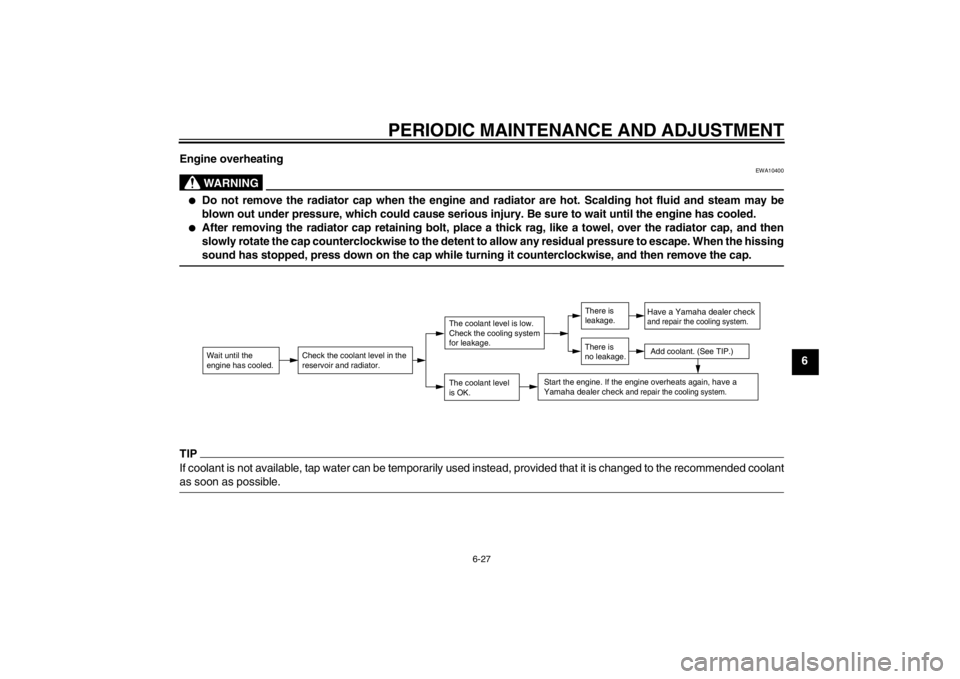
Wait until the
engine has cooled.
Check the coolant level in the
reservoir and radiator.
The coolant level
is OK.The coolant level is low.
Check the cooling system
for leakage.
Have a Yamaha dealer checkand repair the cooling system.Add coolant. (See TIP.)
Start the engine. If the engine overheats again,
have a
Yamaha dealer check
and repair the cooling system.
There is
leakage.
There is
no leakage.
U1PHE0E0.book Page 27 Wednesday, August 29, 2012 4:42 PM
Page 72 of 74

INDEX22-stroke engine oil................................. 3-10AAcceleration and deceleration................. 5-2
Air filter element, cleaning..................... 6-10
Auxiliary light bulb, replacing
(if equipped)........................................ 6-24BBattery................................................... 6-19
Brake fluid, changing ............................ 6-16
Brake fluid level, checking .................... 6-15
Brake lever, front..................................... 3-7
Brake lever, rear ..................................... 3-7
Brake levers, lubricating........................ 6-17
Braking .................................................... 5-2CCarburetor,adjusting ............................. 6-11
Care ........................................................ 7-1
Catalytic converter ................................ 3-10
Centerstand, checking and
lubricating ........................................... 6-17
Coolant.................................................... 6-9
Coolant temperature warning light .......... 3-3
Cowling and panel, removing and
installing................................................ 6-6DDimmer switch ........................................ 3-7EEngine break-in ....................................... 5-3FFinal transmission oil .............................. 6-8
Front and rear brake lever free play,
checking ............................................. 6-14
Front and rear brake pads, checking .... 6-15Front fork, checking .............................. 6-18
Fuel......................................................... 3-9
Fuel and 2-stroke engine oil tank caps ... 3-8
Fuel consumption, tips for reducing........ 5-3
Fuel level warning light ........................... 3-3
Fuse, replacing ..................................... 6-21
HHandlebar switches ................................ 3-6
Headlight bulb, replacing ...................... 6-22
High beam indicator light ........................ 3-2
Horn switch ............................................. 3-7IIdentification numbers ............................ 9-1
Indicator lights and warning light ............ 3-2KKickstarter............................................. 3-11LLicense plate light ................................. 6-24MMain switch/steering lock........................ 3-1
Maintenance and lubrication, periodic .... 6-3
Maintenance, emission control
system .................................................. 6-2
Matte color, caution ................................ 7-1
Model label ............................................. 9-1
Multi-function display (NS50).................. 3-4OOil level warning light.............................. 3-2PParking ................................................... 5-4
Part locations .......................................... 2-1SSafe-riding points.................................... 1-5
Safety information................................... 1-1Seats ..................................................... 3-11
Shock absorber assembly,
adjusting (if equipped) ........................ 3-13
Spark plug, checking ............................... 6-7
Specifications .......................................... 8-1
Speedometer unit (NS50N) ..................... 3-3
Starting a cold engine ............................. 5-1
Starting off ............................................... 5-2
Start switch.............................................. 3-7
Steering, checking................................. 6-19
Storage.................................................... 7-3
Storage compartment............................ 3-12
TTail/brake light bulb, replacing .............. 6-23
Throttle grip and cable, checking and
lubricating ........................................... 6-17
Throttle grip free play, checking ............ 6-11
Tires ...................................................... 6-12
Troubleshooting .................................... 6-25
Troubleshooting charts.......................... 6-26
Turn signal indicator light ........................ 3-2
Turn signal light bulb, replacing ............ 6-23
Turn signal switch ................................... 3-7VVehicle identification number .................. 9-1WWheel bearings, checking ..................... 6-19
Wheels .................................................. 6-14
U1PHE0E0.book Page 1 Wednesday, August 29, 2012 4:42 PM