2013 VOLVO V60 heating
[x] Cancel search: heatingPage 300 of 422

07 During your journey
Driving with a trailer
07
298* Option/accessory, for more information, see Introduction.
General
Payload depends on the car's kerb weight. The
total of the weight of the passengers and all
accessories, e.g. towbar, reduces the car's
payload by a corresponding weight. For more
detailed information on weights, see
page 373.
If the towing bracket is mounted by Volvo, then
the car is delivered with the necessary equip-
ment for driving with a trailer.
•The car's towing bracket must be of an
approved type.
•If the towbar is retrofitted, check with your
Volvo dealer that the car is fully equipped
for driving with a trailer.
•Distribute the load on the trailer so that the
weight on the towing bracket complies
with the specified maximum towball load.
•Increase the tyre pressure to the recom-
mended pressure for a full load. For tyre
pressure label location, see page 317.
•The engine is loaded more heavily than
usual when driving with a trailer.
•Do not tow a heavy trailer when the car is
brand new. Wait until it has been driven at
least 1000 km.
•The brakes are loaded much more than
usual on long and steep downhill slopes.
Downshift to a lower gear and adjust your
speed.
•For safety reasons, the maximum permit-
ted speed for the car when coupled with a
trailer should not be exceeded. Follow the
regulations in force for the permitted
speeds and weights.
•Maintain a low speed when driving with a
trailer up long, steep ascents.
•Avoid driving with a trailer on inclines of
more than 12%.
Trailer cableAn adapter is required if the car's towing
bracket has 13 pin electrics and the trailer has
7 pin electrics. Use an adapter cable approved
by Volvo. Make sure the cable does not drag
on the ground.
Direction indicators and brake lights on
the trailer
If any of the trailer's lamps for direction indica-
tors are broken, then the combined instrument
panel's symbol for direction indicators flashes
faster than normal and the display shows the
text
Bulb fail - Ind. signal trailer.
If any of the trailer's lamps for the brake light
are broken then the
Bulb fail - Stop lamp
trailer text is shown.
Level control*The rear shock absorbers maintain a constant
height irrespective of the car's load (up to the
maximum permissible weight). When the car isstationary the rear of the car lowers slightly,
which is normal.
Trailer weightsFor information on Volvo's permitted trailer
weights, see page 374.
NOTE
The stated maximum permitted trailer
weights are those permitted by Volvo.
National vehicle regulations can further limit
trailer weights and speeds. Towbars can be
certified for higher towing weights than the
car can actually tow.
WARNING
Follow the stated recommendations for
trailer weights. Otherwise, the car and trailer
may be difficult to control in the event of
sudden movement and braking.
Manual gearbox
OverheatingWhen driving with a trailer in hilly terrain in a hot
climate there may be a risk of overheating.
•Do not run the engine at higher revolutions
than 4500 rpm (diesel engines: 3500 rpm)
- otherwise the oil temperature may
become too high.
ProCarManuals.com
Page 301 of 422

07 During your journey
Driving with a trailer
07
299
Diesel engine 5-cyl
•In the event of a risk of overheating the
optimal speed for the engine is 2300-3000
rpm for optimal circulation of the coolant.
Automatic gearbox
OverheatingWhen driving with a trailer in hilly terrain in a hot
climate there may be a risk of overheating.
•An automatic gearbox selects the optimum
gear related to load and engine speed.
•In the event of overheating a warning sym-
bol illuminates on the instrument panel
combined with a text message - follow the
recommendation given.
Steep inclines
•Do not lock the automatic transmission in
a higher gear than the engine "can cope
with" - it is not always a good idea to drive
at a high gear with low engine revolutions.
IMPORTANT
See also the specific information on slow
driving with trailer for cars with the
Powershift automatic transmission on page
125.
Parking on a hill1. Depress the foot brake.2. Activate the parking brake.
3.
Move the gear selector to position P.
4. Release the foot brake.
•Move the gear selector to park position P
when parking an automatic car with a
hitched trailer. Always use the parking
brake.
•Block the wheels with chocks when park-
ing a car with hitched trailer on a hill.
Starting on a hill1. Depress the foot brake.
2. Move the gear selector to driving posi-
tion D.
3. Release the parking brake.
4. Release the foot brake and start driving off.
Towing bracket
If the car is equipped with a detachable towbar,
the installation instructions for the loose sec-
tion must be followed carefully, see page 301.
WARNING
If the car is fitted with a Volvo detachable
towbar:
•Follow the installation instructions care-
fully.
•The detachable section must be locked
with the key before setting off.
•Check that the indicator window shows
green.
Important checks
•The towbar's towball must be cleaned and
greased regularly.
NOTE
If a towball hitch with vibration damper is
used, it is not necessary to grease the tow-
ball.
ProCarManuals.com
Page 319 of 422
08 Wheels and tyres
Tyre pressure
08
317
Tyre pressure
G021830
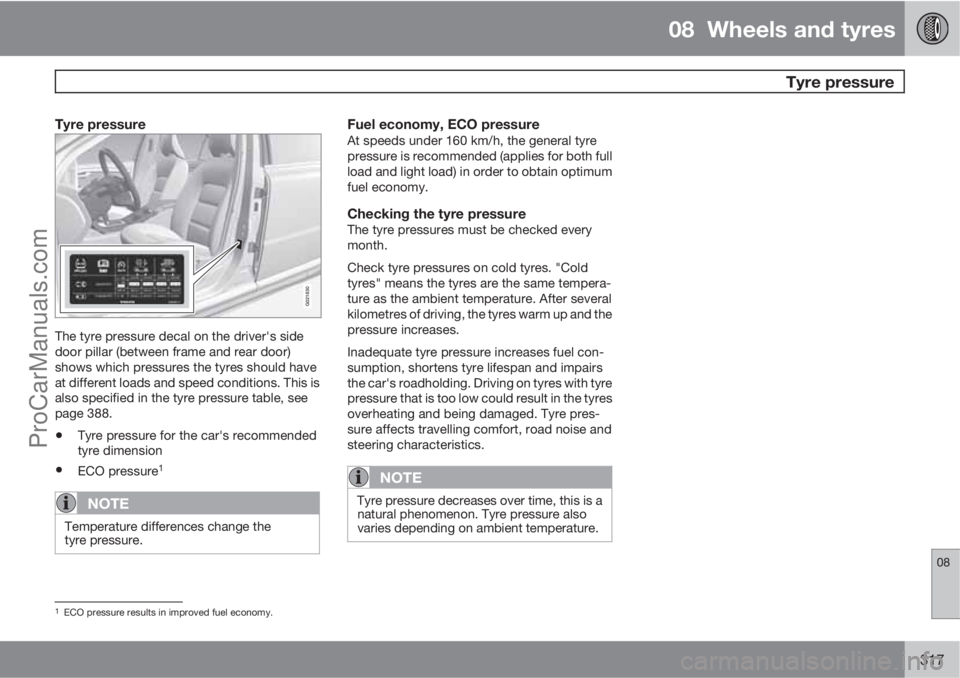
The tyre pressure decal on the driver's side
door pillar (between frame and rear door)
shows which pressures the tyres should have
at different loads and speed conditions. This is
also specified in the tyre pressure table, see
page 388.
•Tyre pressure for the car's recommended
tyre dimension
•ECO pressure1
NOTE
Temperature differences change the
tyre pressure.
Fuel economy, ECO pressureAt speeds under 160 km/h, the general tyre
pressure is recommended (applies for both full
load and light load) in order to obtain optimum
fuel economy.
Checking the tyre pressureThe tyre pressures must be checked every
month.
Check tyre pressures on cold tyres. "Cold
tyres" means the tyres are the same tempera-
ture as the ambient temperature. After several
kilometres of driving, the tyres warm up and the
pressure increases.
Inadequate tyre pressure increases fuel con-
sumption, shortens tyre lifespan and impairs
the car's roadholding. Driving on tyres with tyre
pressure that is too low could result in the tyres
overheating and being damaged. Tyre pres-
sure affects travelling comfort, road noise and
steering characteristics.
NOTE
Tyre pressure decreases over time, this is a
natural phenomenon. Tyre pressure also
varies depending on ambient temperature.
1ECO pressure results in improved fuel economy.
ProCarManuals.com
Page 325 of 422

08 Wheels and tyres
Emergency puncture repair (TMK)
08
323
NOTE
If the compressor is connected to one of the
two 12 V sockets, in the tunnel console, no
other current consumer must be connected
to the other one.
WARNING
Do not leave children in the car without
supervision when the engine is running.
8.
Flick the switch to position I.
WARNING
Never stand next to the tyre when the com-
pressor is running. If cracks or unevenness
arise then the compressor must be
switched off immediately. The journey
should not be continued. Contacting an
authorised tyre centre is recommended.
NOTE
When the compressor starts, the pressure
can increase up to 6 bar but the pressure
drops after approximately 30 seconds.
9. Inflate the tyre for 7 minutes.
IMPORTANT
Risk of overheating. The compressor must
not run for more than 10 minutes.
10. Switch off the compressor to check the
pressure on the pressure gauge. Minimum
pressure is 1.8 bar and maximum 3.5 bar.
(Release air with the pressure reducing
valve if the tyre pressure is too high.)
WARNING
If the pressure is below 1.8 bar then the hole
in the tyre is too big. The journey should not
be continued. Contacting an authorised tyre
centre is recommended.
11. Switch off the compressor and unplug the
cable from the 12 V socket.
12. Detach the hose from the tyre valve and fit
the valve cap.
13. As soon as possible, drive approximately
3 km at a maximum speed of 80 km/h so
that the sealing fluid can seal the tyre.
Rechecking the repair and pressure1. Reconnect the equipment.2. Read the tyre pressure on the pressure
gauge.
•If it is below 1.3 bar then the tyre is
insufficiently sealed. The journey should
not be continued. Contact a tyre centre.
•If the tyre pressure is higher than 1.3
bar, the tyre must be inflated to the pres-
sure specified in accordance with the
tyre pressure table, see page 388 (1
bar=100 kPa). Release air using the
pressure reducing valve if the tyre pres-
sure is too high.
WARNING
Do not unscrew the bottle, it is equipped
with a reverse catch to prevent leakage.
3. Make sure the compressor is switched off.
Detach the air hose and cable. Refit the
dust cap.
NOTE
The sealing fluid bottle and the hose must
be replaced after use. Volvo recommends
that this replacement is performed by an
authorised Volvo workshop.
ProCarManuals.com
Page 326 of 422

08 Wheels and tyres
Emergency puncture repair (TMK)
08
324
WARNING
Check the tyre pressure regularly.
Volvo recommends that you drive to the near-
est authorised Volvo workshop for the replace-
ment/repair of the damaged tyre. Advise the
workshop that the tyre contains sealing fluid.
WARNING
You should not drive faster than 80 km/h
after the emergency tyre repair kit has been
used. Volvo recommends that you visit an
authorised Volvo workshop for inspection of
the sealed tyre (maximum driving distance
is 200 km). The staff there can determine
whether or not the tyre can be repaired or if
it needs to be replaced.
Inflating the tyres
The car's original tyres can be inflated by the
compressor.
1. The compressor must be switched off.
Make sure that the switch is in position 0
and locate the cable and air hose.
2. Unscrew the wheel's dust cap and screw
in the air hose valve connection to the bot-
tom of the thread on the tyre's air valve.
WARNING
Inhaling car exhaust fumes can result in
danger to life. Never leave the engine run-
ning in sealed areas or areas that lack suf-
ficient ventilation.
WARNING
Do not leave children in the car without
supervision when the engine is running.
3. Connect the cable to one of the car's 12 V
sockets and start the car.
4. Start the compressor by flicking the switch
to position I.
IMPORTANT
Risk of overheating. The compressor must
not run for more than 10 minutes.
5. Inflate the tyre to the pressure specified in
accordance with the tyre pressure table,
see page 388. (Release air using the pres-
sure reducing valve if the tyre pressure is
too high.)
6. Switch off the compressor. Detach the air
hose and cable.
7. Refit the dust cap.
Replacing the sealing fluid canister
Replace the bottle when the expiration date
has passed. Treat the old bottle as environ-
mentally hazardous waste.
WARNING
The bottle contains 1.2-Ethanol and natural
rubber-latex.
Harmful if ingested. Could result in allergic
reaction in the event of skin contact.
Avoid contact with the skin and eyes.
Store out of the reach of children.
ProCarManuals.com
Page 350 of 422
09 Maintenance and service
Battery 09
348
NOTE
•The higher the current take-off in the car
(extra cooling/heating, etc.) the more
the batteries must be charged =
increased fuel consumption.
•When the capacity of the battery has
fallen below the lowest permissible level
then the Start/Stop function is disen-
gaged.
Temporarily reduced Start/Stop function due
to high current take-off means:
•The engine starts automatically2 without
the driver depressing the clutch pedal
(manual gearbox).
•The engine starts automatically without the
driver lifting his/her foot off the foot brake
pedal (automatic gearbox).
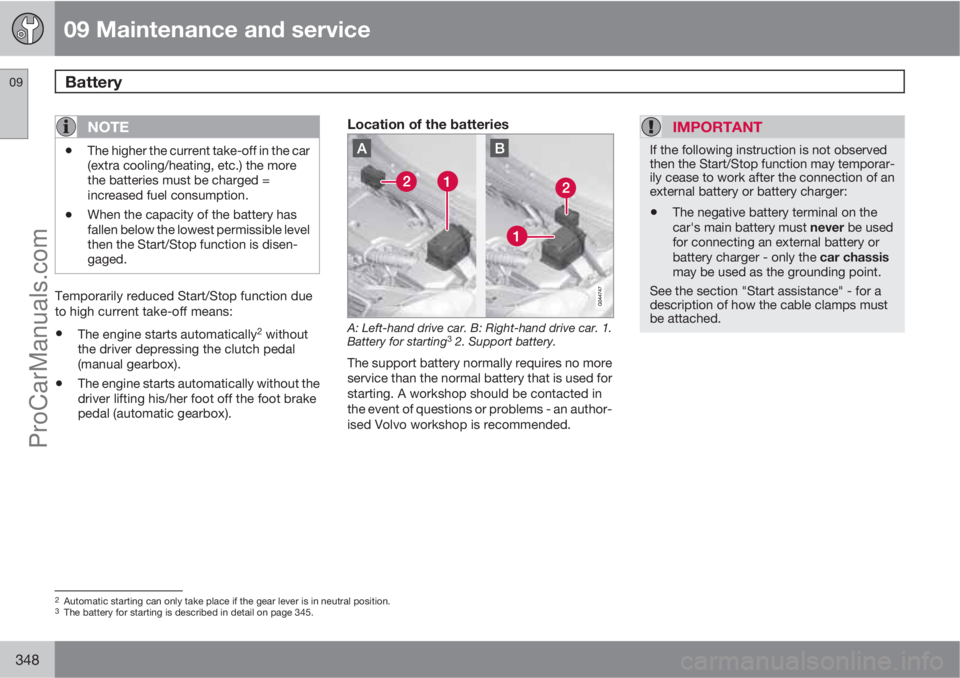
Location of the batteries
A: Left-hand drive car. B: Right-hand drive car. 1.
Battery for starting3 2. Support battery.
The support battery normally requires no more
service than the normal battery that is used for
starting. A workshop should be contacted in
the event of questions or problems - an author-
ised Volvo workshop is recommended.
IMPORTANT
If the following instruction is not observed
then the Start/Stop function may temporar-
ily cease to work after the connection of an
external battery or battery charger:
•The negative battery terminal on the
car's main battery must never be used
for connecting an external battery or
battery charger - only the car chassis
may be used as the grounding point.
See the section "Start assistance" - for a
description of how the cable clamps must
be attached.
2Automatic starting can only take place if the gear lever is in neutral position.3The battery for starting is described in detail on page 345.
ProCarManuals.com
Page 358 of 422

09 Maintenance and service
Fuses 09
356* Option/accessory, for more information, see Introduction.
Box AFunctionA
--
Infotainment control module5
Audio control unit (ampli-
fier)*
Digital radio*; TV*10
Audio15
Telematics*; Bluetooth*5
--
Sunroof*; Interior lighting
roof; Climate sensor*;
Damper motors, air intake5
12 V socket, tunnel console15
Seat heating, rear right*15
Seat heating, rear left*15
--
Seat heating (passenger
side)15
Seat heating (driver's side)15
Box AFunctionA
Parking assistance*; Park-
ing camera*; Towbar control
module *
BLIS*5
AWD control module*15
Active chassis Four-C*10
Box BFunctionA
Rear window wiper15
--
Interior lighting; Driver's
door control panel, power
windows; Power seats,
front*; Remote controlled
garage door opener*7.5
Information display (DIM)5
Adaptive cruise control,
ACC*; collision warning sys-
tem*10
Interior lighting; Rain sensor7.5
Steering wheel module7.5
Box BFunctionA
Central locking system, fuel
filler flap10
Rear window washer15
Windscreen washers15
Unlocking, tailgate10
Folding head restraint*10
Fuel pump20
Movement detector alarm*;
Climate panel5
Steering lock15
Siren alarm*; Data link con-
nector OBDII5
--
Airbags10
Collision warning system*5
Accelerator pedal sensor,
PTC element air preheater*;
Dimming, interior rearview
mirror*; Seat heating, rear*7.5
ProCarManuals.com
Page 413 of 422

11 Alphabetical Index
11
411
ECO pressure.......................................... 317
Eco Start/Stop DRIVe.............................. 127
Electrical socket......................................229
cargo area........................................... 293
front seat............................................. 229
Electric parking brake.............................. 137
low battery voltage.............................137
releasing automatically....................... 138
releasing manually.............................. 138
Emergency equipment
warning triangle.................................. 318
Emergency puncture repair..................... 321
Emissions of carbon dioxide................... 291
Engine
overheating......................................... 298
starting................................................ 113
Engine block heater................................. 118
fuel-driven........................................... 220
Engine compartment
coolant................................................ 332
oil........................................................ 329
overview.............................................. 329
power steering fluid............................ 334
Engine drag control ................................146Engine oil.........................................329, 378
adverse driving conditions.................. 378
capacities........................................... 378
filter..................................................... 329
oil grade.............................................. 378
Engine specifications............................... 376
Environmental labelling, FSC, owner's
manual.......................................................12
Error messages
Adaptive Cruise Control..................... 162
Driver Alert Control............................. 183
Lane Departure Warning..................... 186
see Messages and symbols.......139, 162
Error messages in BLIS........................... 196
Error messages in Distance Alert............ 167
ERS - Remote Start................................. 114
ETC, electronic temperature control ....... 214
Expectant mothers, seatbelt...................... 17
External dimensions................................372
F
Fan........................................................... 215
Fault tracing for the camera sensor. 170, 178First aid equipment.................................. 318
First aid kit .............................................. 318
Flexifuel.................................................... 118
adaptation........................................... 119
Fluids, capacities..................................... 381
Fluids and oils.......................................... 381
Fog lamps
rear........................................................ 91
Foot brake............................................... 135
FOUR-C – Active chassis........................226
FSC, environmental labelling..................... 12
Fuel.......................................................... 288
fuel consumption................................ 384
fuel economy...................................... 317
fuel filter.............................................. 290
Fuse box.................................................. 350
glovebox............................................. 355
Fuses.......................................................350
box in cargo area................................ 358
changing............................................. 350
cold zone............................................ 359
general................................................ 350
relay/fuse box in engine compartment 351
Start/Stop........................................... 359
ProCarManuals.com