2013 VOLVO V60 warning
[x] Cancel search: warningPage 323 of 422
08 Wheels and tyres
Emergency puncture repair (TMK)
08
321 General
Emergency puncture repair (TMK; Temporary
Mobility Kit) is used to seal a puncture and
check and adjust tyre pressure. It consists of a
compressor and a bottle with sealing fluid. The
kit works as a temporary repair. The sealing
fluid bottle must be replaced before its expira-
tion date and after use.
The sealing fluid effectively seals tyres punc-
tured in the tread.
NOTE
The emergency puncture repair kit is only
intended for sealing tyres with a puncture in
the tread.
The emergency puncture repair kit has limited
capacity to seal tyres which have punctures inthe wall. Do not seal tyres with the emergency
puncture repair kit if they have larger slits,
cracks or similar damage.
Connect the compressor to one of the car's 12
V sockets, see pages 229 and 293. Choose the
electrical socket that is nearest the punctured
tyre.
IMPORTANT
If the compressor for emergency puncture
repair is connected to one of the two sock-
ets in the tunnel console, see page 229, no
other current consumer must be connected
to the other one.
NOTE
The compressor for temporary emergency
puncture repair has been tested and
approved by Volvo.
Location of the emergency puncture
repair kit
Set up the warning triangle if a tyre is being
sealed in a trafficked location. The emergency
puncture repair kit is located under the floor in
the cargo area, see page 318.
WARNING
You should not drive faster than 80 km/h
after the emergency tyre repair kit has been
used. Volvo recommends that you visit an
authorised Volvo workshop for inspection of
the sealed tyre (maximum driving distance
is 200 km). The staff there can determine
whether or not the tyre can be repaired or if
it needs to be replaced.
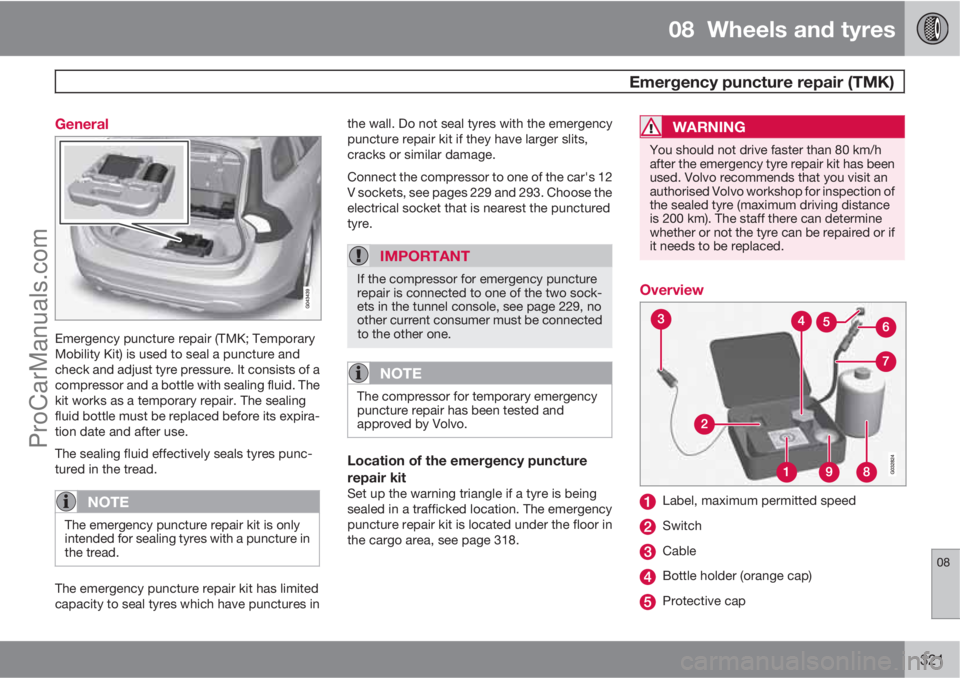
Overview
Label, maximum permitted speed
Switch
Cable
Bottle holder (orange cap)
Protective cap
ProCarManuals.com
Page 324 of 422
08 Wheels and tyres
Emergency puncture repair (TMK)
08
322
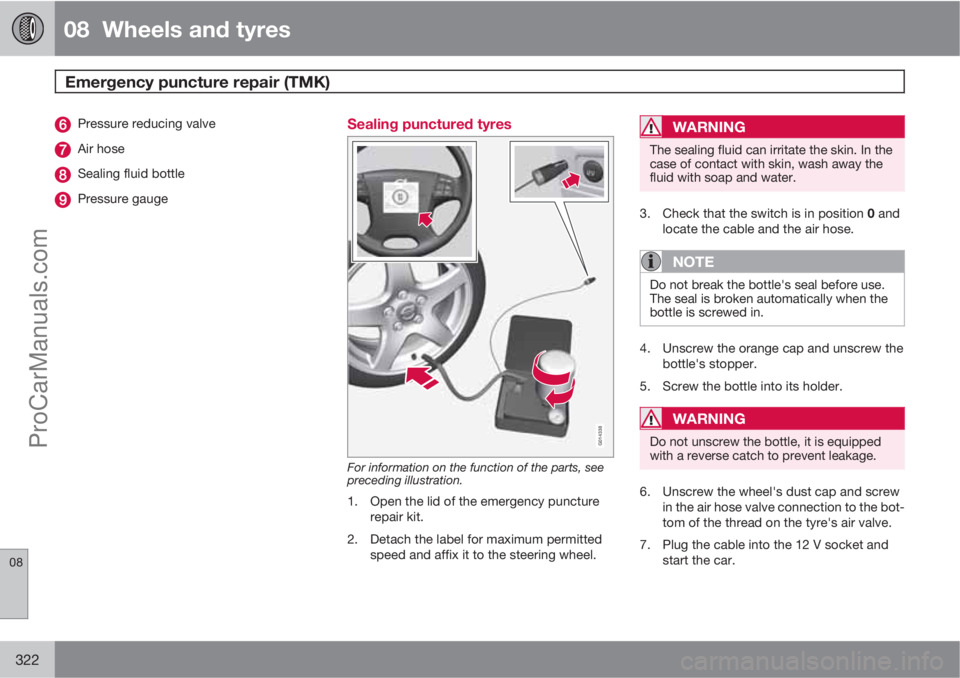
Pressure reducing valve
Air hose
Sealing fluid bottle
Pressure gauge
Sealing punctured tyres
G014338
For information on the function of the parts, see
preceding illustration.
1. Open the lid of the emergency puncture
repair kit.
2. Detach the label for maximum permitted
speed and affix it to the steering wheel.
WARNING
The sealing fluid can irritate the skin. In the
case of contact with skin, wash away the
fluid with soap and water.
3.
Check that the switch is in position 0 and
locate the cable and the air hose.
NOTE
Do not break the bottle's seal before use.
The seal is broken automatically when the
bottle is screwed in.
4. Unscrew the orange cap and unscrew the
bottle's stopper.
5. Screw the bottle into its holder.
WARNING
Do not unscrew the bottle, it is equipped
with a reverse catch to prevent leakage.
6. Unscrew the wheel's dust cap and screw
in the air hose valve connection to the bot-
tom of the thread on the tyre's air valve.
7. Plug the cable into the 12 V socket and
start the car.
ProCarManuals.com
Page 325 of 422

08 Wheels and tyres
Emergency puncture repair (TMK)
08
323
NOTE
If the compressor is connected to one of the
two 12 V sockets, in the tunnel console, no
other current consumer must be connected
to the other one.
WARNING
Do not leave children in the car without
supervision when the engine is running.
8.
Flick the switch to position I.
WARNING
Never stand next to the tyre when the com-
pressor is running. If cracks or unevenness
arise then the compressor must be
switched off immediately. The journey
should not be continued. Contacting an
authorised tyre centre is recommended.
NOTE
When the compressor starts, the pressure
can increase up to 6 bar but the pressure
drops after approximately 30 seconds.
9. Inflate the tyre for 7 minutes.
IMPORTANT
Risk of overheating. The compressor must
not run for more than 10 minutes.
10. Switch off the compressor to check the
pressure on the pressure gauge. Minimum
pressure is 1.8 bar and maximum 3.5 bar.
(Release air with the pressure reducing
valve if the tyre pressure is too high.)
WARNING
If the pressure is below 1.8 bar then the hole
in the tyre is too big. The journey should not
be continued. Contacting an authorised tyre
centre is recommended.
11. Switch off the compressor and unplug the
cable from the 12 V socket.
12. Detach the hose from the tyre valve and fit
the valve cap.
13. As soon as possible, drive approximately
3 km at a maximum speed of 80 km/h so
that the sealing fluid can seal the tyre.
Rechecking the repair and pressure1. Reconnect the equipment.2. Read the tyre pressure on the pressure
gauge.
•If it is below 1.3 bar then the tyre is
insufficiently sealed. The journey should
not be continued. Contact a tyre centre.
•If the tyre pressure is higher than 1.3
bar, the tyre must be inflated to the pres-
sure specified in accordance with the
tyre pressure table, see page 388 (1
bar=100 kPa). Release air using the
pressure reducing valve if the tyre pres-
sure is too high.
WARNING
Do not unscrew the bottle, it is equipped
with a reverse catch to prevent leakage.
3. Make sure the compressor is switched off.
Detach the air hose and cable. Refit the
dust cap.
NOTE
The sealing fluid bottle and the hose must
be replaced after use. Volvo recommends
that this replacement is performed by an
authorised Volvo workshop.
ProCarManuals.com
Page 326 of 422

08 Wheels and tyres
Emergency puncture repair (TMK)
08
324
WARNING
Check the tyre pressure regularly.
Volvo recommends that you drive to the near-
est authorised Volvo workshop for the replace-
ment/repair of the damaged tyre. Advise the
workshop that the tyre contains sealing fluid.
WARNING
You should not drive faster than 80 km/h
after the emergency tyre repair kit has been
used. Volvo recommends that you visit an
authorised Volvo workshop for inspection of
the sealed tyre (maximum driving distance
is 200 km). The staff there can determine
whether or not the tyre can be repaired or if
it needs to be replaced.
Inflating the tyres
The car's original tyres can be inflated by the
compressor.
1. The compressor must be switched off.
Make sure that the switch is in position 0
and locate the cable and air hose.
2. Unscrew the wheel's dust cap and screw
in the air hose valve connection to the bot-
tom of the thread on the tyre's air valve.
WARNING
Inhaling car exhaust fumes can result in
danger to life. Never leave the engine run-
ning in sealed areas or areas that lack suf-
ficient ventilation.
WARNING
Do not leave children in the car without
supervision when the engine is running.
3. Connect the cable to one of the car's 12 V
sockets and start the car.
4. Start the compressor by flicking the switch
to position I.
IMPORTANT
Risk of overheating. The compressor must
not run for more than 10 minutes.
5. Inflate the tyre to the pressure specified in
accordance with the tyre pressure table,
see page 388. (Release air using the pres-
sure reducing valve if the tyre pressure is
too high.)
6. Switch off the compressor. Detach the air
hose and cable.
7. Refit the dust cap.
Replacing the sealing fluid canister
Replace the bottle when the expiration date
has passed. Treat the old bottle as environ-
mentally hazardous waste.
WARNING
The bottle contains 1.2-Ethanol and natural
rubber-latex.
Harmful if ingested. Could result in allergic
reaction in the event of skin contact.
Avoid contact with the skin and eyes.
Store out of the reach of children.
ProCarManuals.com
Page 330 of 422

09 Maintenance and service
Engine compartment 09
328
General
Volvo service programmeTo keep the car as safe and reliable as possi-
ble, follow the Volvo service programme as
specified in the Service and Warranty Booklet.
Volvo recommends engaging an authorised
Volvo workshop to perform the service and
maintenance work. Volvo workshops have the
personnel, special tools and service literature
to guarantee the highest quality of service.
IMPORTANT
For the Volvo warranty to apply, check and
follow the instructions in the Service and
Warranty Booklet.
Check regularlyCheck the following oils and fluids at regular
intervals, e.g. when refuelling:
•Coolant
•Engine oil
•Power steering fluid
•Washer fluid
WARNING
Remember that the radiator fan (located at
the front of the engine compartment, behind
the radiator) may start automatically some
after the engine has been switched off.
Always have the engine cleaned by a work-
shop. There is a risk of fire if the engine is
hot.
Raising the car
NOTE
Volvo recommends only using the jack that
belongs to the car model in question. If a
jack is selected other than the one recom-
mended by Volvo, follow the instructions for
use supplied with the equipment.
If the car is raised with a workshop jack; posi-
tion the jack against the front edge on the
engine's subframe.
Do not damage the splashguard under the
engine. Ensure that the workshop jack is posi-
tioned so that the car cannot slide off the jack.
Always use axle stands or similar.
If you raise the car using a two-pillar workshop
lift, ensure that the front and rear lift arms are
fixed under the lifting points. See preceding
illustration.
Opening and closing the bonnet
The handle for bonnet opening is always on the
left-hand side.
ProCarManuals.com
Page 331 of 422

09 Maintenance and service
Engine compartment09
329
Turn the handle about 20-25 degrees
clockwise. You will hear when the catch
releases.
Move the catch to the left and open the
bonnet. (The catch hook is located
between the headlamp and grille, see illus-
tration.)
WARNING
Check that the bonnet locks properly when
closed.
Engine compartment, overview
The appearance of the engine compartment may
vary depending on engine variant.
Coolant expansion tank
Power steering fluid reservoir
Engine oil dipstick1
Radiator
Filling engine oil
Reservoir for brake and clutch fluid
(located on the driver's side)
Battery
Relay and fuse box
Filling washer fluid
Air filter
WARNING
The ignition system has very high voltage
and output. The voltage in the ignition sys-
tem is highly dangerous. The remote control
key must always be in 0 position when work
is being done in the engine compartment,
see page 78.
Do not touch the spark plugs or ignition coil
when the remote control key is in II position
or when the engine is hot.
Checking the engine oil
1Engines with electronic oil level sensor have no dipstick (5-cyl. diesel).
ProCarManuals.com
Page 332 of 422

09 Maintenance and service
Engine compartment 09
330
Volvo recommends Castrol oil products.
When driving under adverse conditions, see
page 378.
IMPORTANT
In order to fulfil the requirements for the
engine's service intervals all engines are
filled with a specially adapted synthetic
engine oil at the factory. The choice of oil
has been made very carefully with regard to
service life, starting characteristics, fuel
consumption and environmental impact.
An approved engine oil must be used in
order that the recommended service inter-
vals can be applied. Only use a prescribed
grade of oil for both filling and oil change,
otherwise you will risk affecting service life,
starting characteristics, fuel consumption
and environmental impact.
Volvo Car Corporation disclaims all war-
ranty liability if engine oil of the prescribed
grade and viscosity is not used.
Volvo recommends that oil changes are car-
ried out at an authorised Volvo workshop.
Volvo uses different systems for warning of
low/high oil level or low/high oil pressure. Cer-
tain variants have an oil pressure sensor, and
then the lamp for oil pressure is used. Other
variants have an oil level sensor, and then thedriver is informed via the warning symbol in the
centre of the instrument unit as well as by dis-
play texts. Certain models have both variants.
Contact a Volvo dealer for more information.
Change the engine oil and oil filter in accord-
ance with the intervals specified in the Service
and Warranty Booklet.
Using oil of a higher than specified grade is
permitted. If the car is driven in adverse con-
ditions, Volvo recommends using an oil of a
higher grade, see page 378.
For capacities,see page 379 and onwards.
Engine with oil dipstick2
G021734
Dipstick and filler pipe.
Checking the oil level in a new car is especially
important before the first scheduled oil change.
Volvo recommends checking the oil level every
2 500 km. The most accurate measurements
are made on a cold engine before starting. The
measurement will be inaccurate if taken imme-
diately after the engine is switched off. The
dipstick will indicate that the level is too low
because the oil has not had time to flow down
into the oil sump.
G021737
The oil level must be between the MIN and MAX
marks.
Measurement and filling if required1. Ensure that the car is level. After switching
off the engine it is important to wait
2Only applies to petrol and 4-cyl. diesel.
ProCarManuals.com
Page 333 of 422

09 Maintenance and service
Engine compartment09
331
5 minutes to allow the oil time to run back
to the sump.
2. Pull up and wipe the dipstick.
3. Re-insert the dipstick.
4. Pull it out and check the level.
5.
If the level is close to MIN then 0.5 litres
should be added. If the level is significantly
below, then an additional amount is
required.
6. If required, check the level again, do it after
driving a short distance. Then repeat steps
1 - 4.
WARNING
Never fill above the MAX mark. The level
should never be above MAX or below MIN
as this could lead to engine damage.
WARNING
Do not spill oil onto the hot exhaust manifold
due to the risk of fire.
Engine with electronic oil level sensor3
Filler pipe.4
You do not need to take action with respect to
the engine oil level before a message is shown
in the display, see the illustration below.
Message and graph in the display.
Message
Engine oil level
The oil level is checked using the electronic oil
level gauge with the thumbwheel when the
engine is switched off,see page 200.
WARNING
If the message Oil service required is
shown, visit a workshop. The oil level may
be too high.
3Only applies to 5-cyl. diesel.4Engines with electronic oil level sensor have no dipstick (5-cyl. diesel).
ProCarManuals.com