2013 VOLVO S60 child lock
[x] Cancel search: child lockPage 48 of 366
01 Safety
Booster cushions 01
46
Securing a booster cushion
G022851
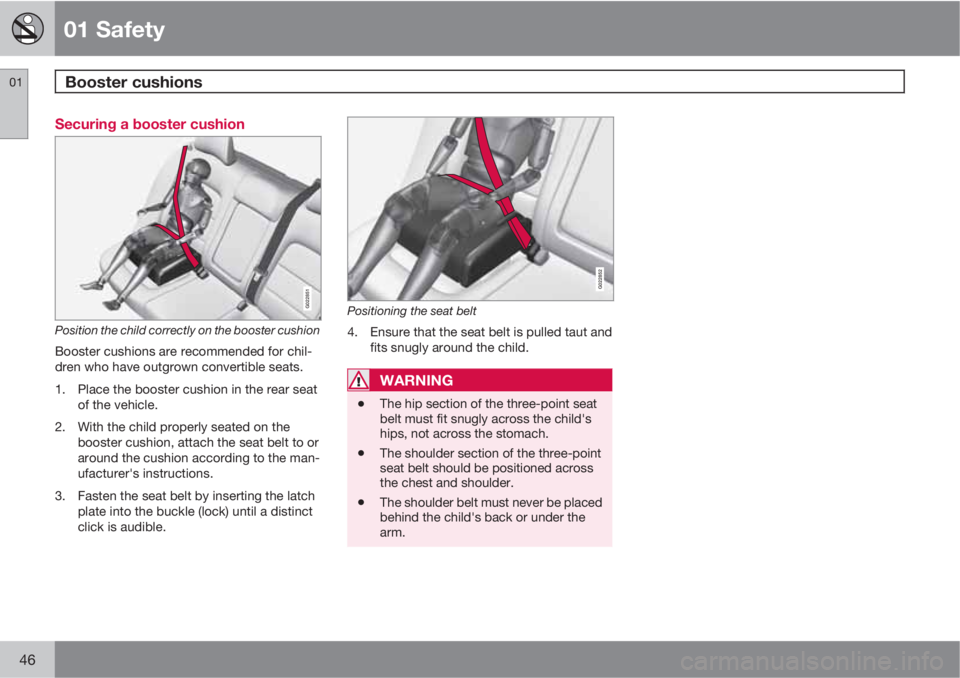
Position the child correctly on the booster cushion
Booster cushions are recommended for chil-
dren who have outgrown convertible seats.
1. Place the booster cushion in the rear seat
of the vehicle.
2. With the child properly seated on the
booster cushion, attach the seat belt to or
around the cushion according to the man-
ufacturer's instructions.
3. Fasten the seat belt by inserting the latch
plate into the buckle (lock) until a distinct
click is audible.
G022852
Positioning the seat belt
4. Ensure that the seat belt is pulled taut and
fits snugly around the child.
WARNING
•The hip section of the three-point seat
belt must fit snugly across the child's
hips, not across the stomach.
•The shoulder section of the three-point
seat belt should be positioned across
the chest and shoulder.
•The shoulder belt must never be placed
behind the child's back or under the
arm.
Page 50 of 366

01 Safety
Top tether anchors 01
48
Child restraint anchorages
Your Volvo is equipped with child restraint top
tether anchorages in the rear seat. They are
located on the rear parcel shelf.
Securing a child seat
1. Place the child restraint on the rear seat.
2. Fold up the plastic cover over the anchor-
age to be used.
3. Route the top tether strap under the head
restraint and attach it to the anchor.
4. Fold down the outboard head restraints or
lower the center head restraint for easier
access to the ISOFIX/LATCH anchor.
5. Attach lower tether straps to the lower ISO-
FIX/LATCH anchors. If the child restraint isnot equipped with lower tether straps, or
the restraint is used in the center seating
position, follow instructions for securing a
child restraint using the Automatic Locking
Retractor seat belt (see page 38).
6. Firmly tension all straps.
Refer also to the child seat manufacturer's
instructions for information on securing the
child seat.
WARNING
•Never route a top tether strap over the
top of the head restraint. The strap
should be routed beneath the head
restraint.
•Child restraint anchorages are designed
to withstand only those loads imposed
by correctly fitted child restraints. Under
no circumstances are they to be used
for adult seat belts or harnesses. The
anchorages are not able to withstand
excessive forces on them in the event of
collision if full harness seat belts or adult
seat belts are installed to them. An adult
who uses a belt anchored in a child
restraint anchorage runs a great risk of
suffering severe injuries should a colli-
sion occur.
•Do not install rear speakers that require
the removal of the top tether anchors or
interfere with the proper use of the top
tether strap.
Page 51 of 366

01 Safety
Child safety locks01
49 Child safety locks
Child safety locks – rear doorsThe controls are located on the rear door
jambs. Use the remote control's key blade or a
screwdriver to adjust these controls.
The rear doors can only be opened from
the outside when the slot is in the horizon-
tal position.
The rear doors can be opened from the
inside when the slot is in the vertical posi-
tion.
Page 54 of 366

02 Locks and alarm
Remote key and key blade
02
52
Introduction
Two remote keys or optional Personal Car
Communicators (PCC) are provided with your
vehicle. They enable you to unlock the doors
and trunk, and also function as ignition keys to
start the vehicle or operate electrical compo-
nents. The remote keys contain detachable
metal key blades for manually locking or
unlocking the driver's door and the glove com-
partment. The visible ends of these key blades
are unique to make it easier to identify "your"
remote key. Up to six remotes can be pro-
grammed for use on the same vehicle.
The PCCs have enhanced functionality com-
pared with the standard remote key.
NOTE
In the remainder of this chapter, all referen-
ces to the remote key also pertain to the
PCC unless otherwise stated.
WARNING
Never leave the remote key in the ignition
slot if children are to remain in the vehicle.
See page 84 for more information on the var-
ious ignition modes.
Detachable key bladeEach remote key or PCC contains a detachable
metal key blade for mechanically locking or
unlocking the driver's door and the glove com-
partment, and to enable the valet locking func-
tion. See page 57 for more information on the
key blade and see page 60 for information on
the valet locking function. The key blades have
a unique code, which is used if new ones need
to be produced. This code is available at an
authorized Volvo retailer.
The visible ends of these key blades are unique
to make it easier to identify "your" remote key.
Loss of a remote keyIf either of the remote keys is lost, the other
should be taken with the car to a Volvo retailer.
As an anti-theft measure, the code of the lost
remote key must be erased from the system.
NOTE
Additional or duplicate remote control keys
can be obtained from any Authorized Volvo
Retailer.
You can also obtain additional or duplicate
remote control keys from certain independ-
ent repair facilities and locksmiths that are
qualified to make remote control keys. Each
key must be programmed to work with your
vehicle.
California Only:
A list of independent repair facilities and/or
locksmiths known to Volvo that can cut and
code replacement keys can be found:
•on the Volvo website at
http://www.volvocars.com/us/keys
•by calling Volvo Customer Care at
1-800-458-1552
The number of registered keys for the vehicle
can be found by pressing MY CAR and going
into Information
Number of keys. See
page 189 for a description of the menu sys-
tem.
USA-5WK49264
FCC ID:KR55WK49264 + Siemens VDO
5WK49236
FCC ID:KR55WK49236, 5WK49266
Page 67 of 366

02 Locks and alarm
Locks
02
65 Locking and unlocking the vehicle
From outside the vehicleThe remote key locks and unlocks all of the
doors and the trunk.
Before the vehicle can be locked from the out-
side with the remote key, the driver's door must
be closed. Any other door/trunk that is open
will be locked and the alarm will be armed.
NOTE
Be sure the remote key is outside of the
vehicle before the other doors/trunk are
closed to help avoid locking the remote
inside the vehicle.
If the vehicle is equipped with the optional key-
less drive system, all doors/trunk must be
closed before the vehicle can be locked.
The first press on the unlock button unlocks the
driver's door and a second press unlocks the
other doors and the trunk (see also page 55).
This setting can be changed in the menu sys-
tem. See page 189 for a description.
If the locks repeatedly do not react when the
unlock button is pressed, it may be necessary
to replace the batteries in the remote, see
page 54. In this case the vehicle can be
unlocked with the detachable key blade. See
page 58.
Manual lockingIn certain situations (e.g., if there is no electrical
current in the vehicle), the doors can be locked
manually.
The detachable key blade (see page 58) can be
used in the lock cylinder in the driver's door to
lock that door.
The other doors do not have lock cylinders and
the slot on the rear edge of each door has to
be used to lock it. This will lock the door from
the outside but it can still be opened from
inside the vehicle. To do so:
Manually locking a door
–Insert the key blade into the slot and turn it
90 degrees to lock that door (the slot in a
particular door locks that door only).
In the horizontal position, the door cannot
be opened from the outside.
In the vertical position, the door can be
opened from the inside and the outside.
NOTE
If the manual child safety lock (see
page 49) is activated for a rear side door and
that door is also locked manually, the door
cannot be opened from the outside or
inside. The door can only be unlocked with
the remote key or the central locking button.
From inside the vehicle (central locking
button)
Central locking button
The lock buttons on the door panel can be used
to lock or unlock all doors and the trunk at the
Page 71 of 366

02 Locks and alarm
Locks
02
69
Opening the trunk from the inside (U.S.
models only)
The vehicle is equipped with a florescent han-
dle on the inside of the trunk lid, which can be
used in an emergency situation to open the
trunk from the inside. Pull the handle down to
release the trunk lid. After use, the handle must
be pushed back into its original position before
the trunk can be closed.
This handle is not intended to be used to
anchor the trunk lid when long loads are being
transported.
WARNING
•Keep vehicle doors and trunk locked
and keep keys out of a child’s reach.
Unsupervised children could lock them-
selves in an open trunk and risk injury.
Children should be taught not to play in
vehicles.
•On hot days, the temperature in the
trunk or vehicle interior can rise very
quickly. Exposure of people to these
high temperatures for even a short
period of time can cause heat-related
injury or death. Small children are par-
ticularly at risk.
Page 91 of 366

03 Your driving environment
Seats
03
* Option/accessory, for more information, see Introduction.89
NOTE
•The seat will move to this position even
if someone else has moved it to a dif-
ferent position and locked the vehicle
with a different remote key.
•This feature will work in the same way
with all of the remote keys that you use
with your vehicle.
Emergency stop
WARNING
•Because the driver's seat can be
adjusted with the ignition off, children
should never be left unattended in the
vehicle.
•Movement of the seat can be STOPPED
at any time by pressing any button on
the power seat control panel.
•Do not adjust the seat while driving. The
seat should be adjusted so that the
brake pedal can be depressed fully. In
addition, position the seat as far rear-
ward as comfort and control allow.
•The seat rails on the floor must not be
obstructed in any way when the seat is
in motion.
Heated seats*See page 199.
Rear seats
Rear center head restraint
The center head restraint should be adjusted
according to the passenger's height. The
restraint should be carefully adjusted to sup-
port the occupant's head.
•Pull the head restraint up as required.
•To lower, press the button at the base of
the head restraint’s left support while
pressing the head restrain down carefully.
Page 93 of 366

03 Your driving environment
Seats
03
91
CAUTION
To help avoid damage to the upholstery,
there should be no objects on the rear seat
and the seat belt should not be buckled
when the backrest is folded down.
WARNING
•Keep vehicle doors and trunk locked
and keep keys out of a child’s reach.
Unsupervised children could lock them-
selves in an open trunk and risk injury.
Children should be taught not to play in
vehicles.
•On hot days, the temperature in the
trunk or vehicle interior can rise very
quickly. Exposure of people to these
high temperatures for even a short
period of time can cause heat-related
injury or death. Small children are par-
ticularly at risk.
WARNING
•When one or more sections of the back-
rest is returned to the upright position,
check that it is properly locked in place
by pushing and pulling it. The red indi-
cators should also not be visible.
•Return the outboard head restraints to
the upright position.
•Long loads should always be securely
anchored to help avoid injury in the
event of a sudden stop.
•Always turn the engine off and apply the
parking brake when loading/unloading
the vehicle.
•Place the transmission in the Park (P)
position to help prevent inadvertent
movement of the gear selector.
•On hot days, the temperature in the
vehicle interior can rise very quickly.
Exposure of people to these high tem-
peratures for even a short period of time
can cause heat-related injury or death.
Small children are particularly at risk.