2013 VOLVO C30 battery
[x] Cancel search: batteryPage 147 of 300

06 Starting and driving
General information
06
145
•Check state of the battery's charge.
•Examine tires carefully (the spare tire as
well), and replace those that are worn.
Check tire pressures.
•The brakes, front wheel alignment, and
steering gear should be checked by your
Volvo retailer only.
•Check all lights, including high beams.
•Reflective warning triangles are legally
required in some states/provinces.
•Have a word with your Volvo retailer if you
intend to drive in countries where it may be
difficult to obtain the correct fuel.
•Consider your destination. If you will be
driving through an area where snow or ice
are likely to occur, consider snow tires.
Page 151 of 300
06 Starting and driving
Ignition switch
06
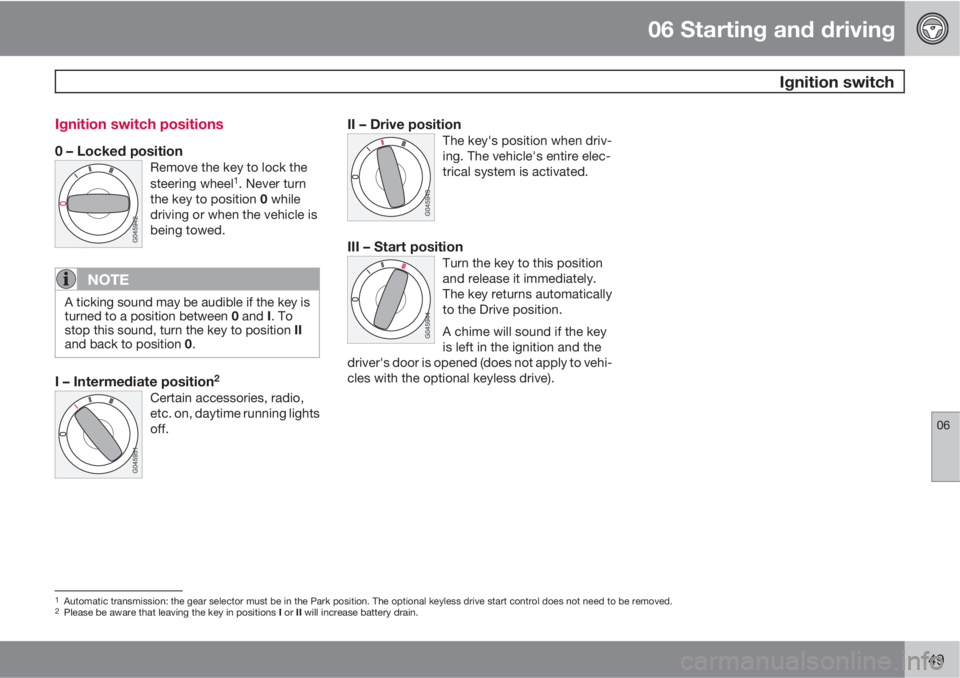
149 Ignition switch positions
0 – Locked positionRemove the key to lock the
steering wheel1. Never turn
the key to position 0 while
driving or when the vehicle is
being towed.
NOTE
A ticking sound may be audible if the key is
turned to a position between 0 and I. To
stop this sound, turn the key to position II
and back to position 0.
I – Intermediate position2
Certain accessories, radio,
etc. on, daytime running lights
off.
II – Drive positionThe key's position when driv-
ing. The vehicle's entire elec-
trical system is activated.
III – Start positionTurn the key to this position
and release it immediately.
The key returns automatically
to the Drive position.
A chime will sound if the key
is left in the ignition and the
driver's door is opened (does not apply to vehi-
cles with the optional keyless drive).
1Automatic transmission: the gear selector must be in the Park position. The optional keyless drive start control does not need to be removed.2Please be aware that leaving the key in positions I or II will increase battery drain.
Page 152 of 300

06 Starting and driving
Starting the vehicle
06
150
To start the engine
WARNING
Before starting, check that the seat, steering
wheel and mirrors are adjusted properly.
Make sure the brake pedal can be
depressed completely. Adjust the seat if
necessary.
1. Fasten the seat belt.
2. Apply the parking brake if not already set.
The gear selector should be locked in the
Park (P) position (Shiftlock). See also page
158.
Manual transmission: The clutch must be
fully depressed.
NOTE
After a cold start, idle speed may be notice-
ably higher than normal for a short period.
This is done to help bring components in the
emission control system to their normal
operating temperature as quickly as possi-
ble, which enables them to control emis-
sions and help reduce the vehicle's impact
on the environment.
3. The vehicle is equipped with an autostart
feature. Without touching the throttle
pedal, turn the key to position III and
release it. The starter motor will then oper-
ate automatically (for up to ten seconds)
until the engine starts. If the engine fails to
start, repeat this step.
CAUTION
If the engine does not start after the third try,
wait for approximately 3 minutes before try-
ing to start it again to give the battery time
to recover its starting capacity.
4. To release the gear selector from the Park
(P) position, the engine must be running (or
the ignition key must be in position II) and
the brake pedal must be depressed.
5. Select the desired gear. On models with an
automatic transmission, the gear engages
after a very slight delay, which is especially
noticeable when selecting R.
WARNING
•Never use more than one floor mat at a
time on the driver's floor. An extra mat
on the driver's floor can cause the
accelerator and/or brake pedal to
catch. Check that the movement of
these pedals is not impeded.
•Volvo's floor mats are specially manu-
factured for your car. They must be
firmly secured in the clips on the floor so
that they cannot slide and become trap-
ped under the pedals on the driver's
side.
Page 154 of 300

06 Starting and driving
Starting the vehicle with keyless drive*
06
152* Option/accessory, for more information, see Introduction.
Starting a vehicle with keyless drive
G019410
Keyless drive makes it possible to unlock, start
and lock the vehicle without using a remote
key.
A start control is fitted in the ignition switch on
vehicles equipped with the optional keyless
drive. This control is used in the same way as
the ignition key to start the engine. See also
page 150 for general information on starting
the engine.
WARNING
•Never use more than one floor mat at a
time on the driver's floor. An extra mat
on the driver's floor can cause the
accelerator and/or brake pedal to
catch. Check that the movement of
these pedals is not impeded.
•Volvo's floor mats are specially manu-
factured for your car. They must be
firmly secured in the clips on the floor so
that they cannot slide and become trap-
ped under the pedals on the driver's
side.
NOTE
A keyless drive remote key must be inside
the vehicle in order to start the engine.
1. Press the brake pedal (the clutch pedal
must also be fully depressed on models
with a manual transmission).
2. Press in the keyless drive start control and
turn it to position III.
NOTE
The vehicle is equipped with an autostart
function that makes it possible to start the
engine without holding the start control in
position III. Turn the start control to posi-
tion III and release it. The starter motor will
then operate automatically (for up to ten
seconds) until the engine starts.
CAUTION
If the engine does not start after the third try,
wait for approximately 3 minutes before try-
ing to start it again to give the battery time
to recover its starting capacity.
Starting the vehicle with the ignition key
(remote key)
A vehicle with keyless drive can also be started
with the ignition key (if, for example, the battery
in the keyless drive remote key is weak). To do
so:
Page 168 of 300

06 Starting and driving
Towing
06
166
2. Insert the key into the ignition to unlock the
steering wheel. With the engine off and the
vehicle at a standstill, great effort will be
required to turn the steering wheel.
3.
Turn the ignition key to position II.
4. Place the gear selector in neutral. For vehi-
cles with automatic transmissions, follow
instruction on page 158, "Shiftlock over-
ride" to allow the gear selector to be moved
from the Park position.
5. Keep firm pressure on the brake pedal
while releasing the parking brake.
6. When towing has been completed, return
the gear selector to Park (automatic) or
Reverse (manual) and apply the parking
brake.
The following points should also be
observed:
•Never exceed 50 mph (80 km/h). Never
exceed local towing speed limits and heed
all local towing restrictions.
•Never tow farther than 50 miles (80 km).
•Keep the tow rope taut at all times while the
vehicle is in motion.
•The disabled vehicle should be towed in
the forward direction only.
WARNING
•Never allow a vehicle to be towed with-
out a driver behind the wheel of the dis-
abled vehicle.
•When the engine is not running, steering
resistance and the effort needed to
apply the brakes will be great.
•Never attempt to tow a vehicle with a
dead battery at night.
CAUTION
•Check with state and local authorities
before attempting this type of towing,
as vehicles being towed are subject to
regulations regarding maximum towing
speed, length and type of towing
device, lighting, marker flags, etc.
•Never attempt to push- or tow-start a
vehicle with a dead battery. This would
inject unburned fuel into the three-way
catalytic converter(s), causing over-
heating, backfiring, and damage, see
page 168 for instructions on jump star-
ting the vehicle.
Towing vehicles with front wheel drive
Volvo recommends the use of flat bed equip-
ment for towing vehicles with front wheel drive.
If wheel lift equipment must be used, please
use extreme caution to help avoid damage to
the vehicle.
In this case, the vehicle should be towed with
the rear wheels on the ground if at all possible.
If it is absolutely necessary to tow the vehicle
with the front wheels on the ground, please
refer to the towing information on the previous
page.
•Sling-type equipment applied at the front
will damage radiator and air conditioning
lines.
•It is equally important not to use sling-type
equipment at the rear or apply lifting equip-
ment inside the rear wheels; serious dam-
age to the rear axle may result.
•If the vehicle is being towed on a flat bed
truck, the towing eyelets must not be used
to secure the vehicle on the flat bed. Con-
sult the tow truck operator.
Page 170 of 300

06 Starting and driving
Jump starting
06
168
Jump starting the vehicle
Follow these instructions to jump start your
vehicle's dead battery or to jump start another
vehicle's dead battery using your vehicle. If the
12-volt auxiliary battery to be used is in another
vehicle, check that the vehicles are not touch-
ing to prevent premature completion of a cir-
cuit. Be sure to follow jump starting instruc-
tions provided for the other vehicle.
To jump start your vehicle:
1. Switch off the ignition.
2. First connect the auxiliary battery positive
(+) terminal (1) to the positive (+) terminal inyour vehicle's battery (2), marked with a
"+" sign.
3. Connect the auxiliary battery's negative (–)
terminal (3) to the ground point in your
vehicle's engine compartment near the
driver's side spring strut (4).
4. Start the engine in the assisting vehicle,
then start the engine in the vehicle with
dead battery.
5. After the engine has started, first remove
the negative (–) terminal jumper cable.
Then remove the positive (+) terminal
jumper cable.WARNING
PROPOSITION 65 WARNING!
Battery posts, terminals, and related acces-
sories contain lead and lead compounds,
chemicals known to the state of California
to cause cancer and reproductive harm.
Wash hands after handling.
WARNING
•Do not connect the jumper cable to any
part of the fuel system or to any moving
parts. Avoid touching hot manifolds.
•Batteries generate hydrogen gas, which
is flammable and explosive.
•Battery fluid contains sulfuric acid. Do
not allow battery fluid to contact eyes,
skin, fabrics or painted surfaces. If con-
tact occurs, flush the affected area
immediately with water. Obtain medical
help immediately if eyes are affected.
•Never expose the battery to open flame
or electric spark.
•Do not smoke near the battery.
•Failure to follow the instructions for
jump starting can lead to personal
injury.
•Do not touch the jumper cables during
the attempt to start the vehicle. This
could cause sparks.
Page 197 of 300

07 Wheels and tires
Tire Sealing System*
07
* Option/accessory, for more information, see Introduction.195 Inflating tires
The tire sealing system can be used to inflate
the tires. To do so:
1. Park the car in a safe place.
2. The compressor should be switched off.
Ensure that the on/off switch is in posi-
tion 0 (the 0 side of the switch should be
pressed down).
3. Take out the electrical wire and hose.
4. Remove the valve cap from the tire’s infla-
tion valve and screw the hose connector
onto the valve as tightly as possible by
hand.
5. Connect the electrical wire to the nearest
12-volt socket in the vehicle.
6. Start the vehicle’s engine.WARNING
•The vehicle’s engine should be running
when the tire sealing system is used to
avoid battery drain. Therefore, be sure
the vehicle is parked in a well ventilated
place, or outdoors, before using the sys-
tem. The parking brake should be
securely applied and on models with an
automatic transmission, the gear selec-
tor should be in the P (park) position.
•Children should never be left unattended
in the vehicle when the engine is running.
7. Check the tire’s inflation pressure on the
gauge. Switch off the compressor briefly to
get a clear reading from the pressure
gauge.
8. Refer to the tire inflation table for the cor-
rect inflation pressure. If the tire needs to
be inflated, start the tire sealing system’s
compressor (press the on/off switch to
position I). If necessary, release air from the
tire by turning the air release knob coun-
terclockwise.
CAUTION
The compressor should not be used for
more than 10 minutes at a time to avoid
overheating.
9. Turn off the compressor (press the on/off
switch to position 0) when the correct infla-
tion pressure has been reached.
10. Unscrew the hose from the tire’s inflation
valve and reinstall the valve cap.
11. Disconnect the electrical wire from the
12-volt socket.
Page 216 of 300

214
Volvo maintenance................................................................................ 216
Maintaining your car............................................................................. 217
Hood..................................................................................................... 219
Engine compartment............................................................................. 220
Engine oil............................................................................................... 221
Fluids..................................................................................................... 223
Wiper blades......................................................................................... 225
Battery................................................................................................... 226
Replacing bulbs.................................................................................... 228
Fuses..................................................................................................... 236