2013 VOLKSWAGEN PASSAT brakes
[x] Cancel search: brakesPage 225 of 379

Reverse (manual transmission) or in Drive (D), Sport Drive (S), or Reverse (R) (automatic
transmission) and you must use the foot brake to hold the vehicle before starting to move.
Hill Hold keeps the brake applied for not quite 2 seconds with the same force you used to prevent the
vehicle from moving. This gives you time to take your foot off the brake, let the clutch out on a manual
transmission vehicle, and gently depress the accelerator to get the vehicle moving again. If you do not
depress the accelerator pedal and get the vehicle moving again within this time, the brakes will release
and the vehicle will roll downhill. Furthermore, if any requirement for engaging Hill Hold is no longer
met while the vehicle is stopped, Hill Hold disengages and the brakes are automatically released and
will no longer hold the vehicle.
Hill Hold is activated automatically when the following conditions are all met at the same
time.
Points 1 to 3 must all be met at the same time:
Manual transmission Automatic transmission
1. Hold the stopped vehicle on an incline with the foot or parking brake.
2. The engine must be running “smoothly.”
3. A manual transmission vehicle must be in 1st
gear (1) if headed up a hill or in Reverse (R) if
backing up a hill; you must hold the clutch
down and the foot brake must be depressed to
keep the vehicle from moving.
An automatic transmission vehicle must be in
Reverse (R), Drive (D), or Sport Drive (S) and
the foot brake must be depressed to keep the
vehicle from moving.
4. To drive off take your foot off the brake pedal
as you let the clutch out and gently depress
the accelerator within 2 seconds.
To drive off take your foot off the brake pedal
and gently depress the accelerator within 2
seconds.
Hill Hold is immediately deactivated:
x If any requirement listed in the table above is no longer met.
x If the engine is not running smoothly or the engine malfunctions.
x If the engine stalls or is switched off.
x Automatic transmission vehicles: If the transmission is in Neutral (N).
x Automatic transmission vehicles: If a tire does not have enough road contact (such as when the
vehicle is tipped or at an angle).
WARNING
The intelligent technology of Hill Hold cannot overcome the laws of physics. Never let the
increased convenience provided by Hill Hold tempt you into taking risks.
x The Hill Hold feature cannot hold the vehicle in all hill start situations (for example, if the
surface is icy or slippery).
x Hill Hold can only help keep the vehicle from moving for less than 2 seconds. After that,
the brakes will be released and the vehicle can roll down the hill.
Page 320 of 379

Overall width
Total width measured at the exterior sidewalls of an inflated tire, including the additional width of
labeling, decorations, or protective bands or ribs.
Passenger car tire
A tire intended for use on passenger cars, multipurpose passenger vehicles, and trucks, that have a
gross vehicle weight rating (GVWR) of 10,000 pounds or less.
Ply
A layer of rubber-coated parallel cords.
Ply separation
A parting of rubber compound between adjacent plies.
Pneumatic tire
A mechanical device made of rubber, chemicals, fabric, and steel or other materials, that, when
mounted on an automotive wheel, provides the traction and contains the gas or fluid that sustains the
load.
Production options weight
The combined weight of installed regular production options weighing over 5 lbs (2.3 kg) more then the
standard items they replace, and not previously considered as curb weight or accessory weight. These
include, for example, heavy-duty brakes, ride levelers, heavy-duty battery, and special trim.
Radial ply tires
A pneumatic tire in which the ply cords that extend to the beads are laid at substantially 90 degrees to
the centerline of the tread.
Recommended inflation pressure
The tire pressure recommended by the vehicle manufacturer for a tire of a specified size that has not
been driven for more than a couple of miles (kilometers) at low speeds in the 3 hour period before the
tire pressure is measured or adjusted.
Reinforced tire
A tire designed to operate at higher loads and at higher inflation pressures than the corresponding
standard tire.
Rim
The outer edge of a wheel upon which the tire beads are seated.
Rim diameter
The nominal diameter of the wheel's tire bead seating surface. If you change your wheel size, to
wheels of a different diameter, you will have to purchase new tires to match the new wheels.
Rim size
Designation means rim diameter and width.
Rim type designation
The industry or manufacturer's designation for a rim by style or code.
Rim width
The nominal distance between wheel rim flanges.
Page 324 of 379

Outer diameter
The diameter of a new, properly inflated tire.
Overall width
Total width measured at the exterior sidewalls of an inflated tire, including the additional width of
labeling, decorations, or protective bands or ribs.
Passenger car tire
A tire intended for use on passenger cars, multipurpose passenger vehicles, and trucks, that have a
gross vehicle weight rating (GVWR) of 10,000 pounds or less.
Ply
A layer of rubber-coated parallel cords.
Ply separation
A parting of rubber compound between adjacent plies.
Pneumatic tire
A mechanical device made of rubber, chemicals, fabric, and steel or other materials, that, when
mounted on an automotive wheel, provides the traction and contains the gas or fluid that sustains the
load.
Production options weight
The combined weight of installed regular production options weighing over 5 lbs (2.3 kg) more then the
standard items they replace, and not previously considered as curb weight or accessory weight. These
include, for example, heavy-duty brakes, ride levelers, heavy-duty battery, and special trim.
Radial ply tires
A pneumatic tire in which the ply cords that extend to the beads are laid at substantially 90 degrees to
the centerline of the tread.
Recommended inflation pressure
The tire pressure recommended by the vehicle manufacturer for a tire of a specified size that has not
been driven for more than a couple of miles (kilometers) at low speeds in the 3 hour period before the
tire pressure is measured or adjusted.
Reinforced tire
A tire designed to operate at higher loads and at higher inflation pressures than the corresponding
standard tire.
Rim
The outer edge of a wheel upon which the tire beads are seated.
Rim diameter
The nominal diameter of the wheel's tire bead seating surface. If you change your wheel size, to
wheels of a different diameter, you will have to purchase new tires to match the new wheels.
Rim size
Designation means rim diameter and width.
Rim type designation
The industry or manufacturer's designation for a rim by style or code.
Rim width
The nominal distance between wheel rim flanges.
Page 327 of 379
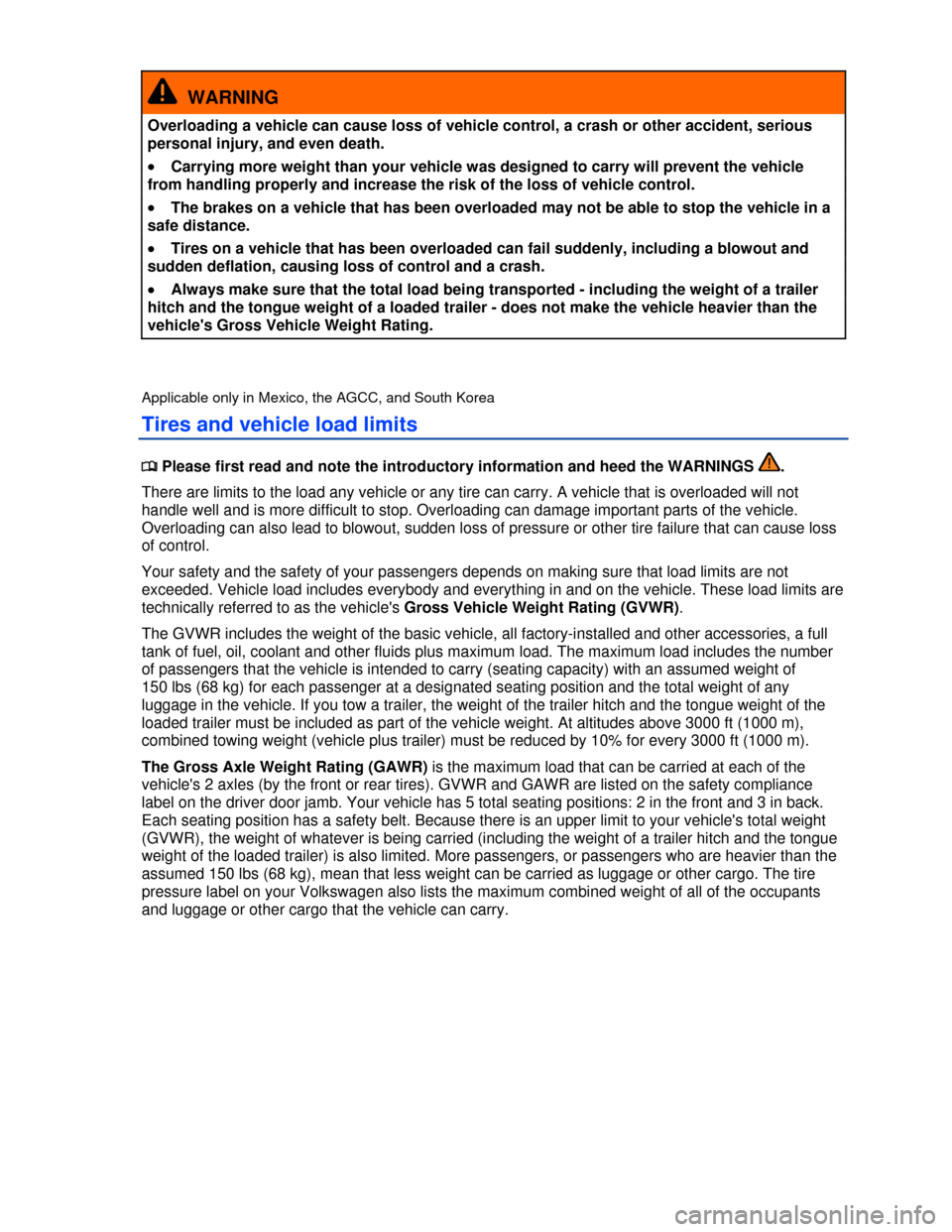
WARNING
Overloading a vehicle can cause loss of vehicle control, a crash or other accident, serious
personal injury, and even death.
x Carrying more weight than your vehicle was designed to carry will prevent the vehicle
from handling properly and increase the risk of the loss of vehicle control.
x The brakes on a vehicle that has been overloaded may not be able to stop the vehicle in a
safe distance.
x Tires on a vehicle that has been overloaded can fail suddenly, including a blowout and
sudden deflation, causing loss of control and a crash.
x Always make sure that the total load being transported - including the weight of a trailer
hitch and the tongue weight of a loaded trailer - does not make the vehicle heavier than the
vehicle's Gross Vehicle Weight Rating.
Applicable only in Mexico, the AGCC, and South Korea
Tires and vehicle load limits
Page 328 of 379
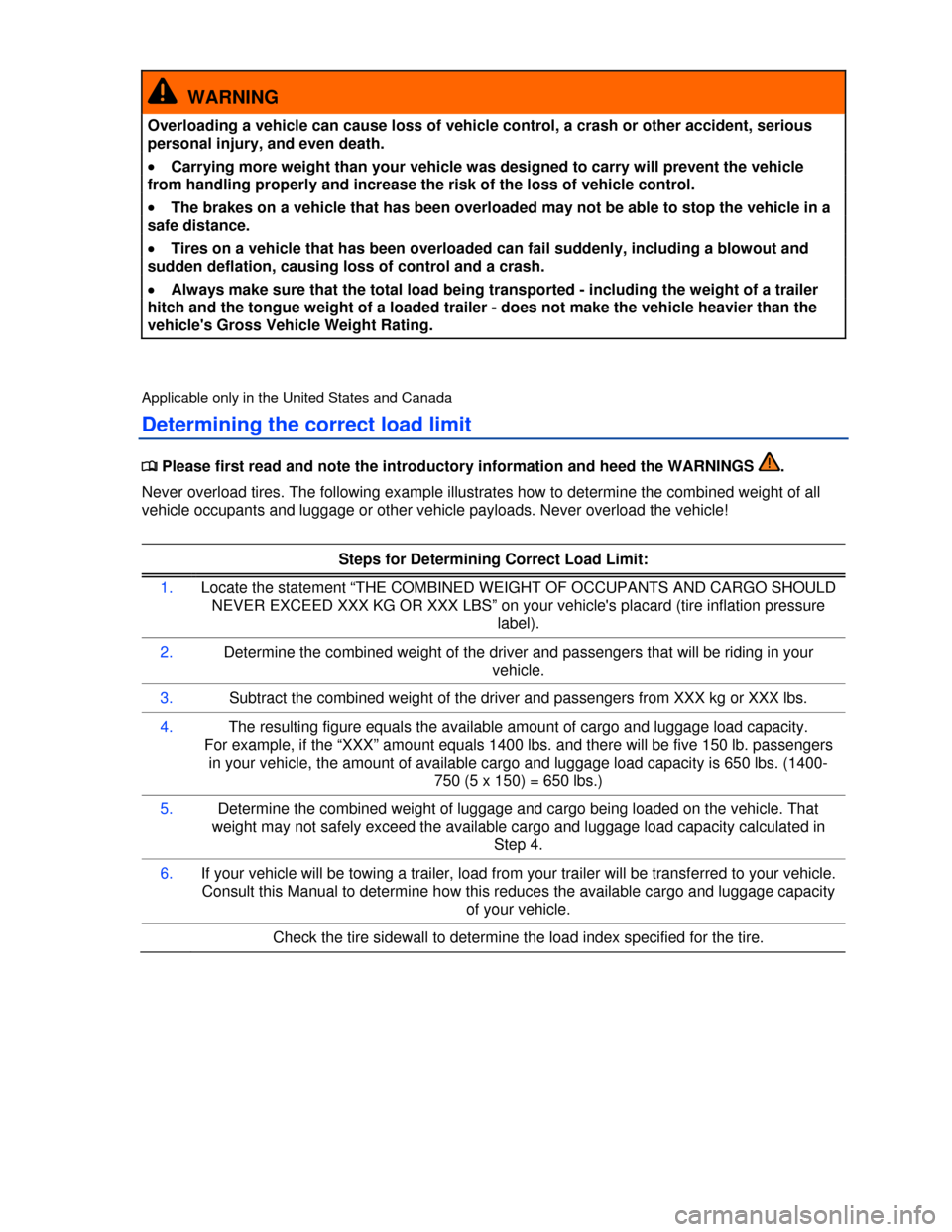
WARNING
Overloading a vehicle can cause loss of vehicle control, a crash or other accident, serious
personal injury, and even death.
x Carrying more weight than your vehicle was designed to carry will prevent the vehicle
from handling properly and increase the risk of the loss of vehicle control.
x The brakes on a vehicle that has been overloaded may not be able to stop the vehicle in a
safe distance.
x Tires on a vehicle that has been overloaded can fail suddenly, including a blowout and
sudden deflation, causing loss of control and a crash.
x Always make sure that the total load being transported - including the weight of a trailer
hitch and the tongue weight of a loaded trailer - does not make the vehicle heavier than the
vehicle's Gross Vehicle Weight Rating.
Applicable only in the United States and Canada
Determining the correct load limit
Page 364 of 379

WARNING
Changing a wheel, especially on the side of the road, can be dangerous. To help reduce the
risk of serious personal injury:
x Always stop the vehicle as soon as it is safe to do so. Move the vehicle a safe distance off
the road where it is safe to change the wheel.
x Always make sure that all passengers, especially children, are in a safe place outside the
vehicle and away from the vehicle and traffic (such as behind a guard rail).
x Turn on the emergency flashers and set up another warning device about 25 yards (25
meters) behind the vehicle to warn approaching traffic.
x Change a wheel by yourself only if you are familiar with the necessary steps. Otherwise,
get expert assistance.
x Always switch the engine off, firmly apply the parking brake, and shift the transmission
into Park (P) (automatic transmission) or any gear (manual only) to help prevent the vehicle
from moving suddenly and slipping off the jack.
x Always make sure that the ground is level and firm. If necessary, place the jack on a large
and sturdy board or on a similar ground support.
x Always block the wheel diagonally opposite the wheel being changed with chocks or other
similar things.
x If you are towing a trailer, always unhitch it from your vehicle before starting to change
the wheel. Always apply the trailer brakes firmly and make sure the trailer cannot move
unintentionally.
x Always use proper and undamaged tools when changing a wheel.
x Once a wheel is lifted off the ground, having the transmission in Park (P) or in gear will not
prevent sudden vehicle movement.
x Always use a jack that has been approved by the manufacturer for your vehicle. Never use
other jacks, even if they have been approved for use on other Volkswagen models.
x To reduce the risk of losing control, crashes, and serious personal injuries, never loosen
the screws on rims with threaded rim rings.
x After changing a wheel, have the wheel bolt tightening torque checked with an accurate
torque wrench.
x After changing a wheel or tire, reset the Tire Pressure Monitoring System.
WARNING
Disregarding the safety-related checklist may lead to accidents and serious personal injuries.
x Always review and follow the checklist. Follow accepted safety practices and use common
sense.
Removing the wheel
x Review the checklist.
x Loosen the wheel bolts.
x Lift the vehicle.
x Completely unscrew and remove the previously loosened wheel bolts using the hexagonal socket
in the screwdriver handle ⇒ fig. 211. Place the wheel bolts on a clean surface.
x Remove the wheel.