2013 VOLKSWAGEN GOLF GTI towing
[x] Cancel search: towingPage 183 of 319

WARNING
Never leave the vehicle unattended while the engine is running. The vehicle could move
suddenly, especially when the vehicle is in gear, resulting in accidents and personal injury.
WARNING
“Starting fluids” can explode and can cause a “run-away” vehicle condition.
x Never use starting assist fluids.
NOTICE
x You can damage the starter or the engine if you try to start the engine when the vehicle is
still moving, or if you try to restart the engine right after switching it off.
x Avoid high engine speeds, full throttle acceleration, and heavy engine loads when the
engine is cold.
x Do not try to start the engine by pushing or towing the vehicle. Unburned fuel can get into
the catalytic converter and damage it. The steering column may also be locked.
Do not let your vehicle warm up while standing; instead, start driving right away after making sure
that you have good visibility through all windows. This will help the engine reach operating
temperature faster and keep down emissions.
Major consumers of electricity are temporarily switched off when the engine is being started.
After starting a cold engine, there may be increased operating noises for a few seconds. This is
normal and harmless.
Stopping the engine
Page 188 of 319

Calm and smooth driving
Consistency is more important than speed. The more smoothly you drive, the less fuel the vehicle
consumes.
When driving on the highway or freeway, a constant, moderate speed is more efficient and economical
than constantly accelerating and braking. Usually you can reach your destination just as quickly by
driving at a moderate, but steady speed.
The cruise control system can assist in maintaining a uniform driving style.
Moderate use of extra electrical loads
Comfort inside the vehicle is nice and important, but it is important to use them in an environmentally
conscious manner.
Some devices can increase fuel consumption when activated (examples):
x Climate control system (air conditioner): If the air conditioner has to produce starkly contrasting
temperatures, it requires a large amount of energy, which is generated by the engine. The temperature
in the vehicle should therefore not be extremely different from that of the outside temperature. It may
be helpful to ventilate the vehicle before driving and then to drive a short distance with the windows
open. After that, switch on the air conditioner with the windows closed. Keep the windows closed when
driving at high speeds. Open windows increase fuel consumption.
x Switch off seat heating once it has served its purpose.
x Switch off the rear window defroster as soon as the windows are free of fog and ice.
Additional factors that increase fuel consumption (examples):
x Malfunctioning engine control.
x Driving in the mountains.
x Towing a trailer.
NOTICE
Never let the vehicle coast or roll down a hill in Neutral (N), especially when the engine is not
running. The transmission will not be lubricated and will be damaged.
Fuel-efficient driving
Fig. 135 Fuel consumption in mpg at 2 different outside air temperatures.
Page 191 of 319

Steering
Introduction
In this section you’ll find information about:
Warning and indicator lights
Steering system information
The power steering system is not hydraulic, it is electro-mechanical. In both cases, the power steering
works only when the engine is running.
The hydraulic power steering system uses hydraulic lines, hydraulic oil, a pump, a filter, and other
parts to maintain a constant oil pressure in the hydraulic system.
The electro-mechanical power steering system automatically adjusts to driving speed, steering torque,
and the steering angle of the wheels. It delivers extra steering force only when you are actually turning
the wheels. The electro-mechanical power steering works only when the engine is running.
More information:
x Starting and stopping the engine
x Vehicle battery
x Towing
WARNING
Turning the steering wheel is very hard when the power steering system is not working. This
makes it harder to steer and control the vehicle.
x Power steering works only when the engine is running.
x Never let the vehicle coast with the engine switched off.
x Never remove the key from the ignition switch while the vehicle is moving or rolling to a
stop. The steering wheel will lock and you will be unable to control the vehicle.
Warning and indicator lights
Page 233 of 319

Engine coolant
Introduction
In this section you’ll find information about:
Warning light and engine coolant temperature gauge
Engine coolant specifications
Checking engine coolant level and topping off
Never do any work on the coolant system unless you
x know exactly how to carry out the job,
x have the correct technical information and the proper tools, supplies, and operating fluids, and
x are familiar with the necessary safety precautions ⇒ !
If you are uncertain in any way, have the work done by an authorized Volkswagen dealer or an
authorized Volkswagen Service Facility.
Serious personal injury may result from improperly performed work.
More information:
x Trailer towing
x Preparations for working in the engine compartment
x Parts, accessories, repairs and modifications
WARNING
Engine coolant is poisonous!
x Always keep the coolant in its original container stored in a safe place.
x To reduce the risk of poisoning, never store engine coolant in empty food or beverage
containers or in any other containers that might mislead someone into drinking from them.
x Always keep engine coolant out of reach of children.
x Always make sure there is enough of the correct coolant additive to provide proper
antifreeze protection at the coldest temperatures that can be expected where the vehicle will
be used.
x At extremely cold temperatures, the coolant could freeze, causing the vehicle to break
down. The heater would also not work, and vehicle occupants could be without protection at
subfreezing temperatures.
Coolant and coolant additives can pollute the environment. Collect leaking operating fluids and
dispose of them properly in accordance with applicable environmental laws and regulations.
Page 247 of 319

Tires and wheels
Introduction
In this section you’ll find information about:
Tire and wheel handling
Wheel rims
New and replacement tires
Tire inflation pressure
Tire inflation pressure in cold tires
Tire inflation pressure in cold tires
Tread depth and tread wear indicators
Tire wear and damage
Spare wheel or compact spare wheel
Tire labeling
Winter tires
Snow chains
Glossary of tire and loading terminology
Tires and vehicle load limits
Determining the correct load limit
Volkswagen recommends that all work on tires and wheels be done by an authorized Volkswagen
dealer or authorized Volkswagen Service Facility. They are familiar with the technical requirements
and recommended procedures, have the necessary special tools and spare parts, and can properly
dispose of old tires.
More information:
x Transporting
x Trailer towing
x Braking, stopping and parking
x Tire Pressure Monitoring System
x Exterior care and cleaning
x Vehicle tool kit
x Consumer information
x Wheel covers
x Changing a wheel
Page 256 of 319

Stowing the replaced wheel
x Hook the floor covering on the upper edge of the luggage compartment.
x Put the wheel you took off the vehicle into the spare wheel well so that the center hole of the rim is
aligned with the threaded pin.
x Turn the handwheel clockwise until the wheel replaced is securely in place.
x If necessary, return the vehicle tool kit to its location in the luggage compartment.
x Unhook the floor covering and fold it back down onto the floor of the luggage compartment.
x Close the rear hatch.
If the spare wheel is different from the road wheels
If the spare is different from the road wheels, a compact spare wheel, for example, or if the road
wheels are winter tires, the spare wheel must be used only in the event of a flat tire, only for a brief
time, and only when driving with extra caution ⇒ .
Replace it with a tire matching the others on your vehicle as soon as possible.
Please heed the following:
x Do not drive faster than 50 mph (80 km/h)!
x Avoid full-throttle acceleration, hard braking and fast cornering!
x Do not use snow chains on the compact spare wheel
x After installing the spare wheel or compact spare wheel, check the tire pressure as soon as
possible
Check the tire inflation pressure of the spare or compact spare whenever you check the tire pressure
of the road wheels, at least once a month. Inflate a spare wheel to the cold tire pressure specified for
the vehicle's road wheels on the tire pressure label; inflate a compact spare wheel to the cold tire
pressure specified for the compact spare on the tire pressure label or on a separate label for the
compact spare, if there is one.
Page 269 of 319

Parts, accessories, repairs and modifications
Introduction
In this section you’ll find information about:
Break-in period
Parts and accessories
Operating fluids and equipment
Repairs and technical modifications
Repairs and other things that can affect Advanced Airbag performance
Repairs and other things that can affect Airbag performance
CB radio equipment
Notice about data recorded by vehicle control modules
Using a mobile phone in a motor vehicle when it is not connected to the vehicle telephone
antenna - some important things to know
Lift points for the vehicle
More information:
x Safety belts
x Airbag system
x Roof rack
x Trailer towing
x 12 Volt sockets
x Braking, stopping and parking
x Starting assistance systems
x Cruise control system (CCS)
x Tire Pressure Monitoring System (TPMS)
x Preparations for working in the engine compartment
x Engine oil
x Engine coolant
x Vehicle battery
x Exterior care and cleaning
x Interior care and cleaning
x Consumer information
x ⇒ Booklet Radio
x ⇒ Booklet Navigation system
x ⇒ Booklet Mobile Phone Package
Page 281 of 319
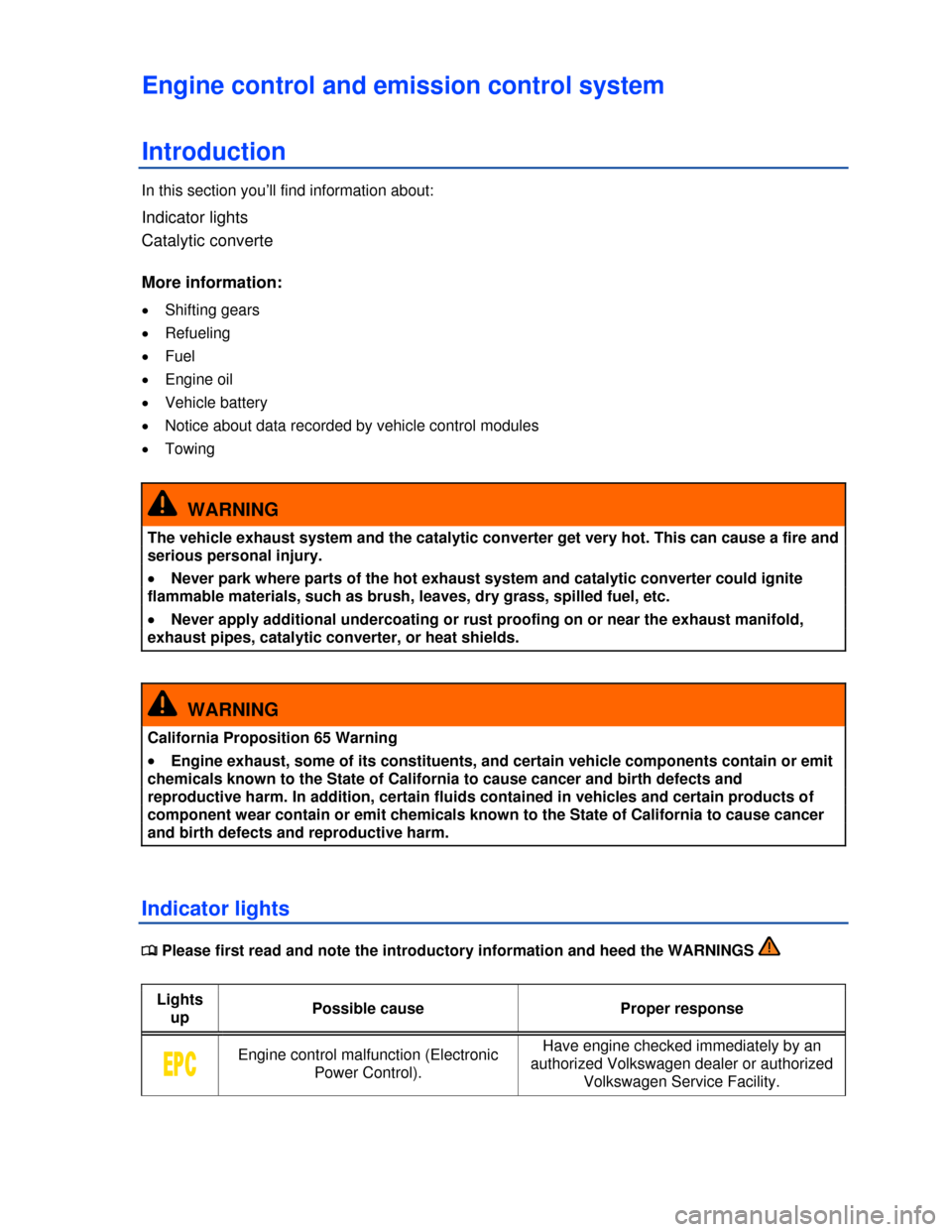
Engine control and emission control system
Introduction
In this section you’ll find information about:
Indicator lights
Catalytic converte
More information:
x Shifting gears
x Refueling
x Fuel
x Engine oil
x Vehicle battery
x Notice about data recorded by vehicle control modules
x Towing
WARNING
The vehicle exhaust system and the catalytic converter get very hot. This can cause a fire and
serious personal injury.
x Never park where parts of the hot exhaust system and catalytic converter could ignite
flammable materials, such as brush, leaves, dry grass, spilled fuel, etc.
x Never apply additional undercoating or rust proofing on or near the exhaust manifold,
exhaust pipes, catalytic converter, or heat shields.
WARNING
California Proposition 65 Warning
x Engine exhaust, some of its constituents, and certain vehicle components contain or emit
chemicals known to the State of California to cause cancer and birth defects and
reproductive harm. In addition, certain fluids contained in vehicles and certain products of
component wear contain or emit chemicals known to the State of California to cause cancer
and birth defects and reproductive harm.
Indicator lights