Page 1 of 752
TABLE OF CONTENTS
1
1Before drivingAdjusting and operating features such as door locks,
mirrors, and steering column.
2When drivingDriving, stopping, and safe-driving information.
3Interior and
exterior featuresAir conditioning and audio systems, as well as other in-
terior features for a comfortable driving experience.
4Maintenance
and careCleaning and protecting your vehicle, performing do-it-
yourself maintenance, and maintenance information.
5When trouble
arisesWhat to do if the vehicle needs to be towed, gets a flat
tire, or is involved in an accident.
6Vehicle
specificationsDetailed vehicle information.
7For owners
Reporting safety defects for U.S. owners, and seat belt
and SRS airbag instructions for Canadian owners and
camper information.
IndexAlphabetical listing of information contained in this
manual.
Page 5 of 752

1
2
3
4
5
6
7
5
4-1. Maintenance and careCleaning and protecting the vehicle exterior............ 528
Cleaning and protecting the vehicle interior............. 531
4-2. Maintenance Maintenance requirements ..................... 534
General maintenance.......... 536
Emission inspection and maintenance (I/M)
programs........................... 539
4-3. Do-it-yourself maintenance Do-it-yourself service precautions ....................... 540
Hood ................................... 544
Engine compartment ........... 545
Tires .................................... 559
Tire inflation pressure ......... 567
Wheels ................................ 571
Air conditioning filter............ 574
Wireless remote control battery ............................... 577
Checking and replacing fuses ................................. 579
Light bulbs........................... 590 5-1. Essential information
Emergency flashers............ 602
If your vehicle needs to be towed........................... 603
If you think something is wrong ............................... 609
Fuel pump shut off system .............................. 610
5-2. Steps to take in an emergency If a warning light turns on or a warning buzzer
sounds... .......................... 611
If a warning message is displayed (vehicles
with multi-information
display) ............................. 622
If you have a flat tire ........... 626
If the engine will not start .................................. 644
If the shift lever cannot be shifted from P .............. 646
If you lose your keys........... 649
If the vehicle battery is discharged........................ 650
If your vehicle overheats .... 654
If the vehicle becomes stuck ................................. 657
If your vehicle has to be stopped
in an emergency............... 658
4Maintenance and care5When trouble arises
Page 6 of 752
TABLE OF CONTENTSIndex
6
6-1. SpecificationsMaintenance data (fuel, oil level, etc.) ........... 662
Fuel information ................. 685
Tire information .................. 690
6-2. Customization Customizable features ....... 701
Items to initialize................. 704
Reporting safety defects for U.S. owners ................ 706
Seat belt instructions for Canadian owners
(in French) ........................ 707
SRS airbag instructions for Canadian owners
(in French) ........................ 709
Camper information............ 720
Abbreviation list........................ 732
Alphabetical index .................... 734
What to do if... .......................... 747
6Vehicle specifications
7For owners
Index
Page 115 of 752
115
1
Before driving
1-6. Theft deterrent system
Engine immobilizer system
: If equipped
■System maintenance
The vehicle has a maintenance-free type engine immobilizer system.
■ Conditions that may cause the system to malfunction
● If the key is in contact with a metallic object
● If the key is in close proximity to or touching a key to the security system
(key with a built-in transponder chip) of another vehicle
The vehicle’s keys have built-in tr ansponder chips that prevent the
engine from starting if the key has not been previously registered in
the vehicle’s on-board computer.
Never leave the keys inside the vehicle when you leave the vehicle.
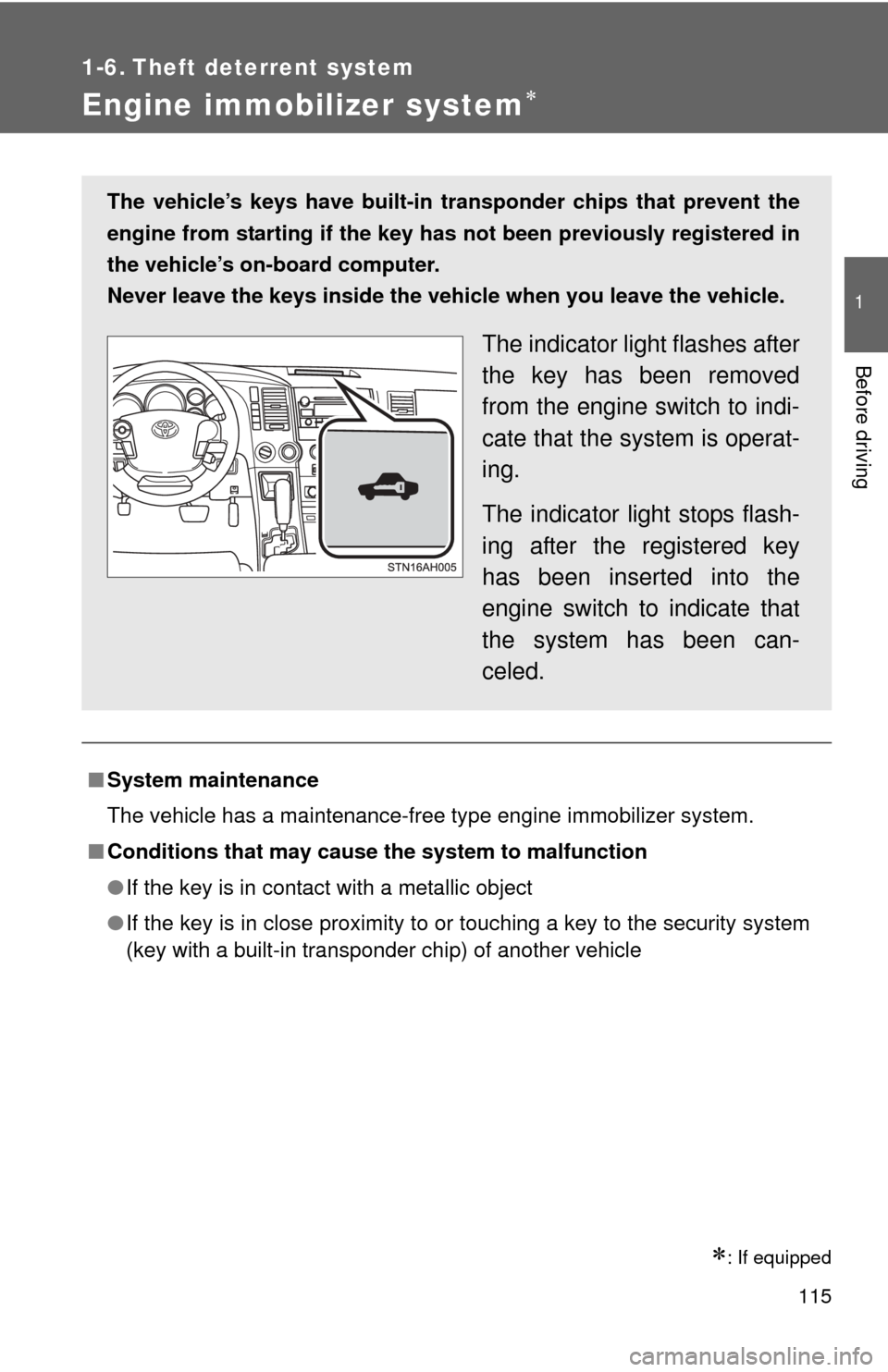
The indicator light flashes after
the key has been removed
from the engine switch to indi-
cate that the system is operat-
ing.
The indicator light stops flash-
ing after the registered key
has been inserted into the
engine switch to indicate that
the system has been can-
celed.
Page 118 of 752
118 1-6. Theft deterrent system
■System maintenance
The vehicle has a maintenance-free type alarm system.
■ Items to check before locking the vehicle
To prevent unexpected triggering of the alarm and vehicle theft, make sure
of the following.
●Nobody is in the vehicle.
● The windows and moon roof are closed before the alarm is set.
● No valuables or other personal items are left in the vehicle.
■ Triggering of the alarm
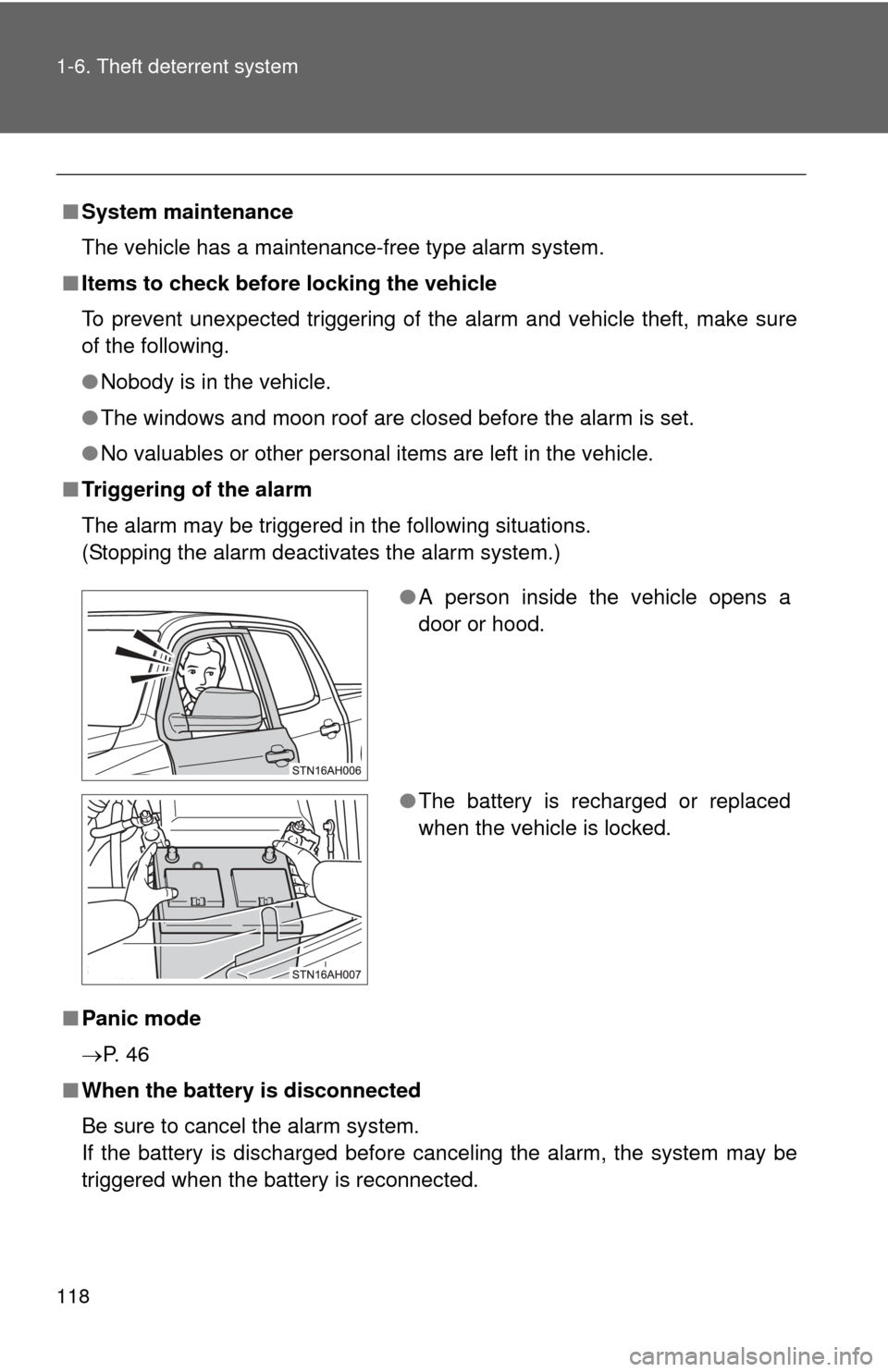
The alarm may be triggered in the following situations.
(Stopping the alarm deactivates the alarm system.)
■ Panic mode
P. 4 6
■ When the battery is disconnected
Be sure to cancel the alarm system.
If the battery is discharged before canceling the alarm, the system may be
triggered when the battery is reconnected.
●A person inside the vehicle opens a
door or hood.
● The battery is recharged or replaced
when the vehicle is locked.
Page 261 of 752

261
2-5. Driving information
2
When driving
NOTICE
■
To prevent the water damage
●Take all necessary safety measures to ensure that water damage to the
engine or other components does not occur.
● Water entering the engine air intake will cause severe engine damage.
● Water entering the automatic transmission will cause deterioration in shift
quality, locking up of your transmission accompanied by vibration, and ulti-
mately damage.
● Water can wash the grease from wheel bearings, causing rusting and pre-
mature failure, and may also enter the differentials, transmission and
transfer case, reducing the gear oil’s lubricating qualities.
■ When you drive through water
If driving through water, such as when crossing shallow streams, first check
the depth of the water and the bottom of the river bed for firmness. Drive
slowly and avoid deep water.
■ Inspection after off-road driving
●Sand and mud that has accumulat ed in brake drums and around brake
discs may affect braking efficiency and may damage brake system compo-
nents.
● Always perform a maintenance inspection after each day of off-road driv-
ing that has taken you through rough terrain, sand, mud, or water. For
scheduled maintenance information, refer to the “Scheduled Maintenance
Guide” or “Owner’s Manual Supplement”.
Page 291 of 752

291
2-5. Driving information
2
When driving
●
The trailer is level when it is hitched.
Do not drive if the trailer is not level, and check for improper tongue
weight, overloading, worn suspension, or other possible causes.
● The trailer cargo is securely loaded.
● The rear view mirrors conform to all applicable federal, state/provincial or
local regulations. If they do not, instal l rear view mirrors appropriate for
towing purposes.
● Depress TOW/HAUL button (if equipped)
■ Break-in schedule
If your vehicle is new or equipped with any new power train components
(such as an engine, transmission, differential or wheel bearing), Toyota rec-
ommends that you do not tow a trailer until the vehicle has been driven \
for
over 500 miles (800 km).
After the vehicle has been driven for over 500 miles (800 km), you can s\
tart
towing. However, for the next 500 miles (800 km), drive the vehicle at a
speed of less than 50 mph (80 km/h) when towing a trailer, and avoid full
throttle acceleration.
■ Maintenance
●If you tow a trailer, your vehicle will require more frequent maintenance
due to the additional load. (See “Owner’s Warranty Information Booklet”
or “Scheduled Maintenance Guide” /“Owner’s Manual Supplement”.)
● Retighten the fixing bolts of the towing ball and bracket after approxi-
mately 600 miles (1000 km) of trailer towing.
■ If trailer sway occurs
One or more factors (crosswinds, passing vehicles, rough roads, etc.) can
adversely affect handling of your vehicle and trailer, causing instability.
●If trailer swaying occurs:
• Firmly grip the steering wheel. Steer straight ahead.
Do not try to control trailer swaying by turning the steering wheel.
• Begin releasing the accelerator pedal immediately but very gradually to reduce speed.
Do not increase speed. Do not apply vehicle brakes.
If you make no extreme correction with the steering or brakes, your vehicle
and trailer should stabilize. (if enabled, Trailer Sway Control can also help to
stabilize the vehicle and trailer.)
Page 527 of 752
Maintenance and care4
527
4-1. Maintenance and careCleaning and protecting the vehicle exterior ......... 528
Cleaning and protecting the vehicle interior .......... 531
4-2. Maintenance Maintenance requirements .................. 534
General maintenance....... 536
Emission inspection and maintenance (I/M)
programs........................ 539
4-3. Do-it-yourself maintenance Do-it-yourself service precautions .................... 540
Hood ................................ 544
Engine compartment ........ 545
Tires ................................. 559
Tire inflation pressure ...... 567
Wheels ............................. 571
Air conditioning filter......... 574
Wireless remote control battery ............................ 577
Checking and replacing fuses .............................. 579
Light bulbs........................ 590