Page 603 of 752

5
When trouble arises
603
5-1. Essential information
If your vehicle needs to be towed
Before towingThe following may indicate a problem with your transmission. Contact
your Toyota dealer before towing.
● The engine is running, but the vehicle will not move.
● The vehicle makes an abnormal sound.
Emergency towing
If a tow truck is not available, in an emergency your vehicle may be
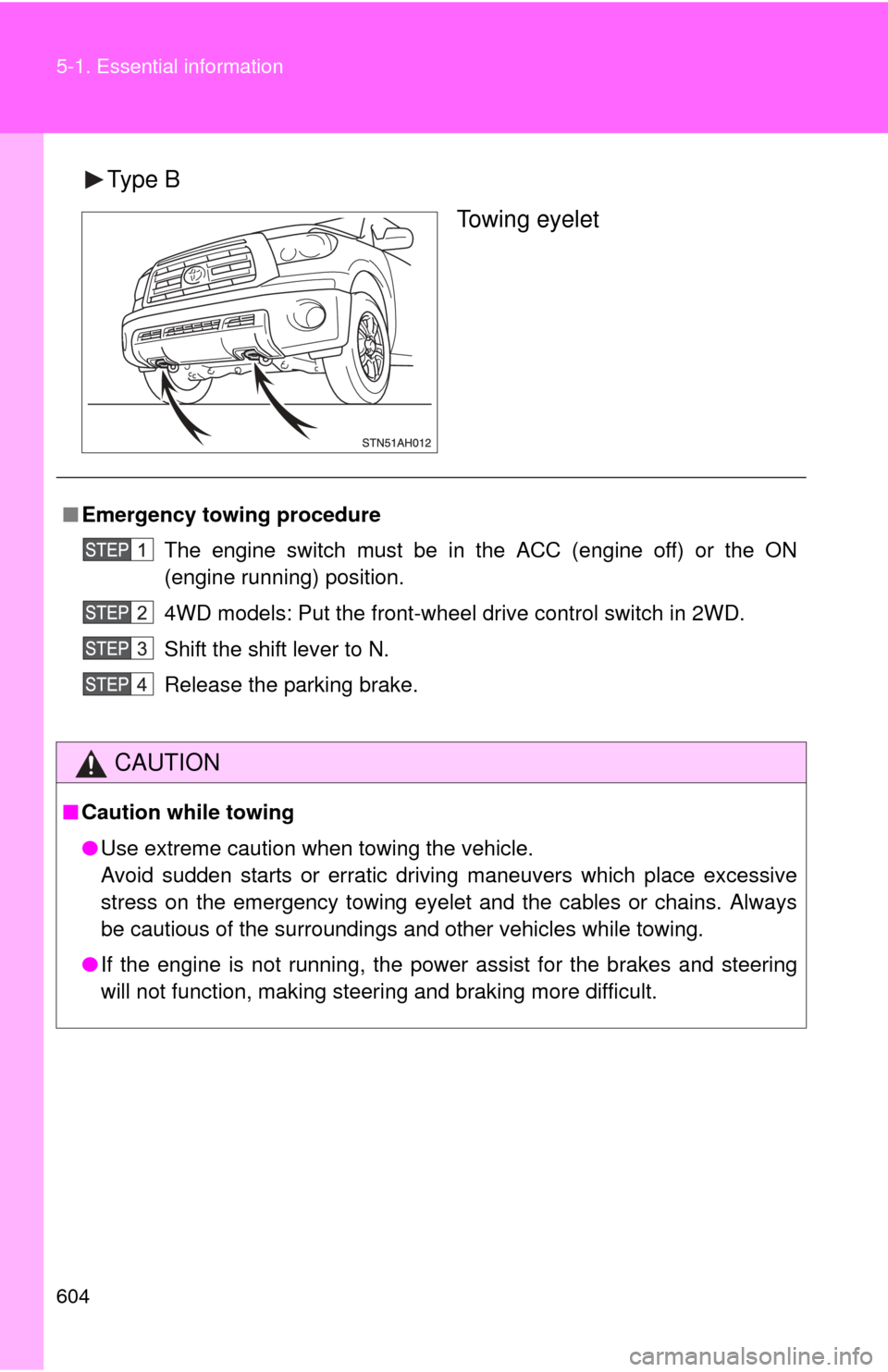
temporarily towed using a cable or chain secured to the emergency
towing eyelet. This should only attempted on hard, surfaced roads for
short distances at low speeds.
A driver must be in the vehicle to steer and operate the brakes. The
vehicle’s wheels, drive train, axles, steering and brakes must be in
good condition.
Type A Towing eyelet
If towing is necessary, we recommend having your vehicle towed by
your Toyota dealer or a commerci al towing service, using a lift-type
truck or a flat bed truck.
Use a safety chain system for all to wing, and abide by all state/pro-
vincial and local laws.
The wheels and axle on the groun d must be in good condition.
If they are damaged, use a towing dolly or flat bed truck.
Page 604 of 752
604 5-1. Essential information
Type BTowing eyelet
■Emergency towin g procedure
The engine switch must be in the ACC (engine off) or the ON
(engine running) position.
4WD models: Put the front-wheel drive control switch in 2WD.
Shift the shift lever to N.
Release the parking brake.
CAUTION
■ Caution while towing
●Use extreme caution when towing the vehicle.
Avoid sudden starts or erratic driving maneuvers which place excessive
stress on the emergency towing eyelet and the cables or chains. Always
be cautious of the surroundings and other vehicles while towing.
● If the engine is not running, the power assist for the brakes and steering
will not function, making steering and braking more difficult.
Page 605 of 752
5
When trouble arises
605
5-1. Essential information
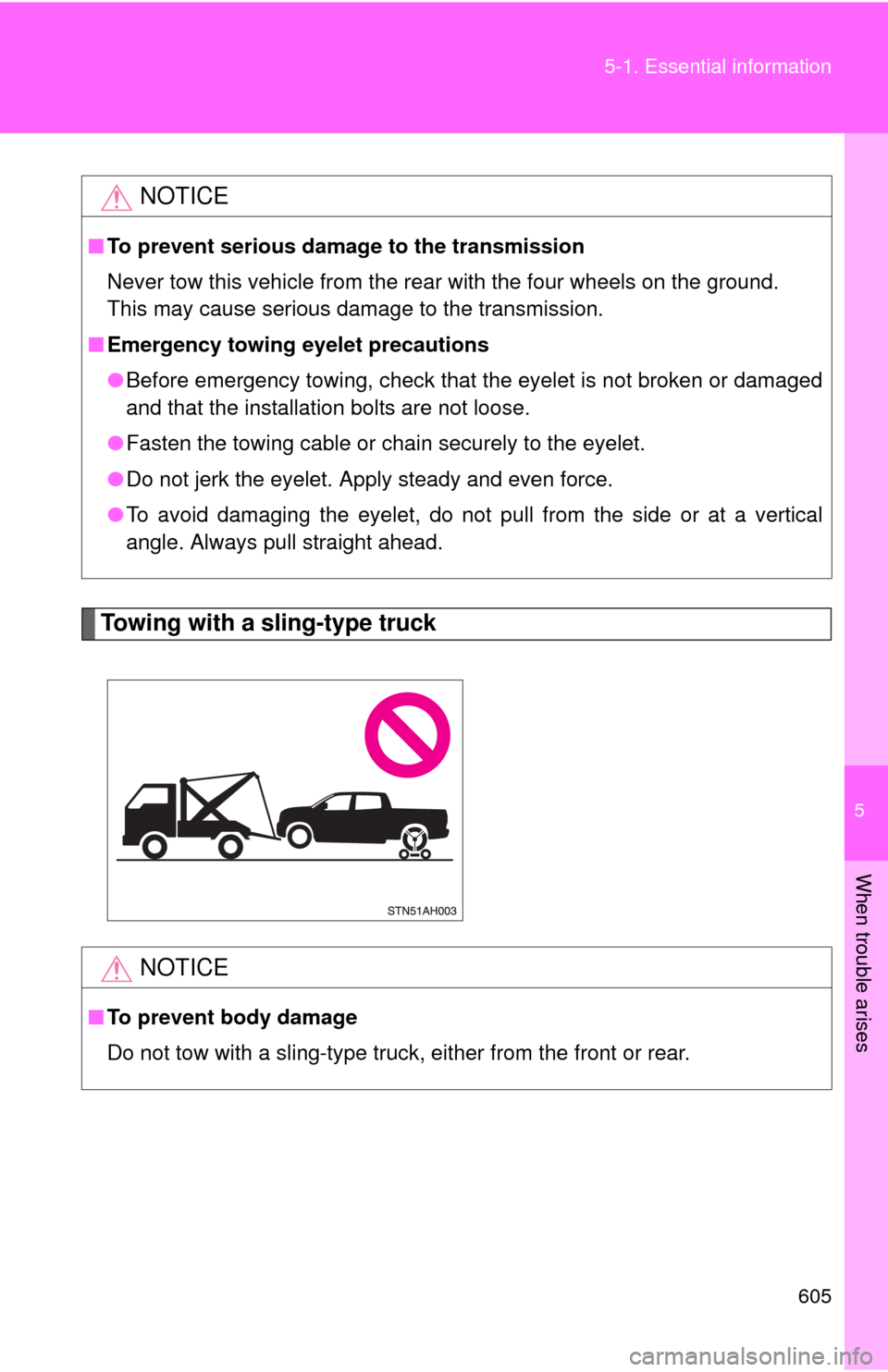
Towing with a sling-type truck
NOTICE
■
To prevent serious damage to the transmission
Never tow this vehicle from the rear with the four wheels on the ground.
This may cause serious damage to the transmission.
■ Emergency towing eyelet precautions
● Before emergency towing, check that the eyelet is not broken or damaged
and that the installation bolts are not loose.
● Fasten the towing cable or chain securely to the eyelet.
● Do not jerk the eyelet. Apply steady and even force.
● To avoid damaging the eyelet, do not pull from the side or at a vertical
angle. Always pull straight ahead.
NOTICE
■To prevent body damage
Do not tow with a sling-type truck, either from the front or rear.
Page 606 of 752
606 5-1. Essential information
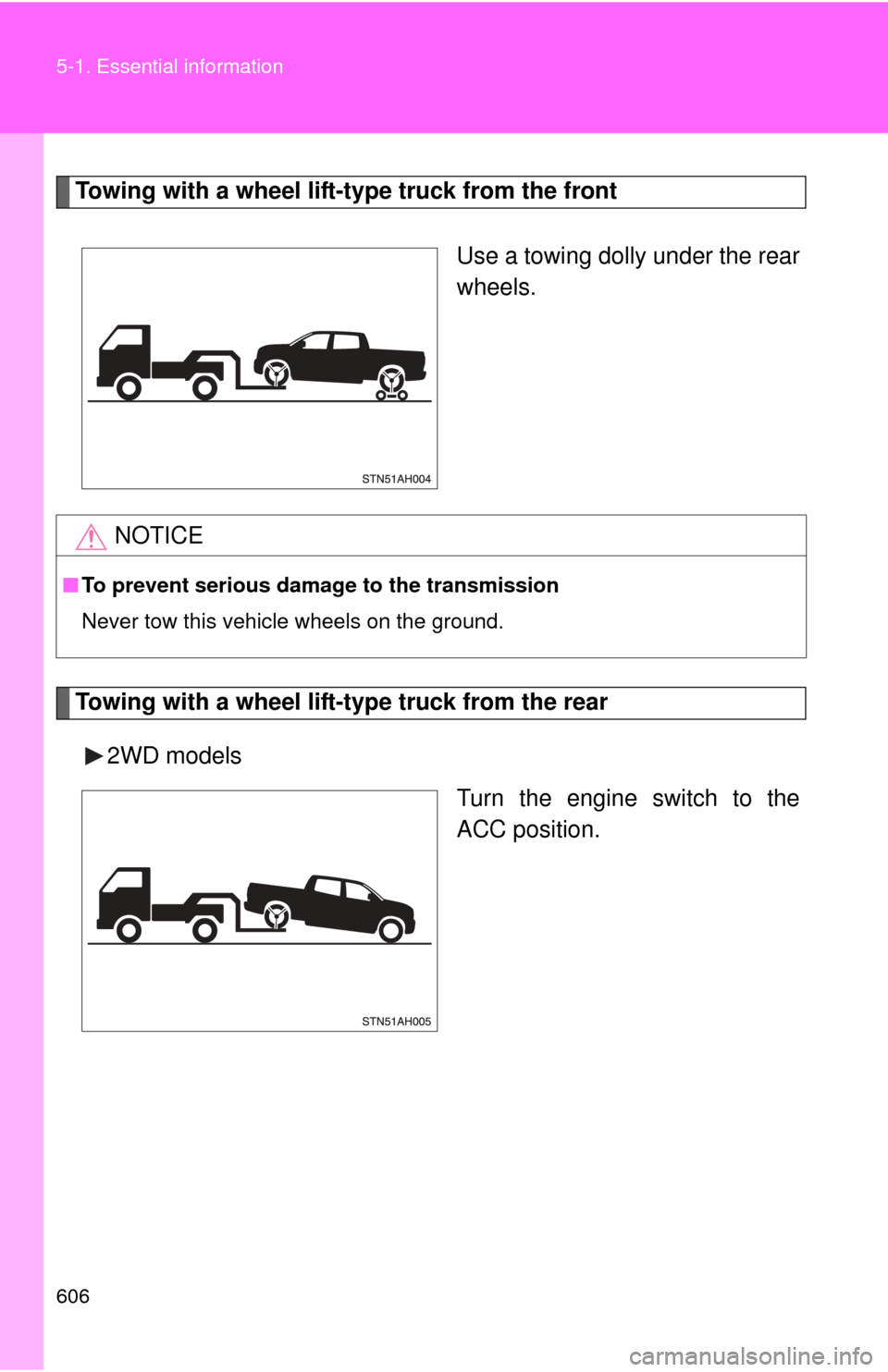
Towing with a wheel lift-type truck from the frontUse a towing dolly under the rear
wheels.
Towing with a wheel lift-type truck from the rear2WD models Turn the engine switch to the
ACC position.
NOTICE
■To prevent serious damage to the transmission
Never tow this vehicle wheels on the ground.
Page 607 of 752
5
When trouble arises
607
5-1. Essential information
4WD models
We recommend the use of a tow-
ing dolly under the front wheels.
When not using a towing dolly,
turn the engine switch to the ACC
position, shift the shift lever to N
and put the front wheel drive con-
trol switch in 2WD.
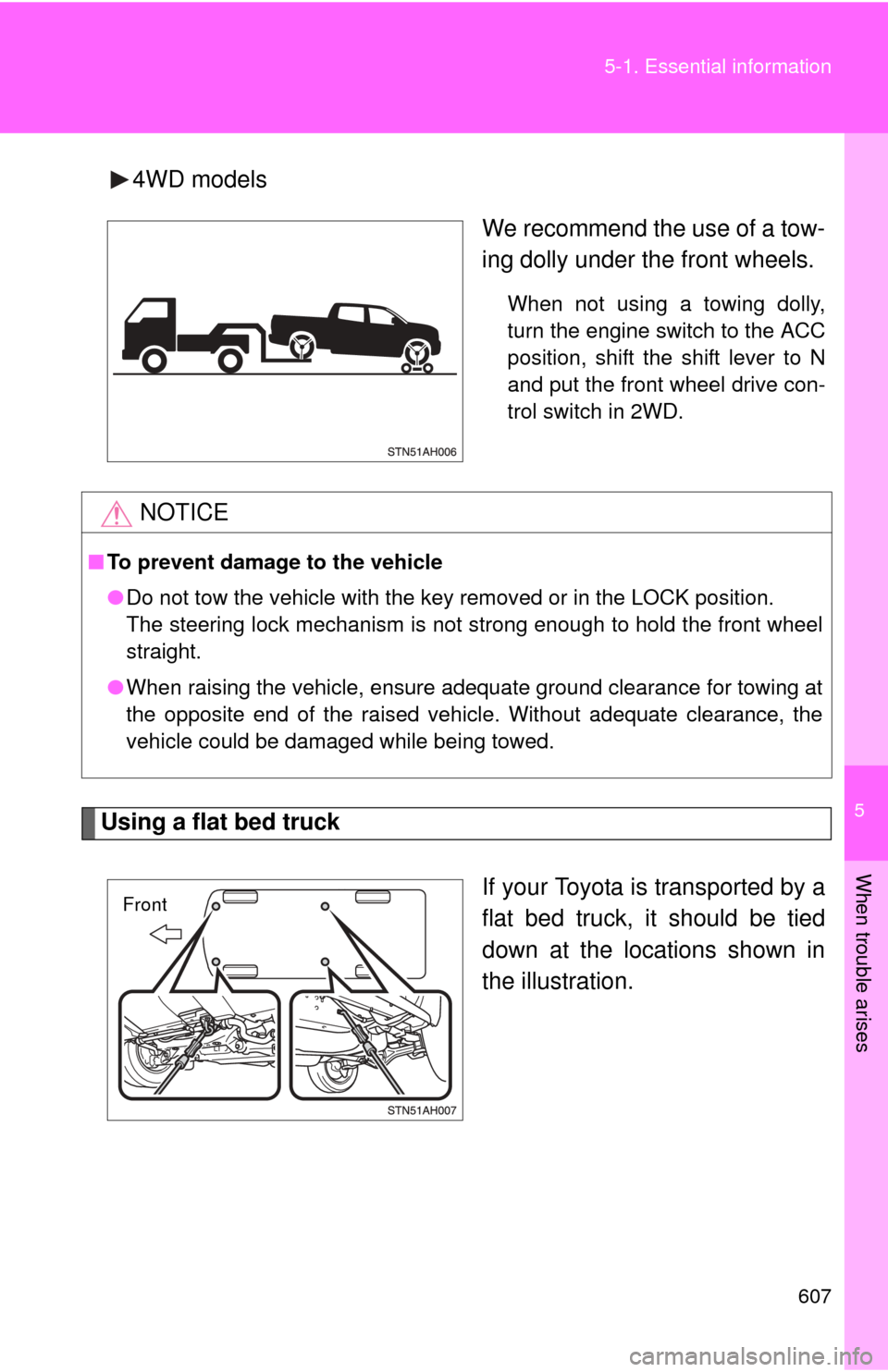
Using a flat bed truck
If your Toyota is transported by a
flat bed truck, it should be tied
down at the locations shown in
the illustration.
NOTICE
■To prevent damage to the vehicle
●Do not tow the vehicle with the key removed or in the LOCK position.
The steering lock mechanism is not strong enough to hold the front wheel
straight.
● When raising the vehicle, ensure adequate ground clearance for towing at
the opposite end of the raised vehicle. Without adequate clearance, the
vehicle could be damaged while being towed.
Front
Page 638 of 752
638 5-2. Steps to take in an emergency
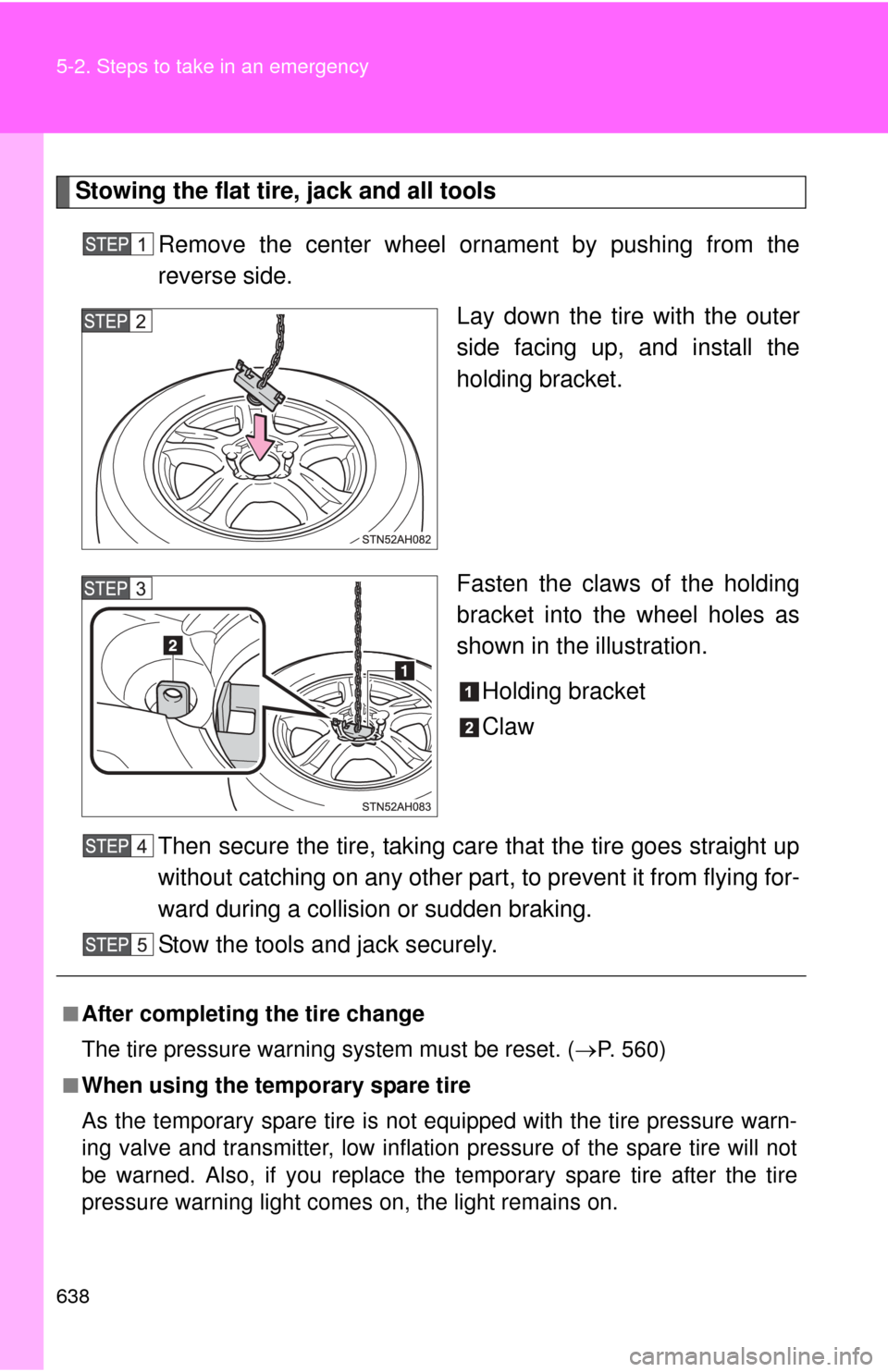
Stowing the flat tire, jack and all toolsRemove the center wheel ornament by pushing from the
reverse side. Lay down the tire with the outer
side facing up, and install the
holding bracket.
Fasten the claws of the holding
bracket into the wheel holes as
shown in the illustration.
Holding bracket
Claw
Then secure the tire, taking care that the tire goes straight up
without catching on any other part , to prevent it from flying for-
ward during a collision or sudden braking.
Stow the tools and jack securely.
■After completing the tire change
The tire pressure warnin g system must be reset. ( P. 560)
■When using the temporary spare tire
As the temporary spare tire is not equipped with the tire pressure warn-
ing valve and transmitter, low inflation pressure of the spare tire will not
be warned. Also, if you replace the temporary spare tire after the tire
pressure warning light comes on, the light remains on.
Page 657 of 752
5
When trouble arises
657
5-2. Steps to take in an emergency
If the vehicle becomes stuck
CAUTION
■When attempting to free a stuck vehicle
If you choose to rock the vehicle back and forth to free it, make sure the sur-
rounding area is clear, to avoid striking other vehicles, objects or persons.
The vehicle may also lunge forward or lunge back suddenly as it becomes
free. Use extreme caution.
■ When shifting the shift lever
Be careful not to shift the shift lever with the accelerator pedal depressed.
This may lead to unexpected rapid acceleration of the vehicle that may
cause an accident and result in death or serious injury.
NOTICE
■To avoid damaging the transmission and other components
●Avoid spinning the wheels and do not rev the engine.
● If the vehicle remains stuck after trying these procedures, the vehicle may
require towing to be freed.
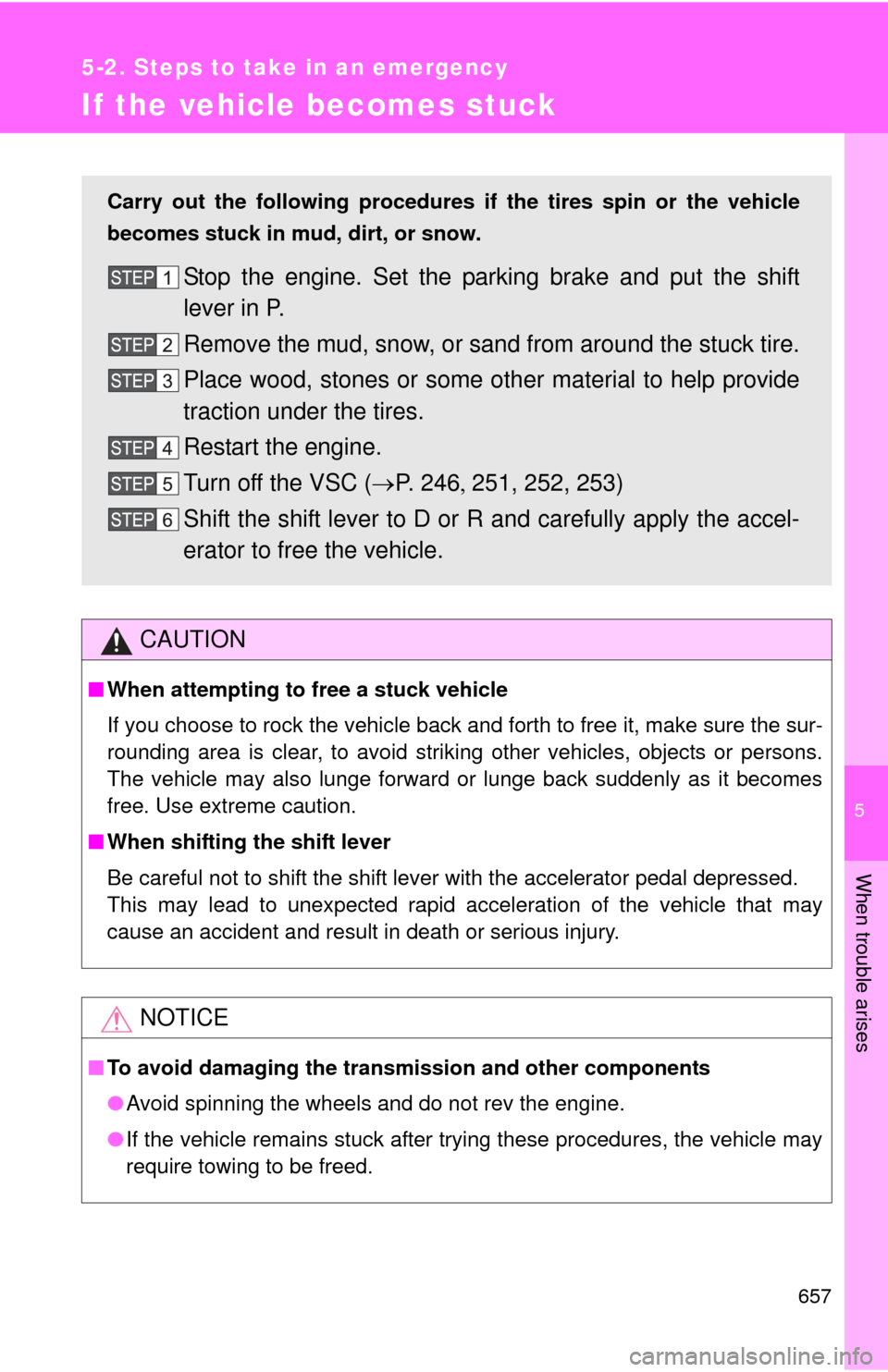
Carry out the following procedures if the tires spin or the vehicle
becomes stuck in mud, dirt, or snow.
Stop the engine. Set the parking brake and put the shift
lever in P.
Remove the mud, snow, or sand from around the stuck tire.
Place wood, stones or some other material to help provide
traction under the tires.
Restart the engine.
Turn off the VSC ( P. 2 4 6 251, 252, 253)
Shift the shift lever to D or R and carefully apply the accel-
erator to free the vehicle.
Page 666 of 752
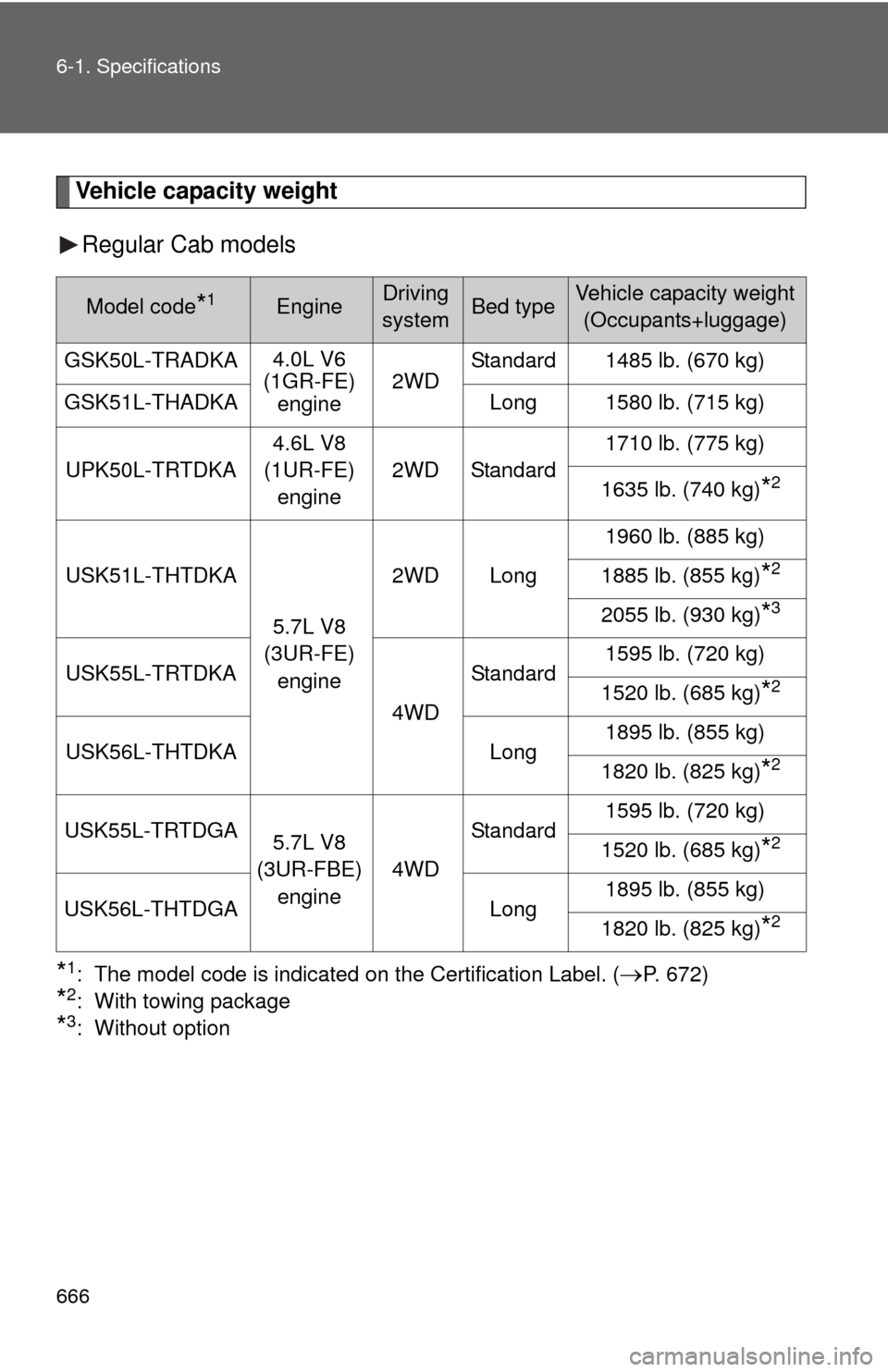
666 6-1. Specifications
Vehicle capacity weightRegular Cab models
*1: The model code is indicated on the Certification Label. (P. 672)
*2: With towing package
*3: Without option
Model code*1EngineDriving
systemBed typeVehicle capacity weight (Occupants+luggage)
GSK50L-TRADKA 4.0L V6
(1GR-FE) engine 2WD
Standard 1485 lb. (670 kg)
GSK51L-THADKA Long 1580 lb. (715 kg)
UPK50L-TRTDKA 4.6L V8
(1UR-FE) engine 2WD Standard 1710 lb. (775 kg)
1635 lb. (740 kg)
*2
USK51L-THTDKA
5.7L V8
(3UR-FE) engine 2WD Long
1960 lb. (885 kg)
1885 lb. (855 kg)*2
2055 lb. (930 kg)*3
USK55L-TRTDKA
4WDStandard
1595 lb. (720 kg)
1520 lb. (685 kg)*2
USK56L-THTDKA Long1895 lb. (855 kg)
1820 lb. (825 kg)*2
USK55L-TRTDGA 5.7L V8
(3UR-FBE) engine 4WDStandard
1595 lb. (720 kg)
1520 lb. (685 kg)*2
USK56L-THTDGA Long1895 lb. (855 kg)
1820 lb. (825 kg)*2