Page 366 of 876
366
2-5. Driving information
SIENNA_OM_OM45472U_(U)
Vehicle load limits
■Total load capacity and seating capacity
These details are also described on the tire and loading information
label. (P. 699)
CAUTION
■Overloading the vehicle
Observe the total load capacity when you load the vehicle. ( P. 800)
Otherwise, it may not only cause damage to the tires, but also degrade
steering and braking ability, resulting in an accident.
Vehicle load limits include total load capacity, seating capacity,
TWR (Trailer Weight Rating) and cargo capacity.
■Total load capacity (vehicle capacity weight): ( P. 800)
Total load capacity means the combined weight of occupants, cargo
and luggage.
■ Seating capacity: 7 or 8 occupants (Front 2, Rear 5 or 6)
Seating capacity means the maxi mum number of occupants whose
estimated average weight is 150 lb. (68 kg) per person.
■ TWR (Trailer Weight Rating): ( P. 376, 801)
TWR means the maximum gross tra iler weight (trailer weight plus
its cargo weight) that your vehicle is able to tow.
■ Cargo capacity
Cargo capacity may increase or decrease depending on the weight
and the number of occupants.
Page 372 of 876
372 2-5. Driving information
SIENNA_OM_OM45472U_(U)
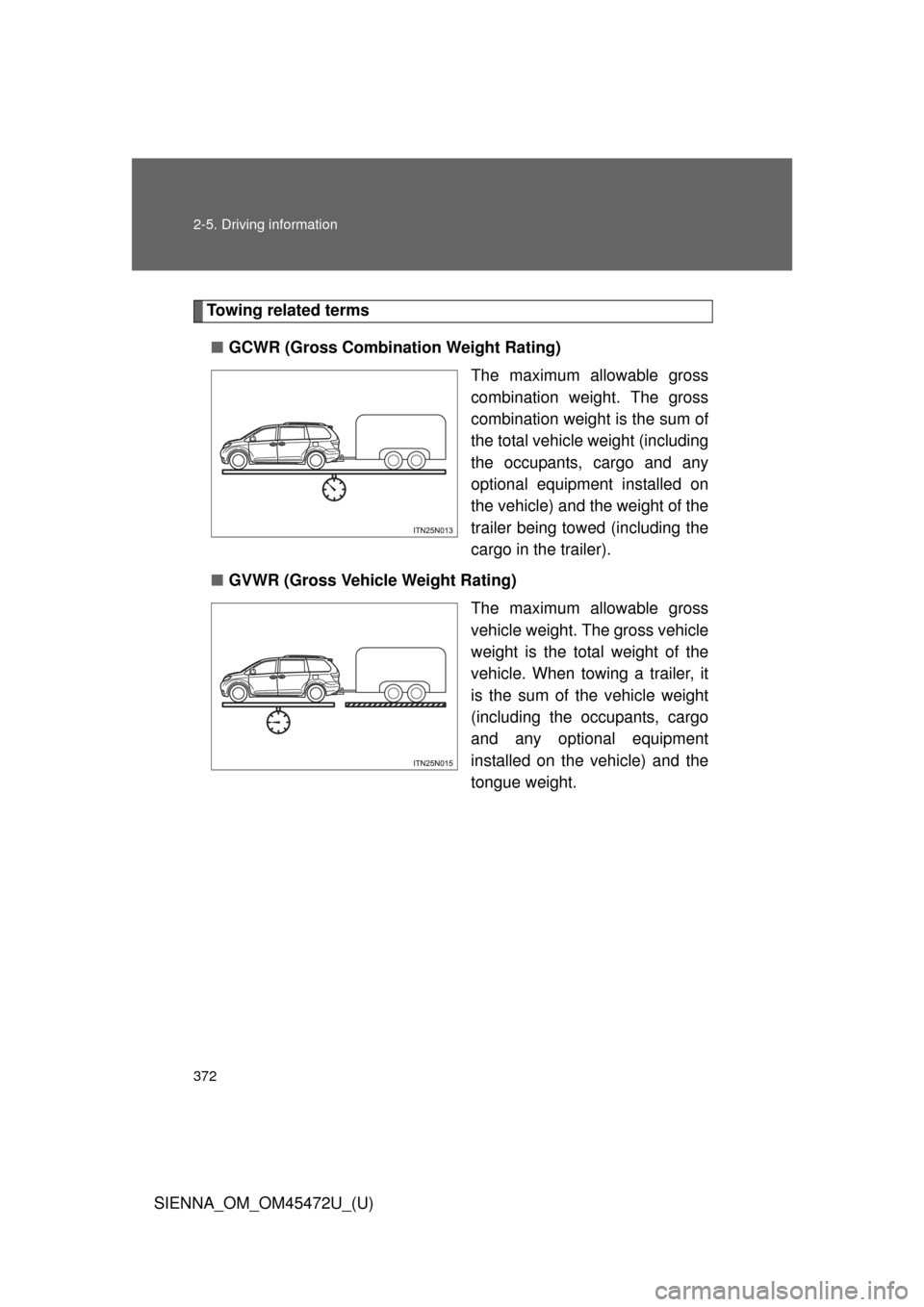
Towing related terms■ GCWR (Gross Combination Weight Rating)
The maximum allowable gross
combination weight. The gross
combination weight is the sum of
the total vehicle weight (including
the occupants, cargo and any
optional equipment installed on
the vehicle) and the weight of the
trailer being towed (including the
cargo in the trailer).
■ GVWR (Gross Vehi cle Weight Rating)
The maximum allowable gross
vehicle weight. The gross vehicle
weight is the total weight of the
vehicle. When towing a trailer, it
is the sum of the vehicle weight
(including the occupants, cargo
and any optional equipment
installed on the vehicle) and the
tongue weight.
Page 373 of 876
373
2-5. Driving information
2
When driving
SIENNA_OM_OM45472U_(U)
■
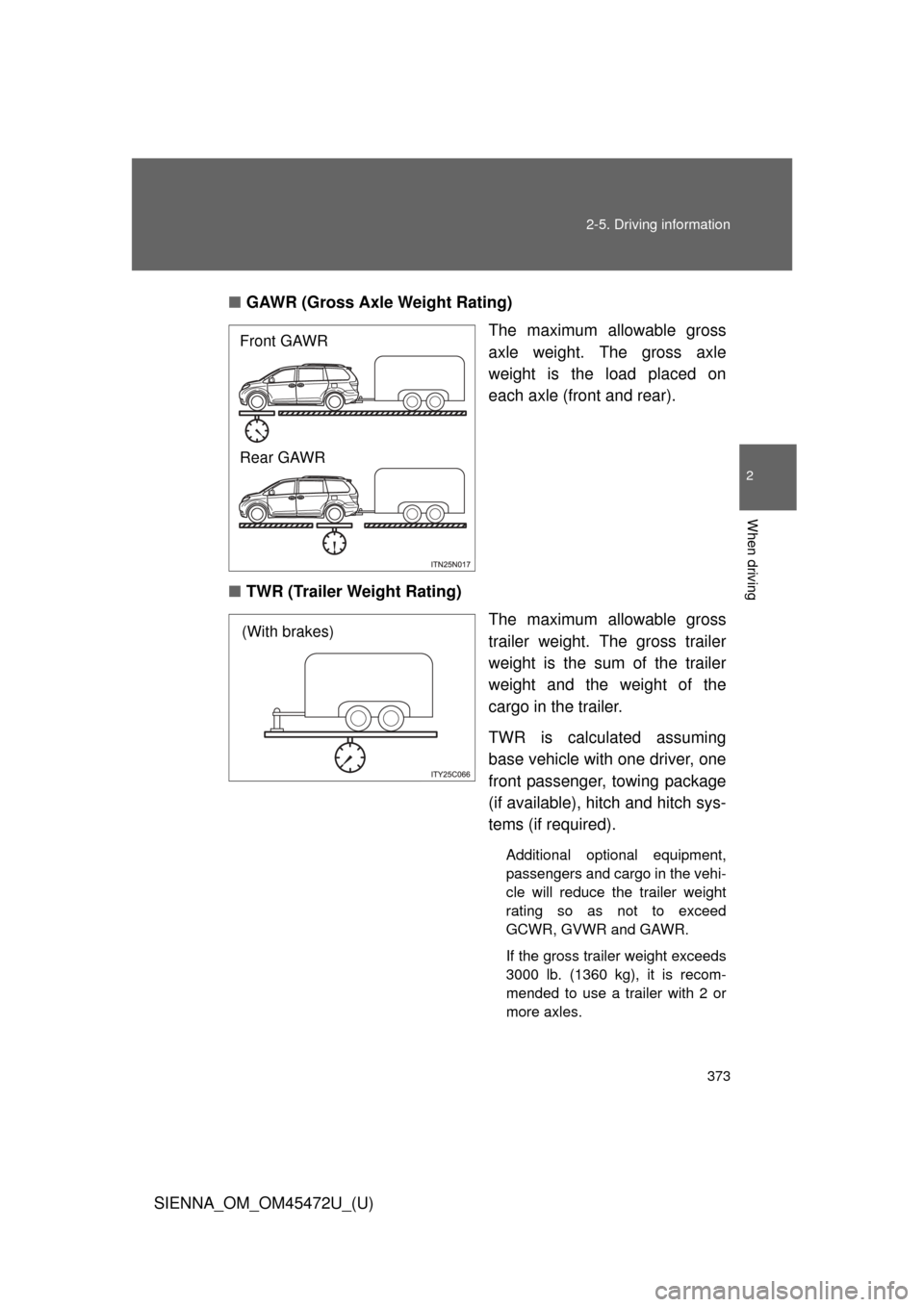
GAWR (Gross Axle Weight Rating)
The maximum allowable gross
axle weight. The gross axle
weight is the load placed on
each axle (front and rear).
■ TWR (Trailer Weight Rating)
The maximum allowable gross
trailer weight. The gross trailer
weight is the sum of the trailer
weight and the weight of the
cargo in the trailer.
TWR is calculated assuming
base vehicle with one driver, one
front passenger, towing package
(if available), hitch and hitch sys-
tems (if required).
Additional optional equipment,
passengers and cargo in the vehi-
cle will reduce the trailer weight
rating so as not to exceed
GCWR, GVWR and GAWR.
If the gross trailer weight exceeds
3000 lb. (1360 kg), it is recom-
mended to use a trailer with 2 or
more axles.
Front GAWR
Rear GAWR
(With brakes)
Page 374 of 876
374 2-5. Driving information
SIENNA_OM_OM45472U_(U)■
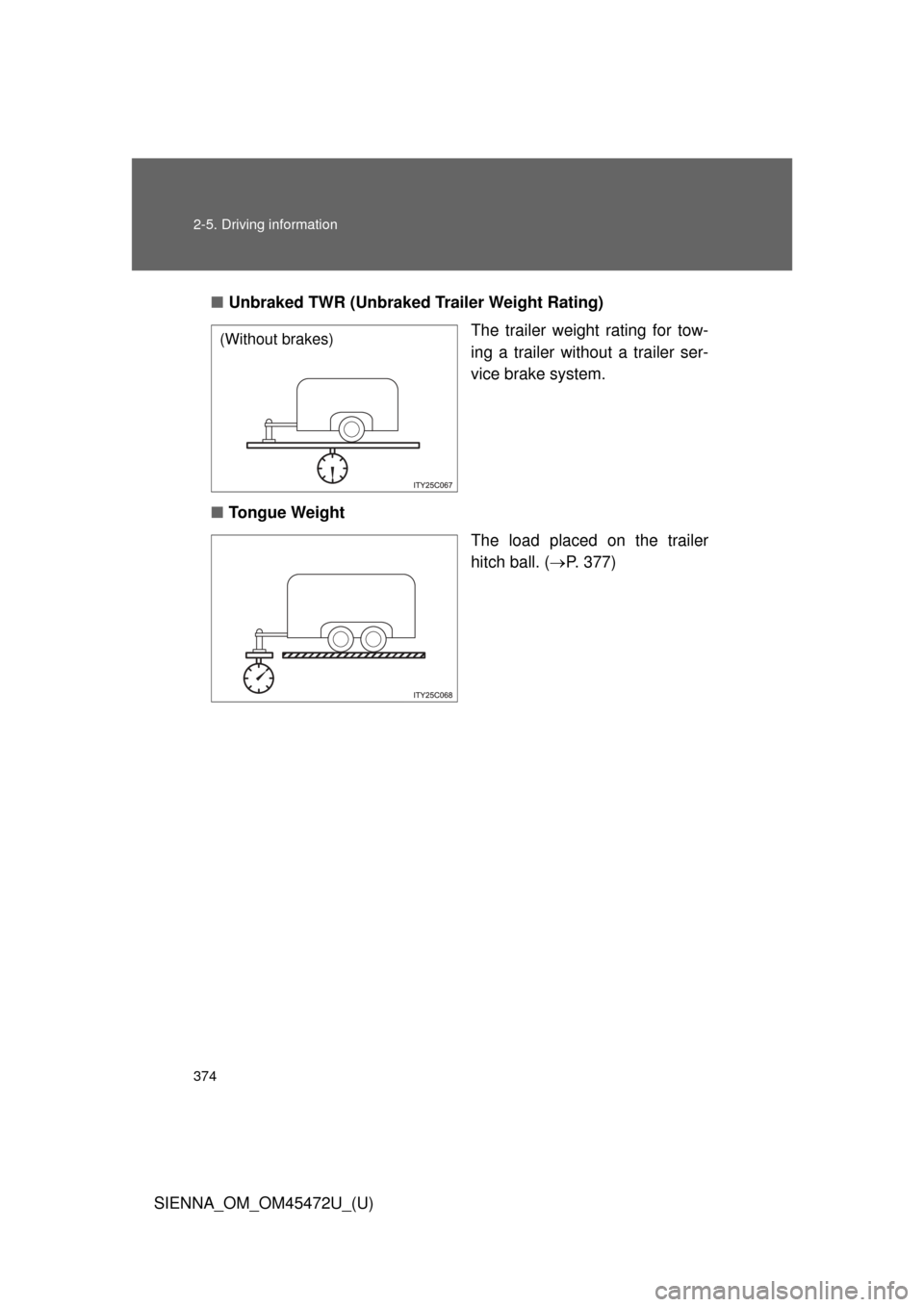
Unbraked TWR (Unbraked Trailer Weight Rating)
The trailer weight rating for tow-
ing a trailer without a trailer ser-
vice brake system.
■ Tongue Weight
The load placed on the trailer
hitch ball. (P. 377)
(Without brakes)
Page 375 of 876
375
2-5. Driving information
2
When driving
SIENNA_OM_OM45472U_(U)
Weight limits
● The gross trailer weight must never exceed 3500 lb. (1588 kg).
● The gross combination weight must never exceed the GCWR
described below.
2WD models: 8900 lb. (4037 kg)
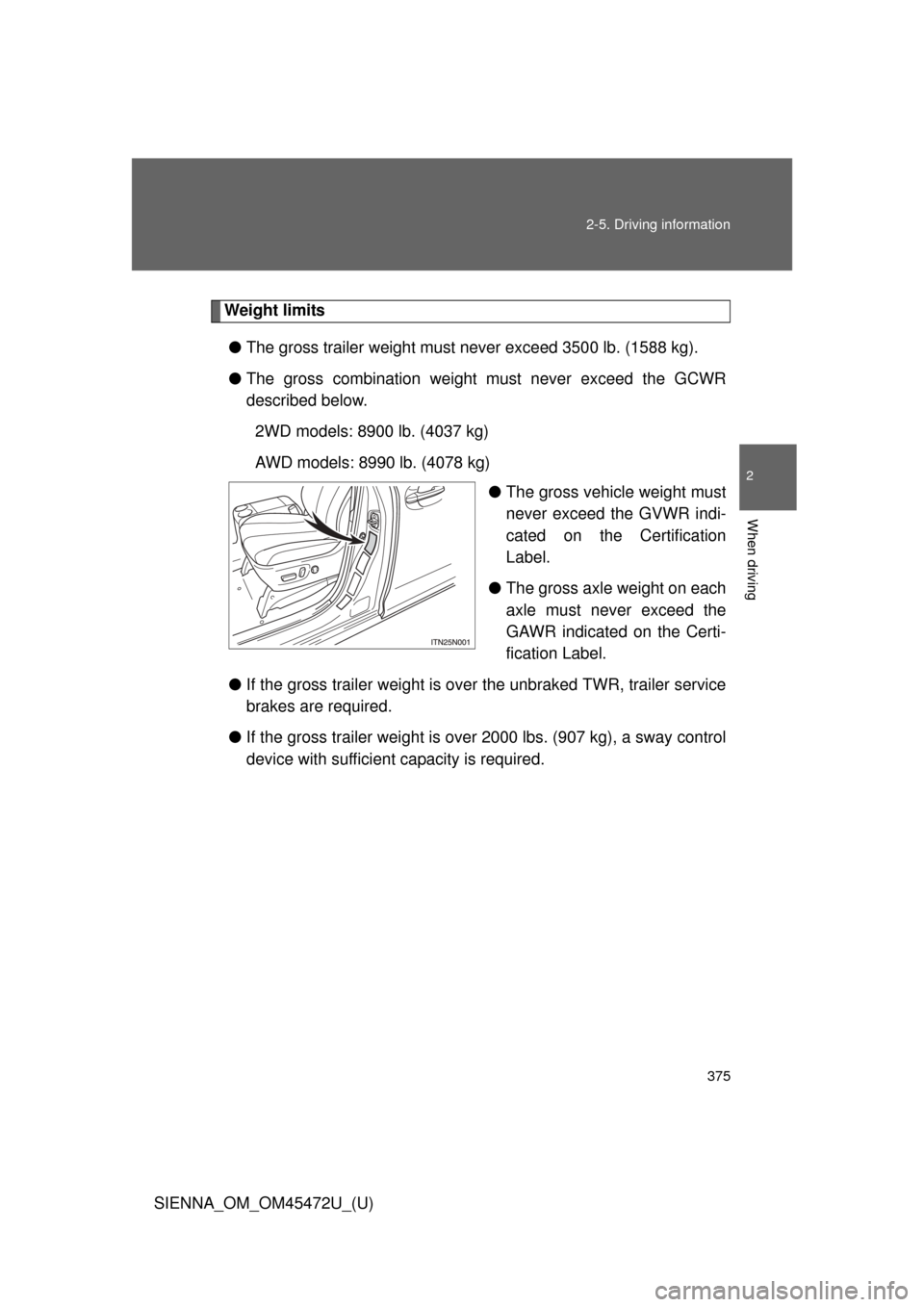
AWD models: 8990 lb. (4078 kg) ●The gross vehicle weight must
never exceed the GVWR indi-
cated on the Certification
Label.
● The gross axle weight on each
axle must never exceed the
GAWR indicated on the Certi-
fication Label.
● If the gross trailer weight is over the unbraked TWR, trailer service
brakes are required.
● If the gross trailer weight is over 2000 lbs. (907 kg), a sway control
device with sufficient capacity is required.
Page 376 of 876
376 2-5. Driving information
SIENNA_OM_OM45472U_(U)
GCWR, TWR and Unbraked TWR Confirm that the gross trailer weight, gross combination weight, gross
vehicle weight, gross axle weight and tongue weight are all within the
limits.
■ GCWR
2WD models: 8900 lb. (4037 kg)
AWD models: 8990 lb. (4078 kg)
■ TWR
3500 lb. (1588 kg)
■ Unbraked TWR
1000 lb. (454 kg)
: These models meet the tow-vehicle trailering requirement of SAE Interna-
tional per SAE J2807.
Page 377 of 876
377
2-5. Driving information
2
When driving
SIENNA_OM_OM45472U_(U)
Trailer Tongue Weight
● A recommended tongue weight varies in accordance with the types
of trailers or towing as described below.
● To ensure the recommended values shown below, the trailer must
be loaded by referring to the following instructions.
• Tongue Weight
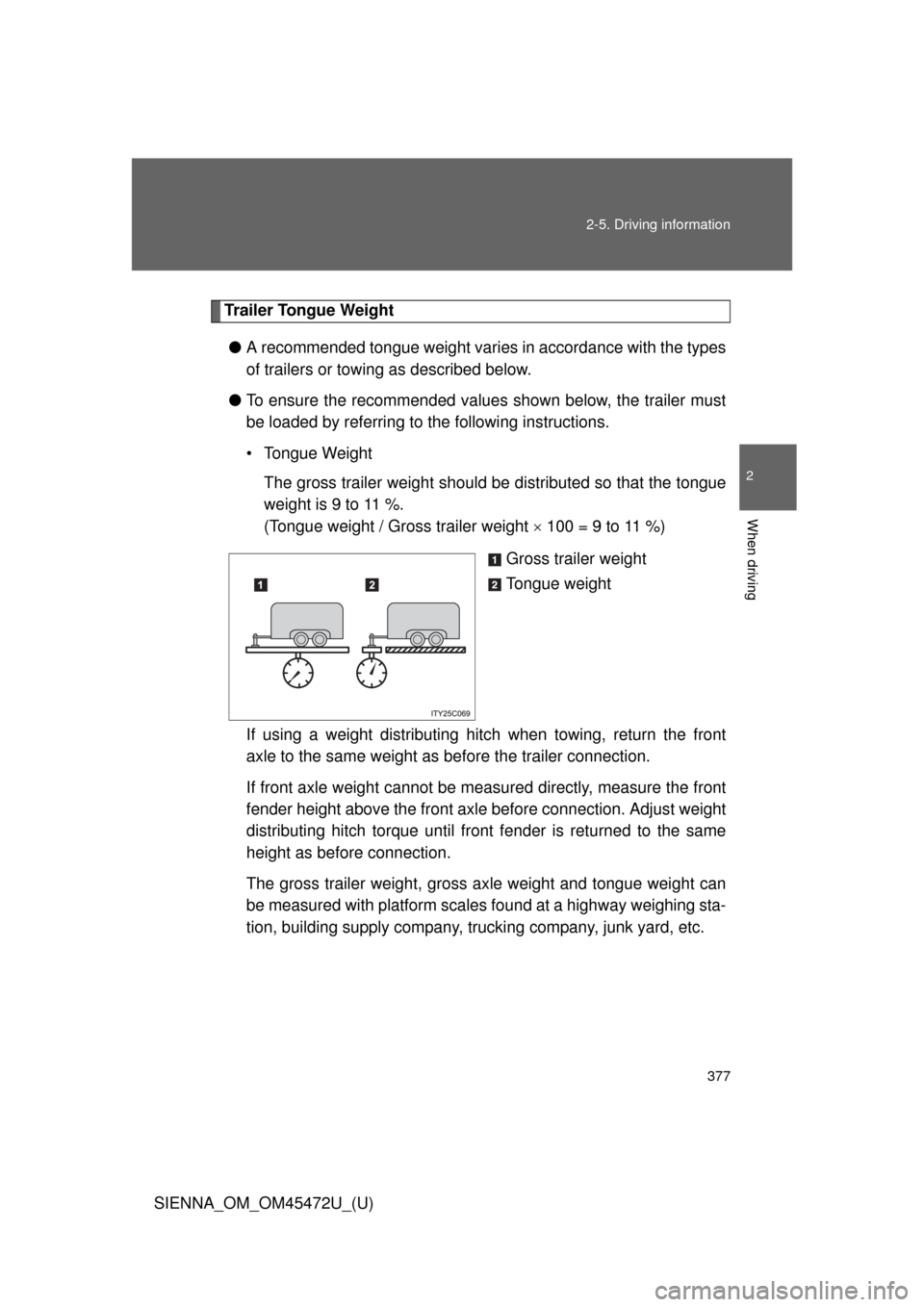
The gross trailer weight should be distributed so that the tongue
weight is 9 to 11 %.
(Tongue weight / Gross trailer weight 100 = 9 to 11 %)
Gross trailer weight
Tongue weight
If using a weight distributing hitch when towing, return the front
axle to the same weight as before the trailer connection.
If front axle weight cannot be measured directly, measure the front
fender height above the front axle before connection. Adjust weight
distributing hitch torque until fr ont fender is returned to the same
height as before connection.
The gross trailer weight, gross axle weight and tongue weight can
be measured with platform scales found at a highway weighing sta-
tion, building supply company, trucking company, junk yard, etc.
Page 378 of 876
378 2-5. Driving information
SIENNA_OM_OM45472U_(U)
HitchTrailer hitch assemblies have different weight capacities. Toyota rec-
ommends the use of Toyota hitch/brac ket for your vehicle. For details,
contact your Toyota dealer.
● If you wish to install a trailer hitch, contact your Toyota dealer.
● Use only a hitch that c onforms to the gross trailer weight require-
ment of your vehicle.
● Follow the directions supplied by the hitch manufacturer.
● Lubricate the hitch ball with a light coating of grease.
● Remove the trailer hitch whenever you are not towing a trailer.
After removing the hitch, seal any mounting hole in the vehicle
body to prevent entry of any substances into the vehicle.