Page 666 of 740

666 5-2. Steps to take in an emergency
■Starting the engine when the battery is discharged
The engine cannot be started by push-starting.
■ Avoiding a discharged battery
●Turn off the headlights and the audio system while the engine is turned
off.
● Turn off any unnecessary electrical components when the vehicle is run-
ning at a low speed for an extended period, such as in heavy traffic, etc.
■ When the battery is removed or discharged
●Flex-fuel vehicles: The information recorded in the computer will be
cleared, which may cause the engine to run roughly and reduce driving
performance for a while when the engine is first started. In this case, wait
until the engine runs normally.
If the vehicle is running on E85, the engine may stall. In this case, restart
the engine, repeatedly if necessary.
● Make sure that the key is not inside the vehicle when recharging or
replacing the battery. The key may be locked in the vehicle if the alarm is
activated. ( P. 110)
■ Charging the battery
The electricity stored in the battery will discharge gradually even when the
vehicle is not in use, due to natural discharge and the draining effects of cer-
tain electrical appliances. If the vehicle is left for a long time, the battery may
discharge, and the engine may be unable to start. (The battery recharges
automatically during driving.)
Once the vehicle’s engine has started, remove the jumper
cables in the exact reverse order in which they were con-
nected.
Once the engine starts, have the vehicle checked at your Toyota
dealer as soon as possible.
Page 667 of 740

5
When trouble arises
667
5-2. Steps to take in an emergency
CAUTION
■
Avoiding battery fires or explosions
Observe the following precautions to prevent accidentally igniting the flam-
mable gas that may be emitted from the battery.
●Make sure the jumper cable is connected to the correct terminal and that it
is not unintentionally in contact with any part other than the intended termi-
nal.
● Do not allow the jumper cables to come into contact with the “+” and “-” ter-
minals.
● Do not smoke, use matches, cigarette lighters or allow open flame near
the battery.
■ Battery precautions
The battery contains poisonous and corrosive acidic electrolyte, while
related parts contain lead and lead compounds. Observe the following pre-
cautions when handling the battery.
When working with the battery, always wear safety glasses and take care
not to allow any battery fluids (acid) to come into contact with skin, clothing
or the vehicle body.
●
Do not lean over the battery.
●In the event that battery fluid comes into contact with the skin or eyes,
immediately wash the affected area with water and seek medical attention.
Place a wet sponge or cloth over the affected area until medical attention
can be received.
● Always wash your hands after handling the battery support, terminals, and
other battery-related parts.
● Do not allow children near the battery.
NOTICE
■When handling jumper cables
Be careful that the jumper cables do not become tangled in the cooling fan
or any of the belts when connecting or disconnecting them.
Page 682 of 740
682 6-1. Specifications
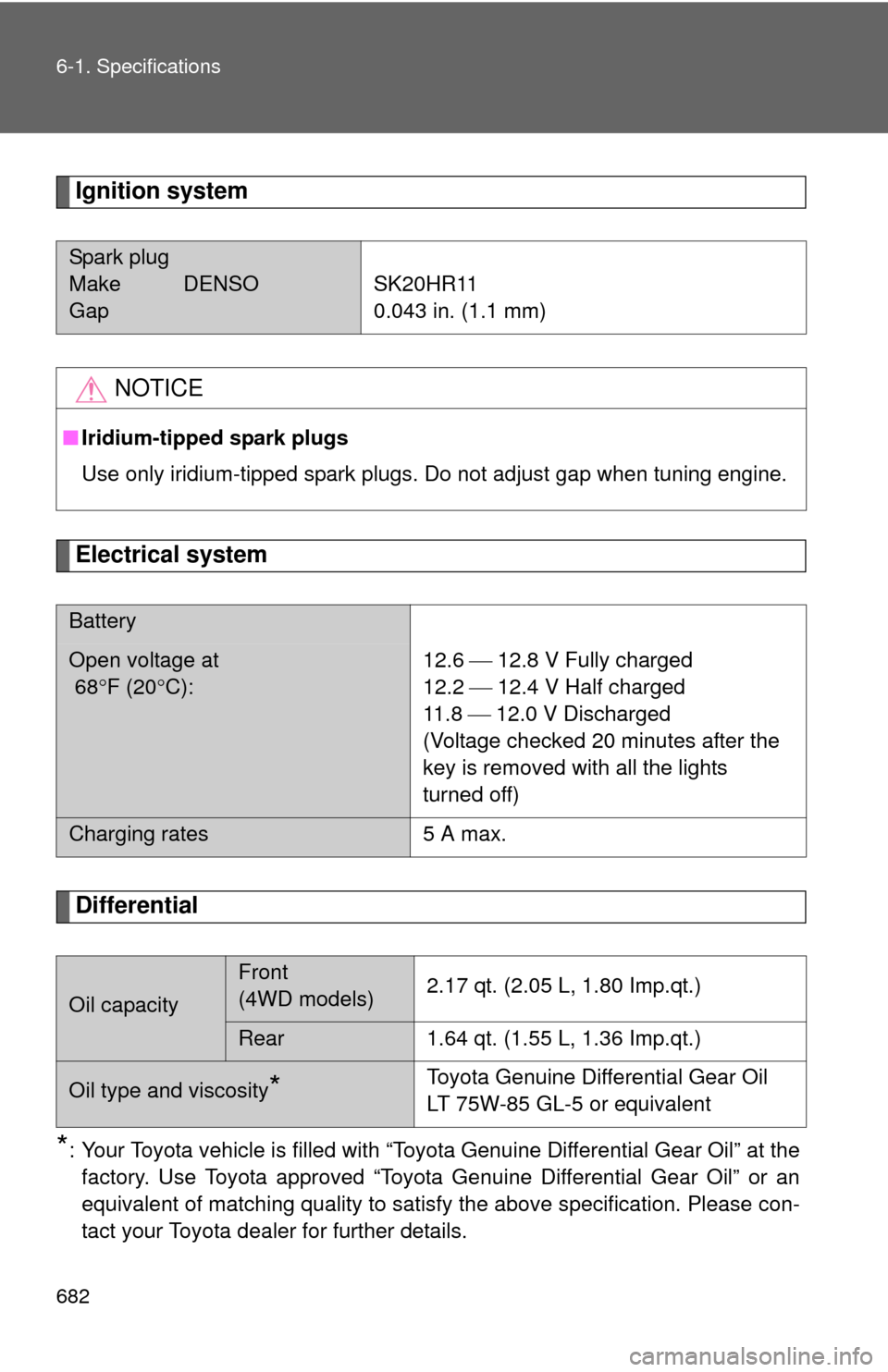
Ignition system
Electrical system
Differential
*: Your Toyota vehicle is filled with “Toyota Genuine Differential Gear Oil” at thefactory. Use Toyota approved “Toyota Genuine Differential Gear Oil” or an
equivalent of matching quality to satisfy the above specification. Please con-
tact your Toyota dealer for further details.
Spark plug
Make DENSO
Gap SK20HR11
0.043 in. (1.1 mm)
NOTICE
■
Iridium-tipped spark plugs
Use only iridium-tipped spark plugs. Do not adjust gap when tuning engine.
Battery
Open voltage at
68 F (20 C): 12.6 12.8 V Fully charged
12.2 12.4 V Half charged
11 . 8
12.0 V Discharged
(Voltage checked 20 minutes after the
key is removed with all the lights
turned off)
Charging rates 5 A max.
Oil capacity
Front
(4WD models)2.17 qt. (2.05 L, 1.80 Imp.qt.)
Rear
1.64 qt. (1.55 L, 1.36 Imp.qt.)
Oil type and viscosity*Toyota Genuine Differential Gear Oil
LT 75W-85 GL-5 or equivalent
Page 686 of 740
686 6-1. Specifications
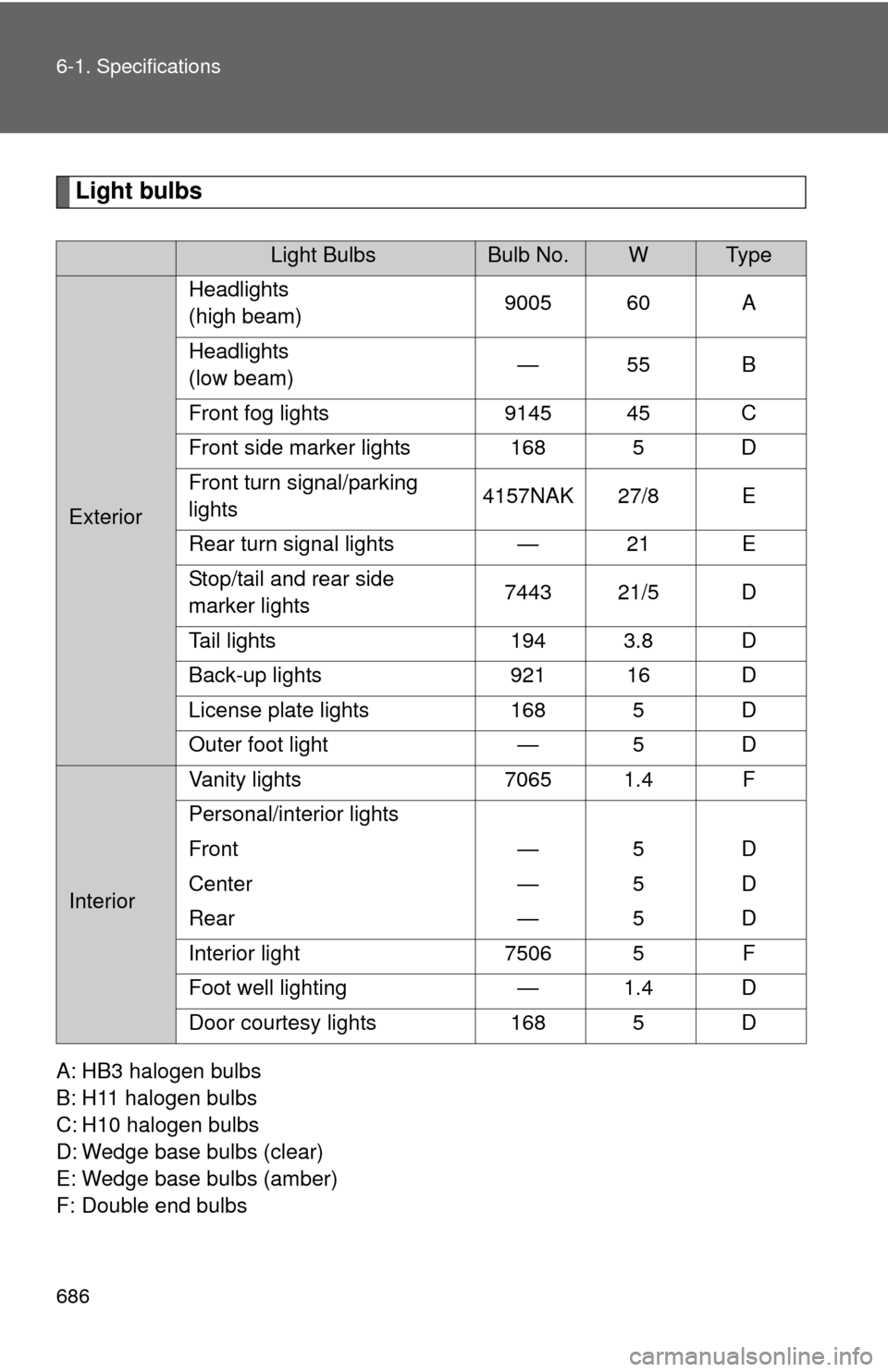
Light bulbs
A: HB3 halogen bulbs
B: H11 halogen bulbs
C: H10 halogen bulbs
D: Wedge base bulbs (clear)
E: Wedge base bulbs (amber)
F: Double end bulbs
Light BulbsBulb No.WTy p e
ExteriorHeadlights
(high beam)
9005 60 A
Headlights
(low beam) —55 B
Front fog lights 9145 45 C
Front side marker lights 168 5 D
Front turn signal/parking
lights 4157NAK 27/8 E
Rear turn signal lights — 21 E
Stop/tail and rear side
marker lights 7443 21/5 D
Tail lights 194 3.8 D
Back-up lights 921 16 D
License plate lights 168 5 D
Outer foot light — 5 D
InteriorVanity lights 7065 1.4 F
Personal/interior lights
Front — 5 D
Center — 5 D
Rear — 5 D
Interior light 7506 5 F
Foot well lighting — 1.4 D
Door courtesy lights 168 5 D
Page 688 of 740

688 6-1. Specifications
■Fuel tank opening fo r unleaded gasoline
To help prevent incorrect fueling, your Toyota has a fuel tank opening that
only accommodates the special nozzle on unleaded fuel pumps.
■ If your engine knocks
●Consult your Toyota dealer.
● You may occasionally notice light knocking for a short time while acceler-
ating or driving uphill. This is normal and there is no need for concern.
■ Fuel quality
In very few cases, driveability problems may be caused by the brand of f\
uel
you are using. If driveability problems persist, try changing the brand of fuel.
If this does not correct the problem, consult your Toyota dealer.
■ Gasoline quality standards
●Automotive manufacturers in the US, Europe and Japan have developed
a specification for fuel quality called World-Wide Fuel Charter (WWFC)
that is expected to be applied worldwide.
● The WWFC consists of four categories that are based on required emis-
sion levels. In the US, category 4 has been adopted.
● The WWFC improves air quality by lowering emissions in vehicle fleets,
and customer satisfaction through better performance.
■ E85 fuel (Flex-fuel vehicles)
●E85 fuel is a blend of 85% ethanol and 15% gasoline. However, E85
does not necessarily contain 85% ethanol. The ethanol content of E85 is
required by ASTM to be between 70% and 85%. For example, in cold cli-
mates the ethanol content of E85 may be reduced during the winter
months to maintain cold weather starting performance.
● E85 has less energy per gallon than gasoline, so you will need to fill your
fuel tank more frequently when using E85.
● The number of fuel stations that sell E85 fuel is limited. For more infor-
mation about fueling stations, please refer to the U.S. Department of
Energy Web site.
http://www.afdc.energy.gov/afdc/locator/stations/
Page 700 of 740

700 6-1. Specifications
Tire related termMeaning
Innerliner separationThe parting of the innerliner from cord material
in the carcass
Intended outboard
sidewall
(a)The sidewall that contains a whitewall, bears white lettering, or bears manufacturer,
brand, and/or model name molding that is
higher or deeper than the same molding on
the other sidewall of the tire, or
(b)The outward facing sidewall of asymmetrical tire that has a particular side that must
always face outward when mounted on a
vehicle
Light truck (LT) tire
A tire designated by its manufacturer as prima-
rily intended for use on lightweight trucks or
multipurpose passenger vehicles
Load ratingThe maximum load that a tire is rated to carry
for a given inflation pressure
Maximum load ratingThe load rating for a tire at the maximum per-
missible inflation pressure for that tire
Maximum permissible
inflation pressureThe maximum cold inflation pressure to which
a tire may be inflated
Measuring rimThe rim on which a tire is fitted for physical
dimension requirements
Open spliceAny parting at any junction of tread, sidewall, or
innerliner that extends to cord material
Outer diameterThe overall diameter of an inflated new tire
Overall width
The linear distance between the exteriors of
the sidewalls of an inflated tire, including eleva-
tions due to labeling, decorations, or protective
bands or ribs
Passenger car tire
A tire intended for use on passenger cars, mul-
tipurpose passenger vehicles, and trucks, that
have a gross vehicle weight rating (GVWR) of
10,000 lb. or less
Page 705 of 740
705
6-2. Customization
6
Vehicle specifications
ItemFunctionDefault settingCustomized
setting
Door lock
( P. 37) Unlocking using a key Driver’s door
unlocked in
one step, all
doors
unlocked in
two stepsAll doors
unlocked in
one step
Power
windows
( P. 93) Door key linked opera-
tion
Open and closeOpen only
Close only OFF
Moon roof
( P. 99) Door key linked opera-
tion
Open and closeOpen only
Close only OFF
Linked operation of
components when door
key is used Slide only Tilt only
Automatic
light off
system
( P. 188) Light sensor sensitivity Level 3 Level 1 to 5
Time elapsed before
headlights automati-
cally turn off after doors
are closed
30 seconds
0 seconds
60 seconds
90 seconds
Back
window
( P. 96) Linked back door key
operation
Open and closeOpen only
Close only
Sensitivity of jam pro-
tection function Level 1 Level 2 to 4
Rear window
wiper and
washer
( P. 200) Washer linkage wiper
control
ON
OFF
Drip prevention function ON OFF
Page 706 of 740
706 6-2. Customization
Illumination
(
P. 478)Time elapsed before
lights turn off
15 seconds7.5 seconds
30 seconds
Operation after the
engine is off ON OFF
Operation when the
doors are unlocked ON OFF
Seat Belt
Reminder
Buzzer
(
P. 635) Vehicle speed linked
seat belt reminder
buzzer
ON OFF
ItemFunctionDefault settingCustomized
setting