Page 561 of 640

5
When trouble arises
561
5-2. Steps to take in an emergency
PRIUS_OM_OM47791U_(U)
If the vehicle becomes stuck
CAUTION
■When attempting to free a stuck vehicle
If you choose to push the vehicle back and forth to free it, make sure the sur-
rounding area is clear to avoid striki ng other vehicles, objects or people. The
vehicle may also lunge forward or lu nge back suddenly as it becomes free.
Use extreme caution.
■ When changing the shift position
Be careful not to change the shift position with the accelerator pedal
depressed.
Changing the shift position to any positions other than P or N may cause the
vehicle to accelerate abruptly, causing an accident and resulting in death or
serious injury.
Carry out the following procedures if the tires spin or the vehicle
becomes stuck in mud, dirt or snow:
Set the parking brake and shift the shift position to P. Stop
the hybrid system.
Remove the mud, snow or sand from around the stuck tire.
Place wood, stones or some other material under the tires
to help provide traction.
Restart the hybrid system.
Shift the shift position to D or R, release the parking brake
and carefully apply the accelerator to free the vehicle.STEP 1
STEP 2
STEP 3
STEP 4
STEP 5
Page 562 of 640
562 5-2. Steps to take in an emergency
PRIUS_OM_OM47791U_(U)
NOTICE
■To avoid damage to the hybrid transmission and other components
● Avoid spinning the wheels and depressing the accelerator pedal more
than necessary.
● If the vehicle remains stuck even after these procedures are performed,
the vehicle may require towing to be freed.
Page 573 of 640
573
6-1. Specifications
6
Vehicle specifications
PRIUS_OM_OM47791U_(U)
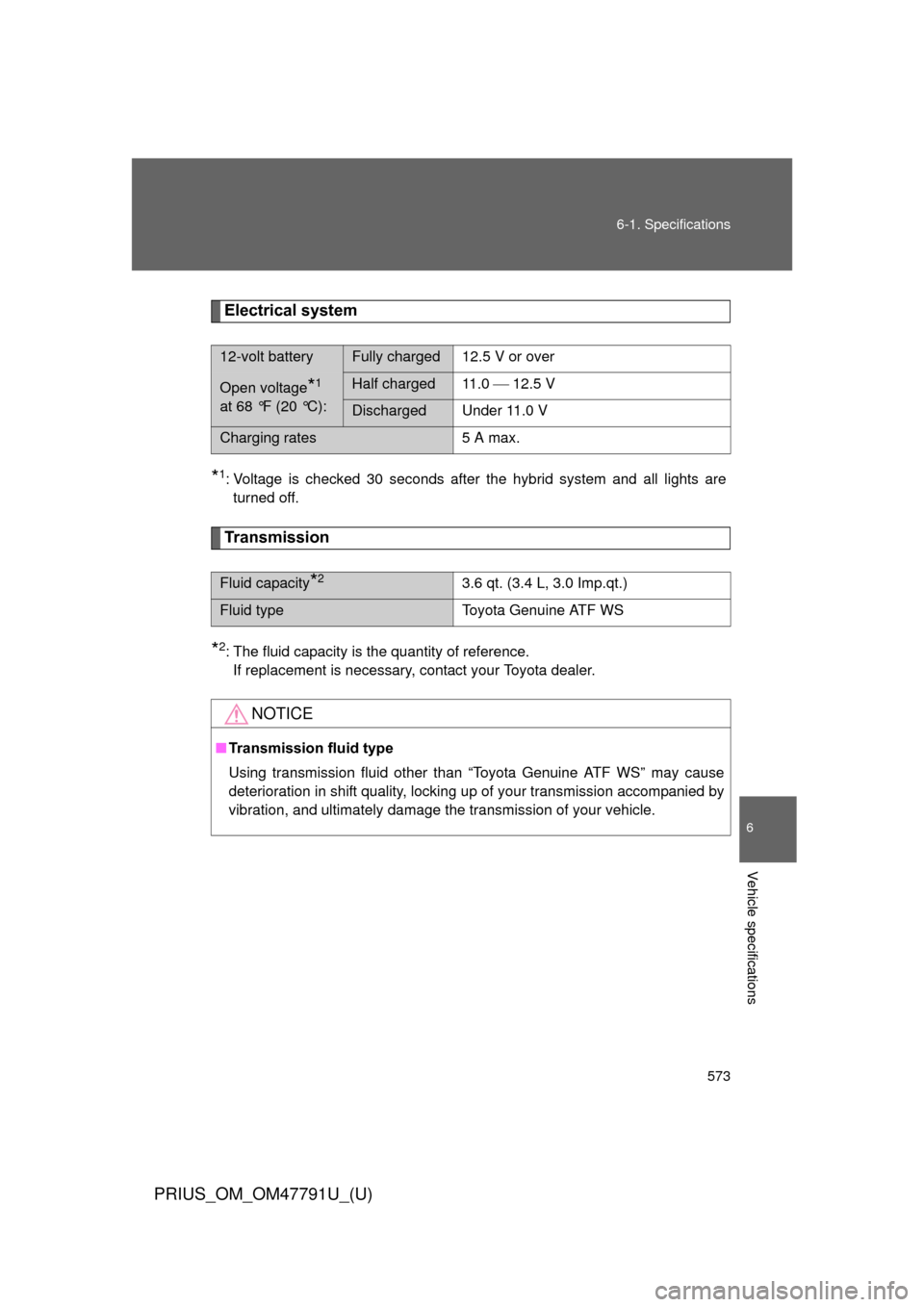
Electrical system
*1: Voltage is checked 30 seconds after the hybrid system and all lights are
turned off.
Transmission
*2: The fluid capacity is the quantity of reference.If replacement is necessary, contact your Toyota dealer.
12-volt batteryFully charged12.5 V or over
Open voltage*1
at 68 °F (20 °C):Half charged 11.0 12.5 V
Discharged Under 11.0 V
Charging rates 5 A max.
Fluid capacity*23.6 qt. (3.4 L, 3.0 Imp.qt.)
Fluid type Toyota Genuine ATF WS
NOTICE
■Transmission fluid type
Using transmission fluid other than “Toyota Genuine ATF WS” may cause
deterioration in shift quality, locking up of your transmission accompanied by
vibration, and ultimately damage the transmission of your vehicle.
Page 577 of 640
577
6-1. Specifications
6
Vehicle specifications
PRIUS_OM_OM47791U_(U)
Fuel infor mation
■Fuel tank opening fo r unleaded gasoline
To help prevent incorrect fueling, your vehicle has a fuel tank opening that
only accommodates the special nozzle on unleaded fuel pumps.
■ Gasoline quality
In very few cases, driveability problems may be caused by the brand of gas-
oline you are using. If driveability problems persist, try changing the brand of
gasoline. If this does not correct the problem, consult your Toyota dealer.
You must only use unleaded gasoline in your vehicle.
Select octane rating 87 (Research Octane Number 91) or higher. Use
of unleaded gasoline with an octane rating lower than 87 may result
in engine knocking. Persistent kno cking can lead to engine damage.
At minimum, the gasoline you use should meet the specifications
of ASTM D4814 in the U.S.A. and CGSB3.5-M93 in Canada.
Page 579 of 640

579
6-1. Specifications
6
Vehicle specifications
PRIUS_OM_OM47791U_(U)
■
Non-recommendation of the use of blended gasoline
● If you use gasohol in your vehicle, be sure that it has an octane rating no
lower than 87.
● Toyota does not recommend the use of gasoline containing methanol.
■ Non-recommendation of the use of gasoline containing MMT
Some gasoline contains an octane enhancing additive called MMT (Methyl-
cyclopentadienyl Manganese Tricarbonyl).
Toyota does not recommend the use of gasoline that contains MMT. If fuel
containing MMT is used, your emission control system may be adversely
affected.
The malfunction indicator lamp on the instrument cluster may come on. If
this happens, contact your Toyota dealer for service.
■ If your engine knocks
● Consult your Toyota dealer.
● You may occasionally notice light knocking for a short time while acceler-
ating or driving uphill. This is normal and there is no need for concern.
●Use only gasoline containing a maxi-
mum of 10% ethanol.
DO NOT use any flex-fuel or gasoline
that could contain more than 10% etha-
nol, including from any pump labeled
E15, E30, E50, E85 (which are only
some examples of fuel containing more
than 10% ethanol).DO NOT use gasoline
containing more than
10% ethanol.
(15% ethanol)
(50% ethanol)
(85% ethanol)
Page 586 of 640

586 6-1. Specifications
PRIUS_OM_OM47791U_(U)
Uniform Tire Quality GradingThis information has been prepared in accordance with regulations
issued by the National Highway Tr affic Safety Administration of the
U.S. Department of Transportation.
It provides the purchasers and/or prospective purchasers of Toyota
vehicles with information on uniform tire quality grading.
Your Toyota dealer will help answ er any questions you may have as
you read this information.
■ DOT quality grades
All passenger vehicle tires mu st conform to Federal Safety
Requirements in addition to these grades. Quality grades can be
found where applicable on the tire sidewall between tread shoulder
and maximum section width.
For example: Treadwear 200 Traction AA Temperature A
■ Treadwear
The treadwear grade is a comparative rating based on the wear
rate of the tire when tested under controlled conditions on a speci-
fied government test course.
For example, a tire graded 150 would wear one and a half (1 - 1/2)
times as well on the government course as a tire graded 100.
The relative performance of tires depends upon the actual conditions
of their use. Performance may diff er significantly from the norm due
to variations in driving habits, service practices and differences in
road characteristics and climate.
Page 588 of 640

588 6-1. Specifications
PRIUS_OM_OM47791U_(U)
Glossary of tire terminology
Tire related termMeaning
Cold tire inflation pres-
sure Tire pressure when the vehicle has been
parked for three hours or more, or has not
been driven more than 1 mile or 1.5 km under
that condition
Maximum inflation
pressure The maximum cold inflated
pressure to which a
tire may be inflated, s hown on the sidewall of
the tire
Recommended infla-
tion pressure Cold tire inflation pressure recommended by a
manufacturer
Accessory weight The combined weight (in excess of those stan-
dard items which may be replaced) of auto-
matic transmission, power steering, power
brakes, power windows, power seats, radio
and heater, to the extent that these items are
available as factory-installed equipment
(whether installed or not)
Curb weight The weight of a motor vehicle with standard
equipment, including the maximum capacity of
fuel, oil and coolant, and if so equipped, air
conditioning and additional weight optional
engine
Maximum loaded vehi-
cle weight The sum of:
(a) Curb weight
(b) Accessory weight
(c) Vehicle capacity weight
(d) Production options weight
Page 589 of 640

589
6-1. Specifications
6
Vehicle specifications
PRIUS_OM_OM47791U_(U)
Tire related termMeaning
Normal occupant
weight 150 lb. (68 kg) times the number of occupants
specified in the second column of Table 1
* that
follows
Occupant distribution Distribution of occupants in a vehicle as speci-
fied in the third column of Table 1
* below
Production options
weight The combined weight of installed regular pro-
duction options weighing over 5 lb. (2.3 kg) in
excess of the standard items which they
replace, not previously considered in curb
weight or accessory weight, including heavy
duty brakes, ride levelers, roof rack, heavy duty
12-volt battery, and special trim
Rim A metal support for a tire or a tire and tube
assembly upon which the tire beads are seated
Rim diameter
(Wheel diameter) Nominal diameter of the bead seat
Rim size designation Rim diameter and width
Rim type designation The industry manufacturer’s designation for a
rim by style or code
Rim width Nominal distance between rim flanges
Vehicle capacity
weight (Total load
capacity) The rated cargo and luggage load plus 150 lb.
(68 kg) times the vehicle’s designated seating
capacity