2013 TOYOTA PRIUS C spark
[x] Cancel search: sparkPage 108 of 556
108 1-6. Refueling
CAUTION
■When refueling the vehicle
Observe the following precautions while refueling the vehicle. Failure to do
so may result in death or serious injury.
●After exiting the vehicle and before opening the fuel door, touch an
unpainted metal surface to discharge any static electricity. It is important to
discharge static electricity before refueling because sparks resulting from
static electricity can cause fuel vapors to ignite while refueling.
● Always hold the grips on the fuel tank cap and turn it slowly to remove it.
A whooshing sound may be heard when the fuel tank cap is loosened.
Wait until the sound cannot be heard before fully removing the cap. In hot
weather, pressurized fuel may spray out the filler neck and cause injury.
● Do not allow anyone that has not discharged static electricity from their
body to come close to an open fuel tank.
● Do not inhale vaporized fuel.
Fuel contains substances that are harmful if inhaled.
● Do not smoke while refueling the vehicle.
Doing so may cause the fuel to ignite and cause a fire.
● Do not return to the vehicle or touch any person or object that is statically
charged.
This may cause static electricity to build up, resulting in a possible ignition
hazard.
■ When refueling
Observe the following precautions to prevent fuel overflowing from the fuel
tank:
●Securely insert the fuel nozzle into the fuel filler neck
● Stop filling the tank after the fuel nozzle automatically clicks off
● Do not top off the fuel tank
■ When replacing the fuel cap
Do not use anything but a genuine Toyota fuel tank cap designed for your
vehicle. Doing so may cause a fire or other incident which may result in
death or serious injury.
Page 360 of 556
360 4-3. Do-it-yourself maintenance
CAUTION
The engine compartment contains many mechanisms and fluids that may
move suddenly, become hot, or become electrically energized. To avoid death
or serious injury, observe the following precautions:
■When working on the engine compartment
●Vehicles without a smart key system: Make sure that the engine switch is
in the “LOCK” position and the “READY” indicator is off.
Vehicles with a smart key system: Make sure that the indicator on the
“POWER” switch and the “READY” indicator are both off.
● Keep hands, clothing and tools away from the moving fans and engine
drive belt.
● Be careful not to touch the engine, power control unit, radiator, exhaust
manifold, etc. right after driving as they may be hot. Oil and other fluids
may also be hot.
● Do not leave anything that may burn easily, such as paper and rags, in the
engine compartment.
● Do not smoke, cause sparks or expose an open flame to fuel. Fuel fumes
are flammable.
■ When working near the electric c ooling fans or radiator grille
Vehicles without a smart key system: The electric cooling fan may keep
rotating for about 3 minutes even after the engine switch is turned to the
“LOCK” position.
With the engine switch in the “ON” position, the electric cooling fan may
automatically start to run if the air conditioning is on and/or the coolant tem-
perature is high. Be sure the engine switch is in the “LOCK” position when
working near the electric cooling fan or radiator grille.
Vehicles with a smart key system: The electric cooling fan may keep rotating
for about 3 minutes even after the “POWER” switch is off.
With the “POWER” switch in ON mode, the electric cooling fans may auto-
matically start to run if the air conditioning is on and/or the coolant tempera-
ture is high. Be sure the “POWER” switch is off when working near the
electric cooling fans or radiator grille.
Page 380 of 556
380 4-3. Do-it-yourself maintenance
CAUTION
■Chemicals in the 12-volt battery
The 12-volt battery contains poisonous and corrosive sulfuric acid and may
produce hydrogen gas which is flammable and explosive. To reduce the risk
of death or serious injury, take the following precautions while working on or
near the 12-volt battery:
●Do not cause sparks by touching the 12-volt battery terminals with tools.
● Do not smoke or light a match near the 12-volt battery.
● Avoid contact with eyes, skin and clothes.
● Never inhale or swallow electrolyte.
● Wear protective safety glasses when working near the 12-volt battery.
● Keep children away from the 12-volt battery.
■ Where to safely charge the 12-volt battery
Always charge the 12-volt battery in an open area. Do not charge the 12-volt
battery in a garage or closed room where there is insufficient ventilation.
■ When disconnecting the 12- volt battery terminals
Always disconnect the negative (-) terminal first. If the positive (+) terminal is
disconnected first and touches a surrounding metal surface it may cause
sparks resulting in a fire or it may result in an electric shock, death or serious
injury.
■ How to recharge the 12-volt battery
Only perform a slow charge (3.5 A or less). The 12-volt battery may explode
if charged at a quicker rate.
Page 497 of 556
497
6-1. Specifications
6
Vehicle specifications
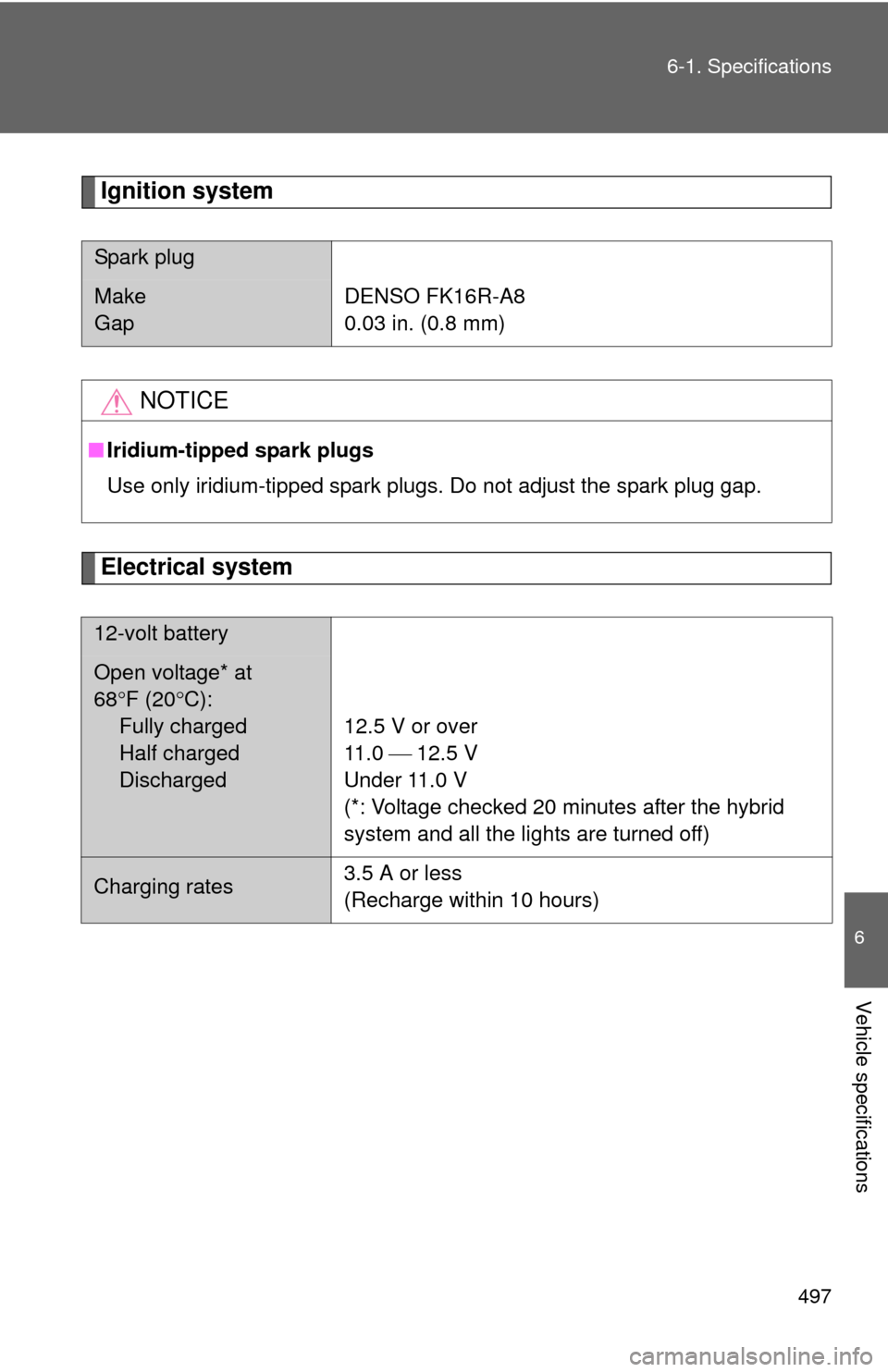
Ignition system
Electrical system
Spark plug
Make
Gap
DENSO FK16R-A8
0.03 in. (0.8 mm)
NOTICE
■
Iridium-tipped spark plugs
Use only iridium-tipped spark plugs. Do not adjust the spark plug gap.
12-volt battery
Open voltage* at
68 F (20 C):
Fully charged
Half charged
Discharged 12.5 V or over
11 . 0
12.5 V
Under
11.0 V
(*: Voltage checked 20 minutes after the hybrid
system and all the lights are turned off)
Charging rates 3.5 A or less
(Recharge within 10 hours)
Page 550 of 556

550 Alphabetical index
Seat beltsAdjusting the seat belt .............84
Automatic Locking
Retractor (ALR).....................88
Child restraint system
installation ........................... 138
Cleaning and maintaining the seat belts ...................... 347
Emergency Locking Retractor (ELR).................... 88
How to wear your seat belt......84
How your child should
wear the seat belt .................88
Pregnant women,
proper seat belt use ..............90
Reminder light ....................... 435
Seat belt extenders .................89
Seat belt pretensioners ...........88
Seat cushion airbag ................. 115
Seat heaters.............................. 335
Seating capacity....................... 229
Seats Adjustment ..............................76
Adjustment precautions........... 76
Child seats/child restraint system
installation ........................... 138
Cleaning ................................ 347
Front seat adjustment .............76
Front seat adjustment precautions ...........................76
Head restraint..........................81
Properly sitting in the seat ..... 113
Seat heaters .......................... 335
Service reminder
indicators ............................... 182 Shift lever
If the shift lever cannot
be shifted from P ................ 473
Transmission......................... 173
Shift lock system ..................... 473
Side airbags ............................. 115
Side marker lights Replacing light bulbs ............. 413
Wattage................................. 501
Side mirror Adjusting and folding............... 96
Defogger ............................... 245
Smart key system Entry function .......................... 47
Starting the hybrid
system ........................ 158, 162
Spare tire
Inflation pressure .................. 500
Storage location .................... 459
Spark plug ................................ 497
Specifications .......................... 492
Speedometer ............................ 179
Steering
Column lock release ..... 160, 166
Steering wheel Adjustment .............................. 93
Audio switches ...................... 286
Stop lights Replacing light bulbs ............. 413
Wattage................................. 501
Storage feature ........................ 322
Storage precautions ................ 227
Stuck If the vehicle becomes stuck ................................... 487
Sun visors ................................ 330S