Page 400 of 532

400 4-3. Do-it-yourself maintenance
14 POWER30 A Power windows
15 SEAT HTR 15 A Seat heater
16 HTR-IG 10 A Air conditioning system
17 WIPER 25 A Windshield wipers
18 WASHER 15 A Windshield washer
19 ECU-IG NO. 1 10 A Automatic transmission, main body
ECU, electric power steering, elec-
tric cooling fan(s), shift lock control
system, anti-lock brake system, tire
pressure warning system, vehicle
stability control system, cruise con-
trol system
20 ECU-IG NO. 2 10 A Back-up lights, charging system,
rear window defogger, air condi-
tioning system, multiport fuel injec-
tion system/sequential multiport
fuel injection system, moon roof
21 OBD 7.5 A On-board diagnosis system
22 STOP 10 AStop lights, high mounted stop-
light, anti-lock brake system, main
body ECU, multiport fuel injection
system/sequential multiport fuel
injection system, shift lock control
system, vehicle stability control
system
23 DOOR 25 A Power door lock system
24 ACC-B 25 A CIG, ACC
25 FR FOG 15 A Front fog lights
26 AM1 7.5 A Starting system, ACC, CIG
FuseAmpereCircuit
Page 417 of 532
5
When trouble arises
417
5-1. Essential information
If your vehicle needs to be towed
Before towingThe following may indicate a problem with your transmission. Contact
your Toyota dealer before towing.
● The engine is running, but the vehicle will not move.
● The vehicle makes an abnormal sound.
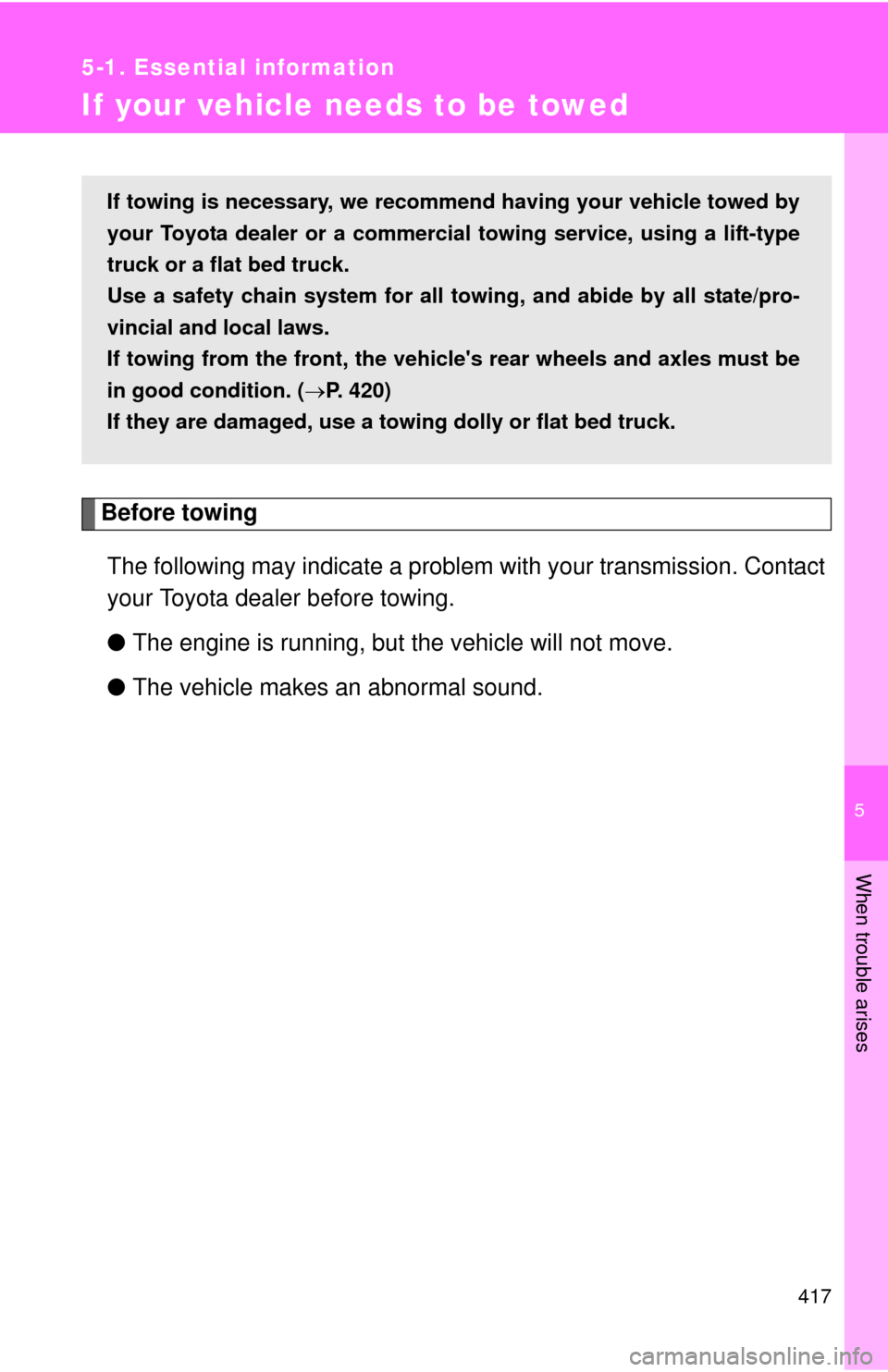
If towing is necessary, we recommend having your vehicle towed by
your Toyota dealer or a commerci al towing service, using a lift-type
truck or a flat bed truck.
Use a safety chain system for all to wing, and abide by all state/pro-
vincial and local laws.
If towing from the front, the vehic le's rear wheels and axles must be
in good condition. (P. 420)
If they are damaged, use a towing dolly or flat bed truck.
Page 421 of 532
5
When trouble arises
421
5-1. Essential information
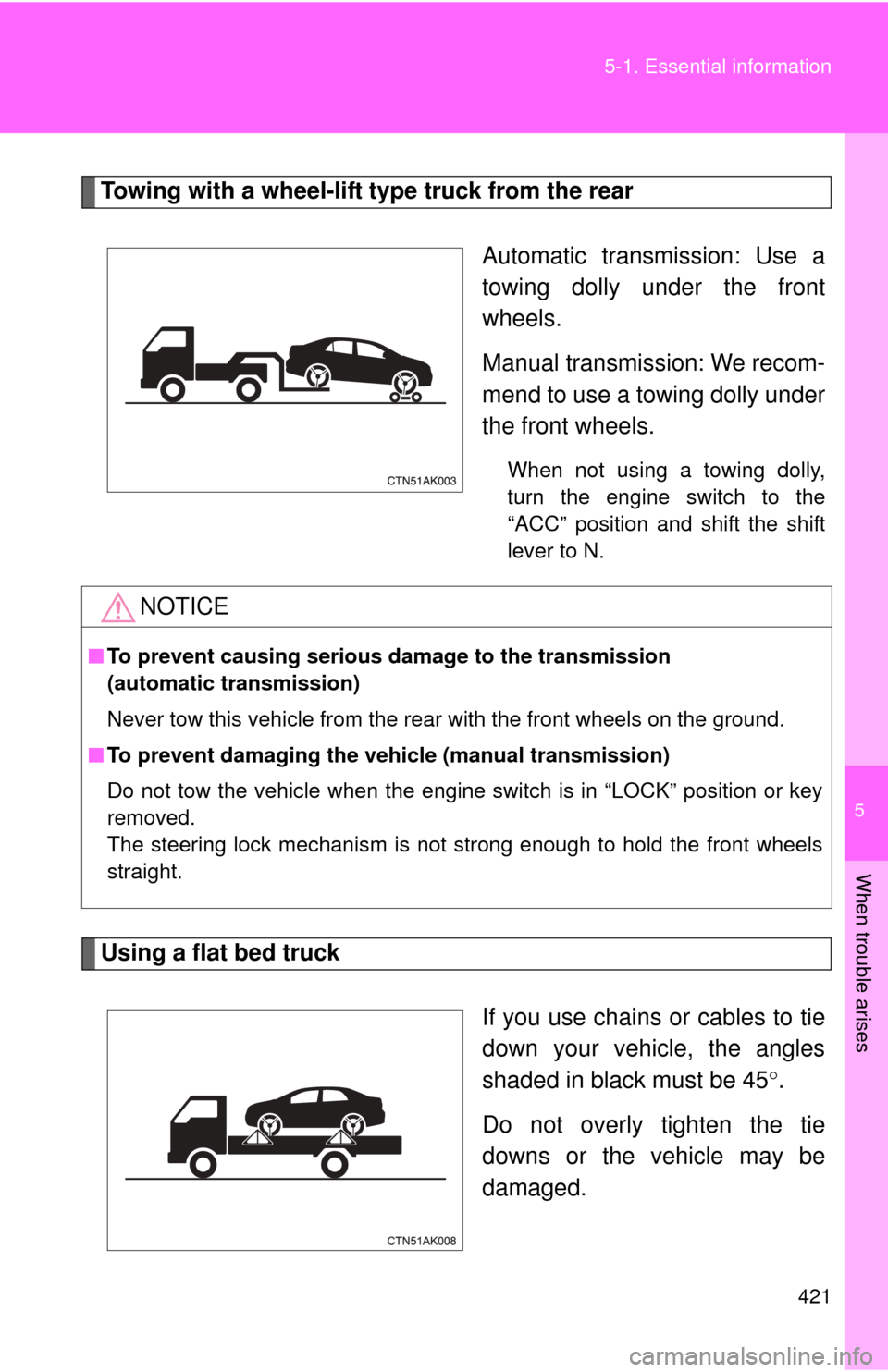
Towing with a wheel-lift type truck from the rear
Automatic transmission: Use a
towing dolly under the front
wheels.
Manual transmission: We recom-
mend to use a towing dolly under
the front wheels.
When not using a towing dolly,
turn the engine switch to the
“ACC” position and shift the shift
lever to N.
Using a flat bed truckIf you use chains or cables to tie
down your vehicle, the angles
shaded in black must be 45.
Do not overly tighten the tie
downs or the vehicle may be
damaged.
NOTICE
■ To prevent causing serious dama ge to the transmission
(automatic transmission)
Never tow this vehicle from the rear with the front wheels on the ground.
■ To prevent damaging the vehicle (manual transmission)
Do not tow the vehicle when the engine switch is in “LOCK” position or key
removed.
The steering lock mechanism is not strong enough to hold the front wheels
straight.
Page 425 of 532
5
When trouble arises
425
5-2. Steps to take in an emergency
Have the vehicle inspected immediately.
Failing to investigate the cause of the following warnings may lead to
the system operating abnormally and possibly cause an accident.
Have the vehicle inspected by your Toyota dealer immediately.
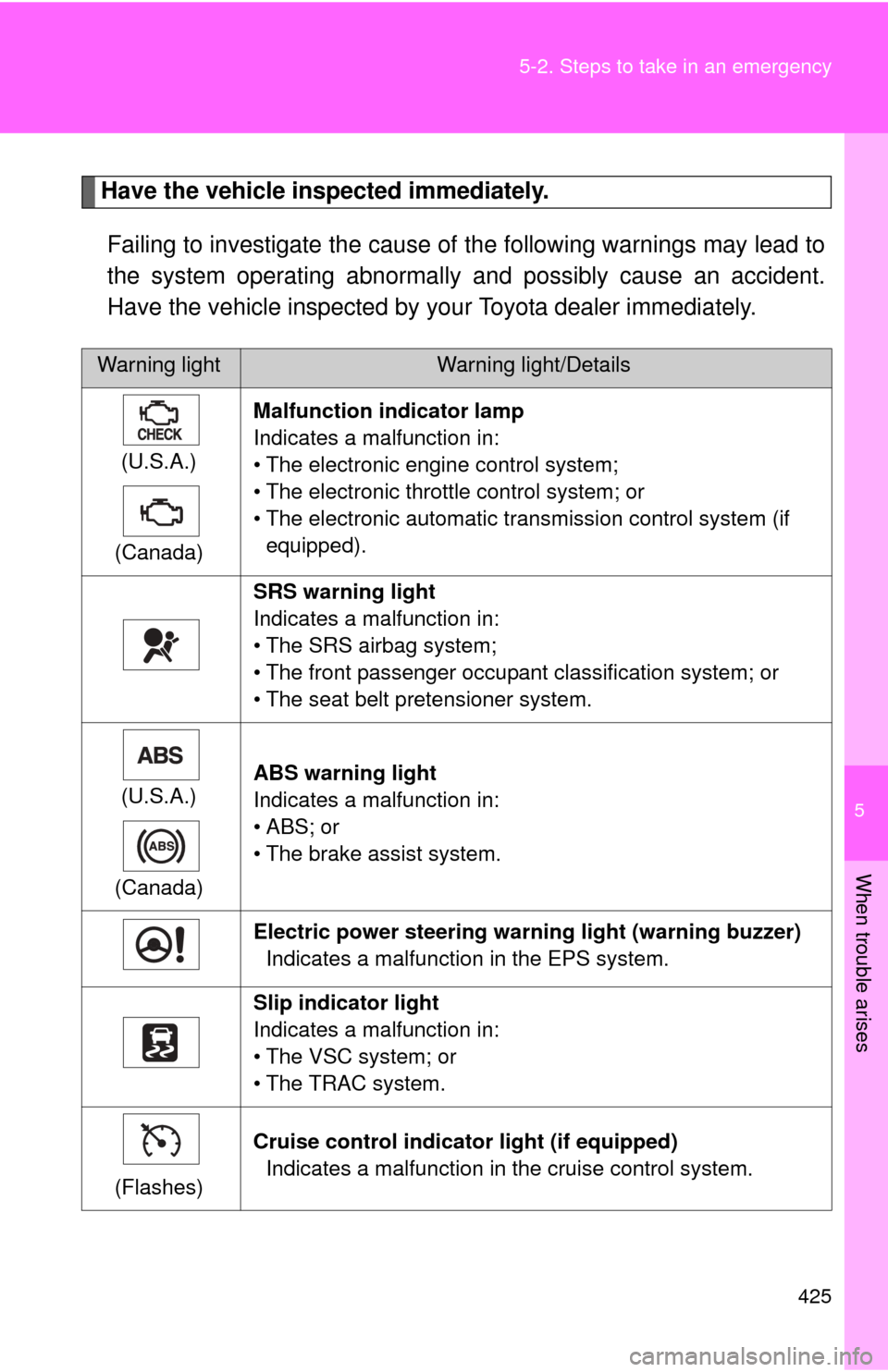
Warning lightWarning light/Details
(U.S.A.)
(Canada) Malfunction indicator lamp
Indicates a malfunction in:
• The electronic engine control system;
• The electronic throttle control system; or
• The electronic automatic transmission control system (if
equipped).
SRS warning light
Indicates a malfunction in:
• The SRS airbag system;
• The front passenger occupant classification system; or
• The seat belt pretensioner system.
(U.S.A.)
(Canada) ABS warning light
Indicates a malfunction in:
•ABS; or
• The brake assist system.
Electric power steering warning light (warning buzzer)
Indicates a malfunction in the EPS system.
Slip indicator light
Indicates a malfunction in:
• The VSC system; or
• The TRAC system.
(Flashes) Cruise control indicator light (if equipped)
Indicates a malfunction in the cruise control system.
Page 436 of 532
436
5-2. Steps to take in an emergency
If you have a flat tire
Remove the flat tire and replace it with the spare provided.
■Before jacking up the vehicle
●Stop the vehicle on a hard, flat surface.
● Set the parking brake.
● Shift the shift lever to P (automatic transmission) or R (manual
transmission).
● Stop the engine.
● Turn on the emergency flashers.
■ Location of the spare tire, jack and tools
*: The jack attachment is used w hen raising your vehicle with a
floor jack. ( P. 353)
Spare tire Jack
Wheel nut
wrenchJack handleJack
attachment*
Page 450 of 532
450
5-2. Steps to take in an emergency
If the shift lever cannot be shifted from P (automatic transmission)
If the shift lever cannot be shifted with your foot on the brake, there
may be a problem with the shift lock system (a system to prevent
accidental operation of the shift lever). Have the vehicle inspected by
your Toyota dealer.
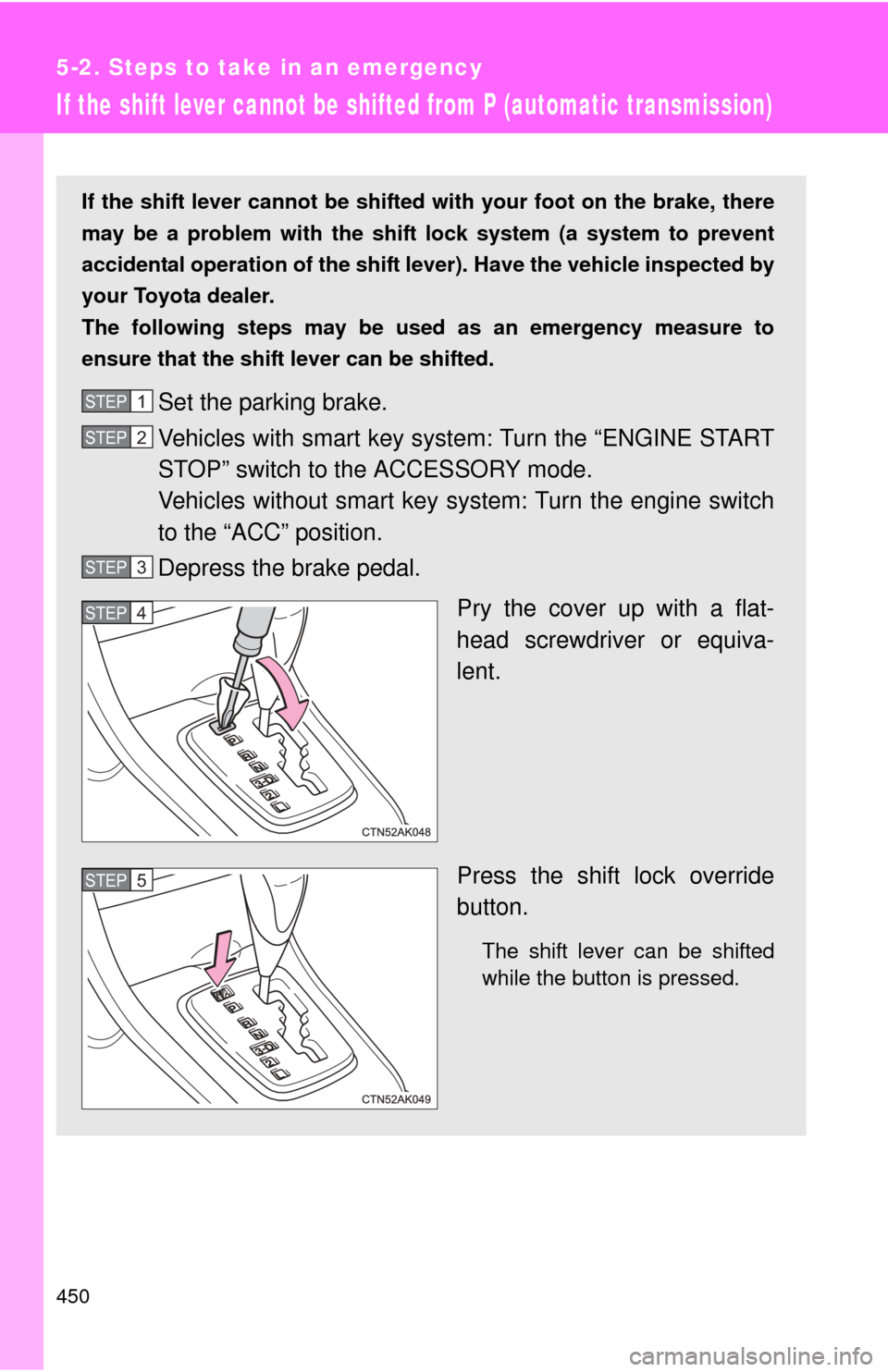
The following steps may be used as an emergency measure to
ensure that the shift lever can be shifted.
Set the parking brake.
Vehicles with smart key system: Turn the “ENGINE START
STOP” switch to the ACCESSORY mode.
Vehicles without smart key system: Turn the engine switch
to the “ACC” position.
Depress the brake pedal.
Pry the cover up with a flat-
head screwdriver or equiva-
lent.
Press the shift lock override
button.
The shift lever can be shifted
while the button is pressed.
STEP 1
STEP 2
STEP 3
STEP 4
STEP 5
Page 454 of 532
454 5-2. Steps to take in an emergency
■Stopping the engine
Shift the shift lever to P and press the “ENGINE START STOP” switch as
you normally do when stopping the engine.
■ Replacing the key battery
As the above procedure is a temporary measure, it is recommended that the
electronic key battery be replaced immediately when the battery is depleted.
(P. 388)
■ Changing “ENGINE START STOP” switch modes
Automatic transmission
Within 5 seconds of the buzzer sounding, release the brake pedal and press
the “ENGINE START STOP” switch.
The engine does not start and modes will be changed each time the switch
is pressed. ( P. 132)
Manual transmission
Within 5 seconds of the buzzer sounding, release the clutch pedal and press
the “ENGINE START STOP” switch.
The engine does not start and modes will be changed each time the switch
is pressed. ( P. 132)
Page 464 of 532
464
5-2. Steps to take in an emergency
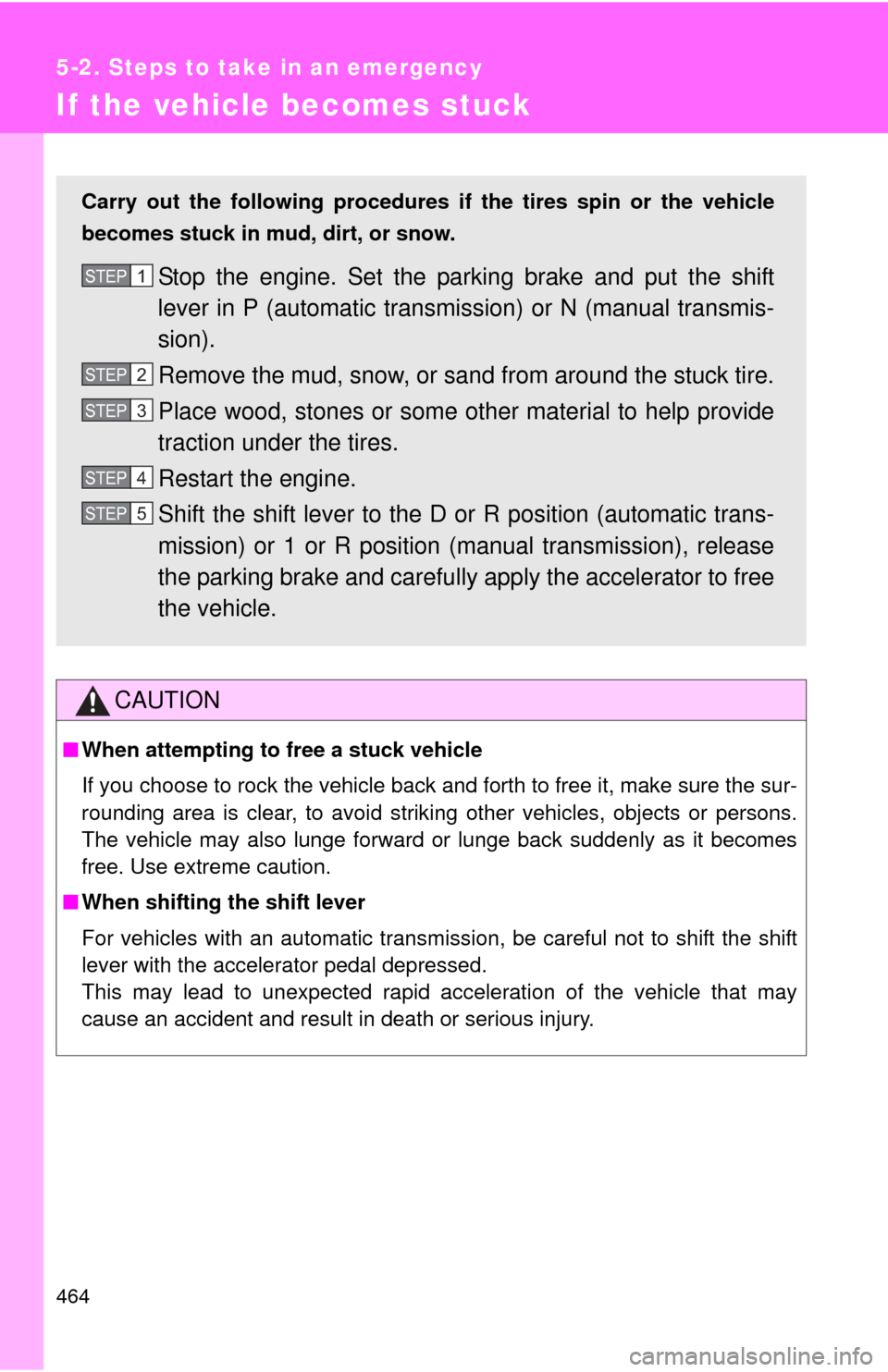
If the vehicle becomes stuck
CAUTION
■When attempting to free a stuck vehicle
If you choose to rock the vehicle back and forth to free it, make sure the sur-
rounding area is clear, to avoid striki ng other vehicles, objects or persons.
The vehicle may also lunge forward or lunge back suddenly as it becomes
free. Use extreme caution.
■ When shifting the shift lever
For vehicles with an automatic transmission, be careful not to shift the shift
lever with the accelerator pedal depressed.
This may lead to unexpected rapid acceleration of the vehicle that may
cause an accident and result in death or serious injury.
Carry out the following procedures if the tires spin or the vehicle
becomes stuck in mud, dirt, or snow.
Stop the engine. Set the parking brake and put the shift
lever in P (automatic transmission) or N (manual transmis-
sion).
Remove the mud, snow, or sand from around the stuck tire.
Place wood, stones or some other material to help provide
traction under the tires.
Restart the engine.
Shift the shift lever to the D or R position (automatic trans-
mission) or 1 or R position (manual transmission), release
the parking brake and carefully apply the accelerator to free
the vehicle.STEP 1
STEP 2
STEP 3
STEP 4
STEP 5