Page 139 of 532
139
2-1. Driving procedures
2
When driving
Automatic transmission
Select a shift position appropriate for the driving conditions.
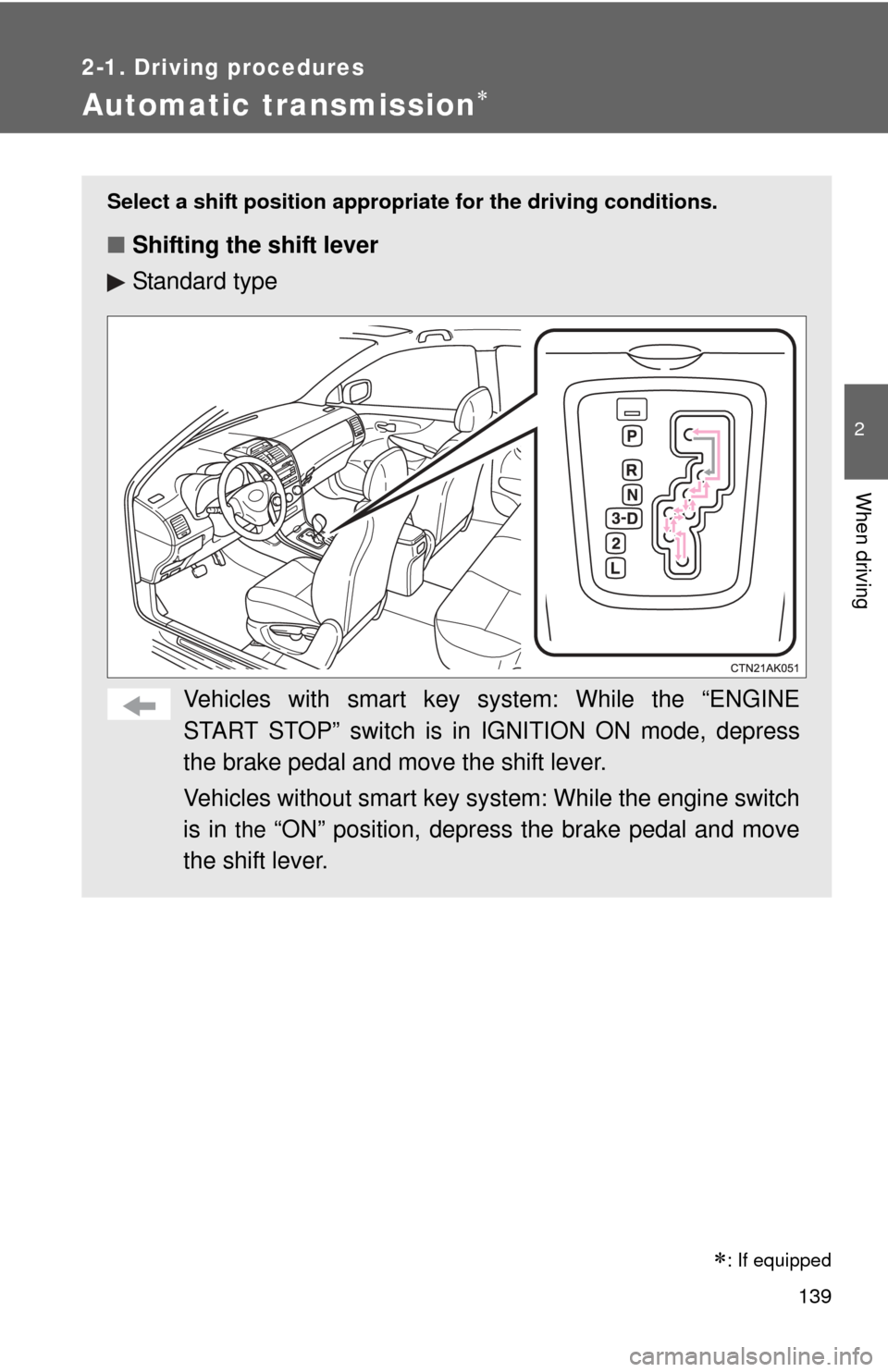
■Shifting the shift lever
Standard type
Vehicles with smart key system: While the “ENGINE
START STOP” switch is in IGNITION ON mode, depress
the brake pedal and move the shift lever.
Vehicles without smart key sy stem: While the engine switch
is in
the “ON” position, depress the brake pedal and move
the shift lever.
: If equipped
Page 144 of 532

144 2-1. Driving procedures
■When driving with cruise cont rol activated (if equipped)
Standard type
Even when performing the following actions with the intent of enabling
engine braking, engine braking will not activate while downshifting to 3
because cruise control will not be canceled. ( P. 168)
Multi-mode type
Even when performing the following actions with the intent of enabling
engine braking, engine braking will not activate while driving in S mode and
downshifting to 4 because cruise control will not be canceled. ( P. 168)
■ If the shift lever cannot be shifted from P
P. 450
■ If the “S” indicator does not come on even after shifting the shift lever
to S (multi-mode type)
This may indicate a malfunction in the automatic transmission system. Have
the vehicle inspected by your Toyota dealer immediately.
(In this situation, the vehicle will operate as if the shift lever is in D.)
■ AI-SHIFT
AI-SHIFT automatically selects the suitable gear according to driver perfor-
mance and driving conditions.
Standard type
AI-SHIFT automatically operates when the shift lever is in the D position. Multi-mode type
AI-SHIFT automatically operates when the shift lever is in the D position.
(Shifting the shift lever to the S position cancels the function.)
Page 145 of 532
145
2-1. Driving procedures
2
When driving
Manual transmission
■Maximum allowable speeds
Observe the following maximum allowable speeds in each gear when maxi-
mum acceleration is necessary.
2.4 L 4-cylinder (2AZ-FE) engine mph (km/h)
1.8 L 4-cylinder (2ZR-FE) engine mph (km/h)
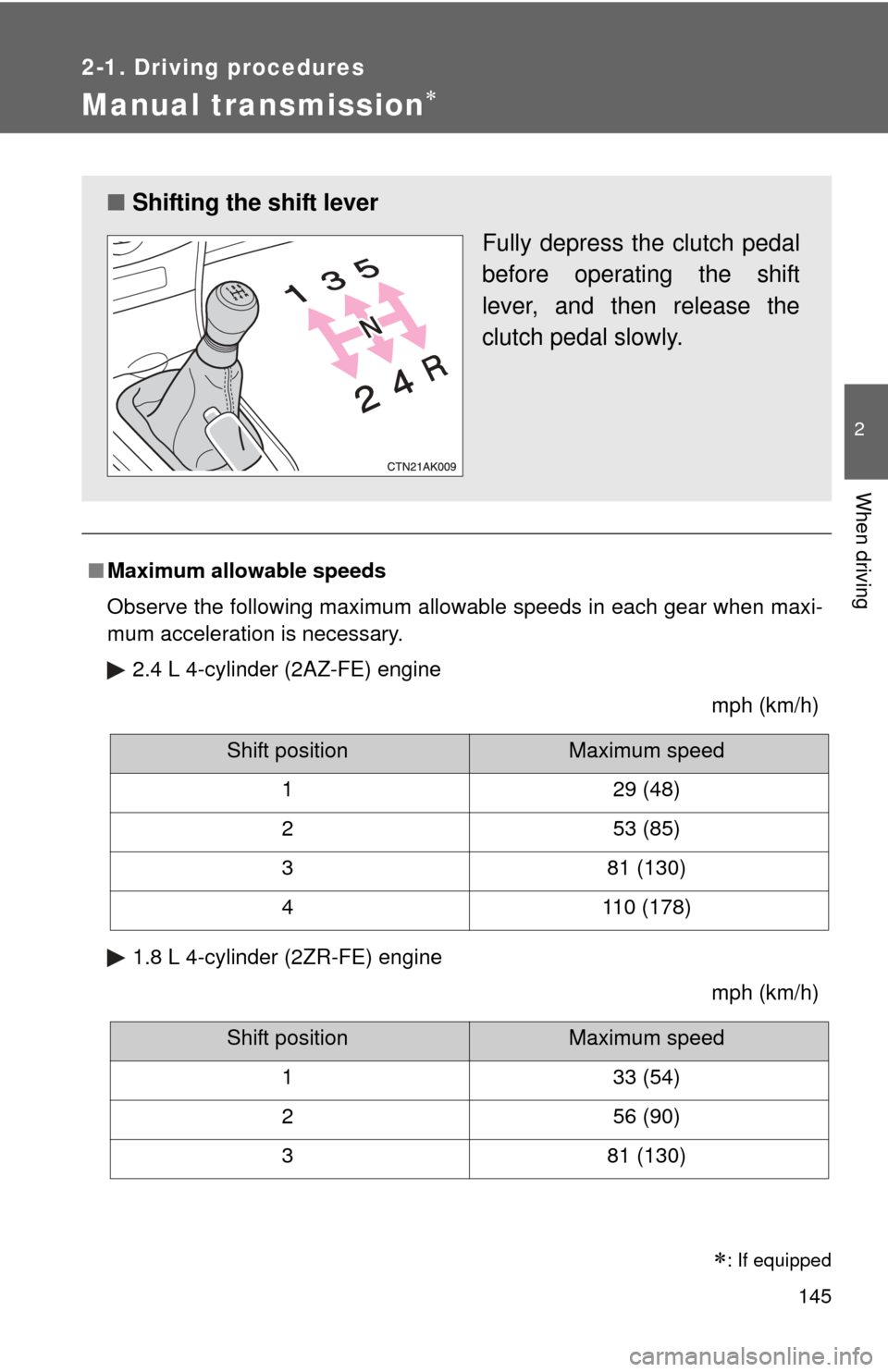
■Shifting the shift lever
Fully depress the clutch pedal
before operating the shift
lever, and then release the
clutch pedal slowly.
Shift positionMaximum speed
1 29 (48)
2 53 (85)
3 81 (130)
4 110 (178)
Shift positionMaximum speed
1 33 (54)
2 56 (90)
3 81 (130)
: If equipped
Page 154 of 532

154 2-2. Instrument cluster
■Indicators
The indicators inform the driver of the operating state of the
vehicle’s various systems.
*1: These lights turn on when the “ENGINE START STOP” switch is
turned to IGNITION ON mode (vehicles with smart key system) or
the engine switch is turned to
the “ON” position (vehicles without
smart key system) to indicate that a system check is being per-
formed. They will turn off after the engine is started, or after a few
seconds. There may be a malfunction in a system if a light does not
come on, or if the lights do not turn off. Have the vehicle inspected
by your Toyota dealer for details.
*2: The light flashes to indicate that the system is operating.
Turn signal indicator
( P. 146)
(if equipped)
Front fog light indicator
( P. 163)
Headlight high beam
indicator ( P. 160)
(if equipped)
Cruise control indicator
(P. 168)
Slip indicator
(P. 172)
(if equipped)
Cruise control set indi-
cator (P. 168)
Engine immobilizer sys-
tem indicator ( P. 81)
VSC OFF indicator
(P. 173)
“TRAC OFF” indicator
(P. 173)
(vehicles with an automatic transmission)
*1, 2
“PASSENGER
AIR BAG ON”
and
“PASSENGER
AIR BAG OFF”
indicator
(P. 98)*1
*1
*1
Shift position
indicators
(P. 139)
Page 170 of 532
170 2-4. Using other driving systems
■Cruise control can be set when
●Automatic transmission:
The shift lever is in the D or range 3 (standard type), or in the D or range
4 or higher of S has been selected (multi-mode type).
● Vehicle speed is above approximately 25 mph (40 km/h).
■ Accelerating after setting the vehicle speed
●The vehicle can be accelerated normally. After acceleration, the set
speed resumes.
● Even without canceling the cruise control, the set speed can be
increased by first accelerating the vehicle to the desired speed and then
pushing the lever down to set the new speed.
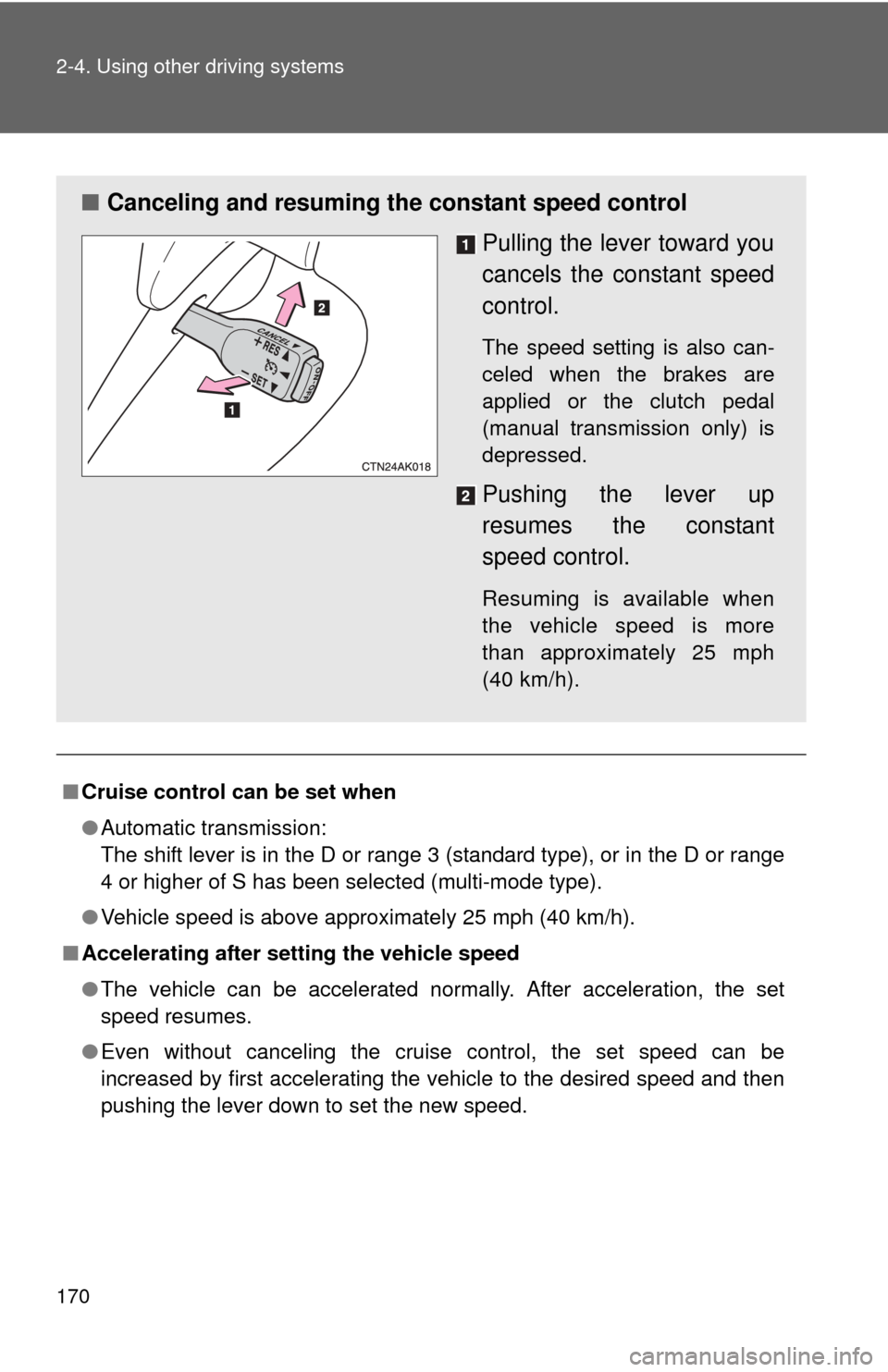
■ Canceling and resuming the constant speed control
Pulling the lever toward you
cancels the constant speed
control.
The speed setting is also can-
celed when the brakes are
applied or the clutch pedal
(manual transmission only) is
depressed.
Pushing the lever up
resumes the constant
speed control.
Resuming is available when
the vehicle speed is more
than approximately 25 mph
(40 km/h).
Page 182 of 532
182 2-5. Driving information
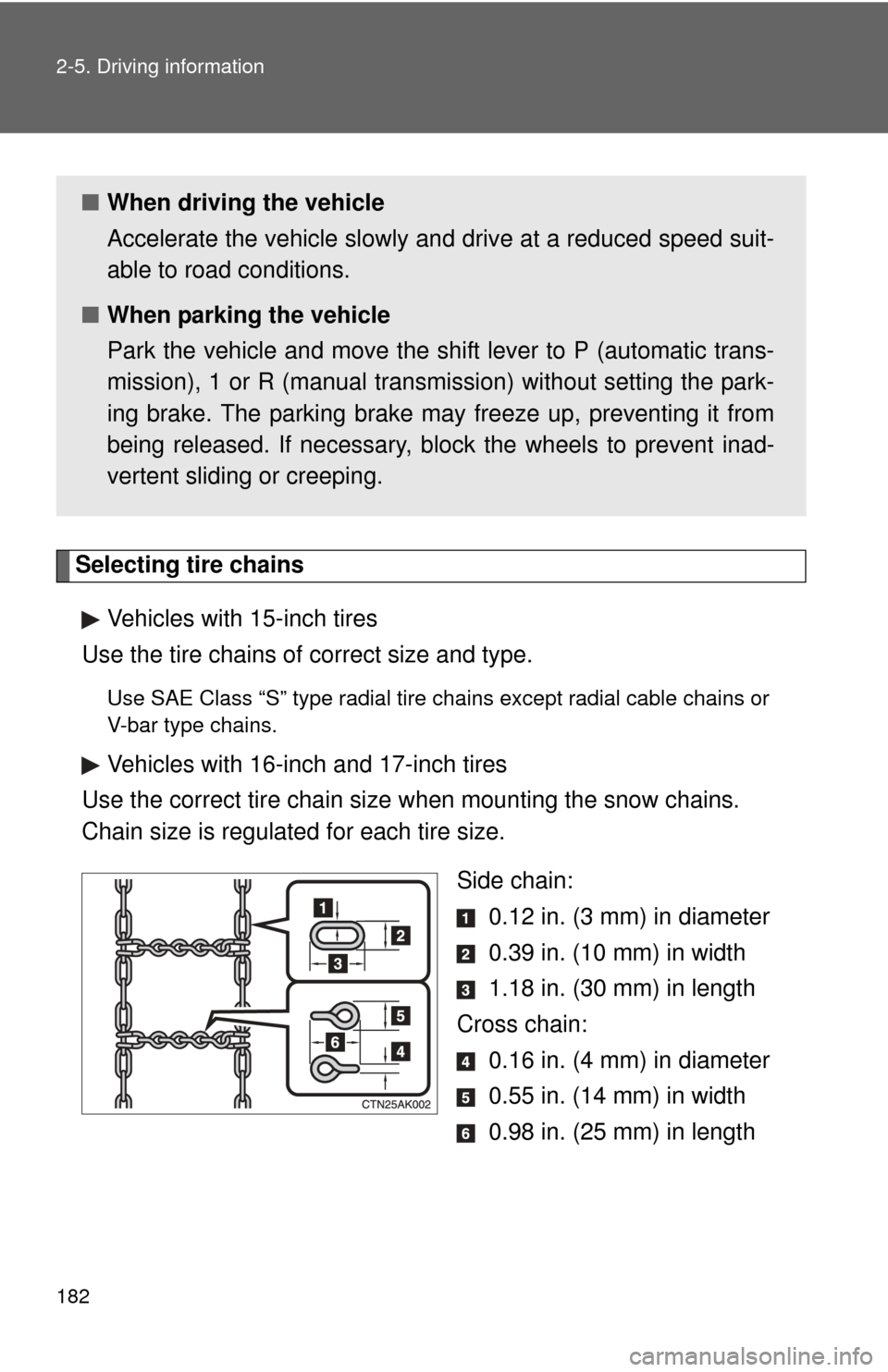
Selecting tire chainsVehicles with 15-inch tires
Use the tire chains of correct size and type.
Use SAE Class “S” type radial tire chai ns except radial cable chains or
V-bar type chains.
Vehicles with 16-inch and 17-inch tires
Use the correct tire chain size when mounting the snow chains.
Chain size is regulated for each tire size.
Side chain: 0.12 in. (3 mm) in diameter
0.39 in. (10 mm) in width
1.18 in. (30 mm) in length
Cross chain: 0.16 in. (4 mm) in diameter
0.55 in. (14 mm) in width
0.98 in. (25 mm) in length
■When driving the vehicle
Accelerate the vehicle slowly and drive at a reduced speed suit-
able to road conditions.
■ When parking the vehicle
Park the vehicle and move the shift lever to P (automatic trans-
mission), 1 or R (manual transmission) without setting the park-
ing brake. The parking brake may freeze up, preventing it from
being released. If necessary, block the wheels to prevent inad-
vertent sliding or creeping.
Page 188 of 532
188 2-5. Driving information
■Tongue Weight
The load placed on the trailer
hitch ball. (P. 190)
Weight limits
● The gross trailer weight must never exceed 1500 lbs (680 kg).
Automatic transmission
● The gross combination weight mu st never exceed 4797 lbs (2176
kg).
Manual transmission
● The gross combination weight mu st never exceed 4732 lbs (2146
kg).
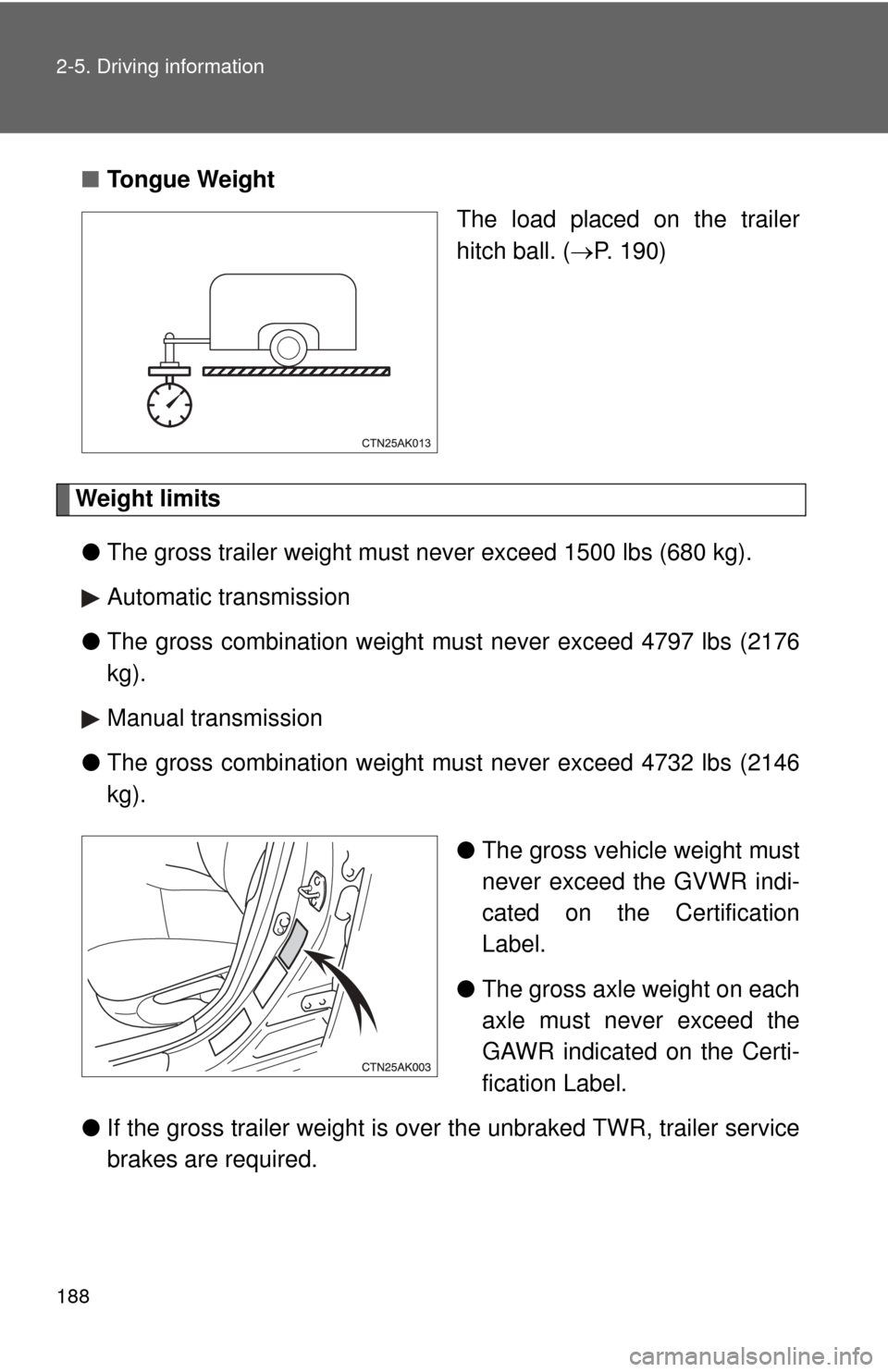
●The gross vehicle weight must
never exceed the GVWR indi-
cated on the Certification
Label.
● The gross axle weight on each
axle must never exceed the
GAWR indicated on the Certi-
fication Label.
● If the gross trailer weight is over the unbraked TWR, trailer service
brakes are required.
Page 189 of 532
189
2-5. Driving information
2
When driving
GCWR, TWR and Unbraked TWR
Confirm that the gross trailer weight, gross combination weight, gross
vehicle weight, gross axle weight and tongue weight are all within the
limits.
■ GCWR
*
Automatic transmission
4797 lb. (2176 kg)
Manual transmission
4732 lb. (2146 kg)
■ TWR
*
1500 lb. (680 kg)
■ Unbraked TWR
*
1000 lb. (454 kg)
*: This model meets the tow-vehicle trailering requirement of SAE Interna-
tional per SAE J2807.