Page 1 of 372
TABLE OF CONTENTS
AYGO_WE_99G80E
1
1Before drivingAdjusting and operating features such as door locks,
mirrors, and steering column.
2When drivingDriving, stopping and safe-driving information.
3Interior featuresAir conditioning and audio systems, as well as other
interior features for a comfortable driving experience.
4Maintenance and
careCleaning and protecting your vehicle, performing do-it-
yourself maintenance, and maintenance information.
5When trouble
arisesWhat to do if the vehicle needs to be towed, gets a flat
tire, or is involved in an accident.
6Vehicle specifi-
cationsDetailed vehicle information.
IndexAlphabetical listing of information contained in this
manual.
Page 4 of 372

TABLE OF CONTENTSIndex
AYGO_WE_99G80E
4
4-1. Maintenance and care
Cleaning and protecting
the vehicle exterior ........... 242
Cleaning and protecting
the vehicle interior ............ 245
4-2. Maintenance
Maintenance
requirements..................... 248
4-3. Do-it-yourself maintenance
Do-it-yourself service
precautions ....................... 251
Hood ................................... 254
Positioning a floor jack ........ 257
Engine compartment........... 260
Clutch pedal (vehicles with
a manual transmission) .... 271
Tires .................................... 272
Tire inflation pressure ......... 275
Wheels ................................ 277
Air conditioning filter ........... 279
Wireless remote control
battery............................... 280
Checking and replacing
fuses ................................. 282
Light bulbs .......................... 2925-1. Essential information
Emergency flashers ........... 304
If your vehicle needs to
be towed .......................... 305
If you think something
is wrong............................ 310
Fuel pump shut off
system.............................. 311
5-2. Steps to take in an emergency
If a warning light turns on
or a warning buzzer
sounds... .......................... 312
If you have a flat tire ........... 318
If the engine will not start ... 329
If the shift lever cannot be
shifted (vehicles with
a multi-mode manual
transmission).................... 330
If you lose your keys .......... 331
If the vehicle battery
is discharged .................... 332
If your vehicle overheats .... 336
If the vehicle becomes
stuck................................. 340
If your vehicle has to
be stopped in
an emergency .................. 342
4Maintenance and care5When trouble arises
Page 7 of 372
AYGO_WE_99G80E
7
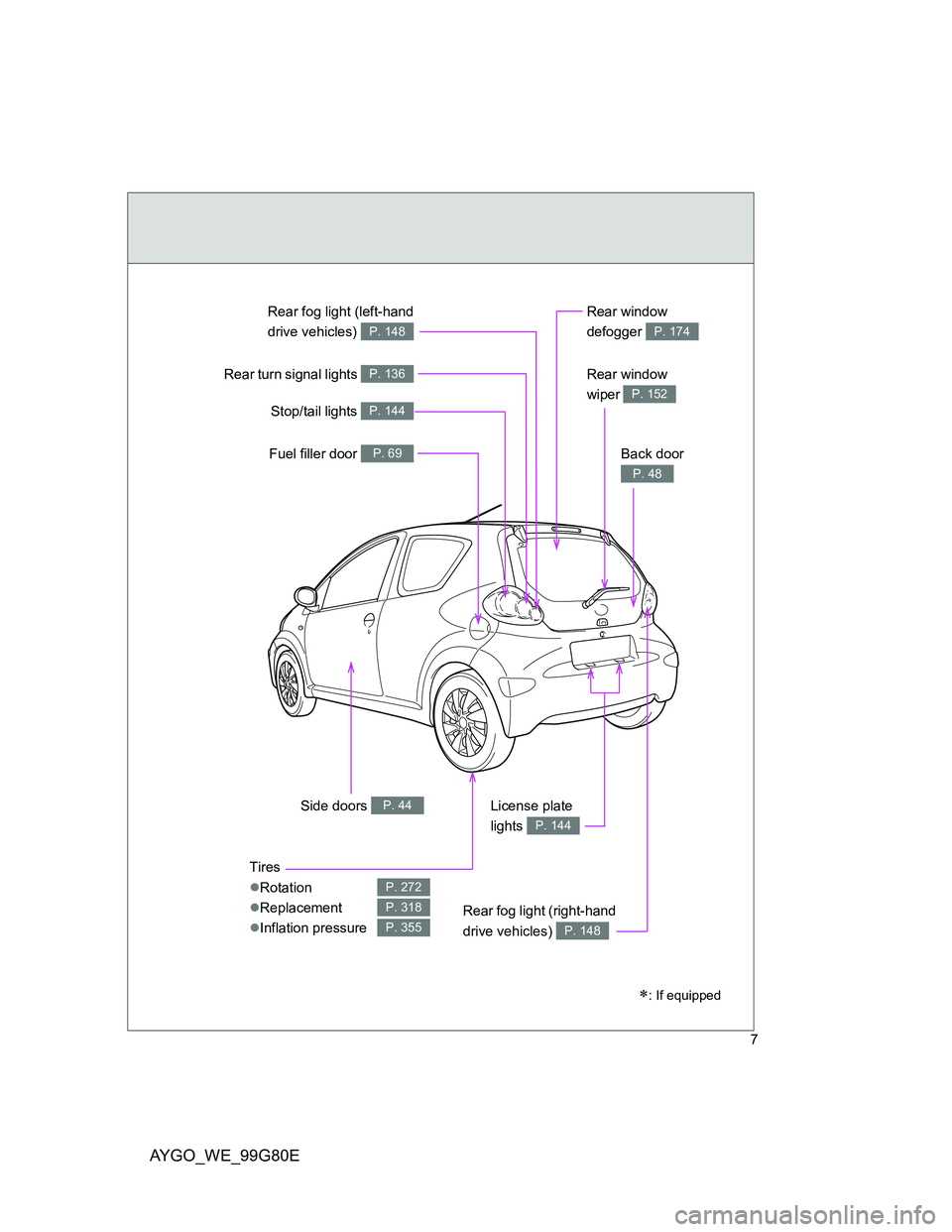
Rear window
wiper
P. 152
Tires
Rotation
Replacement
Inflation pressure
P. 272
P. 318
P. 355
Side doors P. 44
Rear window
defogger
P. 174
Fuel filler door P. 69
Stop/tail lights P. 144
Rear turn signal lights P. 136
Rear fog light (left-hand
drive vehicles)
P. 148
Rear fog light (right-hand
drive vehicles)
P. 148
Back door
P. 48
: If equipped
License plate
lights
P. 144
Page 9 of 372
AYGO_WE_99G80E
9
Rear window
wiper
P. 152
Tires
Rotation
Replacement
Inflation pressure
P. 272
P. 318
P. 355
Side doors P. 44
Rear window
defogger
P. 174
Fuel filler door P. 69
Stop/tail lights P. 144
Rear turn signal lights P. 136
Rear fog light (left-hand
drive vehicles)
P. 148
Rear fog light (right-hand
drive vehicles)
P. 148
Back door
P. 48
: If equipped
License plate
lights
P. 144
Page 79 of 372
79
1
1-7. Safety information
Before driving
AYGO_WE_99G80E
SRS airbags
The SRS airbags inflate when the vehicle is subjected to certain
types of severe impacts that may cause significant injury to the
occupants. They work together with the seat belts to help reduce the
risk of death or serious injury.
SRS front airbags
SRS driver airbag/front passenger airbag
Can help protect the head and chest of the driver and front pas-
senger from impact with interior components
SRS side and curtain shield airbags
SRS side airbags (if equipped)
Can help protect the torso of the front seat occupants
SRS curtain shield airbags (if equipped)
Can help protect primarily the head of occupants in the outer
seats
Page 81 of 372

81 1-7. Safety information
1
Before driving
AYGO_WE_99G80EThe main SRS airbag system components are shown above. The
SRS airbag system is controlled by the airbag sensor assembly. As
the airbags deploy, a chemical reaction in the inflators quickly fills the
airbags with non-toxic gas to help restrain the motion of the occu-
pants.
If the SRS airbags deploy (inflate)
Bruising and slight abrasions may result from contact with a deploying
(inflating) SRS airbag.
A loud noise and white powder will be emitted.
Vehicles without SRS curtain shield airbags: Parts of the airbag module
(steering wheel hub, airbag cover and inflator) as well as the front seats
may be hot for several minutes. The airbag itself may also be hot.
Vehicles with SRS curtain shield airbags: Parts of the airbag module
(steering wheel hub, airbag cover and inflator) as well as the front seats,
parts of the front and rear pillars, and roof side rails, may be hot for sev-
eral minutes. The airbag itself may also be hot.
The windshield may crack.
SRS airbag deployment conditions (SRS front airbags)
The SRS front airbags will deploy in the event of an impact that exceeds
the set threshold level (the level of force corresponding to an approxi-
mately 20 - 30 km/h [12 - 18 mph] frontal collision with a fixed wall that
does not move or deform).
However, this threshold velocity will be considerably higher in the following
situations:
• If the vehicle strikes an object, such as a parked vehicle or sign pole,
which can move or deform on impact
• If the vehicle is involved in an underride collision, such as a collision in
which the front of the vehicle “underrides”, or goes under, the bed of a
truck
Depending on the type of collision, it is possible that only the seat belt
pretensioners will activate.
Page 82 of 372

82 1-7. Safety information
AYGO_WE_99G80E
SRS airbag deployment conditions (SRS side and curtain shield air-
bags [if equipped])
The SRS side and curtain shield airbags will deploy in the event of an impact
that exceeds the set threshold level (the level of force corresponding to the
impact force produced by an approximately 1500 kg [3300 lb.] vehicle collid-
ing with the vehicle cabin from a direction perpendicular to the vehicle orien-
tation at an approximate speed of 20 - 30 km/h [12 - 18 mph]).
Conditions under which the SRS airbags may deploy (inflate), other
than a collision
The SRS front airbags may also deploy if a serious impact occurs to the
underside of your vehicle. Some examples are shown in the illustration.
Types of collisions that may not deploy the SRS airbags (SRS front air-
bags)
The SRS front airbags do not generally inflate if the vehicle is involved in a
side or rear collision, if it rolls over, or if it is involved in a low-speed frontal
collision. But, whenever a collision of any type causes sufficient forward
deceleration of the vehicle, deployment of the SRS front airbags may occur.
Hitting a curb, edge of pavement or
hard surface
Falling into or jumping over a deep hole
Landing hard or falling
Collision from the side
Collision from the rear
Vehicle rollover
Page 83 of 372
83 1-7. Safety information
1
Before driving
AYGO_WE_99G80E
Types of collisions that may not deploy the SRS airbags
(SRS side and curtain shield airbags [if equipped])
The SRS side and curtain shield airbags may not activate if the vehicle is
subjected to a collision from the side at certain angles, or a collision to the
side of the vehicle body other than the passenger compartment.
The SRS side and curtain shield airbags do not generally inflate if the vehi-
cle is involved in a frontal or rear collision, if it rolls over, or if it is involved in
a low-speed side collision.
Collision from the side to the vehicle
body other than the passenger com-
partment
Collision from the side at an angle
Collision from the front
Collision from the rear
Vehicle rollover