4477-2. Steps to take in an emergency
7
When trouble arises
AVALON_HV_U (OM41451U)
CAUTION
■When inspecting under the hood of your vehicle
Observe the following precautions.
Failure to do so may result in serious injury such as burns.
●If steam is seen coming from under the hood, do not open the hood until
the steam has subsided. The engine compartment may be very hot.
● Make sure that the “READY” indicator is off.
● Keep hands and clothing away from the fans, etc. while the hybrid system
is operating.
● On hybrid vehicles, the gasoline engine may automatically start, or the
cooling fan may suddenly operate even if the gasoline engine stops. Do
not touch or approach rotating parts such as the fan, which may lead to fin-
gers or clothing (especially a tie, a scarf or a muffler) getting caught,
resulting in serious injury.
NOTICE
■When adding engine/power control unit coolant
Add coolant slowly after the hybrid system has cooled down sufficiently.
Adding cool coolant to a hot hybrid system too quickly can cause damage to
the hybrid system.
■ To prevent damage to the cooling system
Observe the following precautions:
●Avoid contaminating the coolant with foreign matter (such as sand or dust etc.).
● Do not use commercially available coolant additives.
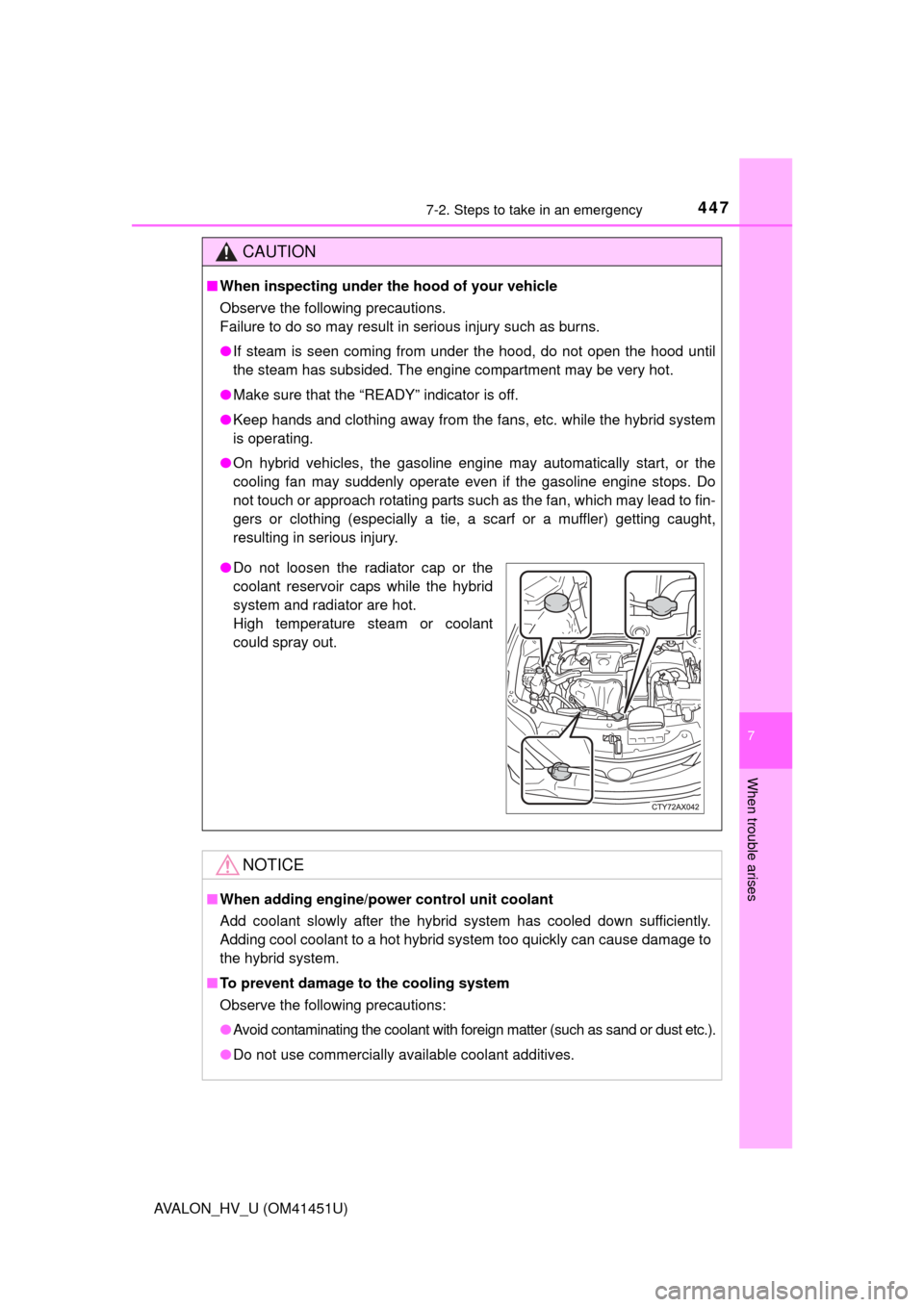
●Do not loosen the radiator cap or the
coolant reservoir caps while the hybrid
system and radiator are hot.
High temperature steam or coolant
could spray out.
4708-1. Specifications
AVALON_HV_U (OM41451U)■
Temperature A, B, C
The temperature grades are A (the hi
ghest), B, and C, representing
the tire’s resistance to the generation of heat and its ability to dissi-
pate heat when tested under cont rolled conditions on a specified
indoor laboratory test wheel.
Sustained high temperature can cause the material of the tire to
degenerate and reduce tire life, and excessive temperature can lead
to sudden tire failure.
Grade C corresponds to a level of performance which all passenger
car tires must meet under the Federal Motor Vehicle Safety Stan-
dard No. 109.
Grades B and A represent higher le vels of performance on the labo-
ratory test wheel than the minimum required by law.
Warning: The temperature grades of a tire assume that it is properly
inflated and not overloaded.
Excessive speed, underinflation, or excessive loading, either sepa-
rately or in combination, can cause heat buildup and possible tire
failure.