Page 5 of 616
5
1
8 7
6
5
4
3
2
Auris Touring Sports_EE (OM12G12E)6-1. Maintenance and care
Cleaning and protecting
the vehicle exterior ..........388
Cleaning and protecting
the vehicle interior ...........392
6-2. Maintenance
Maintenance
requirements....................395
6-3. Do-it-yourself
maintenance
Do-it-yourself service
precautions ......................398
Hood ..................................401
Positioning a floor jack .......403
Engine compartment..........405
Tires ...................................422
Tire inflation pressure ........424
Wheels ...............................426
Air conditioning filter ..........428
Wireless remote control/
electronic key battery.......430
Checking and replacing
fuses ................................433
Light bulbs .........................4507-1. Essential information
Emergency flashers .......... 468
If your vehicle has to
be stopped in an
emergency ...................... 469
7-2. Steps to take in an
emergency
If your vehicle needs to
be towed ......................... 471
If you think something is
wrong .............................. 477
Fuel pump shut off
system............................. 478
If a warning light turns
on or a warning buzzer
sounds ............................ 479
If a warning message or
indicator is displayed....... 492
If you have a flat tire
(vehicles with a spare
tire) .................................. 512
If you have a flat tire
(vehicles with an
emergency tire
puncture repair kit) .......... 524
If the engine will not
start ................................. 548
If the shift lever cannot
be shifted from P ............. 550
6Maintenance and care7When trouble arises
Page 262 of 616
2624-5. Using the driving support systems
Auris Touring Sports_EE (OM12G12E)
CAUTION
Conditions in which the use of Simple-IPA is prohibited
Do not use Simple-IPA under the following conditions.
Doing so may cause improper operation and lead to an unexpected acci-
dent.
On sharp bends or slopes.
On slippery or icy roads, or in snow.
On uneven road surfaces such as gravel.
During bad weather such as heavy rain, fog, snow, or a sandstorm.
When the tires are extremely worn or tire pressure is low.
When the vehicle has improper wheel alignment due to tires having
received a strong impact such as bumping against a curb.
When the compact spare tire (if equipped) or snow chains are installed.
When the tires slid while attempting to park.
When fallen leaves or snow is in a parking space.
When items such as a towing bracket, trailer, bicycle carrier, etc. are
installed on the rear of the vehicle.
When a vehicle of which the front/rear end is above the detection area,
such as a truck, bus or vehicle with a towing bracket, trailer, bicycle carrier,
etc., is parked at the front or rear of the parking space.
If the front bumper has been damaged.
If the sensor is covered by the front bumper cover, etc.
If a vehicle or obstacle is not in a suitable position at the front or rear of the
parking space.
Automatic steering precautions
As the steering wheel moves automatically in the parking assist function, be
aware of the following point.
Keep clothing such as neckties, scarves and long sleeves away from the
steering wheel, as they may become entangled. Also, keep children away
from the steering wheel.
If you have long fingernails, be careful not to injure yourself when the
steering wheel moves.
Page 423 of 616
4236-3. Do-it-yourself maintenance
Auris Touring Sports_EE (OM12G12E)
6
Maintenance and care
CAUTION
When inspecting or replacing tires
Observe the following precautions to prevent accidents.
Failure to do so may cause damage to parts of the drive train as well as
dangerous handling characteristics, which may lead to an accident resulting
in death or serious injury.
Do not mix tires of different makes, models or tread patterns.
Also, do not mix tires of remarkably different treadwear.
Do not use tire sizes other than those recommended by Toyota.
Do not mix differently constructed tires (radial, bias-belted or bias-ply
tires).
Do not mix summer, all season and snow tires.
Do not use tires that have been used on another vehicle.
Do not use tires if you do not know how they were used previously.
Vehicles with a compact spare tire: Do not tow if your vehicle has a com-
pact spare tire installed.
NOTICE
Driving on rough roads
Take particular care when driving on roads with loose surfaces or potholes.
These conditions may cause losses in tire inflation pressure, reducing the
cushioning ability of the tires. In addition, driving on rough roads may cause
damage to the tires themselves, as well as the vehicle’s wheels and body.
Low profile tires (17-inch tires)
Low profile tires may cause greater damage than usual to the tire wheel
when sustaining impact from the road surface. Therefore, pay attention to
the following:
Be sure to use proper tire inflation pressure. If tires are under-inflated, they
may be damaged more severely.
Avoid potholes, uneven pavement, curbs and other road hazards. Failure
to do so may lead to severe tire and wheel damage.
If tire inflation pressure of each tire becomes low while driving
Do not continue driving, or your tires and/or wheels may be ruined.
Page 512 of 616
5127-2. Steps to take in an emergency
Auris Touring Sports_EE (OM12G12E)
Stop the vehicle on a hard, flat surface.
Set the parking brake.
Shift the shift lever to P (Multidrive) or R (manual transmission).
Stop the engine.
Turn on the emergency flashers. (P. 468)
If you have a flat tire (vehicles with a spare
tire)
Remove the flat tire and replace it with the spare tire provided.
For details about tires: P. 422
CAUTION
If you have a flat tire
Do not continue driving with a flat tire.
Driving even a short distance with a flat tire can damage the tire and the
wheel beyond repair, which could result in an accident.
Before jacking up the vehicle
Page 513 of 616
5137-2. Steps to take in an emergency
Auris Touring Sports_EE (OM12G12E)
7
When trouble arises
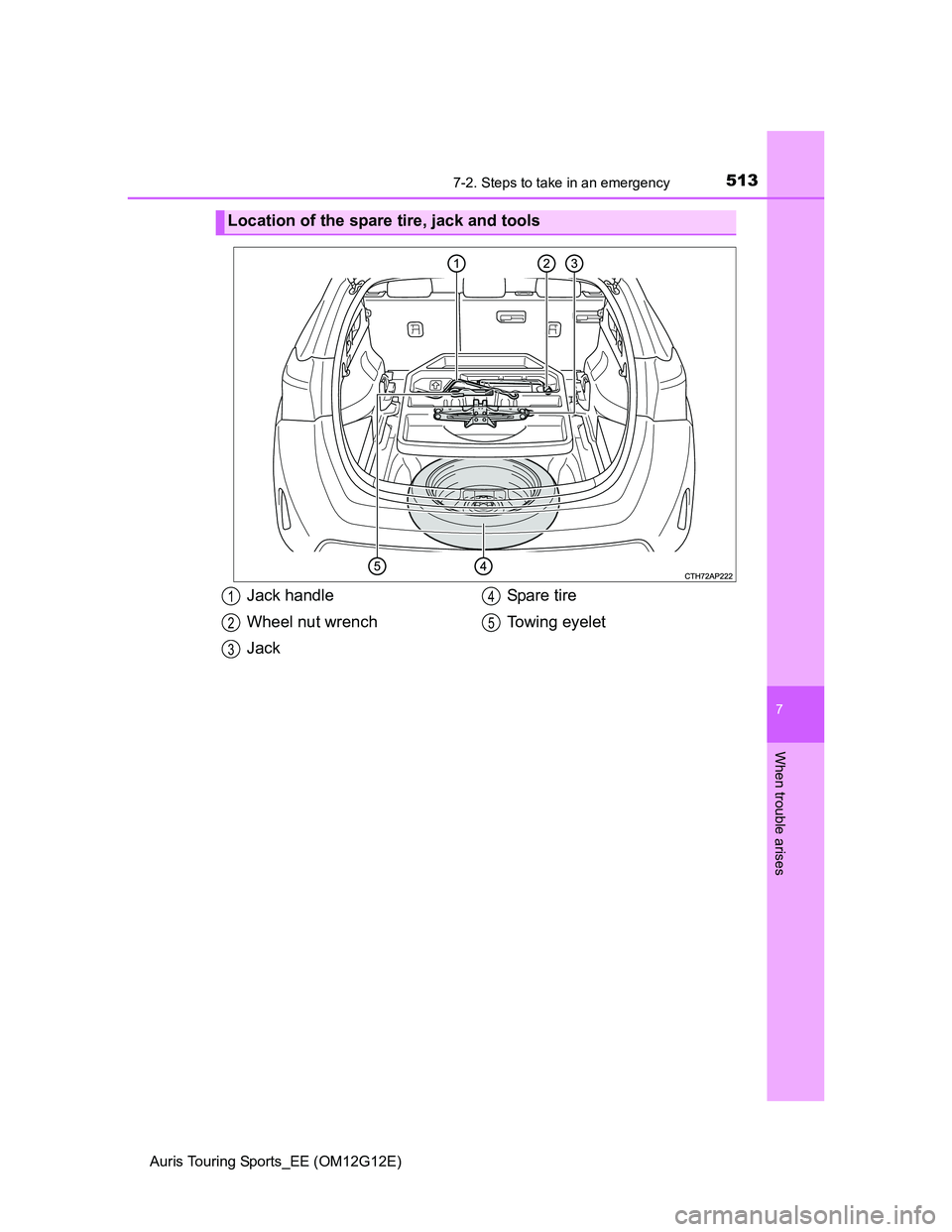
Location of the spare tire, jack and tools
Jack handle
Wheel nut wrench
JackSpare t i re
Towing eyelet1
2
3
4
5
Page 516 of 616
5167-2. Steps to take in an emergency
Auris Touring Sports_EE (OM12G12E)
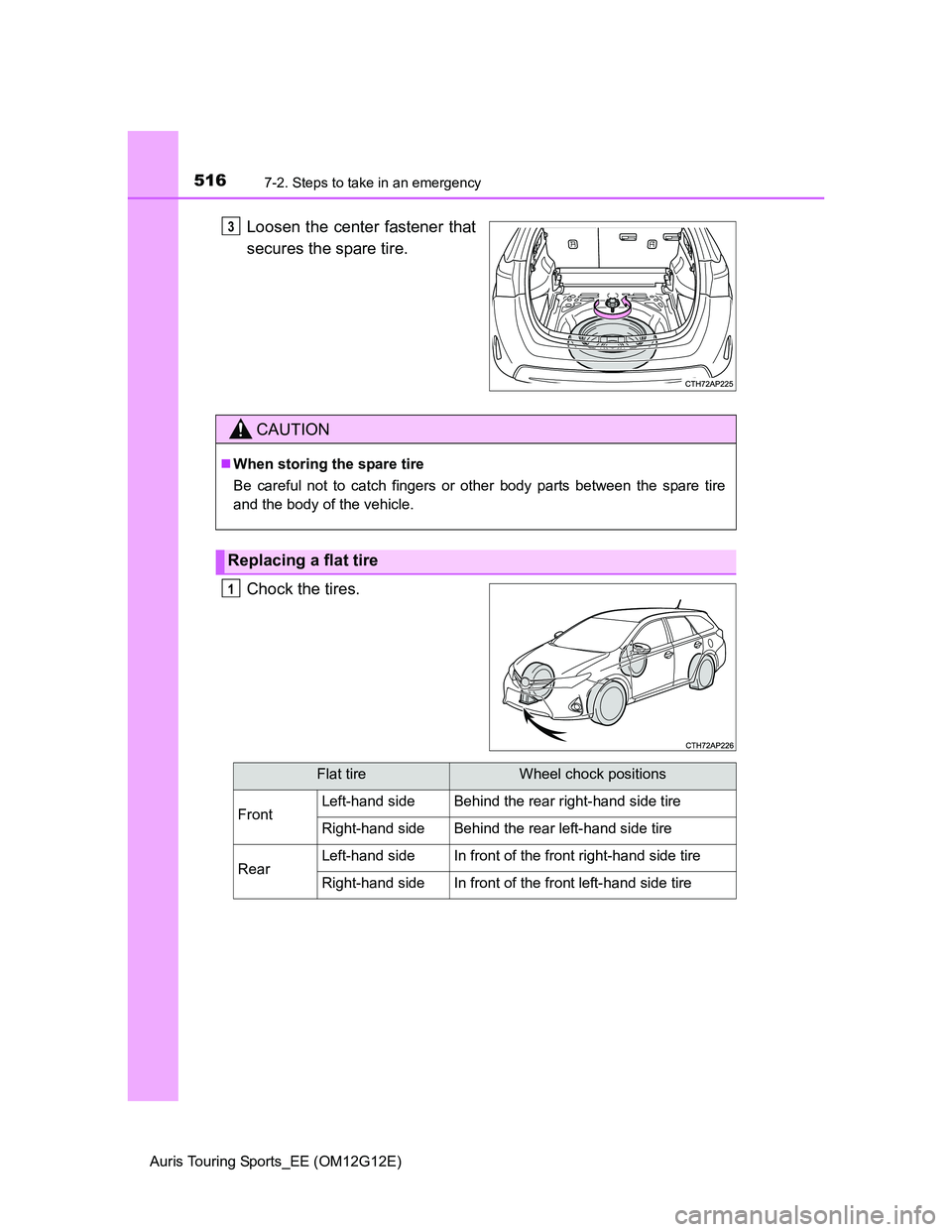
Loosen the center fastener that
secures the spare tire.
Chock the tires.3
CAUTION
When storing the spare tire
Be careful not to catch fingers or other body parts between the spare tire
and the body of the vehicle.
Replacing a flat tire
1
Flat tireWheel chock positions
FrontLeft-hand sideBehind the rear right-hand side tire
Right-hand sideBehind the rear left-hand side tire
RearLeft-hand sideIn front of the front right-hand side tire
Right-hand sideIn front of the front left-hand side tire
Page 519 of 616
5197-2. Steps to take in an emergency
Auris Touring Sports_EE (OM12G12E)
7
When trouble arises
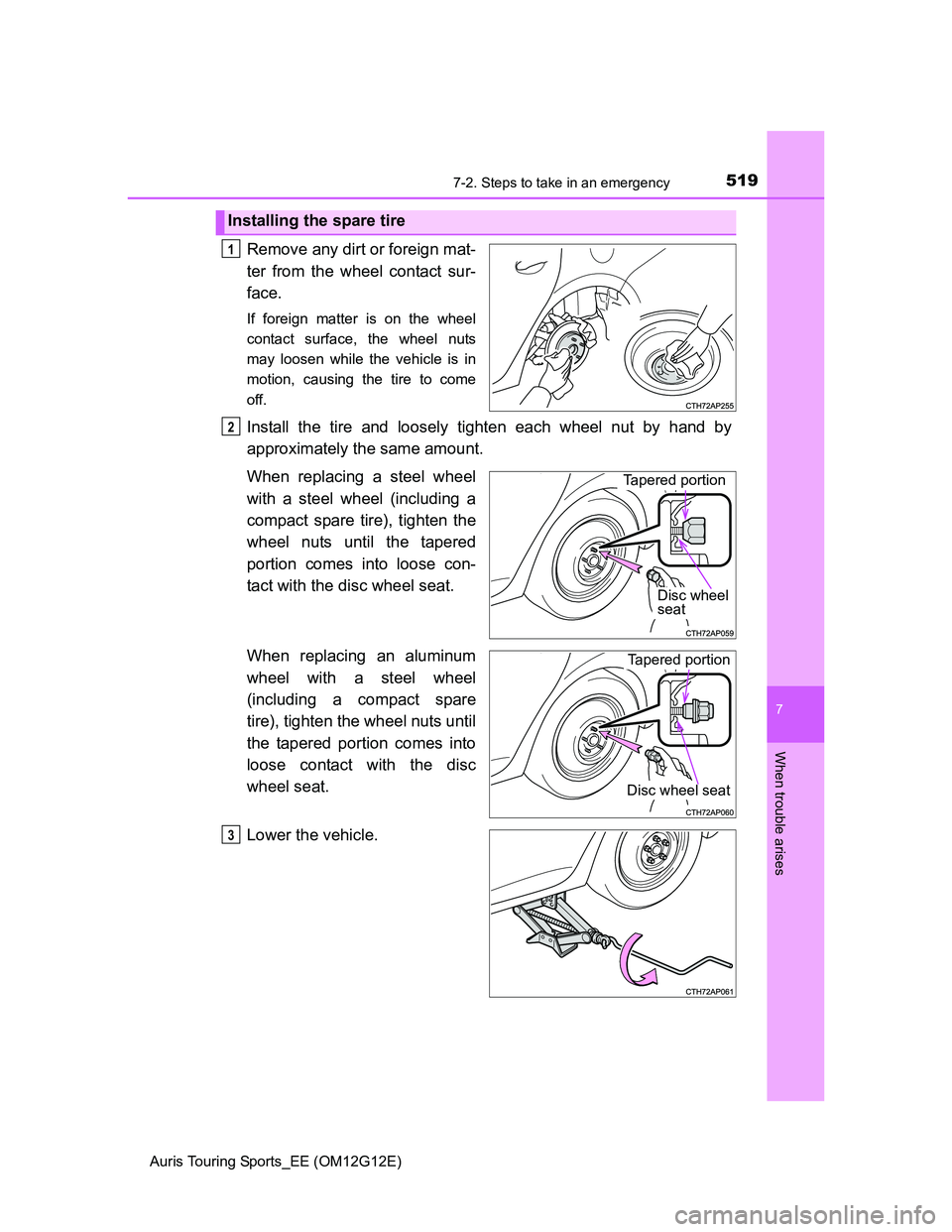
Remove any dirt or foreign mat-
ter from the wheel contact sur-
face.
If foreign matter is on the wheel
contact surface, the wheel nuts
may loosen while the vehicle is in
motion, causing the tire to come
off.
Install the tire and loosely tighten each wheel nut by hand by
approximately the same amount.
When replacing a steel wheel
with a steel wheel (including a
compact spare tire), tighten the
wheel nuts until the tapered
portion comes into loose con-
tact with the disc wheel seat.
When replacing an aluminum
wheel with a steel wheel
(including a compact spare
tire), tighten the wheel nuts until
the tapered portion comes into
loose contact with the disc
wheel seat.
Lower the vehicle.
Installing the spare tire
1
2
Tapered portion
Disc wheel
seat
Tapered portion
Disc wheel seat
3
Page 520 of 616
5207-2. Steps to take in an emergency
Auris Touring Sports_EE (OM12G12E)
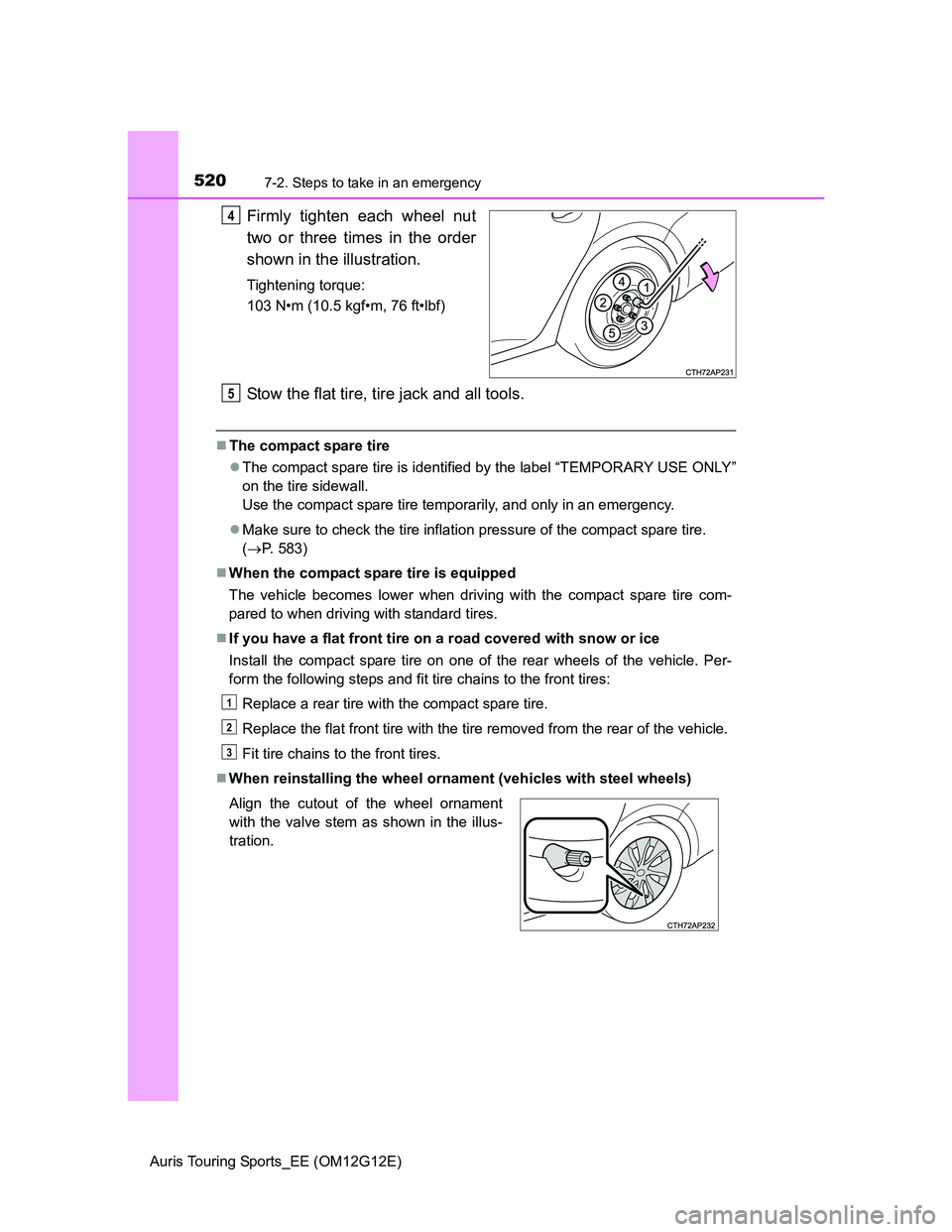
Firmly tighten each wheel nut
two or three times in the order
shown in the illustration.
Tightening torque:
103 N•m (10.5 kgf•m, 76 ft•lbf)
Stow the flat tire, tire jack and all tools.
The compact spare tire
The compact spare tire is identified by the label “TEMPORARY USE ONLY”
on the tire sidewall.
Use the compact spare tire temporarily, and only in an emergency.
Make sure to check the tire inflation pressure of the compact spare tire.
(P. 583)
When the compact spare tire is equipped
The vehicle becomes lower when driving with the compact spare tire com-
pared to when driving with standard tires.
If you have a flat front tire on a road covered with snow or ice
Install the compact spare tire on one of the rear wheels of the vehicle. Per-
form the following steps and fit tire chains to the front tires:
Replace a rear tire with the compact spare tire.
Replace the flat front tire with the tire removed from the rear of the vehicle.
Fit tire chains to the front tires.
When reinstalling the wheel ornament (vehicles with steel wheels)
4
Align the cutout of the wheel ornament
with the valve stem as shown in the illus-
tration.
5
1
2
3