Page 605 of 704

5
When trouble arises
605
5-2. Steps to take in an emergency
4RUNNER_U
CAUTION
■Maintenance of the tires
Each tire, including the spare (if provided), should be checked monthly
when cold and inflated to the inflation pressure recommended by the
vehicle manufacturer on the vehicle
placard or tire inflation pressure
label (tire and load information label). (If your vehicle has tires of a differ-
ent size than the size indicated on the vehicle placard or tire inflation
pressure label [tire and load information label], you should determine the
proper tire inflation pr essure for those tires.)
As an added safety feature, your vehicle has been equipped with a tire
pressure monitoring system (TPMS-ti re pressure warning system) that
illuminates a low tire pressure telltal e (tire pressure warning light) when
one or more of your tires is significantly under-inflated. Accordingly,
when the low tire pressure telltale (tire pre ssure warning light) illumi-
nates, you should stop and check your tires as soon as possible, and
inflate them to the proper pressure. Driving on a significantly under-
inflated tire causes the tire to overheat and can lead to tire failure.
Under-inflation also reduces fuel effi ciency and tire tread life, and may
affect the vehicle's hand ling and stopping ability.
Please note that the TPMS (tire pressure warning system) is not a sub-
stitute for proper ti re maintenance, an d it is the driver's responsibility to
maintain correct tire pressure, even if under-inflation has not reached the
level to trigger illu mination of the TPMS low tire pressure telltale (tire
pressure warning light).
Page 606 of 704

606 5-2. Steps to take in an emergency
4RUNNER_U
CAUTION
Your vehicle has also been equipped with a TPMS (tire pressure warning
system) malfunction indicator to indicate when the system is not operat-
ing properly. The TPMS (tire pressure warning system) malfunction indi-
cator is combined with the low tire pressure telltale (tire pressure
warning light). When the system det ects a malfunction, the telltale will
flash for approximately one minute an d then remain continuously illumi-
nated. This sequence will continue upon subsequent vehicle start-ups as
long as the malfunction exists. When the malfunction indi cator is illumi-
nated, the system may not be able to detect or signal low tire pressure
as intended.
TPMS (tire pressure warning system) malfunctions may occur for a vari-
ety of reasons, including the installati on of replacement or alternate tires
or wheels on the vehicle that prevent the TPMS (tire pressure warning
system) from functioning properly. Always check the TPMS (tire pres-
sure warning system) malfunction te lltale after replacing one or more
tires or wheels on your vehicle to ensure that the replacement or alter-
nate tires and wheels allow the TPMS (tire pressure warning system) to
continue to function properly.
NOTICE
■Precaution when installing a different tire
When a tire of a different specification or maker is installed, the tire pres-
sure warning system may not operate properly.
Page 616 of 704
616 5-2. Steps to take in an emergency
4RUNNER_U
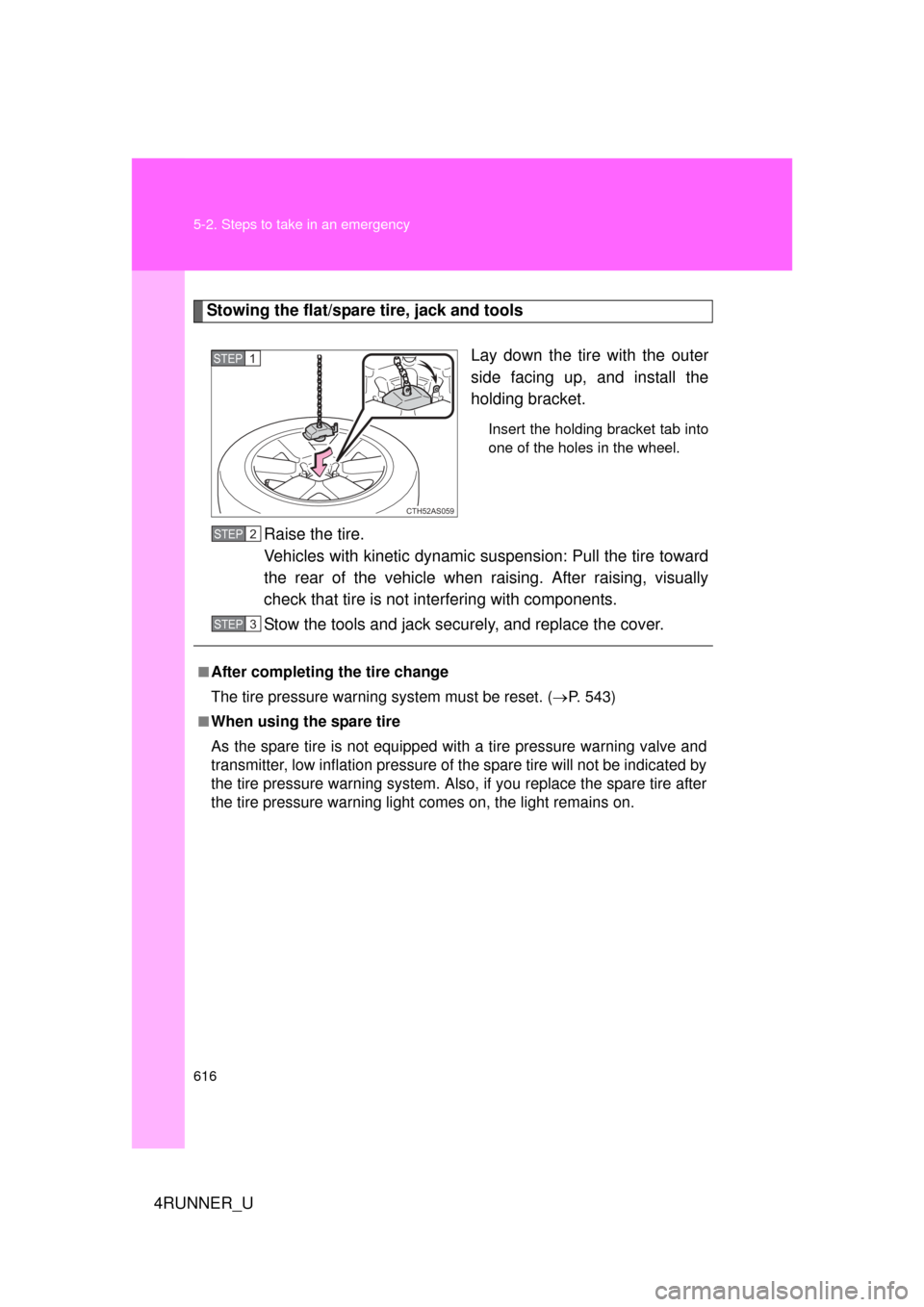
Stowing the flat/spare tire, jack and toolsLay down the tire with the outer
side facing up, and install the
holding bracket.
Insert the holding bracket tab into
one of the holes in the wheel.
Raise the tire.
Vehicles with kinetic dynamic suspension: Pull the tire toward
the rear of the vehicle when raising. After raising, visually
check that tire is not interfering with components.
Stow the tools and jack securely, and replace the cover.
CTH52AS059
STEP 1
■After completing the tire change
The tire pressure warnin g system must be reset. ( P. 543)
■When using the spare tire
As the spare tire is not equipped with a tire pressure warning valve and
transmitter, low inflation pressure of the spare tire will not be indicated by
the tire pressure warning system. Also, if you replace the spare tire after
the tire pressure warning light comes on, the light remains on.
STEP 2
STEP 3
Page 619 of 704

5
When trouble arises
619
5-2. Steps to take in an emergency
4RUNNER_U
NOTICE
■Do not drive the vehicle with a flat tire
Do not continue driving with a flat tire.
Driving even a short distance with a flat tire can damage the tire and the
wheel beyond repair.
■When stowing the flat tire
Ensure that there is no object cau
ght between the tire and the vehicle
underbody.
■When replacing the tires
●When removing or fitting the wheels, tires or the tire pressure warning
valve and transmitter, contact your Toyota dealer as the tire pressure
warning valve and transmitter may be damaged if not handled cor-
rectly.
●Replace the grommets for the tire pressure warning valves and trans-
mitters as well.
■ To avoid damage to the tire pressure warning valves and transmitters
When a tire is repaired with liquid sealants, the tire pressure warning valve
and transmitter may not operate properly. If a liquid sealant is used, contact
your Toyota dealer or other qualified service shop as soon as possible. Make
sure to replace the tire pressure warning valve and transmitter when replac-
ing the tire. ( P. 543)
Page 647 of 704
647
6-1. Specifications
6
Vehicle specifications
4RUNNER_U
Chassis lubrication
Steering
Tires and wheels
Propeller shafts
SpiderLithium base chassis grease, NLGI No.2
Slide yoke
Molybdenum-disulfide lithium base chas-
sis grease, NLGI No.2 or lithium base
chassis grease, NLGI No.2
Free playLess than 1.2 in. (30 mm)
Power steering fluid typeAutomatic transmission fluid DEXRON® II
or III
Tire sizeP265/70R17 113S, P245/60R20 107H
Tire inflation pressure
(Recommended cold tire
inflation pressure)
Front:
32 psi (220 kPa, 2.2 kgf/cm2 or bar)
Rear:
32 psi (220 kPa, 2.2 kgf/cm
2 or bar)
Spare:
32 psi (220 kPa, 2.2 kgf/cm
2 or bar)
Wheel size17 7J, 17 7 1/2J, 20 7J
Wheel nut torque81 ft•lbf (110 N•m, 11.2 kgf•m)
Page 652 of 704
652
6-1. Specifications
4RUNNER_U
Tire infor mation
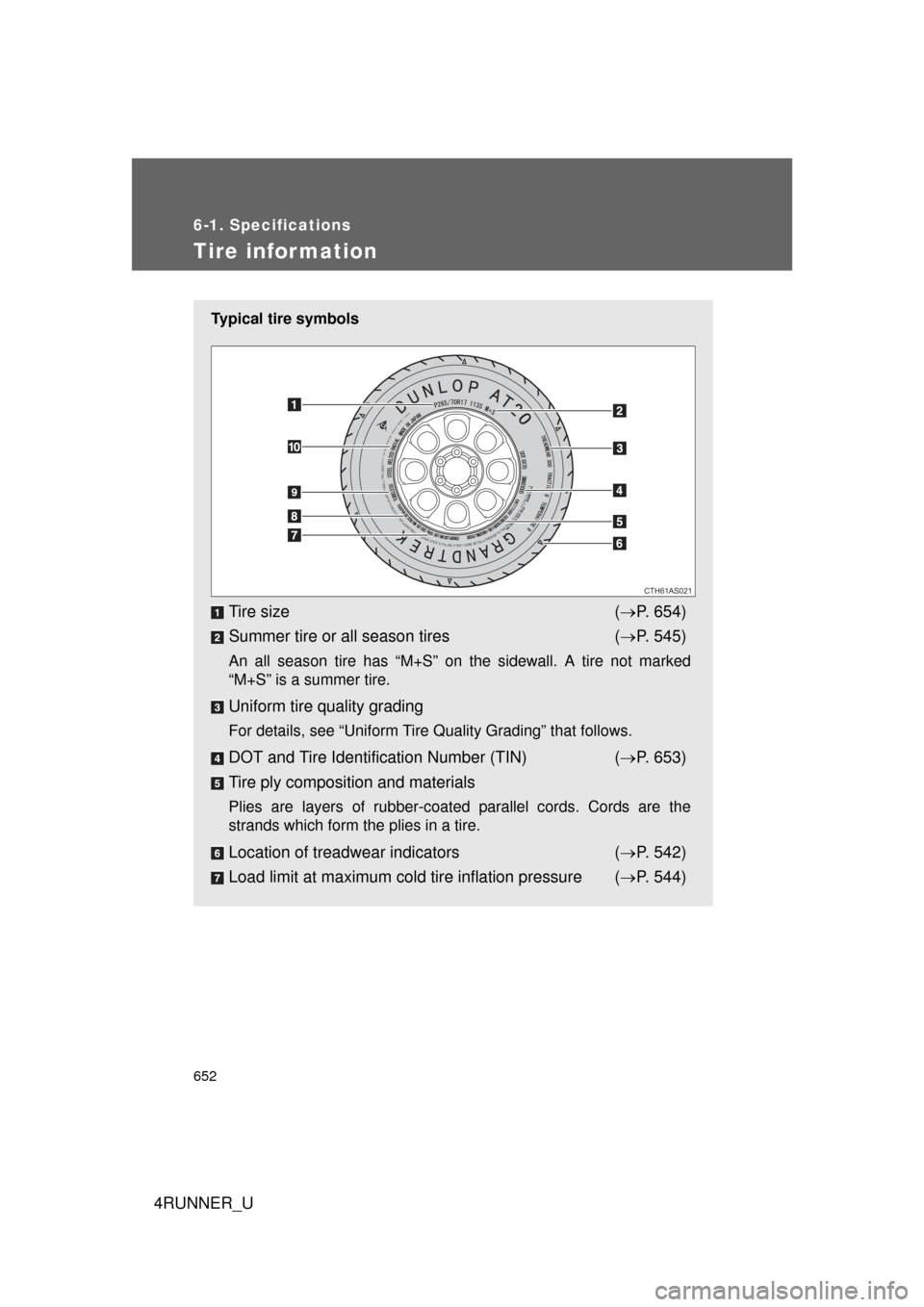
Typical tire symbols
Tire size( P. 654)
Summer tire or all season tires ( P. 545)
An all season tire has “M+S” on the sidewall. A tire not marked
“M+S” is a summer tire.
Uniform tire quality grading
For details, see “Uniform Tire Quality Grading” that follows.
DOT and Tire Identification Number (TIN) ( P. 653)
Tire ply composition and materials
Plies are layers of rubber-coated parallel cords. Cords are the
strands which form the plies in a tire.
Location of treadwear indicators ( P. 542)
Load limit at maximum cold tire inflation pressure ( P. 544)
CTH61AS021
Page 653 of 704
653
6-1. Specifications
6
Vehicle specifications
4RUNNER_U
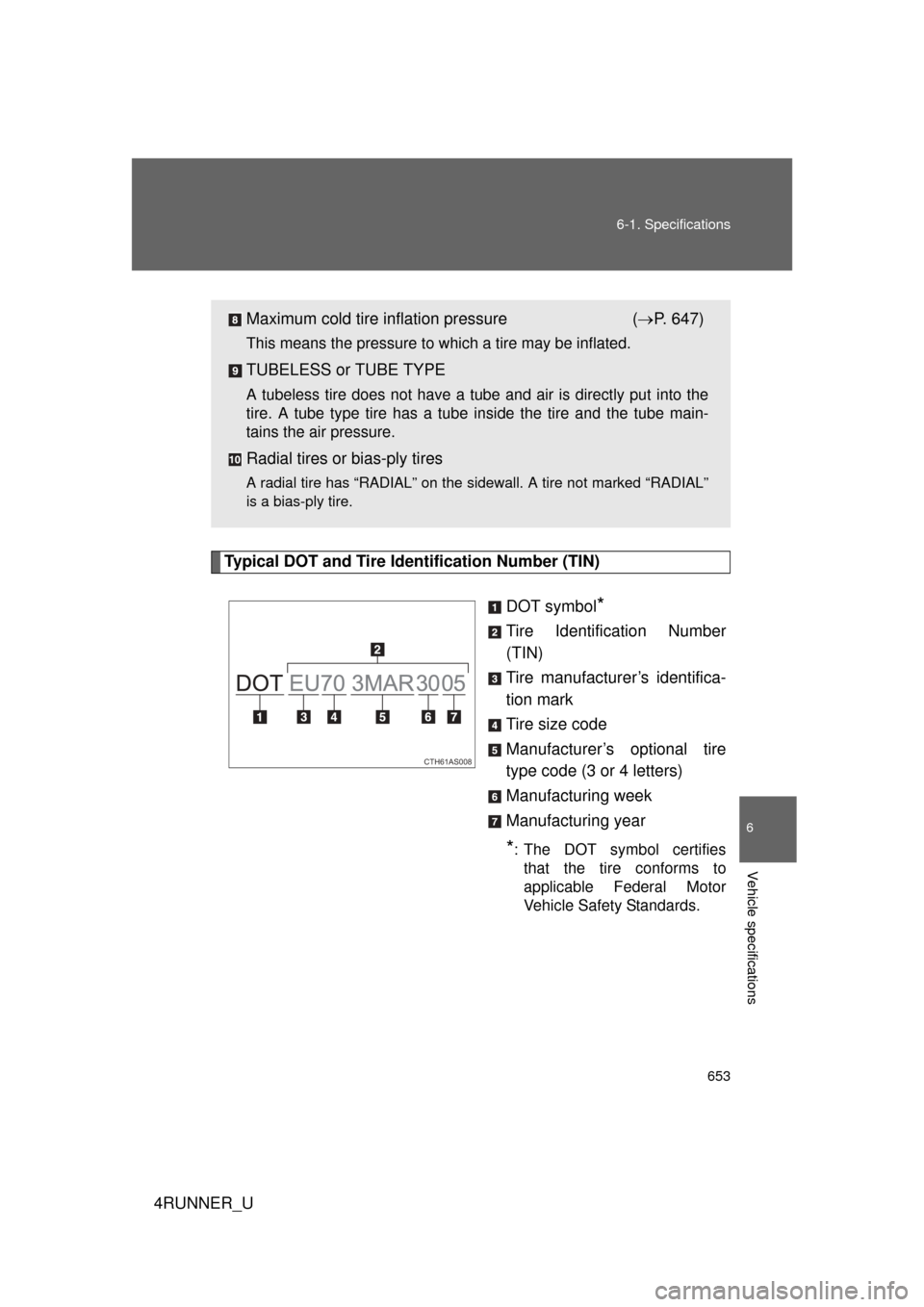
Typical DOT and Tire Identification Number (TIN)
DOT symbol
*
Tire Identification Number
(TIN)
Tire manufacturer’s identifica-
tion mark
Tire size code
Manufacturer’s optional tire
type code (3 or 4 letters)
Manufacturing week
Manufacturing year
*: The DOT symbol certifiesthat the tire conforms to
applicable Federal Motor
Vehicle Safety Standards.
Maximum cold tire inflation pressure ( P. 647)
This means the pressure to which a tire may be inflated.
TUBELESS or TUBE TYPE
A tubeless tire does not have a tube and air is directly put into the
tire. A tube type tire has a tube inside the tire and the tube main-
tains the air pressure.
Radial tires or bias-ply tires
A radial tire has “RADIAL” on the sidewall. A tire not marked “RADIAL”
is a bias-ply tire.
CTH61AS008
Page 657 of 704

657
6-1. Specifications
6
Vehicle specifications
4RUNNER_U
Warning: The temperature grades of a tire assume that it is properly
inflated and not overloaded.
Excessive speed, underinflation, or
excessive loading, either sepa-
rately or in combination, can caus e heat buildup and possible tire fail-
ure.
Glossary of tire terminology
Tire related termMeaning
Cold tire inflation
pressure Tire pressure when the vehicle has been
parked for three hours or more, or has not
been driven more than 1 mile or 1.5 km under
that condition
Maximum inflation
pressure The maximum cold inflated
pressure to which a
tire may be inflated, s hown on the sidewall of
the tire
Recommended
inflation pressure Cold tire inflation pressure recommended by a
manufacturer.
Accessory weight The combined weight (in excess of those stan-
dard items which may be replaced) of auto-
matic transmission, power steering, power
brakes, power windows, power seats, radio
and heater, to the extent that these items are
available as factory-installed equipment
(whether installed or not)
Curb weight The weight of a motor vehicle with standard
equipment, including the maximum capacity of
fuel, oil and coolant, and if so equipped, air
conditioning and additional weight optional
engine
Maximum loaded
vehicle weight The sum of:
(a) Curb weight
(b) Accessory weight
(c) Vehicle capacity weight
(d) Production options weight