Page 443 of 704
443
3-5. Using the interior lights
3
Interior features
4RUNNER_U
■
Illuminated entry system
Vehicles without a smart key system
The lights automatically turn on/off according to the engine switch position,
whether the doors are locked/unlocked, and whether the doors are open/
closed.
Vehicles with a smart key system
The lights automatically turn on/off according to “ENGINE START STOP”
switch mode, the presence of the electronic key, whether the doors are
locked/unlocked, and whether the doors are open/closed.
■ To prevent battery discharge
If the following lights remain on, the lights will go off automatically after 20
minutes:
● Engine switch light
● Front interior light
● Rear interior light
● Personal light
● Footwell lights
● Inside door handle lights
● Door courtesy lights
■ Customization that can be co nfigured at Toyota dealer
Settings (e.g. the time elapsed before lights turn off) can be changed.
(Customizable features
P. 664)
Personal lights
Page 458 of 704
458
3-7. Other interior features
4RUNNER_U
Vanity mirrors
NOTICE
■To prevent battery discharge
Do not leave the vanity lights on for extended periods while the engine is off.
Slide the cover to open.
The light turns on when the
cover is opened.
CTH37AS008
Page 469 of 704
469
3-7. Other interior features
3
Interior features
4RUNNER_U
■
The power outlet can be used when
The engine is running.
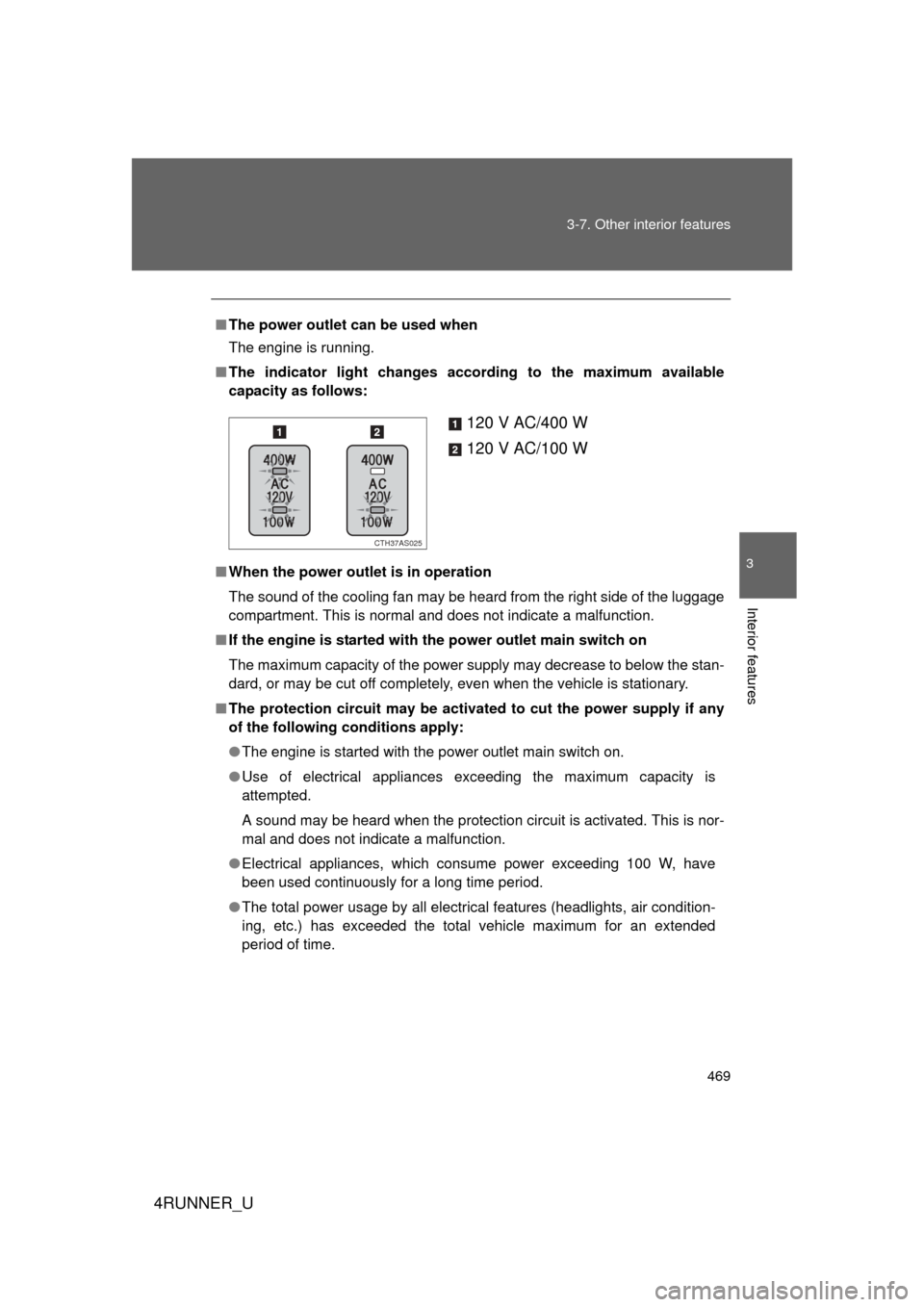
■ The indicator light changes according to the maximum available
capacity as follows:
■ When the power outlet is in operation
The sound of the cooling fan may be heard from the right side of the luggage
compartment. This is normal and does not indicate a malfunction.
■ If the engine is started with the power outlet main switch on
The maximum capacity of the power supply may decrease to below the stan-
dard, or may be cut off completely, even when the vehicle is stationary.
■ The protection circuit may be activated to cut the power supply if any
of the following conditions apply:
● The engine is started with the power outlet main switch on.
● Use of electrical appliances exceeding the maximum capacity is
attempted.
A sound may be heard when the protection circuit is activated. This is nor-
mal and does not indicate a malfunction.
● Electrical appliances, which consume power exceeding 100 W, have
been used continuously for a long time period.
● The total power usage by all electrical features (headlights, air condition-
ing, etc.) has exceeded the total vehicle maximum for an extended
period of time.
120 V AC/400 W
120 V AC/100 W
CTH37AS025
Page 472 of 704
472 3-7. Other interior features
4RUNNER_U
NOTICE
■To avoid damaging the power outlet and the plug
● Close the power outlet lid when not in use.
● Do not allow foreign objects or liquid s to enter the power outlet, as this
may cause a short circuit.
● Do not use plug adaptors to connect too many plugs to the power outlet.
● After removing a plug, gently close the power outlet lid.
■ To prevent the fuse from being blown
Do not use a 120 V AC appliance that requires more than the maximum
capacity of the power outlet. If a 120 V AC appliance that consumes more
than the maximum capacity is used, the protection circuit will cut the power
supply.
■ Appliances that may not ope rate properly (120 V AC)
The following 120 V AC appliances may not operate even if their power con-
sumption is under maximum capacity.
● Appliances with high initial peak wattage
● Measuring devices that process precise data.
● Other appliances that require an extremely stable power supply
■ To prevent battery discharge
Turn off all the vehicle's electronic equipment and accessories, such as the
headlights and air conditioning, when elec trical appliances that consume in
excess of 100 W are used continuously for long periods of time.
■ To prevent any damage caused by heat
● Do not use any electrical appliances that give off intense heat, such as
toasters, in any locations including the internal or external trim, seats and
deck.
● Do not use any electrical appliances that are easily affected by vibration or
heat inside the vehicle. Vibration while driving, or the heat of the sun while
parking, may result in damage to those electrical appliances.
Page 482 of 704
482 3-7. Other interior features
4RUNNER_U
Deviation calibrationStop the vehicle.
Change the accessory meter display to deviation calibration
mode by doing the following.
Vehicles without Multi-terrain Select
When the parking lights are
turned on:
Press and hold the “MODE/ ”
button.
A number (1 to 15) will appear
on the display.
When the parking lights are off:
In accessory meter light control
mode (P. 201), press and hold
the “MODE/ ” button.
A number (1 to 15) will appear
on the display.
Vehicles with Multi-terrain Select When the parking lights are
turned on:
Press and hold the “MODE/ ”
button.
A number (1 to 15) will appear
on the display.
When the parking lights are off:
In accessory meter light control
mode (P. 201), press and hold
the “MODE/ ” button.
A number (1 to 15) will appear
on the display.
STEP 1
STEP 2
Page 518 of 704
518 4-2. Maintenance
4RUNNER_U
Vehicle interior
ItemsCheck points
Accelerator pedal • The accelerator pedal should
move smoothly (without uneven
pedal effort or catching).
Automatic transmission “Park”
mechanism • When parked on a slope and the
shift lever is in P, is the vehicle
securely stopped?
Brake pedal • Does the brake pedal move
smoothly?
• Does the brake pedal have appro- priate clearance from the floor?
• Does the brake pedal have the correct amount of free play?
Brakes • The vehicle should not pull to one
side when the brakes are applied.
• The brakes should work effec- tively.
• The brake pedal should not feel spongy.
• The brake pedal should not get
too close to the floor when the
brakes are applied.
Head restraints • Do the head restraints move
smoothly and lock securely?
Indicators/buzzers • Do the indicators and buzzers
function properly?
Lights • Do all the lights come on?
Page 565 of 704

565
4-3. Do-it-yourself maintenance
4
Maintenance and care
4RUNNER_U
15A/F20 A
A/F sensor
16H-LP RH-HI10 ARight-hand headlight (high
beam)
17H-LP LH-HI10 ALeft-hand headlight (high
beam)
18HTR50 A
Air conditioning system
19400W INV 80 APower outlets
20ST30 A
Starter system
21H-LP HI20 AH-LP RH-HI, H-LP LH-HI fuses
22ALT-S7.5 A Charging system
23TURN&HAZ15 ATurn signal lights, emergency
flashers
24ETCS10 AMultiport fuel injection system/
sequential multiport fuel injec-
tion system
25PRB30 A
Automatic running boards sys-
tem
26TOWING30 A
Trailer stop/turn lights
27SHORT PIN
No circuit
28RAD NO.1 10 A Audio system
29AM27.5 A Starter system
30MAYDAY 7.5 A
MAYDAY
31AMP30 AAudio system
32ABS NO.150 AABS, VSC
33ABS NO.230 A
ABS, VSC
34AIR PMP50 AAIR PMP MTR
35DOME10 AInterior lights, vanity lights
36ECU-B10 AMultiplex communication sys-
tem, meter and gauge
37H-LP RH-LO10 ARight-hand headlight (low
beam)
38H-LP LH-LO10 A
Left-hand headlight (low beam)
39INJ10 AMultiport fuel injection system/
sequential multiport fuel injec-
tion system
FuseAmpereCircuit
Page 620 of 704
620
5-2. Steps to take in an emergency
4RUNNER_U
If the engine will not star t
If the engine will not start even though correct starting procedures
are being followed ( P. 170, 173), consider each of the following
points:
■ The engine will not start even though the starter motor
operates normally.
One of the following may be the cause of the problem:
●There may not be sufficient fuel in the vehicle’s tank.
Refuel the vehicle.
● The engine may be flooded.
Try to restart the engine again following correct starting proce-
dures. ( P. 170, 173)
● There may be a malfunction in the engine immobilizer system.
( P. 1 1 3 )
■ The starter motor turns over slowly, the interior lights and
headlights are dim, or the horn does not sound or sounds at
a low volume.
One of the following may be the cause of the problem:
●The battery may be discharged. ( P. 627)
● The battery terminal connec tions may be loose or corroded.
■ The starter motor does not turn over.
The engine starting system may be malfunctioning due to an
electrical problem such as an open circuit or a blown fuse. How-
ever, an interim measure is available to start the engine.
(
P. 621)