Page 320 of 484
320
4-3. Do-it-yourself maintenance
■When replacing wheels (vehicles with a tire pressure monitoring
system)
The wheels of your SUBARU are equipped with tire pressure warning
valves and transmitters that allow the tire pressure monitoring system to
provide advanced warning in the event of a loss in tire inflation pressure.
Whenever wheels are replaced, the tire pressure warning valves and
transmitters must be installed. (→P. 309)
WARNING
■When replacing wheels
●Do not use wheels that are a different size from those recommended in
the Owner’s Manual, as this may result in loss of handling control.
●Never use an inner tube in a leaking wheel which is designed for a
tubeless tire. Doing so may result in an accident, causing death or seri-
ous injury.
■When installing the wheel nuts
●Never use oil or grease on the wheel bolts or wheel nuts.
Oil and grease may cause the wheel nuts to be excessively tightened,
leading to bolt or disc wheel damage. In addition, the oil or grease can
cause the wheel nuts to loosen and the wheel may fall off, causing an
accident and resulting in death or serious injury. Remove any oil or
grease from the wheel bolts or wheel nuts.
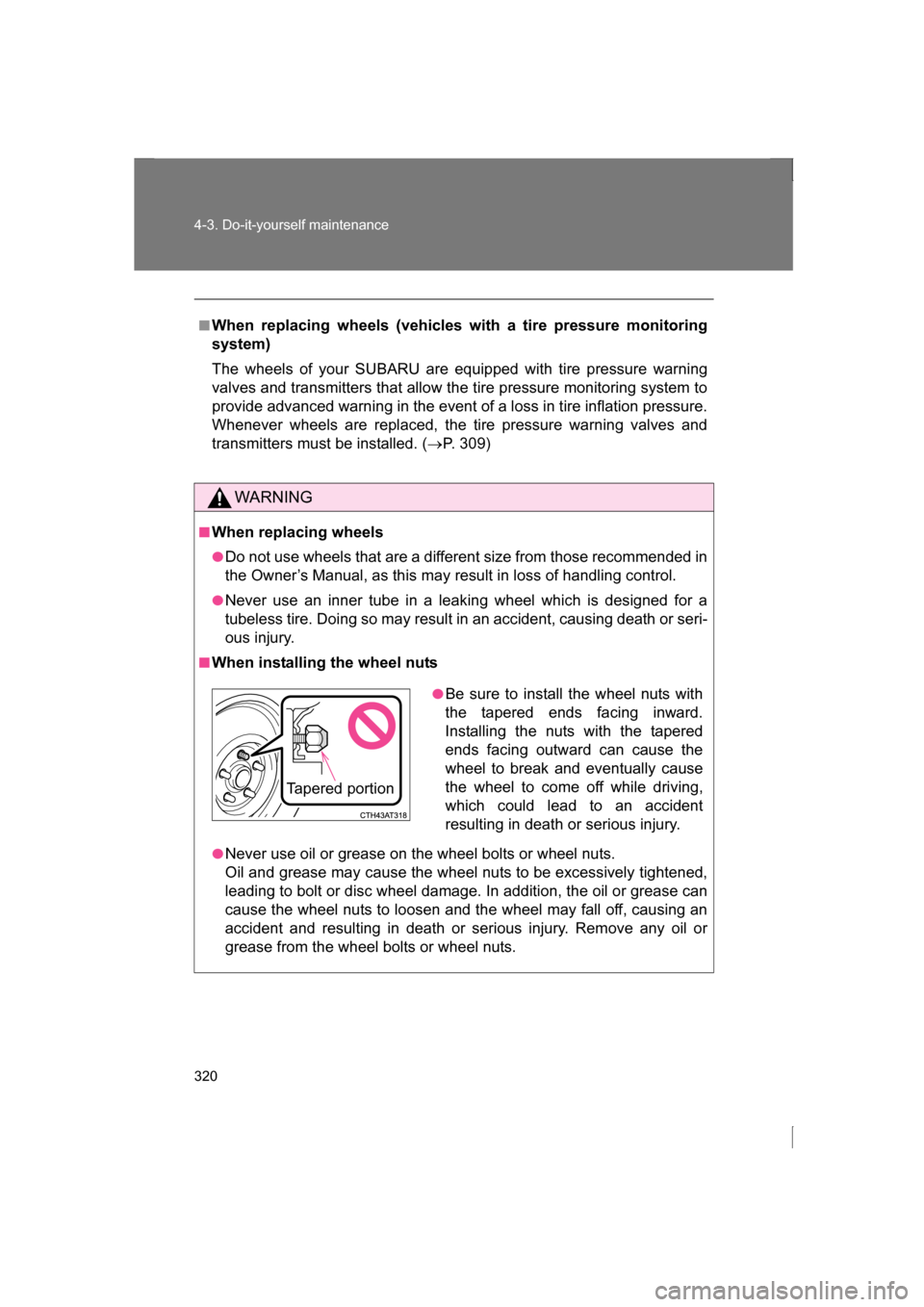
●Be sure to install the wheel nuts with
the tapered ends facing inward.
Installing the nuts with the tapered
ends facing outward can cause the
wheel to break and eventually cause
the wheel to come off while driving,
which could lead to an accident
resulting in death or serious injury.
Tapered portion
Page 321 of 484
321
4-3. Do-it-yourself maintenance
4
Maintenance and care
CAUTION
■Replacing tire inflation pressure warning valves and transmitters
(vehicles with a tire pressure monitoring system)
●Because tire repair or replacement may affect the tire pressure warn-
ing valves and transmitters, make sure to have tires serviced by your
SUBARU dealer or other qualified service shop. In addition, make sure
to purchase your tire pressure warning valves and transmitters at your
SUBARU dealer.
●Ensure that only genuine SUBARU wheels are used on your vehicle.
Tire pressure warning valves and transmitters may not work properly
with non-genuine wheels.
Page 340 of 484
340
4-3. Do-it-yourself maintenance
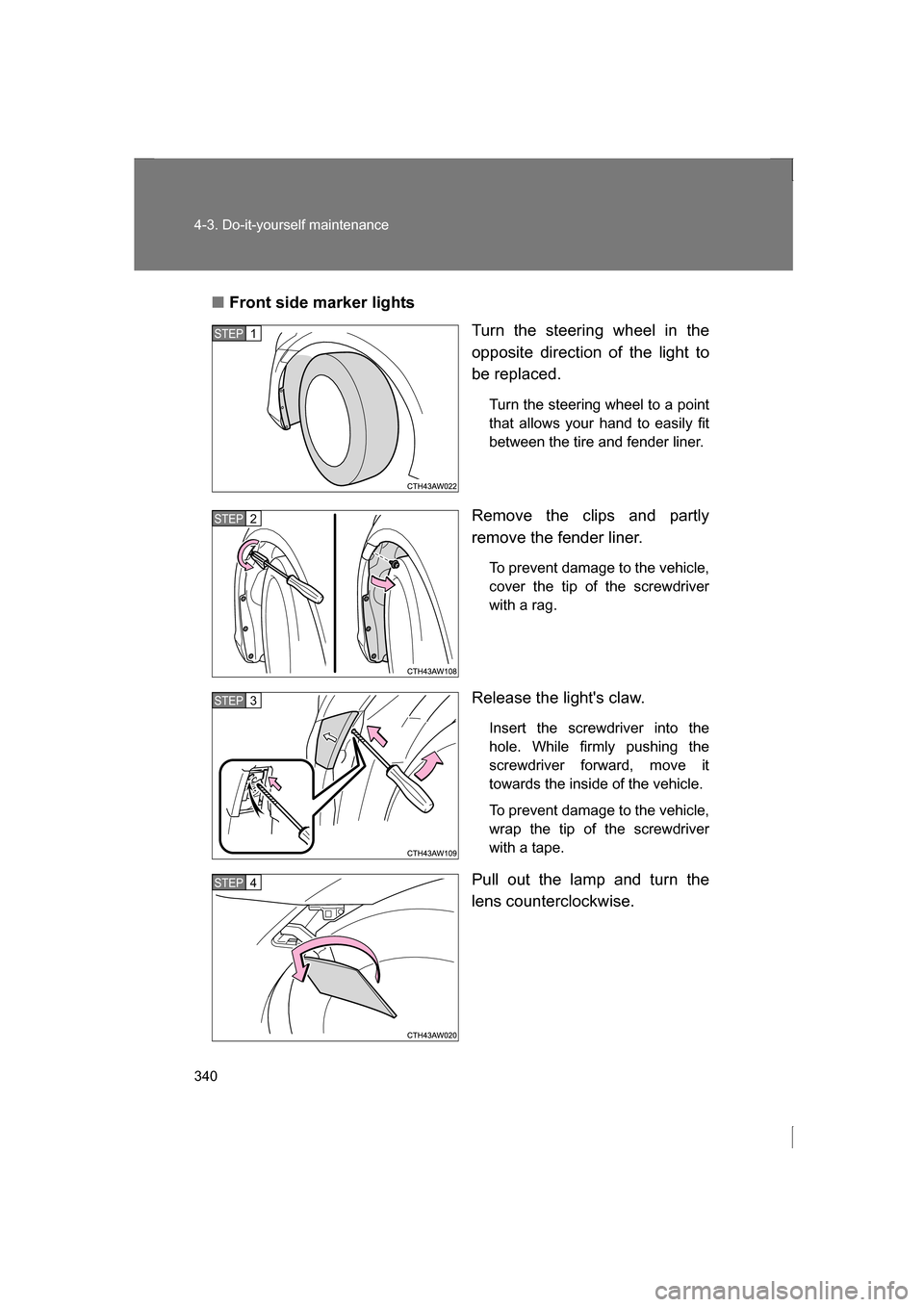
■Front side marker lightsTurn the steering wheel in the
opposite direction of the light to
be replaced.
Turn the steering wheel to a point
that allows your hand to easily fit
between the tire and fender liner.
Remove the clips and partly
remove the fender liner. To prevent damage to the vehicle,
cover the tip of the screwdriverwith a rag.
Release the light's claw. Insert the screwdriver into the
hole. While firmly pushing the
screwdriver forward, move it
towards the inside of the vehicle.
To prevent damage to the vehicle,
wrap the tip of the screwdriver
with a tape.
Pull out the lamp and turn the
lens counterclockwise.
STEP 1
STEP 2
STEP 3
STEP 4
Page 341 of 484
341
4-3. Do-it-yourself maintenance
4
Maintenance and care
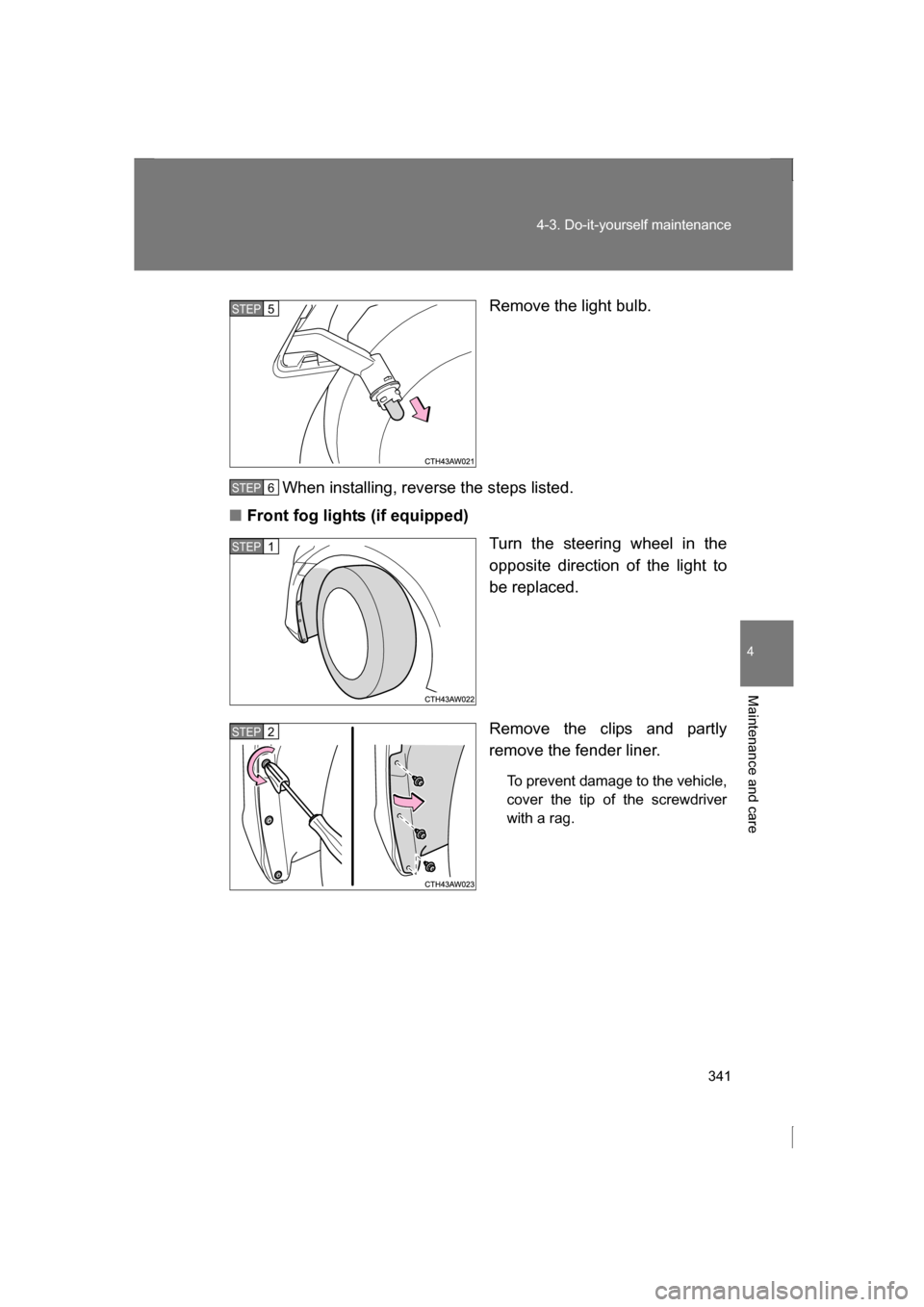
Remove the light bulb.
When installing, reverse the steps listed.
■Front fog lights (if equipped) Turn the steering wheel in the
opposite direction of the light to
be replaced.
Remove the clips and partly
remove the fender liner.
To prevent damage to the vehicle,
cover the tip of the screwdriver
with a rag.
STEP 5
STEP 6
STEP 1
STEP 2
Page 355 of 484

5
When trouble arises
355
5-1. Essential information
If your vehicle needs to be towed
Emergency towingIf a tow truck is not available in an emergency, your vehicle may be
temporarily towed using a cable or chain secured to the emergency
towing eyelet to move the vehicle to a safe location or to free a stuck
vehicle from sand or snow. This should only be attempted on hard
surfaced roads for short distances at low speeds.
A driver must be in the vehicle to steer and operate the brakes. The
vehicle's wheels, drive train, axles, steering and brakes must be in
good condition.
For vehicles with an automatic transmission, only the front towing
eyelet may be used. Towing eyelet
If towing is necessary, we recommend having your vehicle towed by
your SUBARU dealer or a commercial towing service, using a flat
bed truck.
The vehicle must be secured properly with safety chains. Each
safety chain should be equally tightened and care must be taken not
to pull the chains so tightly that the suspension bottoms out.
Page 357 of 484
5
When trouble arises
357
5-1. Essential information
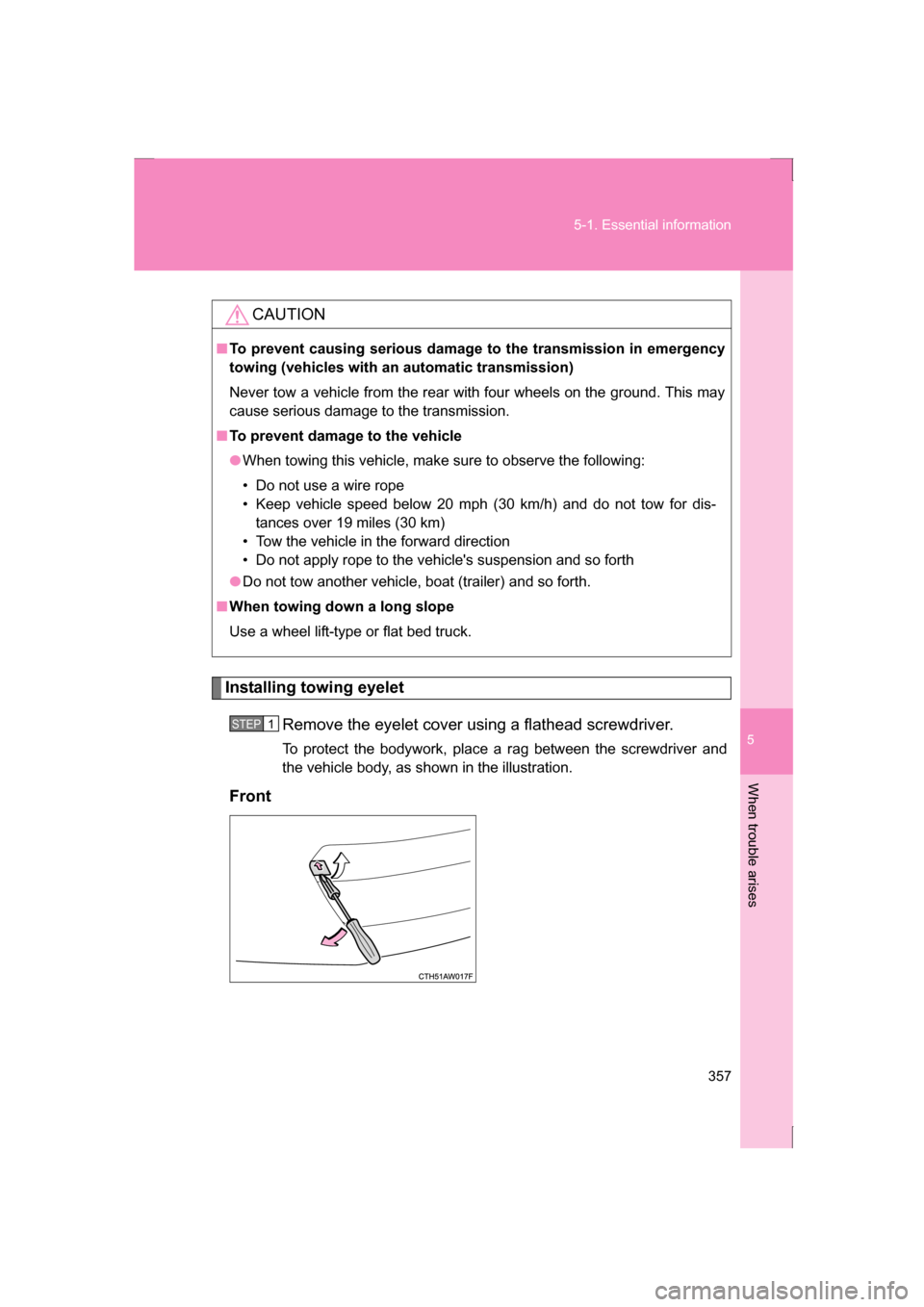
Installing towing eyeletRemove the eyelet cover using a flathead screwdriver.
To protect the bodywork, place a rag between the screwdriver and
the vehicle body, as shown in the illustration.
Front
CAUTION
■To prevent causing serious damage to the transmission in emergency
towing (vehicles with an automatic transmission)
Never tow a vehicle from the rear with four wheels on the ground. This may
cause serious damage to the transmission.
■To prevent damage to the vehicle
●When towing this vehicle, make sure to observe the following:
Page 358 of 484
358
5-1. Essential information
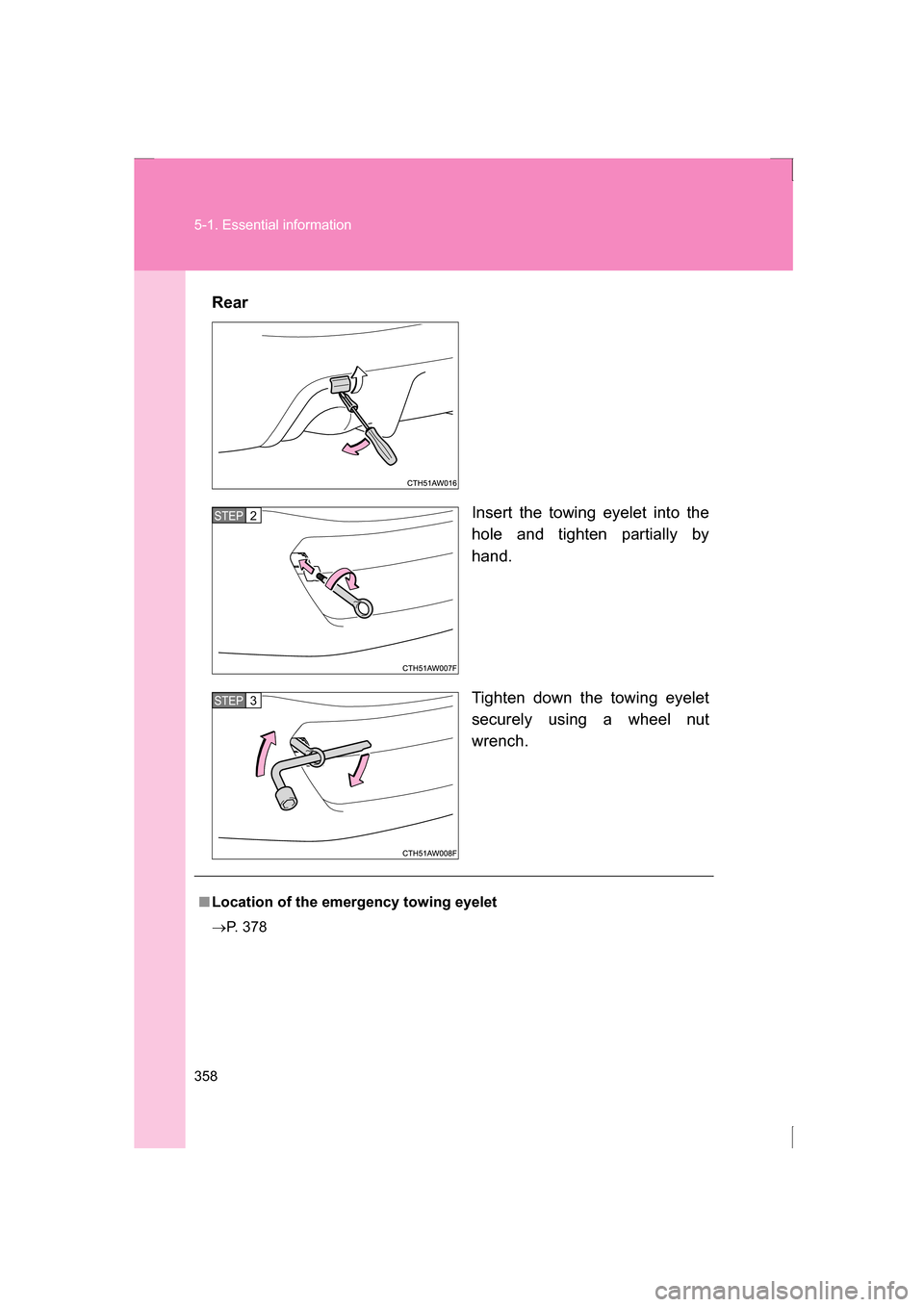
RearInsert the towing eyelet into the
hole and tighten partially by
hand.
Tighten down the towing eyelet
securely using a wheel nut
wrench.
STEP 2
STEP 3
■Location of the emergency towing eyelet
→P. 378
Page 360 of 484
360
5-1. Essential information
CAUTION
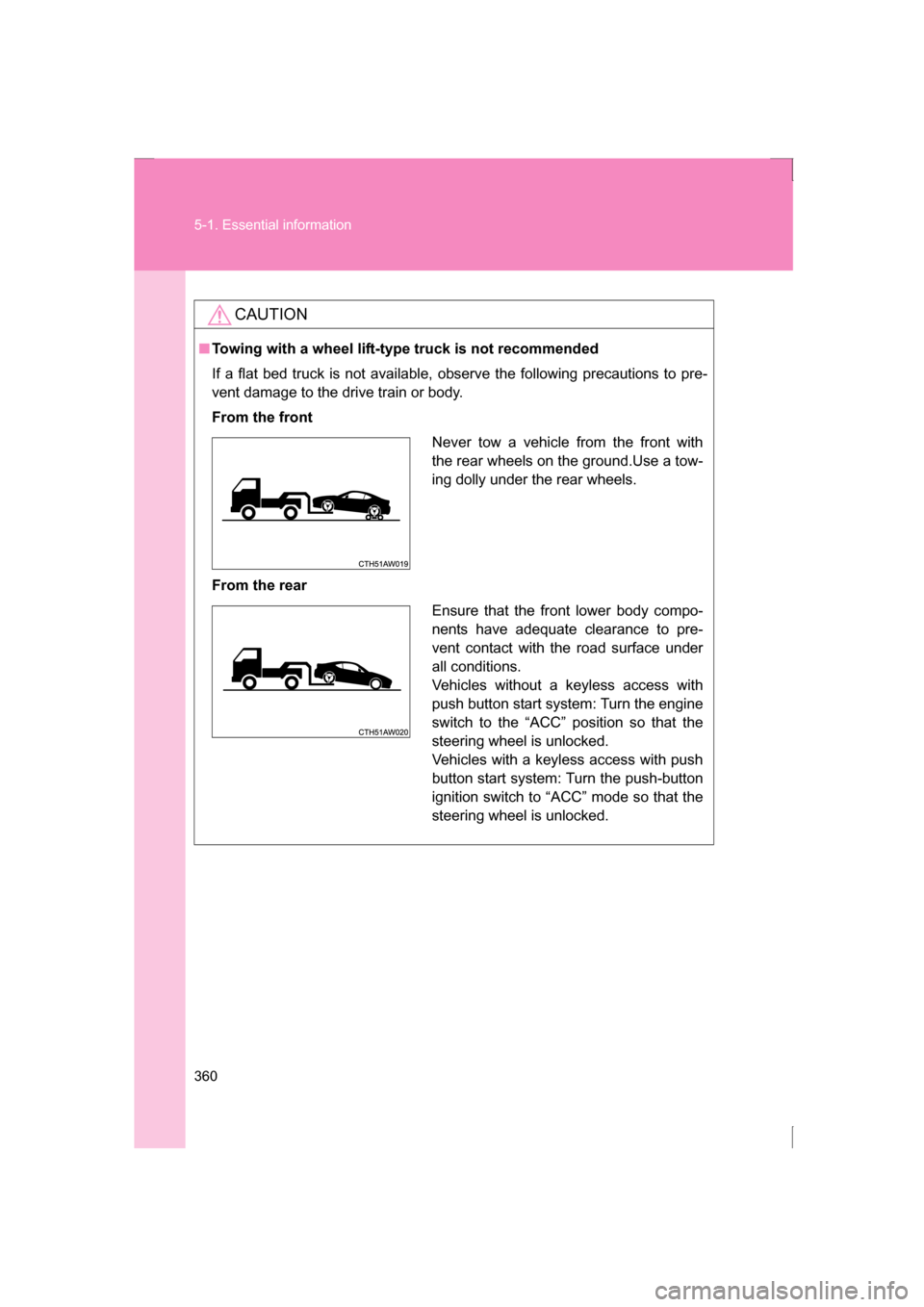
■Towing with a wheel lift-type truck is not recommended
If a flat bed truck is not available, observe the following precautions to pre-
vent damage to the drive train or body.
From the front
From the rear
Never tow a vehicle from the front with
the rear wheels on the ground.Use a tow-
ing dolly under the rear wheels.
Ensure that the front lower body compo-
nents have adequate clearance to pre-
vent contact with the road surface under
all conditions.
Vehicles without a keyless access with
push button start system: Turn the engine
switch to the “ACC” position so that the
steering wheel is unlocked.
Vehicles with a keyless access with push
button start system: Turn the push-button
ignition switch to “ACC” mode so that the
steering wheel is unlocked.