Page 229 of 484
229
2-5. Driving information
2
When driving
■Refueling in cold weather
To help prevent moisture from forming in the fuel system and the risk of its
freezing, use of an antifreeze additive in the fuel tank is recommended dur-
ing cold weather.
Use only additives that are specifically designed for this purpose. When an
antifreeze additive is used, its effect lasts longer if the tank is refilled when-
ever the fuel level reaches half empty.
WARNING
■Driving with snow tires
Observe the following precautions to reduce the risk of accidents.
Failure to do so may result in a loss of vehicle control and cause death or
serious injury.
●Use tires of the specified size, and that are the same size, same maker,
same brand and tread pattern.
●Maintain the recommended level of air pressure.
●Use snow tires on all, not just some wheels.
Page 271 of 484
Maintenance and care4
271
4-1. Maintenance and careCleaning and protecting the vehicle exterior......... 272
Cleaning and protecting the vehicle interior.......... 276
Cleaning and protecting the Alcantara ®
area ....... 280
4-2. Maintenance Maintenance requirements .................. 282
General maintenance....... 285
Emission inspection and maintenance (I/M)
programs........................ 288 4-3. Do-it-yourself
maintenance
Do-it-yourself service precautions .................... 289
Engine hood ..................... 292
Engine compartment ........ 294
Tires ................................. 308
Tire inflation pressure ...... 315
Wheels ............................. 319
Air conditioning filter......... 322
Transmitter/access key battery ............................ 325
Checking and replacing fuses .............................. 329
Light bulbs........................ 337
Page 308 of 484
308
4-3. Do-it-yourself maintenance
Tires
Replace or rotate tires in accordance with maintenance sched-
ules and treadwear.
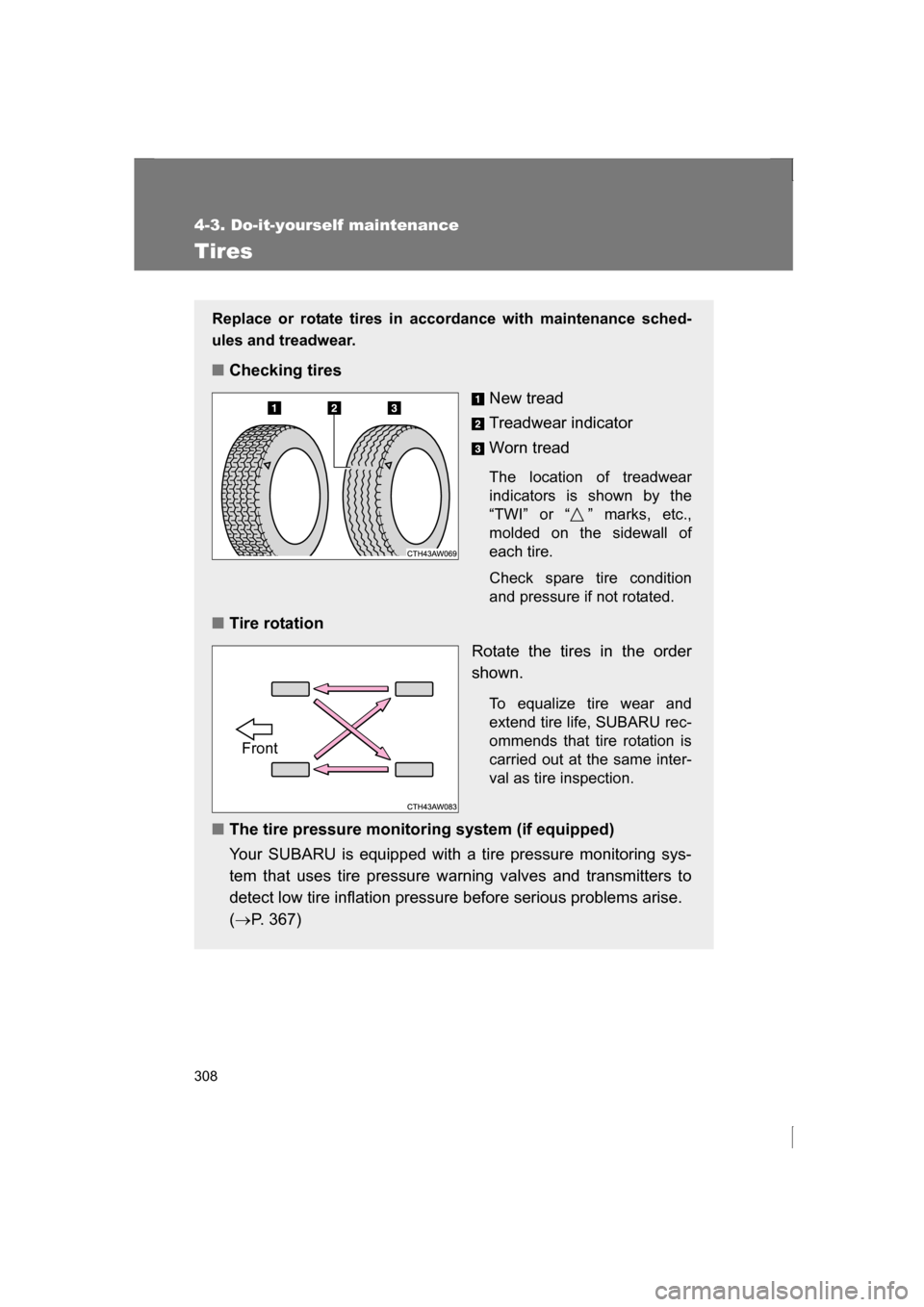
■Checking tiresNew tread
Treadwear indicator
Worn tread
The location of treadwear
indicators is shown by the
“TWI” or “ ” marks, etc.,
molded on the sidewall of
each tire.
Check spare tire condition
and pressure if not rotated.
■Tire rotationRotate the tires in the order
shown.
To equalize tire wear and
extend tire life, SUBARU rec-
ommends that tire rotation is
carried out at the same inter-
val as tire inspection.
■The tire pressure monitoring system (if equipped)
Your SUBARU is equipped with a tire pressure monitoring sys-
tem that uses tire pressure warning valves and transmitters to
detect low tire inflation pressure before serious problems arise. (→ P. 367)
Front
Page 309 of 484
309
4-3. Do-it-yourself maintenance
4
Maintenance and care
Installing tire pressure warning valves and transmitters (vehicles
with a tire pressure monitoring system)When replacing tires or wheels, tire pressure warning valves and
transmitters must also be installed.
When new tire pressure warning valves and transmitters are
installed, new tire pressure warning valve and transmitter ID codes
must be registered in the tire pressure warning computer and tire
pressure monitoring system must be initialized. Have tire pressure
warning valve and transmitter ID codes registered by your SUBARU
dealer. ( →P. 310)
Page 310 of 484
310
4-3. Do-it-yourself maintenance
Registering ID codes (vehicles with a tire pressure monitoring
system)
The tire pressure warning valve and transmitter is equipped with a
unique ID code. When replacing a tire pressure warning valve and
transmitter, it is necessary to register the ID code. Have the ID code
registered by your SUBARU dealer.
■When to replace your vehicle’s tires
Tires should be replaced if:
●You have tire damage such as cuts, splits, cracks deep enough to
expose the fabric or bulges indicating internal damage
●A tire goes flat repeatedly or cannot be properly repaired due to the
size or location of a cut or other damage
If you are not sure, consult with your SUBARU dealer.
■Replacing tires and wheels (vehicles with a tire pressure monitor-
ing system)
If the ID code of the tire pressure warning valve and transmitter is not
registered, the tire pressure monitoring system will not work properly.
After driving for about 20 minutes, the tire pressure warning light comes
on after blinking for 1 minute to indicate a system malfunction.
■Tire life
Any tire over 6 years old must be checked by a qualified technician even
if they have seldom or never been used or damage is not obvious.
■If the tread wears down below 0.16 in. (4 mm) on snow tires
The effectiveness of snow tires is lost.
■Low profile tires (vehicles with 17-inch tires)
Generally, low profile tires will wear more rapidly and tire grip perfor-
mance will be reduced on snowy and/or icy roads when compared to
standard tires. Be sure to use snow tires or tire chains on snowy and/or
icy roads and drive carefully at a speed appropriate for road and weather
conditions.
Page 311 of 484
311
4-3. Do-it-yourself maintenance
4
Maintenance and care
■Maximum load of tire
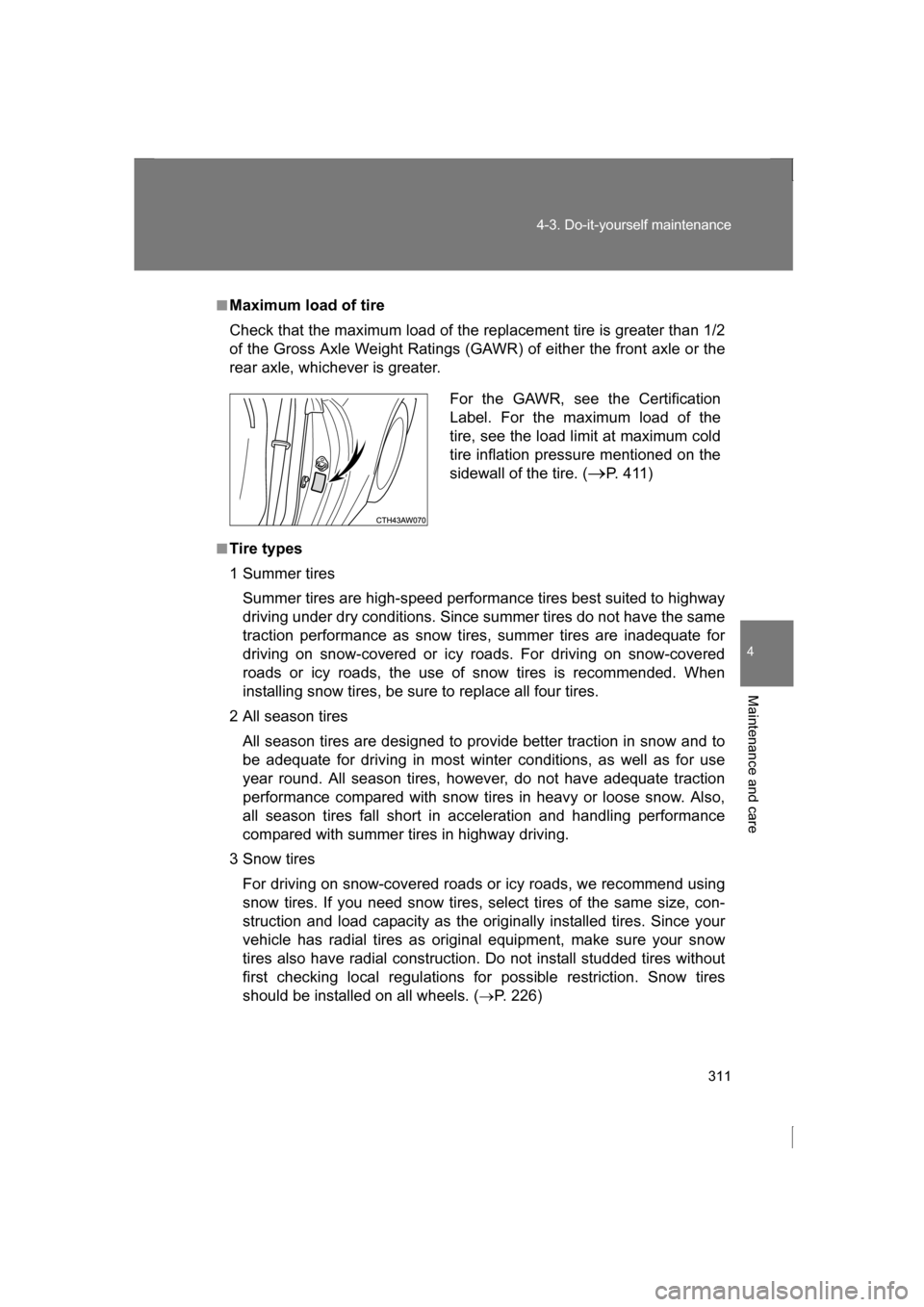
Check that the maximum load of the replacement tire is greater than 1/2
of the Gross Axle Weight Ratings (GAWR) of either the front axle or the
rear axle, whichever is greater.
■Tire types
1Summer tiresSummer tires are high-speed performance tires best suited to highway
driving under dry conditions. Since summer tires do not have the same
traction performance as snow tires, summer tires are inadequate for
driving on snow-covered or icy roads. For driving on snow-covered
roads or icy roads, the use of snow tires is recommended. When
installing snow tires, be sure to replace all four tires.
2 All season tires All season tires are designed to provide better traction in snow and to
be adequate for driving in most winter conditions, as well as for use
year round. All season tires, however, do not have adequate traction
performance compared with snow tires in heavy or loose snow. Also,
all season tires fall short in acceleration and handling performance
compared with summer tires in highway driving.
3 Snow tires
For driving on snow-covered roads or icy roads, we recommend using
snow tires. If you need snow tires, select tires of the same size, con-
struction and load capacity as the originally installed tires. Since your
vehicle has radial tires as original equipment, make sure your snow
tires also have radial construction. Do not install studded tires without
first checking local regulations for possible restriction. Snow tires
should be installed on all wheels. ( →P. 226)
For the GAWR, see the Certification
Label. For the maximum load of the
tire, see the load limit at maximum cold
tire inflation pressure mentioned on the
sidewall of the tire. (
→P. 4 1 1 )
Page 313 of 484
313
4-3. Do-it-yourself maintenance
4
Maintenance and care
WARNING
■Tire pressure monitoring system operation (if equipped)
The tire pressure monitoring system may not provide warning immedi-
ately if a tire bursts or if sudden air leakage occurs.
■When inspecting or replacing tires
Observe the following precautions to prevent accidents.
Failure to do so may cause damage to parts of the drive train, as well as
dangerous handling characteristics, which may lead to an accident
resulting in death or serious injury.
●Make sure to install 4 tires that are of the specified size, and that all 4
tires are the same size, same maker, same brand and tread pattern.
●Do not use tire sizes other than those recommended by SUBARU.
●Only use radial tires.
●Do not mix summer, all season and snow tires.
●Do not use tires that have been used on another vehicle.
Do not use tires if you do not know how they were used previously.
CAUTION
■Repairing or replacing tires, wheels, tire pressure warning valves,
transmitters and tire valve caps (vehicles with a tire pressure moni-
toring system)
●When removing or fitting the wheels, tires or the tire pressure warning
valves and transmitters, contact your SUBARU dealer as the tire pres-
sure warning valves and transmitters may be damaged if not handled
correctly.
●When replacing tire valve caps, do not use tire valve caps other than
those specified. The cap may become stuck.
Page 314 of 484
314
4-3. Do-it-yourself maintenance
CAUTION
■To avoid damage to the tire pressure warning valves and transmit-
ters (vehicles with a tire pressure monitoring system)
When a tire is repaired with liquid sealants, the tire pressure warning
valve and transmitter may not operate properly. If a liquid sealant is
used, contact your SUBARU dealer or other qualified service shop as
soon as possible. Make sure to replace the tire pressure warning valve
and transmitter when replacing the tire. (→P. 309)
■Driving on rough roads
Take particular care when driving on roads with loose surfaces or pot
holes.
These conditions may cause losses in tire inflation pressure, reducing
the cushioning ability of the tires. In addition, driving on rough roads may
cause damage to the tires themselves, as well as the vehicle’s wheels
and body.
■Low profile tires and wheels (vehicles with 17-inch tires)
Low profile tires may cause greater damage than usual to the wheel
when receiving impact from the road surface. Therefore pay attention to
the following:
●Be sure to use proper tire inflation pressure. If tires are under-inflated,
they may be damaged more severely.
●Avoid pot holes, uneven pavement, curbs and other road hazards.
Failure to do so may lead to severe tire and wheel damage.
■If tire inflation pressures become low while driving
Do not continue driving, or your tires and/or wheels may be ruined.