2013 SMART FORTWO COUPE lock
[x] Cancel search: lockPage 45 of 218

Top tether
Top tether permits an additional
connection between a child restraint
system and the passenger seat. Proper
usage of the top tether, in accordance with
instructions provided by the child
restraint manufacturer, can further reduce
the risk of injuries.
The top tether anchorage is located on the
floor of the cargo compartment. The top
tether guide for the top tether strap is
located above, on the head restraint. X
Thread top tether strap 0028through top
tether guide 0002down the back of
passenger seat 0003to top tether
anchorage 002B.
X Attach top tether hook 002Ato top tether
anchorage 002Bon the floor of the cargo
compartment.
i If you are using divider plus*, the
hooks of the top tether and the divider
plus* are attached to the same anchorage. X
Install the child restraint system and
tighten top tether strap 0028according to
the child restraint manufacturer’s
instructions. G
WARNING
After installing top tether straps, make
sure the seat backrests are in an upright
position and are properly locked. Push and
pull on the seat backrests to ensure they are
properly secured in the locked position. If
a seat backrest is not properly locked, the
seat backrest could fold. The child seat
would no longer be properly supported or
positioned to provide its intended
benefit. That could cause serious or even
fatal injuries. Panic alarm
X
Activating: Press and hold button 0002for
at least 1 second.
An audible alarm and flashing exterior
lamps will operate briefly.
X Deactivating: Press button0002once more.
or
X Insert the key in the starter switch.
i USA only:
This device complies with Part 15 of the
FCC Rules. Operation is subject to the
following two conditions:
1. This device may not cause harmful
interference, and Panic alarm
43>> Safety.
* optional Z
Page 46 of 218

2. this device must accept any
interference received, including
interference that may cause undesired
operation.
Any unauthorized modification to this
device could void the user’s authority to
operate the equipment.
The product label with FCC ID and IC
certification number can be foun
dinthe
battery case.
i Canada only:
This device complies with RSS‑210 of
Industr yCanada. Operation is subject to
the following two conditions:
1. This device may not cause
interference, and
2. this device must accept any
interference received, including
interference that may cause undesired
operation of the device.
Any unauthorized modification to this
device could void the user’s authority to
operate the equipment.
The product label with FCC ID and IC
certification number can be found in the
battery case. Driving safety systems
Introduction
G
WARNING
The following factors increase the risk of
accidents:
R Excessive speed, especially in turns
R Wet and slippery road surfaces
R Following another vehicle too closely
The driving safety systems described in
this section cannot reduce these risks or
prevent the natural laws of physics from
acting on the vehicle.
Always adapt your driving style to the
prevailing road and weather and traffic conditions and keep a safe distance to
other road users and objects on the street.
i In winter operation, the maximum
effectiveness of the ABS, the hydraulic
brake assistant, and the ESP ®
is only
achieved with winter tires (Y page 140)
or snow chains* as required. Antilock Brake System (ABS)
G
WARNING
Do not pump the brake pedal. Use firm,
steady brake pedal pressure instead.
Pumping the brake pedal defeats the
purpose of the ABS and significantly
reduces braking effectiveness.
The Antilock BrakeSystem (ABS) regulates
the brake pressure so that the wheels do not
lock during braking. This allows you to
maintain the ability to steer your vehicle.
On slippery road surfaces, the ABS will
respond even to light brake pressure.
The ABS indicator lamp in the instrument
cluster (Y page 22) comes on when you
switch on the ignition. It goes out when the
drive system is active.
Braking At the instant one of the wheels is about to
lock up, a slight pulsation can be felt in
the brake pedal, indicating that the ABS is
regulating the brake pressure.
X
Keep firm and steady pressure on the
brake pedal while experiencing the
pulsation.
Continuous, steady brake pedal pressure
yields the advantages provided by the ABS,
namely braking power and the ability to
steer the vehicle.
A pulsating brake pedal can be an
indication of hazardous road conditions
and functions as a reminder to take extra
care while driving. 44
Driving safety systems>> Safety.
* optional
Page 47 of 218

Emergency brake maneuver
X
Keep continuous full pressure on the
brake pedal. G
WARNING
When the ABS is malfunctioning, the
hydraulic brake assistant and the ESP ®
are
also switched off.
When the ABS is malfunctioning, the wheels
may lock during hard braking, reducing
steering capability and extending the
braking distance. G
WARNING
The ABS cannot prevent the natural laws of
physics from acting on the vehicle, nor can
it increase brakin gor steering efficiency
beyond that afforded by the condition of the
vehicle brakes and tires or the traction
afforded. The ABS cannot prevent
accidents, including those resulting from
excessive speed in turns, following
another vehicle too closely, or
hydroplaning. Only a safe, attentive, and
skillful driver can prevent accidents. The
capabilities of an ABS equipped vehicle
must never be exploited in a reckless or
dangerous manner which could jeopardize
the user’s safety or the safety of others. Electronic Stability Program (ESP
®
)
Your vehicle is equipped with the
Electronic StabilityProgram (ESP ®
). The
ESP ®
is operational as soon as the drive
system is switched on and it monitors the
vehicle’s traction (force of adhesive
friction between the tires and the road
surface) and handling.
The ESP ®
recognizes when awheel is
spinning or if the vehicle starts to skid.
By applying brakes to the appropriate
wheel and by limiting the power output, the
ESP ®
works to stabilize the vehicle. The
ESP ®
is especially useful while driving off
and on wet or slippery road surfaces. The ESP
®
also stabilizes the vehicle during
braking and steering maneuvers.
The ESP ®
warning lamp 0004in the
instrument cluster flashes when the ESP ®
is
engaged.
The ESP ®
warning lamp 0004in the
instrument cluster comes on when you
switch on the ignition. It goes out when the
drive system is active.
Depending on the driving situation, the
ESP ®
R reduces the speed
R selectively brakes individual wheels
R equalizes the speed of the driven wheels
R stabilizes the vehicle when braking
R assists you in evasive maneuvers on all
roads G
WARNING
If the ESP ®
warning lamp 0004in the
instrument cluster flashes, proceed as
follows:
R While driving off, apply as little
throttle as possible.
R While driving, ease up on the accelerator
pedal.
R Adapt your speed and driving style to the
prevailing road conditions.
Failure to observe these guidelines could
cause the vehicle to skid.
The ESP ®
cannot prevent accidents
resulting from excessive speed. G
WARNING
The ESP ®
cannot prevent the natura llaws of
physics from acting on the vehicle, nor can
it increase the traction afforded. The
ESP ®
cannot prevent accidents, including
those resulting from excessive speed in
turns, or hydroplaning. Only a safe,
attentive, and skillful driver can prevent
accidents. The capabilities of an ESP ®
equipped vehicle must never be exploited
in a reckless or dangerous manner which Driving safety systems
45>> Safety.
Z
Page 48 of 218

could jeopardize the user’s safety or the
safety of others.
! Because the ESP ®
operates
automatically, the ignition must be
switched off when the parking brake is
being tested on a brake test
dynamometer. Active braking action
through the ESP ®
may otherwis eseriously
damage the brake system which is not
covered by the smart Limited Warranty.
i The ESP ®
will only function properly if
you use wheels of the recommended tire
size (Y page 210). Hydraulic brake assistant
The hydraulic brake assistant operates in
emergency situations. If you apply the
brakes very quickly, the hydraulic brake
assistant automatically provides full
brake boost, thereby potentially reducing
the braking distance.
X Apply continuous full braking pressure
until the emergency braking situation is
over.
The ABS will prevent the wheels from
locking.
When you release the brake pedal, the
brakes function again as normal. The
hydraulic brake assistant is then
deactivated. G
WARNING
When the hydraulic brake assistant is
malfunctioning, the brake system is still
functioning normally, but without the
additional brake boost that would normally
be provided during an emergency braking
maneuver. Therefore, the braking distance
may increase. G
WARNING
The hydraulic brake assistant cannot
prevent the natural laws of physics from
acting on the vehicle, nor can it increase braking efficiency beyond that afforded by
the condition of the vehicle brakes and
tires or the traction afforded. The
hydraulic brake assistant cannot prevent
accidents, including those resulting from
excessive speed in turns, following
another vehicle too closely, or
hydroplaning. Only a safe, attentive, and
skillful driver can prevent accidents. The
capabilities of a hydraulic brake assistant
equipped vehicle must never be exploited
in a reckless or dangerous manner which
could jeopardize the user’s safety or the
safety of others. Activating the hazard warning flasher
after an emergency braking maneuver
If you bring the vehicle to a complete stop
by strongly braking at a speed of more than
43 mph (70 km/h), the hazard warning
flasher comes on automatically as soon as
the vehicle is at a standstill. The hazard
warning flasher will remain on until it is
switched off using the hazard warning
flasher switch (Y page 66) or until the
speed of the vehicle has exceeded 6mph
(10 km/h). Anti-theft systems
Electronic immobilizer
The electronic immobilizer prevents
unauthorized persons from starting your
vehicle.
When leaving the vehicle, always take the
key with you and lock the vehicle. The drive
system can be switched on by anyone with a
key that is left inside the vehicle.
X Activating: Remove the key from the
starter switch.
X Deactivating: Insert the key in the
starter switch.
X Turn the key to starter switch position 1.46
Anti-theft systems>> Safety.
Page 49 of 218
Anti-theft warning system*
Once the anti-theft warning system has
been armed, a visual and audible alarm is
triggered when
R someone opens a door or the tailgate
R someone enters the vehicle’s interior
R there is motion inside the vehicle
R someone attempts to raise the vehicle
The alarm will also be triggered when
unlocking and opening the driver’s door
with the key.
i The alarm will stay on, even if the
driver’s door is immediately closed. For
canceling the alarm, see (Y page 47).
Close the windows and the tailgate before
arming the alarm system. Make sure there
are no moving objects inside the vehicle. X
Arming: Lock the vehicle using the
remote control.
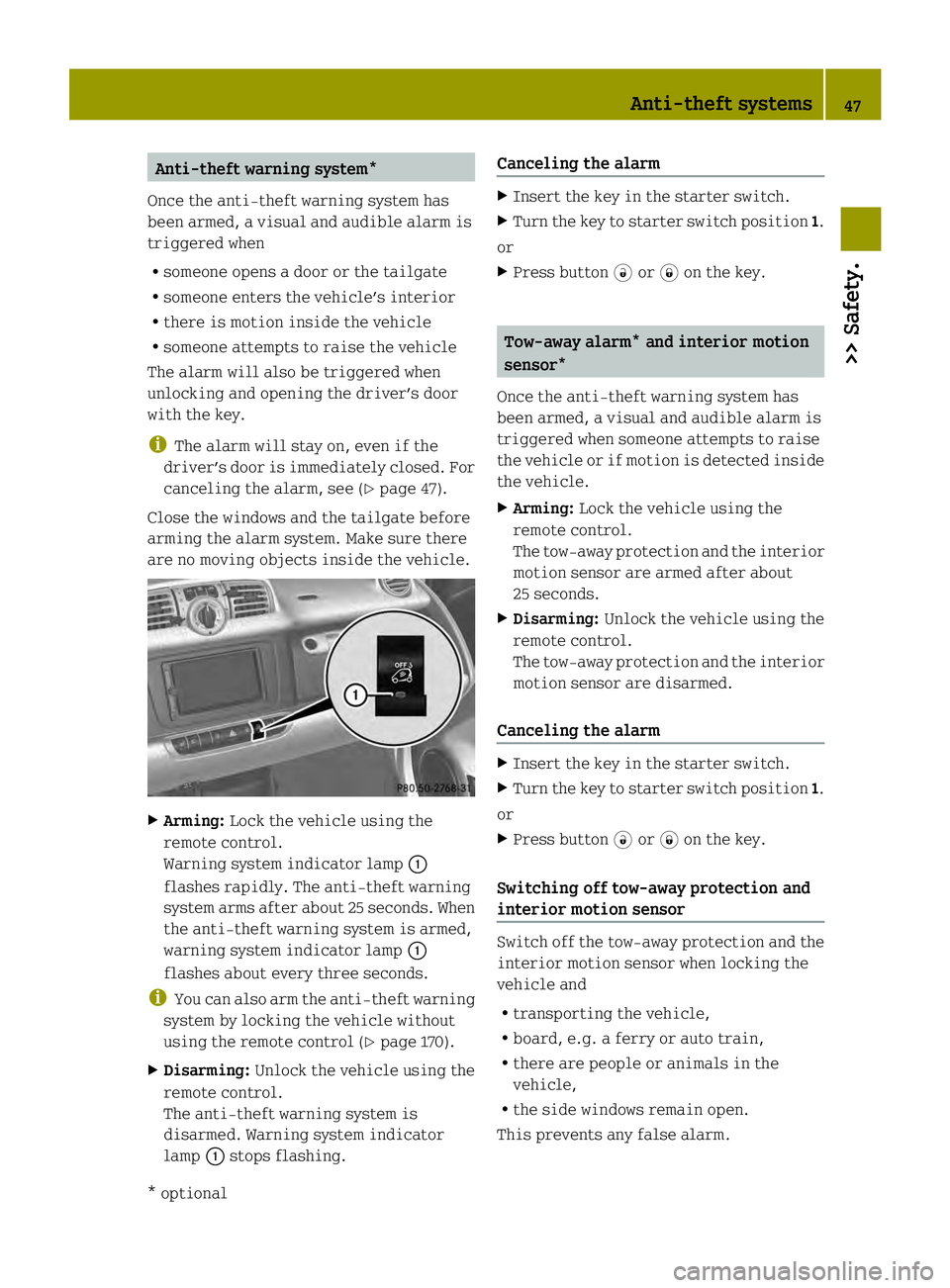
Warning system indicator lamp 0002
flashes rapidly. The anti-theft warning
system arms after about 25 seconds. When
the anti-theft warning system is armed,
warning system indicator lamp 0002
flashes about every three seconds.
i You can also arm the anti-theft warning
system by locking the vehicle without
using the remote control (Y page 170).
X Disarming: Unlock the vehicle using the
remote control.
The anti-theft warning system is
disarmed. Warning system indicator
lamp 0002stops flashing. Canceling the alarm X
Insert the key in the starter switch.
X Turn the key to starter switch position 1.
or
X Press button 0006or0004 on the key. Tow-away alarm* and interior motion
sensor*
Once the anti-theft warning system has
been armed, a visual and audible alarm is
triggered when someone attempts to raise
the vehicle or if motion is detected inside
the vehicle.
X Arming: Lock the vehicle using the
remote control.
The tow-away protectiona nd the interior
motion sensor are armed after about
25 seconds.
X Disarming: Unlock the vehicle using the
remote control.
The tow-away protectio nand the interior
motion sensor are disarmed.
Canceling the alarm X
Insert the key in the starter switch.
X Turn the key to starter switch position 1.
or
X Press button 0006or0004 on the key.
Switching off tow-away protection and
interior motion sensor Switch off the tow-away protectio
nand the
interior motion sensor when locking the
vehicle and
R transporting the vehicle,
R board, e.g. a ferry or auto train,
R there are people or animals in the
vehicle,
R the side windows remain open.
This prevents any false alarm. Anti-theft systems
47>> Safety.
* optional Z
Page 50 of 218

X
Remove the key from the starter switch.
X Press switch 0002within 60 seconds.
Indicator lamp 0003comes on.
X Exit the vehicle.
X Lock the vehicle using the remote
control.
i The tow-away protection and the
interior motion sensor remain switched
off until you lock your vehicle again. 48
Anti-theft systems>> Safety.
Page 52 of 218

Opening and closing
Key
Key with remote control
0002
0004Lock button
0003 0005Opening the retractable soft top 3
/
unlocking the upper tailgate 4
002B 0006Unlock button
The remote control centrally locks and
unlocks:
R the driver’s door
R the charge socket flap
R the passenger door
R the upper tailgate G
WARNING
When leaving the vehicle, always remove the
key from the starter switch, take it with
you, and lock the vehicle. Do not leave
children unattended in the vehicle, or with
access to an unlocked vehicle. It is
possible for children to open a locked door
from the inside, which could result in an
accident and/or serious personal injury.
! To prevent possible malfunction, avoid
exposing the remote control to high
levels of electromagnetic radiation.
If you can no longer lock or unlock the
vehicle with the remote control, the
batteries in the remote control are discharged, or the remote control is
malfunctioning.
X
Check the batteries in the remote control
and replace them if necessary.
X If you do not have a spare transmitter
battery at hand, use the key to open the
driver’s door and the charge socket flap
(Y page 170).
i USA only:
This device complies with Part 15 of the
FCC Rules. Operation is subject to the
following two conditions:
1. This device may not cause harmful
interference, and
2. this device must accept any
interference received, including
interference that may cause undesired
operation.
Any unauthorized modification to this
device could void the user’s authority to
operate the equipment.
The product label with FCC ID and IC
certification number can be found in the
battery case.
i Canada only:
This device complies with RSS‑210 of
Industry Canada. Operation is subject to
the following two conditions:
1. This device may not cause
interference, and
2. this device must accept any
interference received, including
interference that may cause undesired
operation of the device.
Any unauthorized modification to this
device could void the user’s authority to
operate the equipment.
The product label with FCC ID and IC
certification number can be found in the
battery case.
3 cabriolet only.
4 coupé only. 50
Opening and closing>> Controls.
Page 53 of 218

!
The remote control has an operating
range of approximately 50 ft (15 meters).
This can fluctuate greatly as a
consequence of local conditions
(reflective or absorbing objects) and
interference emitted by other radio
transmission systems. Similarly, the
operating range fluctuates in line with
the direction from which the remote
control is activated.
To prevent theft, however, it is advisable
to only unlock the vehicle when you are
in close proximity to it. Locking and unlocking from the
outside
X Selective unlocking: Press button0006on
the key once.
All turn signal lamps flash once.
The driver’s door and the charge socket
flap are unlocked.
X Global unlocking: Press button0006on the
key twice.
All turn signal lamps flash once again.
The passenger door and the tailgate are
unlocked in addition to the driver’s door
and the charge socket flap.
X Global locking: Press button0004on the
key.
With the doors, the tailgate(s), and the
charge socket flap closed, the turn
signal lamps flash three times.
The indicator lamp on the central
locking switch flashes (Y page 51).
The interior lamps come on and then go
out again after 12 seconds. Automatic locking
Auto-relock function The vehicle will lock again automatically
within approximately 60 seconds of unlocking with the key if neither the
driver’s nor passenger door is opened.
!
To prevent an inadvertent lockout,
never leave your key lying in the vehicle.
Drive lock function The vehicle locks automatically when the
ignition is switched on and the wheels are
turning at vehicle speeds of approximately
8 mph (14 km/h) or more. The drive lock
function is enabled at the factory.
X
Switching on: Switch off the ignition.
X Press the central locking switch
(Y page 51) and button 0004on the key
simultaneously.
An acoustic signal sounds.
The drive lock function is switched on.
X Switching off: Switch off the ignition.
X Press the central unlocking switch
(Y page 51) and button 0006on the key
simultaneously.
An acoustic signal sounds.
The drive lock function is switched off. Locking and unlocking from the inside
G
WARNING
When leaving the vehicle, always remove the
key from the starter switch, take it with
you, and lock the vehicle. Do not leave
children unattended in the vehicle, or with
access to an unlocked vehicle. A child’s
unsupervised access to a vehicle could
result in an accident and/or serious
personal injury.
You can lock and unlock the vehicle from
inside using the central locking or
unlocking switch. This can be useful, for
example, if you want to unlock the
passenger door from inside or lock the
vehicle before starting to drive. Opening and closing
51>> Controls. Z