2013 SKODA YETI instrument cluster
[x] Cancel search: instrument clusterPage 210 of 266

A slight drop in the fluid level results when driving due to normal wear-and-tear
and automatic adjustment of the brake pads.
There may be an indication of a leak in the brake system, however, if the fluid lev-
el drops significantly within a short time or if it drops below the “MIN” marking.
If the brake fluid level is too low, this is indicated by the indicator light » page 15 , Brake system lighting up in the instrument cluster.
Changing
First read and observe the introductory information and safety warn-ings
on page 206.
Brake fluid absorbs moisture. Over time it therefore absorbs moisture from the
environment.
Excessive water in the brake fluid may be the cause of corrosion in the brake sys-
tem.
The water content lowers the boiling point of the brake fluid.
The brake fluid must comply with the following standards or specifications: › VW 50114;
› FMVSS 116 DOT4.
Vehicle battery
Introduction
This chapter contains information on the following subjects:
Opening the cover
208
Checking the battery electrolyte level
209
Charging
209
Replacing
210
Disconnecting and reconnecting
210
Automatic load deactivation
210Warning symbols on the vehicle batterySymbolImportanceAlways wear eye protection.Battery acid is severely caustic. Always wear gloves and eye protec- tion.Keep fire, sparks, open flames and lit cigarettes well clear of the ve-
hicle battery.When charging the vehicle battery, a highly explosive gas mixture is produced.Keep children away from the vehicle battery.WARNINGThere is risk of injuries, poisoning, chemical burns, explosions or fire when
working on the battery and on the electrical system. The general applicable
safety rules and the following warnings must be observed without exception.■
Keep children away from the vehicle battery.
■
Do not tilt the battery otherwise battery electrolyte may flow out of the bat-
tery vent openings. Protect your eyes by wearing safety goggles or a face
shield – risk of blindness!
■
Always wear protective gloves, eye and skin protection when handling the
vehicle battery.
■
The battery acid is strongly corrosive and must, therefore, be handled with
the greatest of care.
■
Corrosive fumes in the air irritate the air passages and lead to conjunctivitis
and inflammation of the air passages in the lungs.
■
Battery acid corrodes dental enamel and, if it comes into contact with the
skin, causes deep wounds that take a long time to heal. Repeated contact
with diluted acids causes skin diseases (inflammations, ulcers, slin cracks).
■
If any battery acid comes into contact with your eyes, rinse the affected eye
immediately with clean water for several minutes and consult a doctor imme-
diately!
■
Splashes of acid on your skin or clothes should be neutralised as soon as
possible using soap suds and then rinsed with plenty of water. If you swallow
battery acid, consult a doctor immediately!
207Inspecting and replenishing
Page 240 of 266

›Insert a new fuse.›Replace the bracket at the original position.›
Re-insert the cover of the fuse box .
Fuse assignment in the dash panel
No.Power consumer1Heating of the gearbox ventilation (diesel engine)
Control unit for automatic gearbox DSG2-3Tow hitch4Instrument cluster, windshield wiper lever, turn signal light lever,
camera5Air blower for heating, radiator fan, air conditioning system, Clima-
tronic6Rear window wiper7Phone8Tow hitch9Vehicle voltage control unit - interior lights
Rear fog light10Rain sensor, light switch, diagnosis connector, removable light11Left side cornering lights12Right side cornering lights13Radio, DVD14Central control unit, engine control unit15Light switch16Haldex17KESSY controller, steering wheel locking18Diagnostic socket, engine control unit, brake sensor, Haldex19Control unit for ABS, ESP, switch for tyre air pressure control, control
unit for parking aid, switch for OFF ROAD mode, START STOP button20Switch and airbag control unit21WIV, tail lamp, dimming mirror, pressure sensor, telephone prepara- tion, air mass sensor, control unit for headlight range control and
headlight tilt22Instrument cluster controller for electro-mechanical power steering, control unit for data bus23Central locking system and bonnet lidNo.Power consumer24Rear power window25Rear window heater, auxiliary heating and ventilation26Power socket in the boot27Electric sliding/tilting roof, electric sun screen28Fuel pump, injection valves29Front power window30front and rear lighter31Headlight cleaning system32Front seat heating, regulator for seat heating33Heating, air conditioning, Climatronic, remote control for auxiliary
heating34Alarm, spare horn35Control unit for automatic gearbox DSG36Tow hitch
Fuses in the engine compartment
Fig. 194
Cover for the fuse box in the engine compartment / fuses
First read and observe the introductory information and safety warn-
ings
on page 236.
On some vehicles, the battery cover must be removed before removing the cover
for the fuse box » page 208.
237Fuses and light bulbs
Page 241 of 266
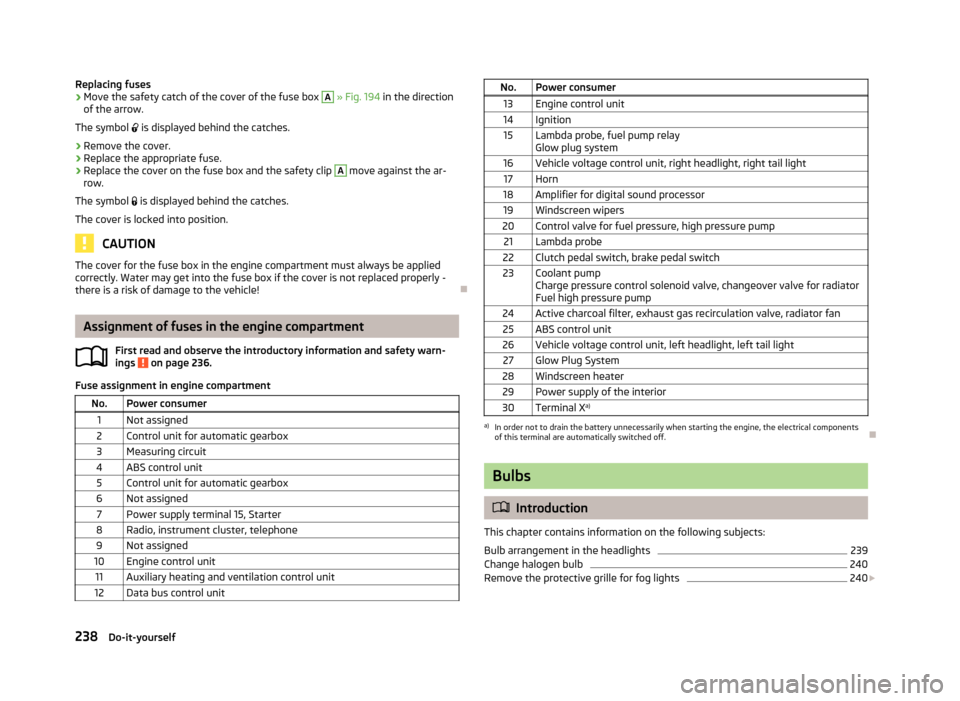
Replacing fuses›Move the safety catch of the cover of the fuse box A » Fig. 194 in the direction
of the arrow.
The symbol is displayed behind the catches.›
Remove the cover.
›
Replace the appropriate fuse.
›
Replace the cover on the fuse box and the safety clip
A
move against the ar-
row.
The symbol is displayed behind the catches.
The cover is locked into position.
CAUTION
The cover for the fuse box in the engine compartment must always be applied
correctly. Water may get into the fuse box if the cover is not replaced properly -
there is a risk of damage to the vehicle!
Assignment of fuses in the engine compartment
First read and observe the introductory information and safety warn-ings
on page 236.
Fuse assignment in engine compartment
No.Power consumer1Not assigned2Control unit for automatic gearbox3Measuring circuit4ABS control unit5Control unit for automatic gearbox6Not assigned7Power supply terminal 15, Starter8Radio, instrument cluster, telephone9Not assigned10Engine control unit11Auxiliary heating and ventilation control unit12Data bus control unitNo.Power consumer13Engine control unit14Ignition15Lambda probe, fuel pump relay
Glow plug system16Vehicle voltage control unit, right headlight, right tail light17Horn18Amplifier for digital sound processor19Windscreen wipers20Control valve for fuel pressure, high pressure pump21Lambda probe22Clutch pedal switch, brake pedal switch23Coolant pump
Charge pressure control solenoid valve, changeover valve for radiator
Fuel high pressure pump24Active charcoal filter, exhaust gas recirculation valve, radiator fan25ABS control unit26Vehicle voltage control unit, left headlight, left tail light27Glow Plug System28Windscreen heater29Power supply of the interior30Terminal X a)a)
In order not to drain the battery unnecessarily when starting the engine, the electrical components
of this terminal are automatically switched off.
Bulbs
Introduction
This chapter contains information on the following subjects:
Bulb arrangement in the headlights
239
Change halogen bulb
240
Remove the protective grille for fog lights
240
238Do-it-yourself
Page 258 of 266

I
Ice warning
24
Ignition119
Immobiliser119
Individual settings Locking
36
Unlocking36
Inertia reel167
Information messages see KESSY
38
Information system23
Compass point display25
Door warning25
Gear recommendation24
Ice warning24
MAXI DOT display28
Multifunction display25
Operation23
Service interval display30
Inserting the variable loading floor
88
Instrument cluster10
Counter for distance driven13
Display12
Fuel gauge12
Lighting53
Overview10
Revolutions counter11
Speedometer11
Temperature gauge11
Warning lights14
Instrument lighting53
Interior monitor40
Internet connection108
ISOFIX180
J
Jack
220
Jacking points Raise vehicle223
Jump-starting226, 227
K
KESSY Information messages
38
lock38
Lock / unlock the steering121
Starting the engine122
Switching off the engine123
Switching off the ignition123
Switching on the ignition122
unlock38
Key Locking
33
Starting the engine119
Stopping the engine120
Unlocking33
Knee airbag172
L
LEAVING HOME
51
Lever Main beam
49
Turn signal49
Levers Windscreen wipers
57
Licht COMING HOME / LEAVING HOME
51
Light Cockpit
53
Fog lights with CORNER function51
Instruments53
Replacing bulbs238
Travel mode50
Lights47
Adaptive headlights (AFS)50
Automatic driving lamp control49
Daylight running48
Fog lights51
Hazard warning light system52
Headlight beam adjustment47
Headlight flasher49
Low beam47
Main beam49
Parking lights53
Rear fog light51
Side lights47
Switching on/off47
Tourist lights50
Turn signal49
Warning lights14
Lights on/off47
Loads244
Locking Individual settings
36
KESSY35
Key33
Remote control34
Vehicle key33
Locking and unlocking the vehicle from the inside 36
Locking the door without a locking cylinder Emergency
233
Low beam47
Luggage compartment81
Cover85
Emergency unlocking233
Fastening elements82
Fastening with sliding hook84
Fixing nets83
Flexible storage compartment84
floor covering on both sides85
foldable hook83
Net partition86
removable light87
Storage compartments86
Unlocking the tailgate233
Variable loading floor88
Luggage compartment cover85
255Index