2013 SKODA YETI remove seats
[x] Cancel search: remove seatsPage 88 of 266

Floor covering on both sidesFirst read and observe the introductory information and safety warn-
ings
on page 81.
You can fit a double-sided floor covering in the luggage compartment.
One side of the double-sided floor covering is made of fabric, the other side is
washable (easy to maintain).
The washable side is used to transport wet or dirty items.
Note
For easier turning of the covering, use the loop attached.
Luggage compartment cover
Fig. 82
Secure luggage compartment cover
First read and observe the introductory information and safety warn- ings
on page 81.
The boot cover can be removed if you want to transport bulky goods.
Removing
›
Fold the seat backrests a little forward to make it easier to remove the luggage
compartment cover » page 68, Setting the tilt of the seat backrests .
›
Unhook the support straps
A
» Fig. 82 from the luggage compartment.
›
Place the cover in the horizontal position.
›
Pull the luggage compartment cover to the rear from the bolts
C
or pat on the
bottom of the cover in the area of the
C
bolts.
› Fold the slackened front part of the boot cover over the head restraints of the
rear seats.›
Slightly tilt the boot cover and remove it to the rear.
Installing
›
Place the cover on the contact surfaces of the side trim panel.
›
Position the mounts on the cover
B
» Fig. 82 onto the side trim panel via bolts
C
.
›
Interlock the cover by lightly knocking on the top side of the cover in the area
between the bolts.
›
Hook the support straps
A
onto the tailgate.
WARNINGNo objects should be placed on the boot cover, the vehicle occupants could be
endangered if there is sudden braking or the vehicle collides with something.
CAUTION
Please ensure that the heating elements for the rear window heater are not dam-
aged as a result of objects placed in this area.
Note
■ If the support straps A » Fig. 82 are attached to the boot, then the boot cover
will rise as well when the luggage compartment is opened.■
After removing the luggage compartment cover, store it in such a way that it
cannot be damaged or soiled.
85Seats and useful equipment
Page 89 of 266

Net partitionFig. 83
Using the net partition behind the rear seats
First read and observe the introductory information and safety warn-
ings
on page 81.
The net partition can either be installed behind the rear seats or behind the front
seats.
Installing the net partition behind the rear seats
›
Remove the boot cover » page 85, Luggage compartment cover .
›
Remove the net partition from the bag.
›
Unfold both parts of the cross rod until they are heard to engage.
›
First of all insert the cross rod into the mount
B
» Fig. 83 on one side and push
it forward. In the same way, insert the cross rod into the mount
B
on the other
side of the vehicle.
›
Hang the carabines
C
at the ends of the strap into the lashing eyes behind the
rear seats.
›
Pull the belts through the tensioning clasp.
Using the net partition behind the rear seats
›
Undo the belts on both sides and unhook the carabines
C
» Fig. 83 .
›
Push the cross rod first of all on the one side and then on the other side to-
wards the rear.
›
Remove the cross rod from the mounts
B
.
Packing the net partition
›
Press the red button of the joint
A
» Fig. 83 - the joint becomes loose.
›Put the net partition folded together in the bag and close it.›Attach the bag with the aid of the plastic carabines to the eyes on the left and
right boot trim panel.
Installing and removing the net partition behind the rear seats with variable load- ing floor » page 88 is carried out analogously as behind the rear seats without
variable loading floor. Use the lower fixing eyes on the carrier rails in order to at-
tach the carabines.
Installing and removing the net partition behind the rear seats is carried out anal-
ogously as behind the rear seats. Use the lower fixing eyes on the carrier rails in
order to attach the carabines. To enlarge the boot, the rear seats can be re-
moved » page 69 .
The opening D
» Fig. 83 in the net partition is designed to feed through the
three-point seat belt » page 167.
Stortage compartments
Fig. 84
Storage compartment on the left / right
First read and observe the introductory information and safety warn-
ings
on page 81.
The cover for the storage compartment
A
» Fig. 84 can be removed, thus enlarg-
ing the boot.
›
Grasp the top part of the cover
A
and carefully remove it in the direction of the
arrow.
86Using the system
Page 90 of 266

CAUTION■The removable storage compartment A » Fig. 84 on the left side is suitable for
stowing small objects weighing up to 1.5 kg.■
The storage compartment
B
is designed for storing small objects of up to 0.5
kg. in weight in total.
Removable storage box
Fig. 85
Storage box
First read and observe the introductory information and safety warn-
ings on page 81.
The storage box » Fig. 85 is placed under the variable loading floor and can be
taken out.
There is a storage space for the vehicle tool kit under the storage box » page 220 , Vehicle tool kit .
WARNINGThe removable storage box must be located under the variable loading floor
for the safe use of the variable loading floor.
Removable lightFig. 86
Use light / remove light
First read and observe the introductory information and safety warn-
ings
on page 81.
A removable light is fitted on the right side of the boot. This lamp has two func-
tions.
› Lighting the luggage compartment - part
B
illuminated
» Fig. 86 (lamp in hold-
er).
› Portable light - part
A
is illuminated (light removed from the holder).
The lamp is fitted with magnets. Therefore it is possible to attach the lamp, for
example on the vehicle body, after removing it.
Using the system
› If you press button
C
» Fig. 86 , the lamp lights up with 100 % light intensity.
› If you press button
C
again, the lamp lights up with 50 % light intensity.
› Press
C
button once again - the light goes out.
Removed from the holder
› Grasp the lamp in the areas of the arrow
D
» Fig. 86 and swivel it in the direc-
tion of the arrow
1
.
Reinserting the lamp the holder › Switch off the ignition
»
.
› First of all, place the deactivated light in the holder on the side facing the boot
lid and then press on the light from the other side until it is clicks into place.
The lamp is supplied by three rechargeable type AAA batteries. The rechargeable
batteries are constantly charged when the engine is running. It takes approx. 3
hours to fully charge the rechargeable batteries.
87Seats and useful equipment
Page 92 of 266
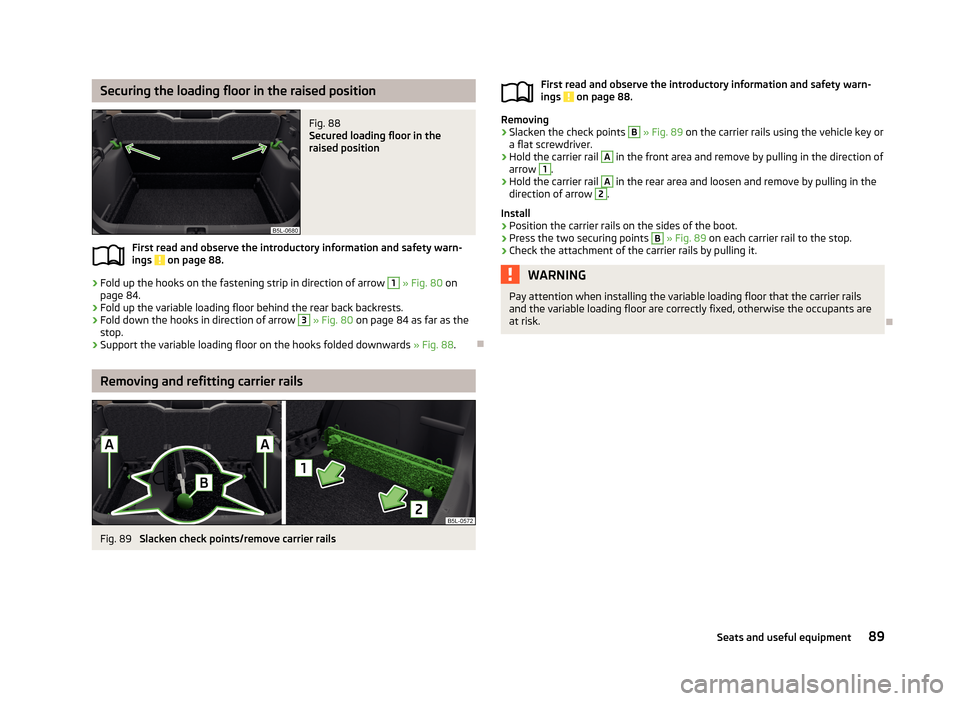
Securing the loading floor in the raised positionFig. 88
Secured loading floor in the
raised position
First read and observe the introductory information and safety warn-
ings on page 88.
›
Fold up the hooks on the fastening strip in direction of arrow
1
» Fig. 80 on
page 84.
›
Fold up the variable loading floor behind the rear back backrests.
›
Fold down the hooks in direction of arrow
3
» Fig. 80 on page 84 as far as the
stop.
›
Support the variable loading floor on the hooks folded downwards » Fig. 88.
Removing and refitting carrier rails
Fig. 89
Slacken check points/remove carrier rails
First read and observe the introductory information and safety warn-
ings on page 88.
Removing
›
Slacken the check points
B
» Fig. 89 on the carrier rails using the vehicle key or
a flat screwdriver.
›
Hold the carrier rail
A
in the front area and remove by pulling in the direction of
arrow
1
.
›
Hold the carrier rail
A
in the rear area and loosen and remove by pulling in the
direction of arrow
2
.
Install
›
Position the carrier rails on the sides of the boot.
›
Press the two securing points
B
» Fig. 89 on each carrier rail to the stop.
›
Check the attachment of the carrier rails by pulling it.
WARNINGPay attention when installing the variable loading floor that the carrier rails
and the variable loading floor are correctly fixed, otherwise the occupants are
at risk.
89Seats and useful equipment
Page 119 of 266

DVD-preinstallationFig. 102
Seat backrest - left front seat/right front seat
First read and observe the introductory information given on page 113.
Explanation of graphic Openings for attachment of DVD player holderAudio/video input
Connection input, DVD player
Only one DVD pre-installation is factory-installed in the seat backrest of the front seat.
The DVD player holder and DVD player can be purchased from ŠKODA original ac-
cessories. For a description of the use, refer to the operating instructions for these devices and equipment.
WARNING■ If there are passengers on both of the rear seats, the DVD player holder
must not be used on its own (without the DVD player) - risk of injury!■
The inclination of the holder can be adjusted to three preset positions. Be
careful not to injure fingers between the holder and the backrest when changes to the position of the DVD player holder are made.
■
The DVD player holder must not be used when the rear seat backrest or the
rear seat is folded forward or has been removed completely.
ABCNoteFollow the instructions given in the operating instructions of the DVD player hold-
er/DVD player.
116Using the system
Page 168 of 266

WARNINGInformation on the proper use of safety belts■Never use one seat belt to secure two persons (including children). The
seatbelt must not be placed over a child who is sitting on the lap of another
passenger.■
The lock tongue should only be inserted into the lock which is the correct
one for your seat. Wrong use of the safety belt will reduce its capacity to pro-
tect and the risk of injury increases.
■
The slot of the belt tongue must not be blocked, otherwise the belt tongue
will not lock in place properly.
■
Many layers of clothing and loose clothing (e. g. a winter coat over a jacket)
do not allow you to be correctly seated and impairs proper operation of the
seat belts.
■
It is prohibited to use clamps or other objects to adjust seat belts (e. g. for
shortening the belts for smaller persons).
■
The seat belts for the rear seats can only fulfil their function reliably when
the seat backrests are correctly locked into position » page 68.
WARNINGInformation on the care and maintenance of safety belts■The belt webbing must always be kept clean. Soiled belt webbing may im-
pair proper operation of the inertia reel » page 195, Seat belts .■
The seat belts must not be removed or changed in any way. Do not attempt
to repair the seat belts yourself.
■
Check the condition of all the seat belts on a regular basis. If any damage to
the seat belts, seat belt connections, inertia reel or the lock is detected, the
relevant seat belt must be replaced by a specialist garage.
■
Damaged seat belts which have been subjected to stress in an accident and
were therefore stretched, must be replaced – this is best done by a specialist
garage. The anchorage points of the belts must also be inspected. The an-
chorage points for the belts should also be checked.
Note
The national legal requirements must be observed when using seat belts.
The physical principle of a head-on collisionFig. 137
Driver without a fastened seat belt/rear passenger without a fas-
tened seat belt
First read and observe the introductory information and safety warn-ings
on page 164.
Motion energy, so-called kinetic energy, is produced as soon as the vehicle is
moving, both for the vehicle and its occupants.
The magnitude of this kinetic energy depends essentially on the speed at which
the vehicle is travelling and on the weight of the vehicle including the occupants. The greater the speed and weight increase, the greater the amount of energy
which has to be absorbed in the event of an accident.
The speed of the vehicle is the most important factor. Doubling the speed of the
vehicle from 25 km/h up to 50 km/hour increases the kinetic energy four times.
The idea that it is possible to support your body with your hands in a minor acci- dent is incorrect. Even in a collision at only a low speed, the forces acting on the
body are such that it is no longer possible to support your body.
Even if you only drive at a speed of 30-50 km/h, the forces that your body is ex-
posed to in the event of an accident can exceed a metric ton (1000 kg).
For example, a person's weight of 80 kg “increases” to 4.8 tons (4800 kg) at
50 km/h.
In the event of a frontal collision, occupants of the car not wearing a seat belt, are thrown forward and strike in an uncontrolled way parts of the interior of the car,
such as steering wheel, dash panel or windscreen » Fig. 137 -
. In certain circum-
stances you could even be thrown out of the vehicle, which could cause life threatening or even fatal injuries.
165Seat belts
Page 176 of 266

Side airbagsFig. 145
Position of the airbag in the front seat / back
Fig. 146
Inflated airbags
First read and observe the introductory information given on page 170.
In the event of severe side collisions, the side airbag system provides additional
protection for the upper body (chest, stomach and pelvis) of passengers in the ve- hicle.
The front side airbags are housed in the upholstery of the seat backrests of the front seats » Fig. 145 -
.
The rear side airbags are located between the entrance area and the seat back-
rest » Fig. 145 -
.
When the side airbags are deployed, the head airbag and belt tensioner are also automatically deployed on the relevant side.
The load of the occupants is cushioned when plunging into the fully inflated air-
bag » Fig. 146 and the risk of injury to the entire upper body (chest, stomach and
pelvis) is reduced on the side facing the door.WARNINGInformation on correct seating position■Your head should never be positioned in the deployment area of the side
airbag. You might suffer severe injuries in the event of an accident. This ap- plies in particular to children who are transported without using a suitablechild safety seat » page 179, Child safety and side airbag .■
There must not be any further persons, animals as well as objects posi-
tioned between the occupants and the deployment area of the airbag. No ac-
cessories, such as cup holders, should be attached to the doors.
■
If children adopt an incorrect seated position when travelling, they may be
exposed to an increased risk of injury in the event of an accident. This can re-
sult in serious injuries » page 177, Child seat .
WARNINGThe airbag control unit operates using pressure sensors located in the front
doors. For this reason, no adjustments may be carried out to the doors or door
panels (e.g. installation of additional loudspeakers). Resulting damage can have a negative impact on the function of the airbag system. Any work on thefront doors and door panels must be carried out by a specialist garage. The
following instructions must be observed.■
Never drive with inner door panels removed.
■
Never drive if parts of the inner door panel have been removed and the re-
sulting openings have not been properly sealed.
■
Never drive if the loudspeakers in the doors have been removed, unless the
loudspeaker openings have been properly sealed.
■
Always make sure that the openings are covered or filled if additional loud-
speakers or other equipment parts have been installed in the inner door pan-
els.
■
Always have work carried out by a ŠKODA service partner or a professional
specialist garage.
173Airbag system
Page 178 of 266

WARNINGThe airbag control unit operates using pressure sensors located in the front
doors. For this reason, no adjustments may be carried out to the doors or door
panels (e.g. installation of additional loudspeakers). Resulting damage can have a negative impact on the function of the airbag system. Any work on thefront doors and door panels must be carried out by a specialist garage. The
following instructions must be observed.■
Never drive with inner door panels removed.
■
Never drive if parts of the inner door panel have been removed and the re-
sulting openings have not been properly sealed.
■
Never drive if the loudspeakers in the doors have been removed, unless the
loudspeaker openings have been properly sealed.
■
Always make sure that the openings are covered or filled if additional loud-
speakers or other equipment parts have been installed in the inner door pan-
els.
■
Always have work carried out by a ŠKODA service partner or a professional
specialist garage.
Note
In vehicles with head airbags, the word AIRBAG can be seen on the B and C col-
umn cladding.
Deactivating airbags
Introduction
This chapter contains information on the following subjects:
Deactivating airbags
175
Deactivating the front passenger airbag
176
Deactivating airbags
First read and observe the introductory information given on page 175.
Deactivating an airbag should be considered in cases such as the ones below.› If using a rear-facing child seat on the front passenger seat (due to different le-
gal regulations, the airbag must be deactivated if using a forwards-facing child
seat in some countries) » page 177, Transporting children safely .
› If it is not possible to maintain a distance of at least 25 cm between the middle
of the steering wheel and chest, despite the driver's seat being correctly adjus-
ted.
› If special attachments are required in the area of the steering wheel because of
a physical disability.
› If different seats have been fitted (e.g. orthopaedic seats without side airbags).
The front passenger airbag can be switched off with the key-operated
switch » page 176 , Deactivating the front passenger airbag .
We recommend that you ask a ŠKODA service partner to deactivate any other air-
bags.
Monitoring the airbag system
The operational capability of the airbag system is monitored electronically, includ-
ing when one of the airbags is switched off.
Airbag deactivated using diagnostic equipment
› The
warning light lights up for approximately 4 seconds after the ignition is
switched on and then flashes again for approximately 12 seconds.
Front passenger airbag deactivated using the key switch in the storage com-
partment
› The
warning light lights up for approximately 4 seconds after the ignition is
switched on.
› The
warning light
3
» Fig. 148 on page 176 lights up after the ignition is
switched on.
Note
■ The national regulations for switching off airbags must be observed.■A ŠKODA service partner will be able to inform you which, if any, of your vehi-
cle's airbags can or must be deactivated.
175Airbag system