2013 SKODA RAPID wheel
[x] Cancel search: wheelPage 190 of 226

›Push the wheel wrench onto the adapter B up to the stop.›Loosen or tighten the wheel bolt
» page 185.›
After removing the adapter, replace the cap on the anti-theft wheel bolt.
›
Have the tightening torque checked with a torque wrench as soon as possible.
Note
■
Make a note of the code number hammered into the rear side of the adapter or
the rear side of the anti-theft wheel bolt. This number can be used to purchase a
replacement adapter from ŠKODA Genuine Parts if required.■
We recommend that you always carry the adapter for the wheel bolts with you
in the vehicle. It should be stowed in the vehicle tool kit.
■
The anti-theft wheel bolt set and adapter can be purchased from a ŠKODA Part-
ner.
Tyre repair
Introduction
This chapter contains information on the following subjects:
Breakdown kit
188
Preparations for using the breakdown kit
188
Sealing and inflating the tyre
188
Check after 10 minutes' driving
189
Use the breakdown kit to reliably repair tyre damage caused by foreign bodies or
a puncture with diameters up to approx. 4 mm.
A repair made using the breakdown kit is never intended to replace a permanent
repair on the tyre. Its purpose is to get you to the nearest specialist garage.
The wheel must not be removed during repair.Do not remove foreign bodies , e.g. screws or nails, from the tyre.
The breakdown kit must not be used under the following circumstances. › There is damage to the rim.
› The outside temperature is less than -20 °C.
› The tears or punctures are greater than 4 mm in size.
› There is damage to the tyre wall.
› Driving with very low tyre pressure or with a completely flat tyre.
› If the use-by-date (see inflation bottle) has passed.
WARNING■
A tyre filled with sealant has the same driving characteristics as a standard
tyre.■
Do not travel faster than 80 km/h.
■
Avoid accelerating at full throttle, sharp braking and fast cornering.
■
Check the tyre pressure after driving for 10 minutes.
■
The sealant is hazardous to heath. Remove immediately if it comes into con-
tact with the skin.
For the sake of the environment
Used sealant or sealant whose expiry date has passed must be disposed of in ac- cordance with environmental protection regulations.
Note
■ Observe the manufacturer's usage instructions for the breakdown kit.■A new bottle of sealant can be purchased from ŠKODA Original Parts.■
Immediately replace the tyre that was repaired using the breakdown kit, or con-
sult a specialist garage about repair options.
187Emergency equipment and self-help
Page 194 of 226

Jump-starting in vehicles with the START-STOP systemFig. 156
Engine earth: START-STOP system
First read and observe the introductory information and safety warn- ings
on page 189.
On vehicles with the START-STOP system, the jump-start cable of the charger must never be connected directly to the negative pole of the vehicle battery, but
only to the engine earth.
› 1.2 l/63 kW TSI and 1.2 l/77 kW TSI engines
» Fig. 156 -
› 1.4 l/90 kW engine
» Fig. 156 -
› 1.6 l/77 kW TDI CR engine
» Fig. 156 -
Towing the vehicle
Introduction
This chapter contains information on the following subjects:
Front towing eye
192
Rear towing eye
192
Vehicles with a tow hitch
192
Vehicles with manual transmission may be towed in with a tow bar or a tow rope
or with the front or rear wheels raised.
Vehicles with automatic transmission may be towed in with a tow bar or a tow
rope or with the front wheels raised. If the vehicle is raised at rear, the automatic
gearbox is damaged!
A tow bar is the safest way of towing a vehicle and also minimises any shocks.
Only use a tow rope if a suitable tow bar is not available.
When towing, the following guidelines must be observed.
Driver of the tow vehicle›
Release the clutch particularly gently when starting off or depress the accelera-
tor particularly gently if the vehicle is fitted with an automatic gearbox.
›
On vehicles with a manual transmission, only push down on the accelerator pedal once the rope is taught.
The maximum towing speed is 50 km/h.
Driver of the towed vehicle
›
Switch on the ignition so that the steering wheel is not locked and so that the turn signal lights, horn, windscreen wipers and windscreen washer system can
be used.
›
Take the vehicle out of gear or move the selector lever into position N if the ve-
hicle is fitted with an automatic gearbox.
Please note that the brake servo unit and power steering only operate if the en-
gine is running. If the engine is not running, significantly more physical force is re- quired to depress the brake pedal and steer the vehicle.
If using a tow rope, ensure that it is always kept taught.
CAUTION
■ Do not tow start the engine – there is a risk of damaging the engine and the
catalytic converter. The battery from another vehicle can be used as a jump-start
aid » page 189 , Jump-starting .■
If the gearbox no longer contains any oil because of a defect, your vehicle must
only be towed with the driven wheels raised clear of the ground or on a special
breakdown vehicle or trailer.
■
The vehicle must be transported on a special breakdown vehicle or trailer if it is
not possible to tow in the vehicle in the way described or if the towing distance is
greater than 50 km.
■
To protect both vehicles when tow-starting or towing, the tow rope should be
elastic. Thus one should only use plastic fibre rope or a rope made out of a simi-
larly elastic material.
■
While towing, take care to avoid impermissibly high tensile forces or jerky loads.
There is always a risk of excessive stresses and damage resulting at the points to
which you attach the tow rope or tow bar when you attempt to tow a vehicle
which is not standing on a paved road.
■
Attach the tow rope or the tow bar to the towing eyes » page 192
or » page 192 to the detachable ball head of the towing equipment » page 119 .
191Emergency equipment and self-help
Page 195 of 226
Note■We recommend using a tow rope from ŠKODA Original Accessories, which is
available from a ŠKODA Partner.■
Towing another vehicle requires a certain amount of practice. Both drivers
should be familiar with the particular points about towing a vehicle. Unskilled
drivers should not attempt to tow in another vehicle or to be towed in.
■
When towing, respect the national legal provisions, especially those which re-
late to the identification of the towing vehicle and the vehicle being towed.
■
The tow rope must not be twisted as it may in certain circumstances result in
the front towing eye being unscrewed out of your vehicle.
Front towing eye
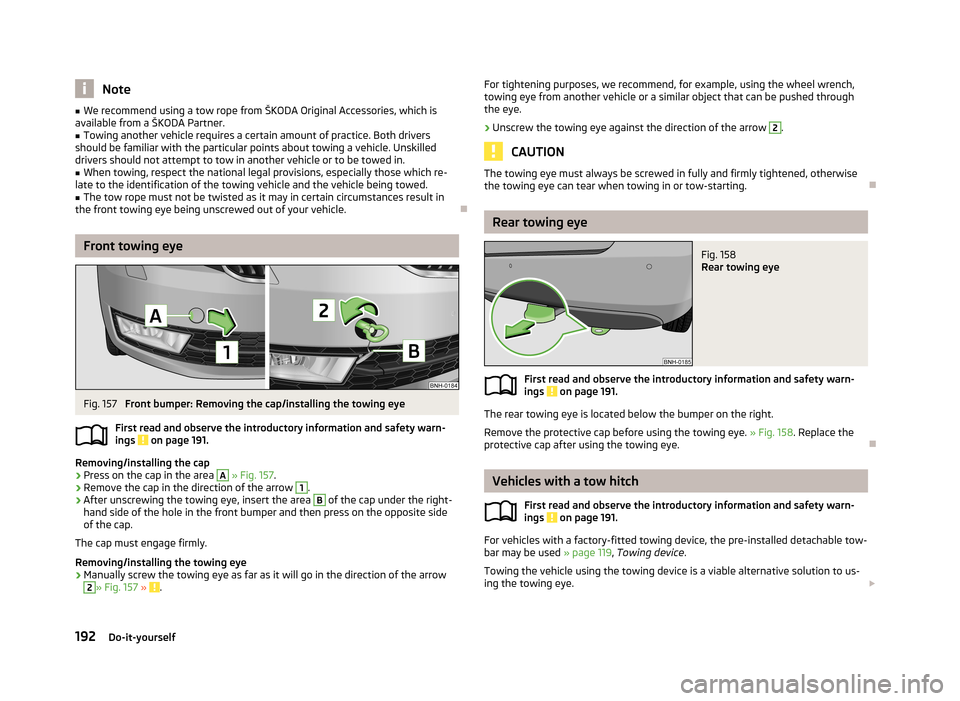
Fig. 157
Front bumper: Removing the cap/installing the towing eye
First read and observe the introductory information and safety warn- ings
on page 191.
Removing/installing the cap
›
Press on the cap in the area
A
» Fig. 157 .
›
Remove the cap in the direction of the arrow
1
.
›
After unscrewing the towing eye, insert the area
B
of the cap under the right-
hand side of the hole in the front bumper and then press on the opposite side
of the cap.
The cap must engage firmly.
Removing/installing the towing eye
›
Manually screw the towing eye as far as it will go in the direction of the arrow
2
» Fig. 157 » .
For tightening purposes, we recommend, for example, using the wheel wrench,
towing eye from another vehicle or a similar object that can be pushed through
the eye.›
Unscrew the towing eye against the direction of the arrow
2
.
CAUTION
The towing eye must always be screwed in fully and firmly tightened, otherwise
the towing eye can tear when towing in or tow-starting.
Rear towing eye
Fig. 158
Rear towing eye
First read and observe the introductory information and safety warn-
ings on page 191.
The rear towing eye is located below the bumper on the right.
Remove the protective cap before using the towing eye. » Fig. 158. Replace the
protective cap after using the towing eye.
Vehicles with a tow hitch
First read and observe the introductory information and safety warn-
ings
on page 191.
For vehicles with a factory-fitted towing device, the pre-installed detachable tow- bar may be used » page 119, Towing device .
Towing the vehicle using the towing device is a viable alternative solution to us- ing the towing eye.
192Do-it-yourself
Page 201 of 226

›Reinsert the cover into the dash panel in the opposite direction to the arrow
such that the guide pins are guided into the dash panel openings.
Carefully push the cover in.
Assignment of the fuses in the dash panel
Fig. 166
Schematic representation of the fuse box for vehicles with left-
hand steering/right-hand steering
First read and observe the introductory information and safety warn-ings
on page 197.
No.Power consumer1S-contact2START - STOP3Instrument cluster, headlight range adjustment, telephone, oil level
sensor, diagnostic port4Control unit for ABS/ESC, steering angle sensor strip with switches5Petrol engine: Speed regulating system6Reversing light (manual gearbox)7Ignition, engine control unit, automatic gearbox8Brake pedal switch, clutch switch, engine cooling fan9Operating controls for the heating, electronic control unit for air condi-
tioning system, park distance control, window lift, engine cooling fan, heated washer nozzles10DC-DC converter11Mirror adjustmentNo.Power consumer12Control unit for trailer detection13Electronic control unit for automatic gearbox, selector lever of the au-tomatic gearbox14Headlight beam control15Not assigned16Power steering, speed sensor, engine control unit, control unit for fuel
pump17Daytime running lights/radio for vehicles with START-STOP18Mirror heater19Ignition lock input20Engine control unit, electronic control unit for fuel pump, fuel pump21Reversing lamp (automatic gearbox), fog lights with the function
CORNER
22
Operating controls for the heating, electronic control unit for air condi- tioning system, telephone, instrument cluster, steering angle sender,
multi-function steering wheel, ignition key removal lock, diagnostic
port23Interior lighting, storage compartment and luggage compartment, side
lights24Central control unit25Not assigned26Rear window wiper27Not assigned28Petrol engine: Purge valve, PTC heater29Injection, coolant pump30Fuel pump, ignition system, cruise control31Lambda probe32High pressure fuel pump, pressure valve33Engine control unit34Engine control unit, vacuum pump35Switch illumination, number plate light, parking light36Main beam37Rear fog light, DC-DC converter38Fog lights 198Do-it-yourself
Page 202 of 226

No.Power consumer39Air blower for heating40Not assigned41Heated front seats42Rear window heater43Horn44Windscreen wipers45Boot lid lock, central locking system46Alarm47Cigarette lighter, power socket in the luggage compartment48ABS49Turn signal lights, brake lights50DC-DC converter, radio51Electric windows (driver's window and rear left window)52Electric windows (front passenger's window and rear right)53Windscreen washer54START-STOP instrument cluster, steering wheel module, multi-function
steering wheel55Control unit for automatic gearbox56Headlight cleaning system57Low beam on the left58Low beam on the right
Fuses in the engine compartment
Fig. 167
Vehicle battery: Cover for the
fuse box (variant 1)
Fig. 168
Vehicle battery: Cover for the
fuse box (variant 2)
First read and observe the introductory information and safety warn-
ings on page 197.
Replacing fuses
›
Press the lock buttons on the cover together simultaneously in the direction of
the arrow
1
» Fig. 167 or » Fig. 168 .
›
Remove the cover in the direction of the arrow
2
.
›
Replace the appropriate fuse.
›
Place the cover on top of the fuse box.
›
Push in the interlocks on the cover and lock.
The cover must engage firmly.
199Fuses and light bulbs
Page 203 of 226

Fuse assignment in the engine compartmentFig. 169
Schematic representation of fuse box in engine compartment: Ver-
sion 1/version 2
First read and observe the introductory information and safety warn-
ings
on page 197.
No.Power consumer1Generator2Not assigned (version 1), auxiliary electric heater (version 2)3Interior (version 1) » Fig. 169
Power supply for fuse block (version 2) » Fig. 1694Auxiliary electric heating (version 1) » Fig. 169
Interior (version 2) » Fig. 1695Interior6Engine cooling fan, control unit for preheating unit7Electrohydraulic power steering8ABS9Radiator fan10Automatic gearbox11ABS12Central control unit13Electrical auxiliary heating system
Note
Fuses 1-7 are replaced by a specialist garage.
Bulbs
Introduction
This chapter contains information on the following subjects:
Bulb arrangement in the headlights
201
Replacing the low beam bulb
201
Replacing bulb for main beam, daytime running lights and parking light
202
Changing the front turn signal bulb
202
Replacing the bulb for the fog light
203
Replacing the bulb for the licence plate light
203
Rear light (Rapid)
204
Replacing bulbs in rear light (Rapid)
204
Tail lamp (Rapid Spaceback)
205
Replacing bulbs in rear light (Rapid Spaceback)
206
Some manual skills are required to change a bulb. For this reason, we recommend
having bulbs replaced by a specialist garage or seeking other expert help in the
event of any uncertainties.
› Switch off the ignition and all of the lights before replacing a bulb.
› Faulty bulbs must only be replaced with the same type of bulbs. The designa-
tion is located on the light socket or the glass bulb.
› A stowage compartment for replacement bulbs is located in a plastic box in the
spare wheel or underneath the floor covering in the boot.
WARNING■ Always read and observe the warning notes before completing any work in
the engine compartment » page 162, Engine compartment .■
Accidents can be caused if the road in front of the vehicle is not sufficiently
illuminated and the vehicle cannot or can only be seen with difficulty by other
road users.
■
H7 and H15 bulbs are pressurised and may burst when changing the bulb -
risk of injury! We therefore recommended wearing gloves and safety glasses
when changing a bulb.
■
Gas discharge bulbs (xenon bulbs) operate with a high voltage, professional
knowledge is required – risk of death!
■
The corresponding lamp must always be switched off when replacing a light
bulb.
200Do-it-yourself
Page 206 of 226

Replacing the bulb for the fog lightFig. 174
Front bumper: Protective grille/removing the fog light
Fig. 175
Replacing the light bulb
First read and observe the introductory information and safety warn-
ings on page 200.
Removing the protective grille
›
Undo the protective grille in the area of the arrow » Fig. 174 -
using the clamp
for removing the wheel trims » page 183, Vehicle tool kit .
›
Remove the protective grille in the direction of the arrow
1
» Fig. 174 .
Changing light bulbs for fog lights
›
Unscrew the screws » Fig. 174 -
marked with the arrows 1)
.
›
Unlock the fuse in the direction of the arrow
2
with the screwdriver.
›
Remove the headlight in the direction of arrow
3
.
›
Remove the connector » Fig. 175.
›Turn the bulb holder in an
anti-clockwise direction as far as the stop and then
remove it » Fig. 175.›
Insert the bulb holder with the new bulb into the headlight and turn in a clock-
wise direction as far as the stop.
›
Attach the connector.
›
Replace the fog light by inserting it in the opposite direction of the arrow
3
» Fig. 174 and tighten.
›
Insert the protective grille and carefully press it in.
The protective grille must engage firmly.
Replacing the bulb for the licence plate light
Fig. 176
Remove the number plate light/replace the bulb
First read and observe the introductory information and safety warn-
ings
on page 200.
›
Open the boot lid.
›
Push in the lamp in the direction of the arrow
1
» Fig. 176 .
The lamp comes loose.
›
Swivel out the lamp in the direction of the arrow
2
and remove it.
›
Remove the faulty bulb from the holder in the direction of the arrow
3
.
›
Insert a new bulb into the holder.
›
Reinsert the lamp in the opposite direction to the arrow
1
.
›
Push on the light until the spring clicks into place.
Check that the light is securely inserted.
1)
The screwdriver is part of the tool kit.
203Fuses and light bulbs
Page 207 of 226

Rear light (Rapid)Fig. 177
Remove cover/light
Fig. 178
Installing the lamp connector/lamp
First read and observe the introductory information and safety warn-
ings
on page 200.
Removing
›
Open the boot lid.
›
Insert the clamp for removing the wheel trims » page 183, Vehicle tool kit into
the hole at the position indicated by the arrow » Fig. 177 -
.
›
Remove the cover in the direction of the arrow » Fig. 177 -
.
›
Use the screwdriver from the tool kit to unscrew the lamp » Fig. 177 -
.
›
Grip the tail lamp and carefully remove it by jiggling it out in the opposite direc-
tion of travel.
›
Pull the locking mechanism
1
» Fig. 178 on the connector in the direction of the
arrow.
›
Press the latching mechanism
2
» Fig. 178 and remove the connector.
Installing›Insert the connector into the lamp and lock it securely.›
Insert the lamp into the mounts in the body » Fig. 178 - .
›
Carefully press the tail lamp into the body so that the bolts
2
» Fig. 179 on
page 204 on the lamp engage into the mounts in the body » .
Ensure that the cable bundle does not become pinched between the body and
the lamp.
›
Screw the tail lamp into place and install the cover.
The cover must engage securely.
CAUTION
■ Ensure that the cable bundle does not become pinched between the body and
the lamp when it is being refitted – risk of damage to the electric installation and risk of water ingress.■
If you are not sure whether the cable bundle has become pinched, we recom-
mend that you have the light connection checked by a specialist garage.
■
Ensure that the vehicle paintwork and the tail lamp are not damaged when re-
moving and installing the tail lamp.
Replacing bulbs in rear light (Rapid)
Fig. 179
Outer part of the lamp/inner part of the lamp
First read and observe the introductory information and safety warn-
ings
on page 200.
Outer part of the lamp
›
Turn the bulb holder
1
» Fig. 179 in an anti-clockwise direction and remove it
from the lamp housing.
204Do-it-yourself