2013 SKODA RAPID service
[x] Cancel search: servicePage 153 of 226

Tests required by lawFirst read and observe the introductory information and safety warn-ings
on page 149.
Many countries have legislation requiring the operational reliability and roadwor- thiness and/or exhaust gas properties of a vehicle to be tested at specific inter-
vals. These tests can be carried out by workshops or testing stations that have
been legally authorized for this purpose.
The ŠKODA Service Partners are up-to-date on the legally required tests and will
prepare the vehicle for the tests as part of a service operation if required, or will
be responsible for carrying out these tests. The specialist garages can carry out
the specified tests directly if required by the customer if they are authorised to do
so. This saves you time and money.
Even if you want to take your vehicle to an officially approved test centre for prior checking in preparation of a legally required test, we recommend that you consult
the service consultant of your ŠKODA Service Partner beforehand.
Based on their appraisal, the service consultant will tell you which areas you
should focus on in order to ensure that your vehicle will pass the technical test
without any problems. This allows you to avoid additional expenses resulting
from a possible subsequent test.
ŠKODA Service Partners
First read and observe the introductory information and safety warn-ings
on page 149.
ŠKODA Service Partners feature modern, specially developed tools and equip- ment. Here, trained specialists have access to a comprehensive range of ŠKODA
Original Parts and ŠKODA Original Accessories for carrying out modifications, re- pairs and technical alterations.
All ŠKODA service partners operate according to the most recent guidelines and instructions from ŠKODA AUTO a.s. All service and repair work is therefore carried
out on time and at the appropriate quality. Adhering to these instructions and
guidelines helps ensure road safety and helps keep your vehicle in a good techni-
cal condition.
ŠKODA Service Partners are therefore properly prepared to service your vehicle
and to provide quality work. We therefore advise you to have all modifications, re-
pairs and technical alterations to your vehicle carried out by a ŠKODA Service
Partner.
ŠKODA Genuine Parts
First read and observe the introductory information and safety warn-
ings
on page 149.
We recommend the use of ŠKODA Genuine Parts for your vehicle, as these parts
are approved by ŠKODA AUTO a.s.. They correspond precisely to the ŠKODA AUTO
a.s. regulations with regard to design, dimensional accuracy and material, and are
identical to the components used in series production.
ŠKODA AUTO a.s. is able to vouch for the safety, suitability and long service life ofthese products. We therefore recommend that you only use ŠKODA Genuine
Parts.
ŠKODA AUTO a.s. supplies the market with a complete range of ŠKODA Genuine
Parts - not only while the model is still in production but for at least 15 years after the end of series production for wear parts and at least 10 years after the end of
series production for all other vehicle parts.
ŠKODA Service Partners are liable for any defects of ŠKODA Genuine Parts for a
period of 2 years after sale in accordance with the materials defect liability, unless agreed otherwise in the purchase agreement. You should keep the approved war-ranty certificate and the invoices for these components for this period of time, so
that the commencement of the term can be verified.
Body repairs
ŠKODA vehicles are designed such that if any damage occurs to the body, it is on- ly necessary to replace those parts that are actually damaged.
However, before you decide to have damaged body parts replaced, you shouldfirst of all contact your specialist garage to determine whether or not the parts
can also be repaired. Repairs to body parts are usually cheaper.
150General Maintenance
Page 154 of 226

ŠKODA Genuine AccessoriesFirst read and observe the introductory information and safety warn-ings
on page 149.
If you wish to fit accessories to your vehicle, you should remember the following:
We recommend that you use ŠKODA Genuine Accessories in your vehicle. ŠKODA
AUTO a.s. has selected these accessories to ensure that they are reliable, safe
and suitable for your particular vehicle. Although we constantly monitor the mar- ket, we are not able to assess or vouch for other products even though in some
instances such parts may have operational approval or may have been approved
by a nationally recognised testing laboratory.
All accessory products are subjected to a challenging process in the areas of tech-
nical development (technical testing) and quality inspection (customer testing), and the product only becomes a ŠKODA Genuine Accessory if all tests are passed.
Our ŠKODA Genuine Accessories service also includes expert advice and profes-
sional fitting if required by the customer.
ŠKODA Service Partners are liable for any defects of ŠKODA Genuine Accessories
for a period of 2 years after installation or delivery in accordance with the materi-
als defect liability, unless agreed otherwise in the purchase agreement or any
other agreements. You should keep the approved warranty certificate and the in-
voices for these accessories for this period of time, so that the commencement of
the term can be verified.
ŠKODA Service Partners also stock a range of suitable car care products and all
parts that are subject to natural wear-and-tear, such as tyres, batteries, bulbs
and wiper blades.
Note
The accessories authorized by the company ŠKODA AUTO a.s. will be offered by
the ŠKODA Partners in all countries where the company ŠKODA AUTO a.s. has a
sales and after-sales service network. This will usually be in the form of a printed
catalogue of ŠKODA Genuine Accessories, in the form of separate printed bro-
chures or in the form of ŠKODA Genuine Accessories on the ŠKODA Partner web-
sites.
Spoiler
First read and observe the introductory information and safety warn-ings
on page 149.
If your new vehicle is fitted with a spoiler on the front bumper in combination
with the spoiler on the luggage compartment lid, the following instructions must
be adhered to.
› For safety reasons, the vehicle must only be fitted with a spoiler on the front
bumper in combination with the associated spoiler on the luggage compart-
ment lid.
› This kind of spoiler cannot be left on the front bumper either on its own, in
combination with another spoiler not on the luggage compartment lid or in combination with an unsuitable spoiler on the luggage compartment lid.
› We recommend that you consult the ŠKODA Service Partner for any repairs to or
replacement, addition or removal of spoilers.
WARNINGIf work on your vehicle's spoilers is not carried out properly, this can lead to
operational faults - risk of accident and serious injuries!
Airbags
First read and observe the introductory information and safety warn-
ings
on page 149.
The system components of the airbag system can be situated in the front bump-
er, doors, front seats, roof lining or body.
WARNINGAny work on the airbag system including the installation and removal of sys-
tem components due to other repair work (e.g. removal of the steering wheel) must only be carried out by a specialist garage.■
Modifications, repairs and technical alterations that have been carried out
unprofessionally can cause damage and operational faults, and can also seri-
ously impair the effectiveness of the airbag system – risk of accident and fatal
injury!
■
The airbag system must then be replaced if the airbag has been deployed.
Airbag modules cannot be repaired.
151Vehicle care
Page 157 of 226

We recommend using vehicle care products from ŠKODA Original Accessories.These are available from ŠKODA Partners. The usage instructions on the package
must be observed.WARNING■ Vehicle care products may be harmful to your health if not used according to
the instructions.■
Always store vehicle care products safely, in particular out of the reach of
children – risk of poisoning!
■
Protect your hands and arms from sharp-edged metal parts when cleaning
the underfloor, the inside of the wheel housings or the wheel trims – risk of cuts!
CAUTION
■ Do not use any insect sponges, rough kitchen sponges or similar cleaning prod-
ucts – risk of damaging the paintwork surface.■
Cleaner that contain solvents can damage the material being cleaned.
For the sake of the environment
Used vehicle care product cans represent hazardous waste that is harmful to the
environment. These must be disposed of in accordance with national legal regula- tions.
Note
Due to the special tools and knowledge required, and to avoid any potential prob-
lems with the cleaning and care of your vehicle's exterior, we recommend that
the cleaning and care of your vehicle be carried out by a ŠKODA Service Partner.
Taking care of your vehicle's paintwork
First read and observe the introductory information and safety warn-ings
on page 153.
Minor paint damage such as scratches, scuffs or stone chips should be treated im-
mediately if possible, using touch-up pens or sprays .
Preserving the vehicle paintwork
A thorough wax treatment provides the vehicle's paintwork with highly effective
protection against harmful environmental influences.
The vehicle must be treated with a high-quality hard wax polish at the latest,when no more drops form on the clean paintwork.
A new layer of a high-quality hard wax polish can be applied to the clean body- work after it has dried thoroughly.
Even if you use a wax preserver regularly we still recommend that you treat the paintwork of the vehicle at least twice a year with hard wax.
Polishing
Polishing is necessary if the vehicle's paintwork has become unattractive and if it
is no longer possible to achieve a gloss with wax preservatives.
If the polish does not contain any preserving elements, the paint must be treatedwith a preservative afterwards.
CAUTION
■ Never apply wax to the windows.■Mat painted or plastic parts must not be treated with polishing products or hard
waxes.■
Do not polish the paintwork in a dusty environment - risk of paint scratches.
■
Do not apply any paint care products to door seals or window guides.
■
If possible, do not apply any paint care products to parts of the bodywork that
come into contact with door seals or window guides.
Plastic parts
First read and observe the introductory information and safety warn-ings
on page 153.
Clean plastic parts with a damp cloth.
If this method does not completely clean the plastic parts, use cleaning products
specially designed for this purpose.
CAUTION
Do not use paint care products on plastic parts.
154General Maintenance
Page 160 of 226

CAUTIONSevere layers of dirt on the wheels can also result in wheel imbalance. This may
show itself in the form of a wheel vibration which is transmitted to the steering
wheel which, in certain circumstances, can cause premature wear of the steering.
This means it is necessary to remove the dirt.
Underbody protection
First read and observe the introductory information and safety warn-ings
on page 153.
The underside of your vehicle is protected for life against chemical and mechani-cal influences.
It is not possible to guarantee that the protective coating will not suffer any
damage as the vehicle is driven.
We recommend having the protective coating underneath the vehicle and the
chassis checked — preferably before the beginning of winter and at the end of
winter.
WARNINGNever use additional underbody protection or anti-corrosion agents for ex-
haust pipes, catalytic converters, diesel particle filters or heat shields. When
the engine reaches its operating temperature, these substances may ignite -
risk of fire!
Taking care of the interior
Introduction
This chapter contains information on the following subjects:
Natural leather
158
Artificial leather, cloths and Alcantara ®
158
Seat covers
159
Seat belts
159
Regular and proper care help to retain the efficiency and
value of your vehicle.
We recommend using vehicle care products from ŠKODA Original Accessories.
These are available from ŠKODA Partners. The usage instructions on the package must be observed.WARNING■ Vehicle care products may be harmful to your health if not used according to
the instructions.■
Always store vehicle care products safely, in particular out of the reach of
children – risk of poisoning!
CAUTION
■ Be sure to check clothing for colourfastness to avoid any damage or visible
stains on the material (leather), panels and textiles.■
Remove fresh stains such as those from ball-point pens, ink, lipstick, shoe pol-
ish, etc., from the material (leather), panels and textiles as quickly as possible.
■
Air fresheners and scents can be hazardous to heath when the temperature in-
side the vehicle is high.
■
Do not attach scents or air fresheners to the dash panel – there is a risk of dam-
age to the dash panel.
■
Do not stick any stickers on the inside of the rear windows, the rear side win-
dows and in the vicinity of the heating elements on the windscreen or near the
window aerial. These may get damaged.
■
Do not clean the roof panelling with a brush – risk of damage to the surface of
the panelling.
■
Cleaner that contain solvents can damage the material being cleaned.
■
Apply only a small amount of the cleaning and care product.
For the sake of the environment
Used vehicle care product cans represent hazardous waste that is harmful to the
environment. These must be disposed of in accordance with national legal regula- tions.
Note
Due to the special tools and knowledge required, and to avoid any potential prob-
lems with the cleaning and care of the interior of your vehicle, we recommend
that cleaning and care of the interior of your vehicle be carried out by a ŠKODA service partner.
157Vehicle care
Page 169 of 226

The filling level of the container is about 3.5 litres and about 5.4 litres on vehicles
that have a headlight washing system 1)
.
Clear water is not sufficient to intensively clean the windscreen and headlights. We recommend using clean water together with a screen cleaner from the range
of ŠKODA Original Accessories (with antifreeze in winter), which will remove any
stubborn dirt.
In Winter, the washing water should always be mixed with antifreeze even if the
vehicle has heated windscreen washer nozzles.
Under exceptional circumstances, methylated spirits can also be used if no screen
cleaner with antifreeze is available. The concentration of methylated spirits must
not be more than 15 %. The freeze protection at this concentration is sufficient
only to -5 °C.
CAUTION
■ Under no circumstances must radiator antifreeze or other additives be added to
the windscreen washer fluid.■
If the vehicle is fitted with a headlight cleaning system, only cleaning products
which do not attack the polycarbonate coating of the headlights must be added
to the windscreen washer fluid.
■
Do not remove the filter from the windscreen washer fluid reservoir when refill-
ing, as this may cause contamination of the liquid transportation system, leading
in turn to a windscreen washer system malfunction.
Engine oil
Introduction
This chapter contains information on the following subjects:
Specifications and capacity
167
Checking the oil level
167
Replenishing
168
Changing
168
The engine has been factory-filled with a high-grade oil that can be use through-
out the year - except in extreme climate zones.
The engine oils are undergoing continuous further development. Thus the infor-
mation stated in this Owner's Manual is only correct at the time of publication.
ŠKODA Service Partners are informed about the latest changes by the manufac-
turer. We therefore recommend that the oil change be completed by a ŠKODA
Service Partner.
The specifications (VW standards) stated in the following can be indicated sepa-
rately or together with other specifications on the bottle.
The oil capacities include oil filter change. Check the oil level when filling; do not
over fill. The oil level must be between the markings » page 167.WARNING■
The engine compartment of your car is a hazardous area. The following
warning instructions must be followed at all times when working in the en-
gine compartment » page 162.■
Do not continue your journey if for some reason it is not possible to top up
the engine oil ! Switch off the engine and seek assistance from a specialist
garage.
■
If the oil level is above level
A
» Fig. 136 on page 167, do not continue to
drive! Switch off the engine and seek assistance from a specialist garage.
CAUTION
Do not pour any additives into the engine oil – risk of serious damage to the en-
gine parts!
Note
■ Before a long drive we recommend that you purchase and carry with you engine
oil which complies with the specification for your vehicle.■
We recommend that you use oils from ŠKODA Original Accessories.
■
If your skin has come into contact with oil, it must be washed thoroughly.
1)
In some countries, 5.4 l. applies for both variants.
166General Maintenance
Page 170 of 226

Specifications and capacityFirst read and observe the introductory information and safety warn-
ings
on page 166.
Specifications and capacity (in l) for vehicles with flexible service intervals
Petrol enginesSpecificationFilling level1.2 l/55 kWVW 503 00, VW 504 002.81.2 l/63 kW TSIVW 504 003.91.2 l/77 kW TSIVW 504 003.91.4 l/90 kW TSIVW 503 00, VW 504 003.6Diesel engine a)SpecificationFilling level1.6 l/66, 77 kW TDI CRVW 507 004.3a)
Engine oil VW 505 01 can optionally be used in diesel engines
without a DPF.
Specifications and capacity (in l) for vehicles with fixed service intervals
Petrol enginesSpecificationFilling level1.2 l/55 kWVW 501 01, VW 502 002.81.2 l/63 kW TSIVW 502 003.91.2 l/77 kW TSIVW 502 003.91.4 l/90 kW TSIVW 501 01, VW 502 003.61.6 l/77 kWVW 501 01, VW 502 003.6
If the oils specified above are not available, oils according to ACEA A2 or ACEA A3
can be used once for refilling.
Diesel engine a)SpecificationFilling level1.6 l/66, 77 kW TDI CRVW 507 004.3a)
Engine oil VW 505 01 can optionally be used in diesel engines
without a DPF.
If the oils specified above are not available, oils according to ACEA B3 or ACEA B4
can be used once for refilling.
CAUTIONOnly the above-mentioned oils can be used on vehicles with flexible service inter-
vals. We recommend always refilling with oil of the same specification since thiswill maintain the properties of the oil. In exceptional cases, a maximum of 0.5 l ofspecification VW 502 00 (only for petrol engines) or specification VW 505 01 (only
for diesel engines) engine oil can be used to refill once. Other engine oils must not be used - risk of engine damage!
Checking the oil level
Fig. 136
Dipstick
First read and observe the introductory information and safety warn-
ings on page 166.
The dipstick indicates the engine oil level » Fig. 136.
Checking the oil level
Ensure that the vehicle is positioned on a level surface and the engine has reached its operating temperature.
›
Switch off the engine.
Wait a few minutes until the engine oil flows back into the oil trough.
›
Open the bonnet.
›
Pull out the dipstick.
›
Wipe the dipstick with a clean cloth and insert it again to the stop.
›
Pull the dipstick out again and check the oil level.
Oil level within range
A
No oil must be refilled.
Oil level within range
B
Oil can be refilled. Afterwards, the oil level can lie in the range
A
.
167Inspecting and replenishing
Page 171 of 226

Oil level within range CThe engine must be topped up with oil so that the oil level at least reaches the
range B
.
The engine consumes a little oil. The oil consumption may be as much as 0.5 l/
1 000 km depending on your style of driving and the conditions under which you
operate your vehicle. Consumption may be slightly higher than this during the
first 5 000 kilometres.
The oil level must be checked at regular intervals. We recommend after each time
you refuel or prior to making a long journey.
We recommend maintaining the oil level within the range
A
, but not above , if
the engine has been operating at high loads, for example, during a lengthy motor-
way trip during the summer months, towing a trailer or negotiating a high moun- tain pass.
If the oil level is too low, this will be indicated by an indicator light in the instru- ment cluster » page 16,
Engine Oil . Check the oil level using the dipstick as
soon as possible. Add oil accordingly.
CAUTION
The oil level must not exceed level A » Fig. 136 - risk of damaging the exhaust
system!
Replenishing
First read and observe the introductory information and safety warn-
ings
on page 166.
›
Check the oil level » page 167.
›
Unscrew the cap of the engine oil filler opening » Fig. 134
on page 165.
›
Replenish the oil in portions of 0.5 litres in accordance with the correct specifi-
cations » page 167 .
›
Check the oil level » page 167.
›
Carefully screw on the oil filler opening cap and push the dipstick in fully.
Changing
First read and observe the introductory information and safety warn-ings
on page 166.
The engine oil must be changed according to prescribed service inter-
vals » page 147 or according to the service interval display » page 28, Service in-
terval display .
Coolant
Introduction
This chapter contains information on the following subjects:
Capacity
169
Checking the coolant level
169
Replenishing
170
The coolant consists of water with coolant additive. This mixture guarantees anti- freeze protection, protects the cooling/heater system against corrosion and pre-
vents lime formation.
Vehicles exported to countries with a mild climate are already factory-filled with
a coolant which offers antifreeze protection down to about -25 ℃. In these coun-
tries, the concentration of coolant additive should be at least 40%.
Vehicles exported to countries with a cold climate are already factory-filled with a
coolant which offers antifreeze protection down to about -35 °C. In these coun-
tries, the concentration of coolant additive should be at least 50%.
If a higher concentration of antifreeze is required for climatic reasons, the con-centration of coolant additive can be increased up to a maximum of 60% (anti-
freeze protection down to approx. -40 °C).
When refilling, only use antifreeze with the name specified on the coolant expan- sion tank » Fig. 137 on page 169.
168General Maintenance
Page 173 of 226
Loss of coolant
A loss of coolant is first and foremost an indication of a leak in the system. Do
not merely top up the coolant. Have the cooling system checked by a specialist
garage.
Replenishing
First read and observe the introductory information and safety warn-
ings
on page 168.
Only top up with new coolant.
›
Switch off the engine.
›
Allow the engine to cool.
›
Place a cloth over the cap of the coolant expansion tank and unscrew the cap carefully .
›
Replenish the coolant.
›
Turn the cap until it clicks into place.
Do not use an alternative additive if the specified coolant is not available in an emergency. In this case, use just water and have the correct mixing ratio of waterand coolant additive restored by a specialist garage as soon as possible.
Brake fluid
Introduction
This chapter contains information on the following subjects:
Checking the brake fluid level
170
Changing
171WARNING■ The engine compartment of your car is a hazardous area. The following
warning instructions must be followed at all times when working in the en-
gine compartment » page 162.■
If the fluid level has dropped below the MIN marking » Fig. 138 on page 170,
do not continue your journey - risk of accident! Seek help from a specialist
garage.
■
Do not use used brake fluid - the function of the brake system may be im-
paired – risk of accident!
CAUTION
Brake fluid damages the paintwork of the vehicle.
Note
The brake fluid is changed as part of a compulsory inspection service.
Checking the brake fluid level
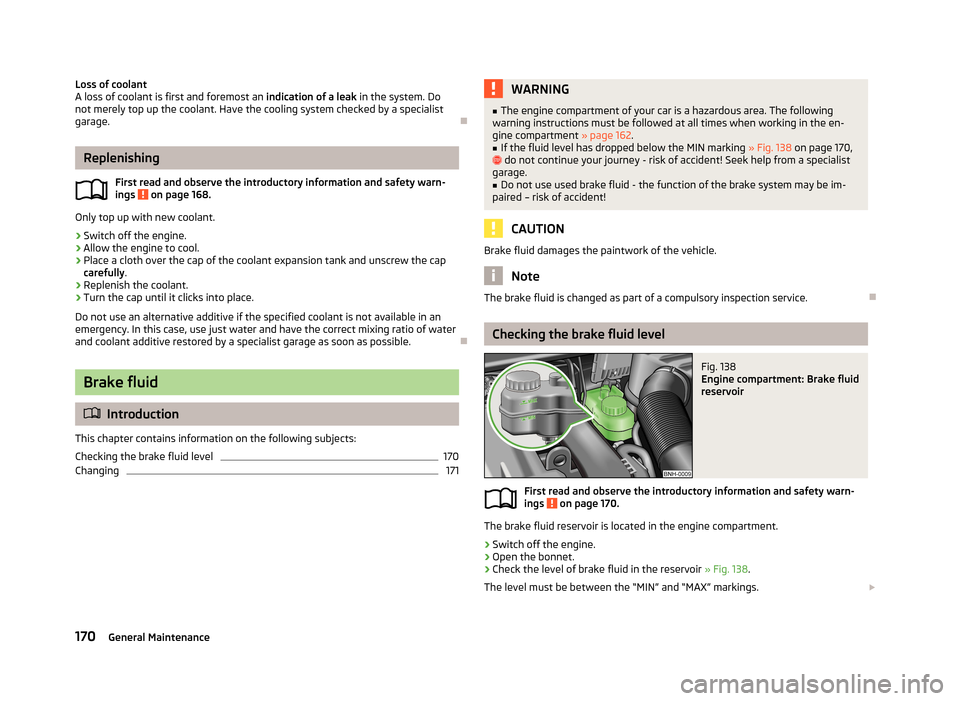
Fig. 138
Engine compartment: Brake fluid
reservoir
First read and observe the introductory information and safety warn-
ings on page 170.
The brake fluid reservoir is located in the engine compartment.
›
Switch off the engine.
›
Open the bonnet.
›
Check the level of brake fluid in the reservoir » Fig. 138.
The level must be between the “MIN” and “MAX” markings.
170General Maintenance