2013 SKODA OCTAVIA remove seats
[x] Cancel search: remove seatsPage 100 of 287

Stowing roll-up luggage compartment cover and roof racksFig. 90
Removing the side covers/stowing roof racks properly
Fig. 91
Stowing roll-up luggage compartment cover/stowing roof racks and
roll-up luggage compartment cover properly
First read and observe the introductory information and safety warn-
ings
on page 91.
If the vehicle is equipped with the variable loading floor, the removed roll-up lug-
gage compartment cover and the roof racks can be stowed in the recesses of the
luggage compartment side trim.
Stowing the roof racks
›
Fold the variable loading floor in the upper position » page 101.
›
Remove the side covers of the luggage compartment in the direction of the ar-
row
1
» Fig. 90 .
›
Insert the front roof rack
A
into the front recesses of the side trim.
›
Insert the rear roof rack
B
into the rear recesses of the side trim.
›Replace the side trims of the luggage compartment in the opposite direction of
the arrow 1.›
Fold out the variable loading floor to the upper position » page 100.
Stowing the roll-up luggage compartment cover
›
Fold the variable loading floor in the upper position » page 101.
›
Remove the side covers of the luggage compartment in the direction of the ar-
row
1
» Fig. 90 .
›
Insert the front part of the roll-up luggage compartment cover under a portion
of the side trim
D
» Fig. 91 on the left.
›
Fold the rear part of the roll-up luggage compartment cover in the direction of
the arrow
2
.
›
Replace the side trims of the luggage compartment in the opposite direction of
the arrow
1
» Fig. 90 .
›
Fold out the variable loading floor to the upper position » page 100.
When stowing both the roof rack and the roll-up luggage compartment cover, the
rear part of the roll-up luggage compartment cover should overlap the rear roof
rack » Fig. 91 .
Note
■
Before stowing the roof rack, pull out the key from the carrier, otherwise it
could be damaged.■
The keys to the roof rack can be stowed in the recess
C
» Fig. 90 .
97Seats and useful equipment
Page 101 of 287
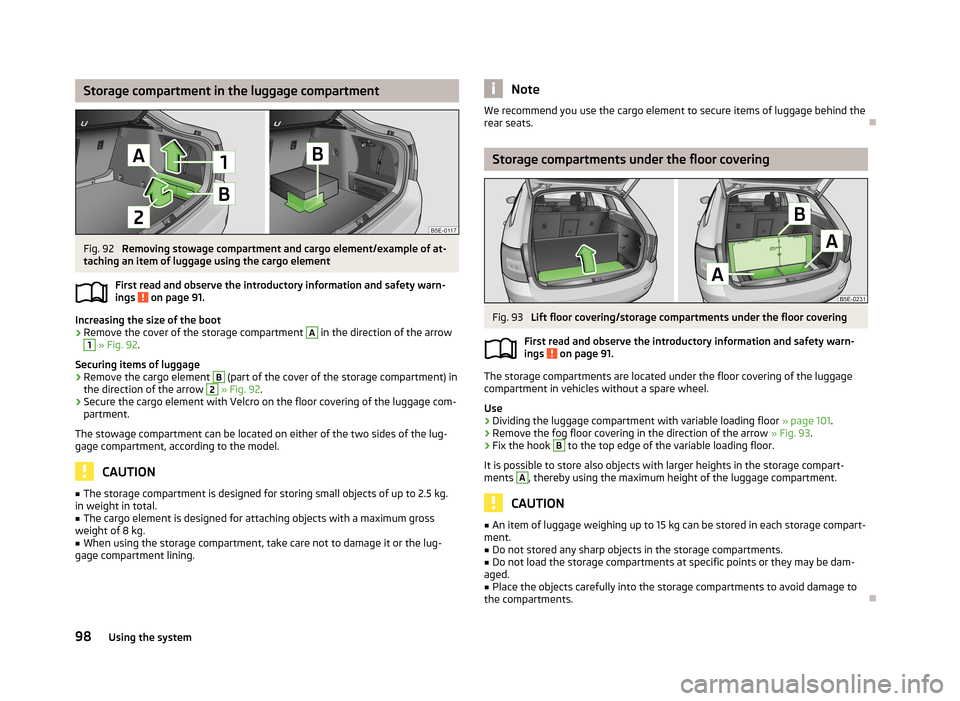
Storage compartment in the luggage compartmentFig. 92
Removing stowage compartment and cargo element/example of at-
taching an item of luggage using the cargo element
First read and observe the introductory information and safety warn-ings
on page 91.
Increasing the size of the boot
›
Remove the cover of the storage compartment
A
in the direction of the arrow
1
» Fig. 92 .
Securing items of luggage
›
Remove the cargo element
B
(part of the cover of the storage compartment) in
the direction of the arrow
2
» Fig. 92 .
›
Secure the cargo element with Velcro on the floor covering of the luggage com-
partment.
The stowage compartment can be located on either of the two sides of the lug-
gage compartment, according to the model.
CAUTION
■ The storage compartment is designed for storing small objects of up to 2.5 kg.
in weight in total.■
The cargo element is designed for attaching objects with a maximum gross
weight of 8 kg.
■
When using the storage compartment, take care not to damage it or the lug-
gage compartment lining.
NoteWe recommend you use the cargo element to secure items of luggage behind the
rear seats.
Storage compartments under the floor covering
Fig. 93
Lift floor covering/storage compartments under the floor covering
First read and observe the introductory information and safety warn-
ings
on page 91.
The storage compartments are located under the floor covering of the luggage compartment in vehicles without a spare wheel.
Use
›
Dividing the luggage compartment with variable loading floor » page 101.
›
Remove the fog floor covering in the direction of the arrow » Fig. 93.
›
Fix the hook
B
to the top edge of the variable loading floor.
It is possible to store also objects with larger heights in the storage compart- ments
A
, thereby using the maximum height of the luggage compartment.
CAUTION
■ An item of luggage weighing up to 15 kg can be stored in each storage compart-
ment.■
Do not stored any sharp objects in the storage compartments.
■
Do not load the storage compartments at specific points or they may be dam-
aged.
■
Place the objects carefully into the storage compartments to avoid damage to
the compartments.
98Using the system
Page 102 of 287

Multifunction box (Octavia Estate)Fig. 94
Multifunctional pocket: withdrawing / sliding in
Fig. 95
Remove multifunction box
First read and observe the introductory information and safety warn-
ings on page 91.
The multifunction box under the roll-up luggage compartment cover is provided
for the storage of clothing and light objects with no sharp edges.
Extending
›
Fold down the front hooks on both sides of the luggage compart- ment » page 94 .
›
Grasp the rear bar
A
» Fig. 94 with both hands and withdraw the complete
pocket in the direction of the arrow
1
.
›
Place the rear bar onto the two hooks that are folded forward in the direction of
the arrow
2
all the way to the stop.
Pushing in
›
Remove the rear bar from the hook in the direction of the arrow
3
» Fig. 94 .
›
Push in the complete multifunction box in the direction of the arrow
4
.
›Place the rear bar against the front bar and press them together at both endsB.›
Fold back the front hooks on both sides of the luggage compartment.
Removing/inserting
›
Remove the roll-up luggage compartment cover » page 96.
›
Remove the multifunction box from the receptacle in the direction of the ar-
row » Fig. 95 .
Insertion takes place in reverse order.
›
When inserting, push the end of the bar marked into the right receptacle and
the end of the bar marked into the left receptacle. The arrows should be
pointing forward » Fig. 95.
CAUTION
The maximum permissible load of the multifunction box is 3 kg.
Variable loading floor in the luggage compartment
(Estate)
Introduction
This chapter contains information on the following subjects:
Positions of the variable loading floor
100
Fold up variable loading floor
101
Dividing the luggage compartment
101
The variable loading floor makes handling of bulky items of luggage easier.
CAUTION
The maximum permissible load of the variable loading floor is 75 kg. For the trans- port of heavy loads, adjust the variable loading floor in the lower posi-
tion » page 100 .
Note
The space below the variable loading floor can be used for stowing objects, for
example, the removed roll-up luggage compartment cover, roof cross bars,
etc. » page 97 .
99Seats and useful equipment
Page 105 of 287

WARNING■Check that the crossbar of the net partition is hung firmly into the recepta-
cles D » Fig. 101 on page 102 and C » Fig. 103 on page 103.■
The belts and the belt locks must be in their original position after folding
back the seat backrests – they must be ready to use.
■
The seat backrests must be securely locked in position so that no objects in
the luggage compartment can slide into the passenger compartment on sud-
den braking – risk of injury.
■
Ensure that the rear seat backrests are properly engaged. Only then can the
seat belt for the middle seat reliably fulfil its function.
Using the net partition behind the rear seats
Fig. 101
Folding out part of the roll-up luggage compartment cover/net par-
tition behind the rear seats in the pulled-out state
Fig. 102
Net partition: Release lever
First read and observe the introductory information and safety warn-
ings on page 101.
Extending
›
Fold out part of the roll-up luggage compartment cover
A
in the direction of
the arrow » Fig. 101.
›
Pull out the net partition at the upper crossbar
B
from the housing
C
.
›
Hook the crossbar into one of the receptacles
D
.
›
On the other side, press on the crossbar and hook it into the appropriate recep-
tacle
D
.
If the cross-bar is hooked into the receptacle
D
for example, the press on the
cross bar in the direction of arrow 1 and insert into the receptacle to the right
D
.
›
Fold back part of the roll-up luggage compartment cover
A
in the opposite di-
rection of the arrow.
Retracting
›
Fold out part of the roll-up luggage compartment cover
A
in the direction of
the arrow » Fig. 101.
›
Press on the crossbar and remove it from the receptacles
D
, first on one side,
then on the other side.
›
Hold the crossbar
B
in such a way that the net partition can slowly roll up into
the housing
C
without being damaged.
›
Fold back part of the roll-up luggage compartment cover
A
in the opposite di-
rection of the arrow.
CAUTION
If the net partition blocks when pulling it out of the housing, push the release lev- er E in the direction of the arrow » Fig. 102.
Note
If you wish to use the entire luggage compartment, the roll-up luggage compart-
ment cover can be removed » page 96.
102Using the system
Page 106 of 287

Using the net partition behind the front seatsFig. 103
Net partition behind the front
seats in the pulled-out state
First read and observe the introductory information and safety warn-
ings on page 101.
Extending
›
Fold the rear seats forward » page 78.
›
Pull out the net partition at the upper crossbar
A
from the housing
B
» Fig. 103 .
›
Hook the crossbar into one of the receptacles
C
.
›
On the other side, press on the crossbar and hook it into the appropriate recep-
tacle
C
.
If the crossbar is hooked into the receptacle
C
to the left for example, then press
on the crossbar in the direction of the arrow 1 and insert into the receptacle
C
to
the right.
Retracting
›
Press on the crossbar and remove it from the receptacles
C
, first on one side,
then on the other side.
›
Hold the crossbar
A
in such a way that the net partition can slowly roll up into
the housing
B
without being damaged.
›
Fold the rear seats back into their original positions » page 78.
CAUTION
If the net partition blocks when pulling it out of the housing, push the release lev-
er E in the direction of the arrow » Fig. 102 on page 102.
Removing and refitting the net partition housingFig. 104
Rear seats: Removing the net
partition housing
First read and observe the introductory information and safety warn-
ings on page 101.
Removing
›
Fold the rear seats forward » page 78.
›
Open the rear right door » page 40.
›
Push the net partition housing
A
in the direction of the arrow
1
and remove it
from the mounts on the right seat backrests in the direction of the arrow
2
» Fig. 104 .
Installing
›
Insert the recesses on the net partition housing into the mounts on the rear seat backrests.
›
Push the net partition housing in the opposite direction of the arrow
1
» Fig. 104 as far as the stop.
›
Fold the rear seats back into their original positions » page 78.
Roof rack system
Introduction
This chapter contains information on the following subjects:
Attachment points
104
Roof load
105
103Seats and useful equipment
Page 184 of 287

WARNINGObserve the following instructions for the proper use of the seat belts.■Never use one seat belt to secure two people (including children). The seat-
belt must not be placed over a child who is sitting on the lap of another pas-
senger.■
The lock tongue should only be inserted into the lock which is the correct
one for your seat. Wrong use of the safety belt will reduce its capacity to pro-
tect and the risk of injury increases.
■
The slot of the belt tongue must not be blocked otherwise the belt tongue
will not lock in place properly.
■
Many layers of clothing and loose clothing (e. g. a winter coat over a jacket)
do not allow you to be correctly seated and impairs proper operation of the
seat belts.
■
It is prohibited to use clamps or other objects to adjust seat belts (e. g. for
shortening the belts for smaller persons).
■
The seat belts for the rear seats can only fulfil their function reliably when
the seat backrests are correctly locked into position » page 78.
WARNINGObserve the following instructions for proper use of the seat belts.■The belt webbing must always be kept clean. Soiled belt webbing may im-
pair proper operation of the inertia reel » page 211.■
The seat belts must not be removed or changed in any way. Do not attempt
to repair the seat belts yourself.
■
Check the condition of all the seat belts on a regular basis. If any damage to
the seat belts, seat belt connections, inertia reel or the lock is detected, the
relevant seat belt must be replaced by a specialist garage.
■
Damaged seat belts which have been subjected to stress in an accident and
were therefore stretched, must be replaced – this is best done by a specialist
garage. The anchorage points for the belts should also be checked.
Note
The national legal requirements must be observed when using seat belts.
The physical principle of a head-on collisionFig. 160
Driver without a fastened seat belt/rear seat passenger without a
fastened seat belt
First read and observe the introductory information and safety warn-
ings
on page 180.
As soon as the vehicle is moving, so-called kinetic energy (the energy of motion)
is produced both in terms of the car as well as in terms of the occupants.
The magnitude of this kinetic energy depends essentially on the speed at which
the vehicle is travelling and on the weight of the vehicle including the occupants.
The greater the speed and weight increase, the greater the amount of energy
which has to be absorbed in the event of an accident.
The speed of the vehicle is the most important factor. Doubling the speed of the
vehicle from 25 km/h up to 50 km/hour increases the kinetic energy four times.
The opinion that it is possible to support your body in a minor accident with your
hands, is incorrect. Even in a collision at only a low speed, the forces acting on the body are such that it is no longer possible to support your body.
Even if you only drive at a speed of 30 km/h to 50 km/h, the forces that your body is exposed to in the event of an accident can exceed a metric ton (1000 kg).
For example, a person's weight of 80 kg “increases” at 50 km/h to 4.8 tons
(4800 kg).
In the event of a frontal collision, occupants of the car not wearing a seat belt are thrown forward and strike parts of the vehicle interior in an uncontrolled manner, such as the steering wheel, dash panel or windscreen » Fig. 160 -
. In certain
circumstances you could even be thrown out of the vehicle, which could cause life
threatening or even fatal injuries.
181Seat belts
Page 192 of 287

The load of the occupants is cushioned when plunging into the fully inflated air-
bag and the risk of injury to the entire upper body (chest, stomach and pelvis) is
reduced on the side facing the door.WARNINGObserve the following instructions for the proper seated position.■Your head should never be positioned in the deployment area of the side
airbag. You might suffer severe injuries in the event of an accident. This ap- plies in particular to children who are transported without using a suitable
child safety seat » page 195, Child safety and side airbag .■
There must not be any further persons, animals as well as objects posi-
tioned between the occupants and the deployment area of the airbag. No ac-
cessories, such as cup holders, should be attached to the doors.
■
If children adopt an incorrect seated position when travelling, they may be
exposed to an increased risk of injury in the event of an accident. This can re-
sult in serious injuries » page 193, Child seat .
WARNINGThe airbag control unit operates using pressure sensors located in the front
doors. For this reason, no adjustments may be carried out to the doors or door
panels (e.g. installation of additional loudspeakers). Resulting damage can have a negative impact on the function of the airbag system. Any work on thefront doors and door panels must be carried out by a specialist garage. The
following guidelines must be observed.■
Never drive with inner door panels removed.
■
Never drive if parts of the inner door panel have been removed and the re-
sulting openings have not been properly sealed.
■
Never drive if the loudspeakers in the doors have been removed, unless the
loudspeaker openings have been properly sealed.
■
Always make sure that the openings are covered or filled if additional loud-
speakers or other equipment parts have been installed in the inner door pan-
els.
■
Always have work carried out by a ŠKODA service partner or a professional
specialist garage.
WARNING■ Only hang light items of clothing on the hooks fitted in the vehicle. Never
leave any heavy or sharp-edged objects in the pockets of the items of cloth-
ing.■
Ensure that there are no excessive forces, such as violent knocks, kicks etc.,
impact on the backrests of the seats otherwise the system may be damaged.
The side airbags would not be deployed in such a case!
■
Any seat or protective covers which you fit to the driver or front passenger
seats must only be of the type expressly authorized by ŠKODA. In view of the
fact that the airbag inflates out of the backrest of the seat, use of non-ap-
proved seat or protective covers would considerably impair the protective
function of the side airbag.
■
Any damage to the original seat covers in the area of the side airbag module
must be repaired immediately by a specialist garage.
■
The airbag modules in the front seats must not display any damage, cracks
or deep scratches. It is not permissible to use force in order to open the mod-
ules.
Head airbags
Fig. 169
Location of the head airbag/gas-filled head airbag
First read and observe the introductory information given on page 186.
In the event of a severe side collision, the head airbag system offers additional
protection for the head and neck area of passengers.
The head airbags are positioned above the doors on both sides of the vehicle in-terior » Fig. 169 -
.
189Airbag system
Page 196 of 287

Transporting children safely
Child seat
Introduction
This chapter contains information on the following subjects:
Use of a child seat on the front passenger seat
194
Child safety and side airbag
195
Classification of child seats
195
Use of child seats fastened with a seat belt
195
Children are generally safer on the rear seats than on the front passenger seat.
In contrast to adults, the muscles and bone structure of children are not yet fully developed. Thus children are exposed to increased risk of injury.
Children should be transported in accordance with the relevant statutory provi-sions.
Child seats that comply with the ECE-R 44 standard must be used. The ECE-R
standard stands for: Economic Commission for Europe – Regulation.
Child seats that comply with the ECE-R 44 standard have a test seal that cannot
be removed: a large E within a circle with the test number below.
WARNING■ The national legal requirements must be observed when using child seats.■One should never carry children, and also not babies! - on one's lap.■
Never leave children unattended in the vehicle. Certain outside climatic con-
ditions can cause life-threatening temperatures in the vehicle.
■
The child must be secured in the vehicle during the entire travelling time!
Otherwise, in the event of an accident, the child would be thrown through the
vehicle and as a result may suffer fatal injuries, and also injure other occu-
pants.
WARNING (Continued)■ Children are exposed to an increased risk of injury in the event of an acci-
dent if they lean forward or adopt an incorrect seated position when the vehi-
cle is moving. This particularly applies to children who are transported on the
front passenger seat as they can suffer severe, or even fatal injuries if the air-
bag system is deployed!■
Pay particular attention to the information provided by the manufacturer of
the child safety seat regarding the correct routing of the belt. Seat belts which are not correctly adjusted can themselves cause injuries even in minor
accidents.
■
Safety belts must be checked to ensure that they are running properly. One
should also ensure that the belt is not damaged by sharp-edged fittings.
■
It is essential to switch off the front passenger airbag if using a child seat in
which the child is carried with its back facing the direction of travel on the front passenger seat. Further information » page 194, Use of a child seat on
the front passenger seat .
CAUTION
■
When installing a child seat in which the child faces forward, adjust the head re-
straints so that they are as high as possible.■
If the head restraints still prevent the child seat from being installed, even in
the highest position, you will need to remove them » page 73. After removing the
child seat, re-install the head restraints.
Note
We recommend that you use child seats from ŠKODA Original Accessories. These child seats were developed and also tested for use in ŠKODAvehicles. They meetthe ECE-R 44 standard.
193Transporting children safely