2013 SKODA CITIGO mirror
[x] Cancel search: mirrorPage 117 of 176

WARNING■When washing your vehicle in the winter: Water and ice in the braking sys-
tem can affect the braking efficiency – risk of accident!■
Only wash the vehicle when the ignition is switched off – risk of accident!
CAUTION
Do not wash your vehicle in bright sunlight – risk of paint damage.
For the sake of the environment
Only wash the vehicle at washing bays intended for this purpose.
Washing by hand
First read and observe the introductory information and safety warn-
ings
on page 113.
Soak the dirt with plenty of water and rinse as well as possible.
Clean the vehicle with a soft sponge, a washing glove or a washing brush . Work
from the top to the bottom – starting with the roof.
Only use a car shampoo for stubborn dirt.
Wash out the sponge or washing glove thoroughly at short intervals.
Clean wheels, door sills and similar parts last. Use a second sponge for such
areas.
Give the vehicle a good rinse after washing it and dry it off using a chamois leath- er.
CAUTION
■ When washing the car by hand, protect your hands and arms from sharp-edged
metal parts (e.g. when cleaning the underfloor, the inside of the wheel housings
or the wheel trims, etc.) - There is a risk of cuts!■
Only apply slight pressure when cleaning the vehicle's paintwork.
Automatic car wash systems
First read and observe the introductory information and safety warn-
ings
on page 113.
The usual precautionary measures must be taken before washing the vehicle in
an automatic car wash system (e.g. closing the windows and the sliding/tilting
roof etc.).
If your vehicle is fitted with any particular attached parts, such as a spoiler, roof
rack system, two-way radio aerial etc., it is best to consult the operator of the car
wash system beforehand.
After an automatic wash with wax treatment, the lips of the wipers should be cleaned with cleaning agents specially designed for the purpose, and then de-
greased.
WARNINGFold in the exterior mirrors to prevent damage before washing the vehicle in
an automatic car wash system.
Washing with a high-pressure cleaner
First read and observe the introductory information and safety warn-
ings
on page 113.
When washing the vehicle with a high-pressure cleaner, the instructions for use
of the equipment must be observed. This applies in particular to the pressure
used and to the spraying distance .
Maintain a sufficiently large distance to the parking aid sensors and soft materials
such as rubber hoses or insulation material.
WARNINGNever use circular spray nozzles or dirt cutters! 114General Maintenance
Page 118 of 176

CAUTION■If washing the vehicle in the winter using a hose or high-pressure cleaner, en-
sure that the jet of water is not aimed directly at the locking cylinders or the
door/panel joints – risk of freezing!■
To avoid damaging the parking aid sensors while cleaning with high-pressure
cleaners or steam jets, the sensors must only be directly sprayed for short periods
while a minimum distance of 10 cm must be observed.
■
The temperature of the water used for cleaning must not exceed 60 °C – risk of
damaging the vehicle.
■
See also Washing cars with decorative films using a high-pressure clean-
er » page 116 .
Taking care of your vehicle exterior
Introduction
This chapter contains information on the following subjects:
Taking care of your vehicle's paintwork
115
Plastic parts
116
Rubber seals
116
Chrome parts
116
Decorative films
116
Windows and exterior mirrors
117
Headlight lenses
117
Door lock cylinders
117
Cavity protection
117
Wheels
118
Underbody protection
118
Regular and proper care help to retain the efficiency and value of your vehicle. It
may also be one of the requirements for the acceptance of warranty claims relat- ing to corrosion damage and paint defects on the bodywork.
We recommend using vehicle care products from ŠKODA Original Accessories.These are available from ŠKODA Partners. The usage instructions on the package must be observed.
WARNING■ Vehicle care products may be harmful to your health if not used according to
the instructions.■
Always store vehicle care products safely, in particular out of the reach of
children – risk of poisoning!
■
Protect your hands and arms from sharp-edged metal parts when cleaning
the underfloor, the inside of the wheel housings or the wheel trims – risk of
cuts!
CAUTION
■ Do not use any insect sponges, rough kitchen sponges or similar cleaning prod-
ucts – risk of damaging the paintwork surface.■
Cleaner that contain solvents can damage the material being cleaned.
For the sake of the environment
Used vehicle care product cans represent hazardous waste that is harmful to the
environment. These must be disposed of in accordance with national legal regula- tions.
Note
Due to the special tools and knowledge required, and to avoid any potential prob-
lems with the cleaning and care of the interior of your vehicle, we recommend
that cleaning and care of the interior of your vehicle be carried out by a ŠKODA service partner.
Taking care of your vehicle's paintwork
First read and observe the introductory information and safety warn-ings
on page 115.
Minor paint damage such as scratches, scuffs or stone chips should be treated im-
mediately if possible, using touch-up pens or sprays.
Preserving the vehicle paintwork
A thorough wax treatment provides the vehicle's paintwork with highly effective
protection against harmful environmental influences.
115Vehicle care
Page 120 of 176

The following instructions must be followed when washing the vehicle with a
high-pressure cleaner:
› The minimum distance between the nozzle and the vehicle body should be 50
cm.
› Keep jet perpendicular to the film surface.
› The maximum water temperature is 50 °C.
› The maximum water pressure is 80 bar.
CAUTION
In the winter months, do not use an ice scraper to remove ice and snow from the
areas with films. Do not use any other objects to remove frozen layers of snow or
ice – risk of film damage.
Windows and exterior mirrors
First read and observe the introductory information and safety warn-
ings
on page 115.
Use a plastic ice scraper for removing snow and ice from the windows and mir-
rors.
Regularly clean windows from the inside with clean water. Dry the glass surfaces with a clean chamois leather or a cloth intended for thispurpose.
When drying the windows after washing the vehicle, do not use window leathers
that have been used to polish the bodywork. Residues of preservatives in the
window leather can make the window dirty and reduce visibility.
CAUTION
■ The ice scraper should not be moved forward and backward but in one direction
to avoid any damage to the surface of the glass.■
Snow or ice that is contaminated with coarse dirt such as fine gravel, sand or
salt must not be removed from the windows and mirrors – there is a risk of dam-
age to the surface of the windows and mirrors.
■
Do not remove snow or ice from glass parts using warm or hot water – risk of
cracks forming in the glass.
■ When removing snow or ice from windows and mirror lenses ensure that the
paintwork of the vehicle is not to damage.■
Do not clean the inside of the rear window with sharp-edged objects or corro-
sive and acidic cleaning agents – risk of damaging the heating elements or win-
dow aerial.
Headlight lenses
First read and observe the introductory information and safety warn-ings
on page 115.
Clean plastic front headlight lenses using clean, warm water and soap.
CAUTION
■ Never wipe headlights to dry.■Do not use any sharp objects to clean the plastic lenses, as this may damage
the protective paintwork and consequently cause cracks to form on the headlight lenses.■
Do not use any harsh cleaning products or chemical solvents to clean the head-
lights, as this could damage the headlight lenses.
Door lock cylinders
First read and observe the introductory information and safety warn-
ings
on page 115.
Specific products must be used for de-icing door lock cylinders.
CAUTION
When washing your vehicle, ensure as little water as possible gets into the lock-
ing cylinders.
Cavity protection
First read and observe the introductory information and safety warn-
ings
on page 115.
All the cavities of your vehicle which are at risk from corrosion are protected for life by a layer of protective wax applied in the factory.
117Vehicle care
Page 158 of 176

Replacing fuses›Press the button 1 » Fig. 124 .›
Push the lid in the direction of the arrow.
›2
Remove the bracket.
›
Place the bracket on the respective fuse and pull this out.
›
Insert a new fuse.
›
Replace the bracket at the original position.
›
Fold the cover upwards against the direction of the arrow.
›
Close the cover until it clicks into place.
Fuse assignment on the underside of the dash panel
No.Power consumer1Telephone, radiator fan, instrument cluster, engine control unit2Diagnostic port, air compressor, bar with buttons, control unit for air
conditioning3Clutch pedal switch, brake pedal switch4Switch illumination, number plate light5Steering column switch, central control unit6Headlamp beam adjustment, exterior mirror adjustment7-8Automated transmission9Airbag, bar with buttons10Park Assist11Headlights12The rear fog light13Headlights14Rear window wiper15Light switch16Steering force assistance17Windscreen washer18Reverse light switch19Injection valves, coolant pump20ABS/ESP21Parking lights,22Daytime running lights23Headlights24FlasherNo.Power consumer25Windscreen Wiper and Washer System26Not assigned27Interior lighting28Diagnostic connector29Central control unit30Exterior mirror heater31Radiator fan, lambda probe32Blinking light, brake light, daytime running lights, rear light33Main beam34Main beam35Fuel pump36Cigarette lighter, 12-volt power socket37Air blower for heating and air conditioning38Radio39Panoramic sliding roof, horn40Engine control unit41Central locking system42Ignition module43Seat heaters44Fuel pump45Light switch46Rear window heater47Windows48Horn49Windscreen wipers50Fog lights, headlight51Power windows
155Fuses and light bulbs
Page 161 of 176
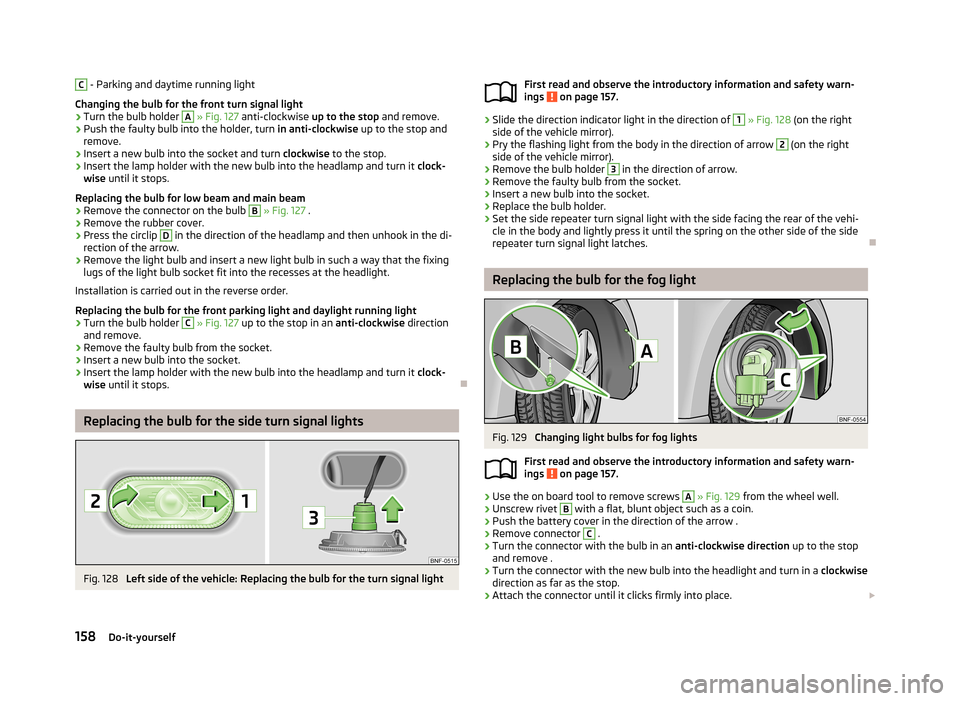
C - Parking and daytime running light
Changing the bulb for the front turn signal light›
Turn the bulb holder
A
» Fig. 127 anti-clockwise up to the stop and remove.
›
Push the faulty bulb into the holder, turn in anti-clockwise up to the stop and
remove.
›
Insert a new bulb into the socket and turn clockwise to the stop.
›
Insert the lamp holder with the new bulb into the headlamp and turn it clock-
wise until it stops.
Replacing the bulb for low beam and main beam
›
Remove the connector on the bulb
B
» Fig. 127 .
›
Remove the rubber cover.
›
Press the circlip
D
in the direction of the headlamp and then unhook in the di-
rection of the arrow.
›
Remove the light bulb and insert a new light bulb in such a way that the fixing lugs of the light bulb socket fit into the recesses at the headlight.
Installation is carried out in the reverse order.
Replacing the bulb for the front parking light and daylight running light
›
Turn the bulb holder
C
» Fig. 127 up to the stop in an anti-clockwise direction
and remove.
›
Remove the faulty bulb from the socket.
›
Insert a new bulb into the socket.
›
Insert the lamp holder with the new bulb into the headlamp and turn it clock-
wise until it stops.
Replacing the bulb for the side turn signal lights
Fig. 128
Left side of the vehicle: Replacing the bulb for the turn signal light
First read and observe the introductory information and safety warn-
ings on page 157.›
Slide the direction indicator light in the direction of
1
» Fig. 128 (on the right
side of the vehicle mirror).
›
Pry the flashing light from the body in the direction of arrow
2
(on the right
side of the vehicle mirror).
›
Remove the bulb holder
3
in the direction of arrow.
›
Remove the faulty bulb from the socket.
›
Insert a new bulb into the socket.
›
Replace the bulb holder.
›
Set the side repeater turn signal light with the side facing the rear of the vehi- cle in the body and lightly press it until the spring on the other side of the side
repeater turn signal light latches.
Replacing the bulb for the fog light
Fig. 129
Changing light bulbs for fog lights
First read and observe the introductory information and safety warn- ings
on page 157.
›
Use the on board tool to remove screws
A
» Fig. 129 from the wheel well.
›
Unscrew rivet
B
with a flat, blunt object such as a coin.
›
Push the battery cover in the direction of the arrow .
›
Remove connector
C
.
›
Turn the connector with the bulb in an anti-clockwise direction up to the stop
and remove .
›
Turn the connector with the new bulb into the headlight and turn in a clockwise
direction as far as the stop.
›
Attach the connector until it clicks firmly into place.
158Do-it-yourself
Page 165 of 176

The operating weight also contains the weight of the driver (75 kg), the weight ofthe operating fluids, the tool kit, and a fuel tank filled to 90 % capacity.
It is possible to calculate the approximate loading capacity from the differencebetween the permissible total weight and the operating weight »
.
The payload consists of the following components: › Passengers
› All items of luggage and other loads
› Roof load including roof rack system
› Equipment not included in the operating weight.
Fuel consumption and CO 2 emissions according to ECE standards and EU
directives
The measurement of the intra-urban cycle begins with a cold start of the engine.
Afterwards standard urban driving is simulated.
In the extra-urban driving cycle, the vehicle is accelerated and decelerated in all gears, corresponding to daily routine driving conditions. The driving speed variesbetween 0 and 120 km/h.
The calculation of the combined fuel consumption considers a weighting of about 37 % for the intra-urban cycle and 63 % for the extra-urban cycle.
WARNINGDo not exceed the specified maximum permissible weights – risk of accident
and damage!
Note
■ If required, you can find out the precise weight of your vehicle at a specialist ga-
rage.■
The fuel consumption and emission values have been determined in accordance
with rules and under conditions set out by legal or technical requirements for de-
termining operational and technical data for motor vehicles.
■
Depending on the range of equipment, style of driving, traffic situation, weather
influences and vehicle condition, consumption values may deviate from the indi-
cated values.
Dimensions
First read and observe the introductory information given on page 161.
Vehicle dimensions (mm)
Length3563Width1641/1645 a)Width including exterior mirror1910Height1478/1463 b)
/1480 c)Clearance136/121 b)
/134 c)Wheel base2420/2421 c)Track gauge front/rear1428/1424a)
Valid for vehicles with rear side doors.
b)
Applies to vehicles with a Green-tec package.
c)
Valid for vehicles with CNG operation.
162Technical data
Page 167 of 176

Index
Numbers and Symbols
12-volt power socket
52
A
Abroad Driving abroad
79
Unleaded petrol79
ABS81
Warning light19
Accessories110
Adjusting Exterior mirrors
41
Interior mirror40
Seat43
Steering wheel66
Adjusting the seats91
Aerial114
Air-conditioning system Air outlet vents
57
Airbag98
Deactivating101
Deactivating the front passenger airbag102
Deployment98
Front airbag99
Modifications and damage to the airbag system112
Side airbag Head-Thorax100
Airbag system98
Air conditioning system59
Control elements60
Recirculated air mode61
Air outlet vents57
Antilock Braking System81
Artificial leather120
Ash tray51
Assist systems80
ABS19, 81
City Safe Drive86
Cruise Control System83
EDS81
ESC18, 80
Parking aid81
START-STOP85
TC81
Traction Control System (TCS)19
Visual parking system82
Automated transmission71
Lever control71
Automatic gearbox Operational faults
73
Tiptronic72
Automatic load deactivation137
Automatic transmission Kick-down
72
Starting-off and driving72
Avoiding damage to the vehicle Driving through water
78
Avoiding damage to your vehicle78
B
Bag hooks
47
Belts94
Belt tensioners97
Bonnet Closing
128
Opening128
Boot Class N1 vehicles
47
Boot lid Automatic locking
29
Brake assist80
Brake booster69
Brake fluid133
Changing134
Checking133
Brakes Brake assist systems80
Brake booster69
Brake fluid133
Handbrake70
Running in74
Warning lights16
Braking Information on braking
69
Breakdown kit149
Bulbs In the tail light
159
Replacing157
Button in the driver's door Electrical power windows
30
C
Car computer see multifunction display
13
Carrier49
Cavity protection117
Central locking button27
Central locking system25
lock26
unlock26
Changing Brake fluid
134
Engine oil131
Fuses on the underside of the dash panel154
Wheels145
Changing a wheel Follow-up work
146
Preliminary work145
Remove and attaching a wheel146
Charging a vehicle battery136
Checking Battery electrolyte level
135
Brake fluid133
Coolant132
Engine oil131
164Index
Page 169 of 176
Jump-starting150
locking of the doors25
Towing the vehicle152
Tyre repair148
Unlocking the luggage compartment lid29
Emergency equipment First aid kit
144
Jack144
Vehicle tool kit144
Warning triangle144
Emissions161
Engine Running in
73
Engine compartment127
Brake fluid133
Coolant132
Overview129
Vehicle battery134
Engine oil130
Capacity130
Changing131
Checking131
Replenishing131
Specifications130
Warning light17
Engine revolutions counter11
Environment74
Environmental compatibility77
Environmentally friendly driving74
ESC Function
80
Warning light18
F
Films
116
First aid kit144
Fog lights35
Footmats71
see footmats71
Front airbag99
Front seats42
Fuel122
Fuel gauge11
refer to Fuel122
Refuelling122
Unleaded petrol123
Fuel consumption74
Fuel gauge Fuel gauge
11
Fuses Assignment
154
Colour coding154
Replacing154
G
Gear changing Gear stick
70
Gearshift Information on the switched gearshift
12
Recommended gear12
General view Cockpit
9
H
Handbrake
70
Hazard warning light system36
Head-Thorax100
Headlights Driving abroad
79
Replacing a bulb157
Head restraint45
Heating Control elements
58
Defrost windows59
Exterior mirrors41
operating58
Rear window37
Recommended settings59
Seats44
Heating and air-conditioning57
Hill hold control80
Horn9
I
Ignition
68
Ignition lock68
Immobilizer68
Inertia reels97
Instrument cluster10
Overview10
ISOFIX106
J
Jack
144
Jacking points Raise vehicle
147
Jump-starting150, 151
K
Key Starting the engine
68
L
Lashing eyes
47
Lever Main beam
34
Turn signal34
Windscreen wipers39
lever control71
See lever control71
light low beam
33
on and off33
parking light33
Light Cockpit
36, 37
166Index