2013 Seat Exeo ST ignition
[x] Cancel search: ignitionPage 284 of 327
282If and when
● Main headlight lamps: Xenon ⇒
lights.
● Sources of the DRL (daylight) light unit and position.
WARNING
● Take particular care when working on components in the engine com-
partment if the engine is warm. Risk of burns.
● Bulbs are highly sensitive to pressure. The glass can break when you
touch the bulb, causing injury.
● The high voltage element of gas discharge bulbs* (xenon light) must
be handled correctly. Otherwise, there is a risk of death.
● When changing bulbs, please take care not to injure yourself on sharp
parts in the headlight housing.
CAUTION
● Remove the ignition key before working on the electric system. Other-
wise, a short circuit could occur.
● Switch off the lights or parking lights before you change a bulb.
For the sake of the environment
Please ask your specialist retailer how to dispose of used bulbs in the prop-
er manner.
Note
● Depending on weather conditions (cold or wet), the front lights, the fog
lights, the tail lights and the turn signals may be temporarily misted. This
has no influence on the useful life of the lighting system. By switching on
the lights, the area through which the beam of light is projected will quickly
be demisted. However, the edges may continue to be misted.
● Please check at regular intervals that all lighting (especially the exterior
lighting) on your vehicle is functioning properly. This is not only in the inter-
est of your own safety, but also in that of all other road users. ●
Before changing a bulb, make sure you have the correct new bulb.
● Do not touch the glass part of the bulb with your bare hands, use a cloth
or paper towel instead. Otherwise, the fingerprints left on the glass will va-
porise as a result of the heat generated by the bulb, they will be deposited
on the reflector and will impair its surface.
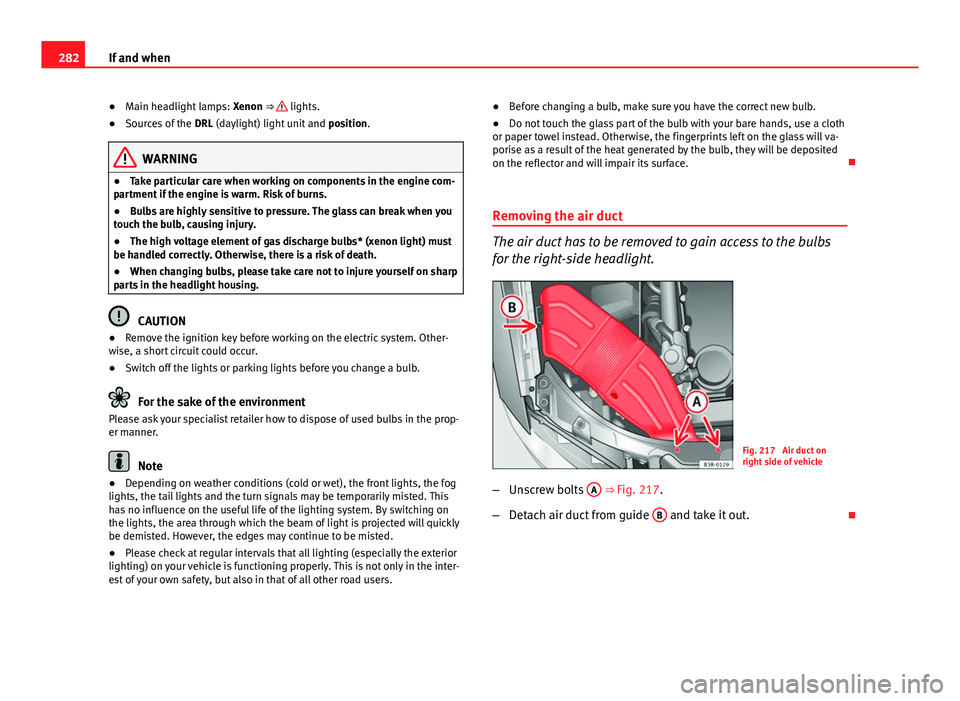
Removing the air duct
The air duct has to be removed to gain access to the bulbs
for the right-side headlight.
Fig. 217 Air duct on
right side of vehicle
– Unscrew bolts A
⇒ Fig. 217.
– Detach air duct from guide B
and take it out.
Page 286 of 327

284If and when
Changing the turn signal bulb
The procedure for changing the bulb is the same on both
sides of the vehicle.
Fig. 220 Turn signal
bulb
Fig. 221 Turn signal
bulb
– Switch off the ignition and the lights. –
Raise the bonnet.
– Pull the rubber cap ⇒ Fig. 220 to remove it.
– Remove the bulb holder by pulling on the grip and turning it an-
ticlockwise ⇒ Fig. 221.
– Replace the blown bulb in the bulb holder (press and turn anti-
clockwise to remove) with a new bulb (press and turn clockwise
to insert).
– Insert the bulb holder into the socket with the tab facing up-
wards and the grip horizontal. Press it against the socket and
turn clockwise. When changing the bulb, you can check the po-
sition of the bulb through the headlight glass.
– Fit the rubber cap and tighten, making sure it fit properly into
the headlight casing.
– Check whether the new bulb is working.
Changing the xenon bulb
The procedure for changing the bulb is the same on both sides of the vehi-
cle.
WARNING
This type of bulb should be changed at a specialised workshop.
Page 298 of 327

296If and when
Jump leads
Jump leads must comply with standard DIN 72553 (see cable manufactur-
er's instructions). The wire cross section must be at least 25 mm 2
for petrol
engines and at least 35 mm 2
for diesel engines.
Note
● The vehicles must not touch each other, otherwise electricity could flow
as soon as the positive terminals are connected.
● The discharged battery must be properly connected to the on-board net-
work.
How to jump start: description
Fig. 245 Diagram of con-
nections for vehicles
without Start Stop sys-
tem
Fig. 246 Diagram of con-
nections for vehicles
with Start Stop system
Jump lead terminal connections
1. Switch off the ignition of both vehicles ⇒
.
2. For vehicles without Start-Stop system :
– Connect one end of the red jump lead to the positive +
termi-
nal of the vehicle with the flat battery A ⇒ Fig. 245.
– Connect the other end of the red jump lead to the positive ter-
minal +
in the vehicle providing assistance B.
– Connect one end of the black jump lead to the negative terminal
–
of the vehicle providing assistance B ⇒ Fig. 245.
– Connect the other end of the black jump lead X
to a solid met-
al component bolted to the engine block or to the engine block
itself of the vehicle with the flat battery. However, connect it to
a point as far as possible from the battery A
.
3. For vehicles with Start-Stop system :
Page 301 of 327

299
If and when
Towing and tow-starting
Tow-starting
The use of jump leads is preferable to tow-starting.
We recommend that you do not tow-start your vehicle. Jump-start-
ing is preferable ⇒ page 295.
However, if your vehicle has to be tow-started:
– Engage the 2nd or the 3rd gear.
– Keep the clutch pressed down.
– Switch the ignition on.
– Once both vehicles are moving, release the clutch.
– As soon as the engine starts, press the clutch and move the
gear lever into neutral. This helps to prevent driving into the
towing vehicle.
WARNING
The risk of accidents is high when tow-starting. The vehicle being towed
can easily collide with the towing vehicle.
CAUTION
When tow-starting, fuel could enter the catalytic converter and damage it. General notes
Please observe the following points if you use a tow rope:
Notes for the driver of the towing vehicle
–
Drive slowly at first until the tow rope is taut. Then accelerate
gradually.
– Begin and change gears cautiously. If you are driving an auto-
matic vehicle, accelerate gently.
– Remember that the brake servo and power steering are not
working in the vehicle you are towing. Brake sooner than nor-
mal and pressing the pedal gently.
Notes for the driver of the towed vehicle
– Ensure that the tow rope remains taut at all times when towing.
Tow rope or tow bar
It is easier and safer to tow a vehicle with a tow bar. You should only use a
tow rope if you do not have a tow bar.
A tow rope should be slightly elastic to reduce the loading on both vehicles.
It is advisable to use a tow rope made of synthetic fibre or similarly elastic
material.
Attach the tow rope or the tow bar only to the towline anchorages provided
or a towing bracket.
Driving style
Towing requires some experience, especially when using a tow rope. Both
drivers should be familiar with the technique required for towing. Inexper-
ienced drivers should not attempt to tow.
Safety FirstOperating instructionsPractical TipsTechnical Specifications
Page 302 of 327

300If and when
Do not pull too hard with the towing vehicle and take care to avoid jerking
the tow rope. When towing on an unpaved road, there is always a risk of
overloading and damaging the anchorage points.
The ignition of the vehicle being towed must be switched on to prevent the
steering wheel from locking and also to allow the use of the turn signals,
horn, windscreen wipers and washers.
As the brake servo does not work if the engine is not running, you must ap-
ply considerably more pressure to the brake pedal than you normally would.
As the power assisted steering does not work if the engine is not running,
you will need more strength to steer than you normally would.
Towing vehicles with an automatic gearbox
● Put the selector lever into position “N”.
● Do not drive faster than 50 km/h (30 mph).
● Do not tow further than 50 km.
● If a breakdown vehicle is used, the vehicle must be towed with the front
wheels raised.
Note
● Observe legal requirements when towing or tow-starting.
● Switch on the hazard warning lights of both vehicles. However, observe
any regulations to the contrary.
● For technical reasons, vehicles with an automatic gearbox must not be
tow-started.
● If damage to your vehicle means that there is no lubricant in the gear-
box, you must raise the driven wheels while the vehicle is being towed.
● If the vehicle has to be towed more than 50 km (30 miles), the front
wheels should be raised during towing, and towing should be carried out by
a qualified person. ●
The steering wheel is locked when the vehicle has no electrical power.
The vehicle must then be towed with the front wheels raised. Towing should
be carried out by a qualified person.
● The towline anchorage should always be kept in the vehicle. Please refer
to the notes ⇒ page 299, Tow-starting.
Front towing eyeFig. 247 Fitting the tow-
line anchorage to front of
the vehicle
Fitting the towline anchorage
– Take the towline anchorage from the on-board tool set.
– Remove the front cover by pressing down on the right hand
side.
– Bolt the anchorage to its limit to the left, in the direction of the
arrow ⇒ Fig. 247.
Page 317 of 327

Index
Numbers and Symbols
230 V socket . . . . . . . . . . . . . . . . . . . . . . . . . . . 158
A
Accessories . . . . . . . . . . . . . . . . . . . . . . . . . . . . 230 Towing . . . . . . . . . . . . . . . . . . . . . . . . . . . . . 210
Adaptive headlights . . . . . . . . . . . . . . . . . . . . . 123 Faulty . . . . . . . . . . . . . . . . . . . . . . . . . . . . . . . 84
Airbag Warning lamp . . . . . . . . . . . . . . . . . . . . . . . . 68
Airbag covers . . . . . . . . . . . . . . . . . . . . . . . . . . . 35
Airbag system . . . . . . . . . . . . . . . . . . . . . . . . . . . 29 control lamp . . . . . . . . . . . . . . . . . . . . . . . . . 31
Curtain airbags . . . . . . . . . . . . . . . . . . . . . . . 42
Front airbags . . . . . . . . . . . . . . . . . . . . . . . . 33
side airbags . . . . . . . . . . . . . . . . . . . . . . . . . 39
Air conditioner 2C-Climatronic . . . . . . . . . . . . . . . . . . . . . . 163
Air distribution . . . . . . . . . . . . . . . . . . . . . . 170
Air outlets . . . . . . . . . . . . . . . . . . . . . . . . . . 170
Air purity sensor . . . . . . . . . . . . . . . . . . . . . 168
Air recirculation . . . . . . . . . . . . . . . . . . . . . 167
Air recirculation (automatic) . . . . . . . . . . . 168
Automatic mode . . . . . . . . . . . . . . . . . . . . . 166
Blower . . . . . . . . . . . . . . . . . . . . . . . . . . . . . 169
Controls . . . . . . . . . . . . . . . . . . . . . . . . . . . . 165
Defrosting . . . . . . . . . . . . . . . . . . . . . . . . . . 167
ECON Mode (economy) . . . . . . . . . . . . . . . 167 Economical use . . . . . . . . . . . . . . . . . . . . . 171
Key settings . . . . . . . . . . . . . . . . . . . . . . . . 171
Solar-powered blower/sunroof . . . . . . . . . 171
Temperature selection . . . . . . . . . . . . . . . . 166
Air duct Fitting . . . . . . . . . . . . . . . . . . . . . . . . . 276, 283
Removing . . . . . . . . . . . . . . . . . . . . . . 276, 282
Air purity sensor . . . . . . . . . . . . . . . . . . . . . . . . 168
Alcantara . . . . . . . . . . . . . . . . . . . . . . . . . . . . . . 226
Alternator Warning lamp . . . . . . . . . . . . . . . . . . . . . . . . 72
Ambient lighting . . . . . . . . . . . . . . . . . . . . . . . 126
Anti-lock brake system How it works . . . . . . . . . . . . . . . . . . . . . . . . 197
Anti-theft alarm system . . . . . . . . . . . . . . . . . . 110 Interior monitoring . . . . . . . . . . . . . . . . . . . 111
Antifreeze . . . . . . . . . . . . . . . . . . . . . . . . . . . . . 240
Aquaplaning . . . . . . . . . . . . . . . . . . . . . . . . . . . 256
Armrest Storage compartment in front armrest . . . 144
Armrests Adjusting the front armrest . . . . . . . . . . . . 144
Ashtray Front . . . . . . . . . . . . . . . . . . . . . . . . . . . . . . 155
Rear . . . . . . . . . . . . . . . . . . . . . . . . . . . . . . . 156
ASR Control lamp . . . . . . . . . . . . . . . . . . . . . . . . . 71
How the system works . . . . . . . . . . . . . . . . 198
Athermic windscreen . . . . . . . . . . . . . . . . . . . . 231 Auto-check system . . . . . . . . . . . . . . . . . . . . . . . 78
Automatic car wash tunnel . . . . . . . . . . . . . . . 219
Automatic gearbox
Dynamic gear control programme . . . . . . . 192
Kick-down feature . . . . . . . . . . . . . . . . . . . . 192
multitronic® . . . . . . . . . . . . . . . . . . . . . . . . 188
Paddle levers (tiptronic mode) . . . . . . . . . 194
Safety interlock for ignition key . . . . . . . . . 174
Selector lever lock . . . . . . . . . . . . . . . . . . . 191
Selector lever positions . . . . . . . . . . . . . . . 190
Steering wheel with paddle levers . . . . . . 194
tiptronic . . . . . . . . . . . . . . . . . . . . . . . . . . . 188
tiptronic mode . . . . . . . . . . . . . . . . . . . . . . 193
Automatic headlight control . . . . . . . . . . . . . . 117
Auxiliary heater . . . . . . . . . . . . . . . . . . . . . . . . 172
B
Battery . . . . . . . . . . . . . . . . . . . . . . . . . . . . . . . . 247 Battery voltage . . . . . . . . . . . . . . . . . . . . . . . 84
Charging . . . . . . . . . . . . . . . . . . . . . . . . . . . 249
Disconnection . . . . . . . . . . . . . . . . . . . . . . . 248
Long periods of non-use . . . . . . . . . . 247, 248
Replacing . . . . . . . . . . . . . . . . . . . . . . 247, 248
Testing . . . . . . . . . . . . . . . . . . . . . . . . . . . . 247
Winter operation . . . . . . . . . . . . . . . . 247, 248
Bicycle rack Towing . . . . . . . . . . . . . . . . . . . . . . . . . . . . . 210
Biodiesel . . . . . . . . . . . . . . . . . . . . . . . . . . . . . . 234
Biodiesel fuel . . . . . . . . . . . . . . . . . . . . . . . . . . 234
315
Index
Page 321 of 327

Head restraintsFront seats . . . . . . . . . . . . . . . . . . . . . . . . . 142
Rear seats . . . . . . . . . . . . . . . . . . . . . . . . . . 143
Removing and fitting . . . . . . . . . . . . . . . . . 142
Heated Seats . . . . . . . . . . . . . . . . . . . . . . . . . . . . . . 172
Heated rear window . . . . . . . . . . . . . . . . . . . . . 128 Heating element wires . . . . . . . . . . . . . . . . 222
Heated seats . . . . . . . . . . . . . . . . . . . . . . . . . . . 172
High pressure cleaners . . . . . . . . . . . . . . . . . . 220
Horn . . . . . . . . . . . . . . . . . . . . . . . . . . . . . . . . . . 59
How to jump start description . . . . . . . . . . . . . 296
I
Identification number . . . . . . . . . . . . . . . . . . . 303
Identification plate . . . . . . . . . . . . . . . . . . . . . . 303
Ignition key Safety interlock . . . . . . . . . . . . . . . . . . . . . . 174
Ignition lock . . . . . . . . . . . . . . . . . . . . . . . . . . . 174
Indicator lamps Glow plug system . . . . . . . . . . . . . . . . . . . . . 72
Main beam headlights . . . . . . . . . . . . . . . . . 72
Indicator lamps - overview . . . . . . . . . . . . . . . . . 67
Instruments Lighting . . . . . . . . . . . . . . . . . . . . . . . . . 64, 121
Interior lights Ambient lighting . . . . . . . . . . . . . . . . . . . . 126
Front . . . . . . . . . . . . . . . . . . . . . . . . . . . . . . 125
Luggage compartment . . . . . . . . . . . . . . . . 127
Rear . . . . . . . . . . . . . . . . . . . . . . . . . . . . . . . 127 Interior mirror
With manual anti-dazzle setting . . . . . . . . 133
Interior monitoring . . . . . . . . . . . . . . . . . . . . . . 111
Intermittent wipe . . . . . . . . . . . . . . . . . . . . . . . 129
ISOFIX . . . . . . . . . . . . . . . . . . . . . . . . . . . . . . . . . 53
J
Jack . . . . . . . . . . . . . . . . . . . . . . . . . . . . . . 261, 266
Jump-starting . . . . . . . . . . . . . . . . . . . . . . . . . . 295
Jump leads . . . . . . . . . . . . . . . . . . . . . . . . . . . . 295
K
Keys . . . . . . . . . . . . . . . . . . . . . . . . . . . . . . . . . . . 99 Air conditioner settings . . . . . . . . . . . . . . . 171
Battery . . . . . . . . . . . . . . . . . . . . . . . . . . . . . 100
Remote control key . . . . . . . . . . . . . . . . . . . 108
Settings for the driver seat . . . . . . . . . . . . 142
Kick-down feature . . . . . . . . . . . . . . . . . . . . . . . 192
L
Lamps Cruise speed . . . . . . . . . . . . . . . . . . . . . . . . . 69
Lighting . . . . . . . . . . . . . . . . . . . . . . . . . . . . . . . 117 Instruments . . . . . . . . . . . . . . . . . . . . . 64, 121
Lights Adaptive headlights . . . . . . . . . . . . . . . . . . 123
Automatic headlight control . . . . . . . . . . . 117
Coming home function . . . . . . . . . . . . . . . 119
Cornering light . . . . . . . . . . . . . . . . . . . . . . 123 Dipped beam headlights faulty . . . . . . . . . . 85
Dynamic headlight range control . . . . . . . 122
Headlight flasher . . . . . . . . . . . . . . . . . . . . 125
Leaving home function . . . . . . . . . . . . . . . 119
Parking light . . . . . . . . . . . . . . . . . . . . . . . . 125
Reverse lights faulty . . . . . . . . . . . . . . . . . . . 85
Switching on and off . . . . . . . . . . . . . . . . . 117
Xenon lights . . . . . . . . . . . . . . . . . . . . . . . . 122
Load compartment in the luggage compart- ment
see Loading the luggage compartment . . . 16
Loading the luggage compartment . . . . . . . . . . 16
Locking the doors manually if the central lock- ing fails to work
Locking the doors manually if the centrallocking fails to work . . . . . . . . . . . . . . . . 105
Locks . . . . . . . . . . . . . . . . . . . . . . . . . . . . . . . . . 222
Long periods of non-use Battery . . . . . . . . . . . . . . . . . . . . . . . . . . . . . 247
Luggage compartment . . . . . . . . . . . . . . . . . . . 145 Cover . . . . . . . . . . . . . . . . . . . . . . . . . . . . . . 147
Extending . . . . . . . . . . . . . . . . . . . . . . . . . . 151
Fastening rings . . . . . . . . . . . . . . . . . . . . . . 146
Light . . . . . . . . . . . . . . . . . . . . . . . . . . . . . . 127
Loading . . . . . . . . . . . . . . . . . . . . . . . . . . . . 145
Luggage compartment liner . . . . . . . . . . . 150
Luggage net . . . . . . . . . . . . . . . . . . . . . . . . 146
Net partition . . . . . . . . . . . . . . . . . . . . . . . . 148
Retaining strap . . . . . . . . . . . . . . . . . . . . . . 147
Side storage compartment . . . . . . . . . . . . 151
Ski bag . . . . . . . . . . . . . . . . . . . . . . . . . . . . 152
see also Loading the luggage compartment . .16
319
Index