2013 Seat Alhambra lock
[x] Cancel search: lockPage 313 of 387

311
Wheels and tyres
● Fit the wheel brace onto the adapter as far as possible.
● Hold the wheel brace at the end and rotate the bolt approximately one
turn anticlockwise ⇒
.
Important information about wheel bolts
The wheel rims and bolts have been designed to be fitted to factory op-
tions. If different rims are fitted, the correct wheel bolts with the right length
and correctly shaped bolt heads must be used. This ensures that wheels are
fitted securely and that the brake system functions correctly.
In some circumstances, wheel bolts from the same model vehicle should
not be used.
Wheel bolt tightening torque
The prescribed tightening torque for wheel bolts for steel and alloy wheels
is 140 Nm. Have the tightening torque of the wheel bolts checked as soon
as possible with a reliable torque wrench.
If wheel bolts are rusty and it is difficult to tighten them, the threads should
be replaced and cleaned before checking the tightening torque.
Never grease or lubricate wheel bolts or the wheel hub threads. Although
they have been tightened to the prescribed torque, they could come loose
while driving.
WARNING
If the wheel bolts are not fitted correctly they could be released while
driving leading to loss of vehicle control and serious damage.
● Only use wheel bolts which correspond to the wheel rims in question.
● Never use different wheel bolts.
● The bolts and threads should be clean, free of oil and grease and easy
to thread.
● To loosen and tighten the wheel bolts, always use the wheel brace
supplied with the vehicle.
● Loosen the wheel bolts only about one turn before raising the vehicle
with the jack.
● Never grease or lubricate wheel bolts or the wheel hub threads. Al-
though they have been tightened to the prescribed torque, they could
come loose while driving.
● Never loosen the bolted joints of wheel rims with bolted ring trims.
● If the wheel bolts are not tightened to the correct torque, they may
come loose while driving, and the bolts and rims may come out. If the
tightening torque is too high, the wheel bolts and threads can be dam-
aged.
Safety FirstOperating instructionsPractical tipsTechnical Specifications
Page 316 of 387

314Wheels and tyres
Changing a wheel
Fig. 187 Changing a
wheel: loosen wheel
bolts with the socket at
the end of the wheel
brace
Removing the wheel
● Please observe the check list
⇒ page 309.
● Loosen the wheel bolts
⇒ page 310.
● Jacking up the vehicle
⇒ page 312.
● Using the hexagonal socket in the wheel brace
⇒ Fig. 187, unscrew the
slackened wheel bolts and place them on a clean surface.
● Take off the wheel.
Putting on the spare wheel
Check the direction of rotation of the tyre ⇒ page 298.
● Fit the wheel.
● Screw on the anti-theft locking bolt with the adapter in position
⇒ Fig. 184 2
or 3 clockwise and tighten gently.
● Replace the other wheel bolts and tighten slightly using the hexagonal
socket on the end of the wheel brace.
● Lower the car with the jack. ●
Tighten all of the wheel bolts clockwise ⇒
. Tighten the bolts in diago-
nal pairs (not in a circle).
● Put the caps, trim or full hubcap back on ⇒ page 307.
WARNING
If the wheel bolts are not treated suitably or not tightened to the correct
torque then this could lead to loss of vehicle control and to a serious ac-
cident.
● All the wheel bolts and hub threads should be clean and free of oil
and grease. The wheel bolts should be easily tightened to the correct tor-
que.
● The hexagonal socket in the wheel brace should be used for turning
wheel bolts only. Do not use it to loosen or tighten the wheel bolts.
After changing the wheel
● Clean the wheel brace, if necessary and put it away in the luggage com-
partment ⇒ page 323.
● Have the tightening torque of the wheel bolts checked as soon as possi-
ble with a torque wrench ⇒ page 311.
Note
If the vehicle is fitted with a tyre monitoring system, this should be “reprog-
rammed” if necessary whenever a tyre is changed ⇒ page 226.
Page 317 of 387

315
If and when
If and when
In case of emergency
Introduction
Additional information and warnings:
● Braking, stopping and parking ⇒ page 184
● Emergency locking and unlocking ⇒ page 317
● Vehicle tools ⇒ page 323
WARNING
A faulty vehicle in traffic represents a risk of accident for the driver and
for other road users.
● Stop the vehicle safely as soon as possible. Park the vehicle a safe
distance from surrounding traffic to lock all the doors in case of an emer-
gency. Turn on the hazard warning lights to warn other road users.
● Never leave children or disabled people alone in the vehicle if the
doors are to be locked. In case of an emergency, passengers will be trap-
ped inside the vehicle. Individuals locked in the vehicle can be exposed
to very high or very low temperatures.
Protecting yourself and securing the vehicle
Fig. 188 In the centre of
the dash panel: Switch
for hazard warning lights
Always fulfil legal requirements for securing a broken down vehicle. In a
number of countries it is now obligatory, for example, to turn on the hazard
warning lights and use a reflective safety vest ⇒ page 317.
When being towed with the hazard warning lights on, a change in direction
or traffic lane can be indicated as usual using the turn signal lever. The haz-
ard lights will be interrupted temporarily.
Checklist
For your own safety and that of other passengers, the following points
should be observed in the order given ⇒
:
Park the vehicle a safe distance from traffic and on suitable ground
⇒
.
Turn on the hazard warning lights with the button
⇒ Fig. 188.
Connect the electronic parking brake ⇒ page 184.
1.
2.
3.
Safety FirstOperating instructionsPractical tipsTechnical Specifications
Page 319 of 387

317
If and when
First aid kit, warning triangle, reflective vests and fire
extinguishers*
Fig. 189 On the rear lid:
Warning triangle bracket
Reflective vests
Some vehicles will have a driver door compartment to store a reflective vest
⇒ page 53.
Warning triangle
With the rear lid open, rotate the lock ⇒ Fig. 189 90°. Lower the bracket and
remove the warning triangle.
First-aid kit
There is a first aid kit
⇒ page 141 in the rear left-hand side storage com-
partment of the luggage compartment.
The first aid kit must comply with legal requirements. Check the expiry date
of the contents of the first aid kit.
Fire extinguisher
There is a Fire extinguisher underneath the front passenger seat. The fire extinguisher must conform to legal requirements, be ready for use
and be checked regularly. Check the certification seal on the extinguisher.
WARNING
Loose objects in the vehicle interior can be violently thrown in case of a
sudden manoeuvre or braking and especially in accidents causing seri-
ous injury.
● Secure fire extinguishers, first aid kit, reflective vests and warning
triangle securely to their respective supports.
Emergency locking and unlocking Introduction
The doors, rear lid and panoramic sliding sunroof can be locked manually
and partially opened, for example if the key or the central locking is dam-
aged.
Additional information and warnings:
● Vehicle key set ⇒ page 71
● Central locking and locking system ⇒ page 74
● Doors ⇒ page 80
● Rear lid ⇒ page 83
● Panoramic sliding sunroof ⇒ page 92
● In case of emergency ⇒ page 315
Safety FirstOperating instructionsPractical tipsTechnical Specifications
Page 320 of 387

318If and when
WARNING
Opening and closing doors carelessly can cause serious injury.
● If the vehicle is locked from outside, the doors and windows cannot
be opened from the inside.
● Never leave children or disabled people alone in the car. They could
be trapped in the car in an emergency and will not be able to get them-
selves to safety.
● Depending on the time of the year, temperatures inside a locked and
closed vehicle can be extremely high or extremely low resulting in seri-
ous injuries and illness or even death, particularly for young children.
WARNING
Getting in the way of the doors and the panoramic sliding sunroof is dan-
gerous and can lead to serious injury.
● Open and close the doors and the panoramic sliding sunroof only
when nobody is in the way.
CAUTION
When opening and closing in an emergency, carefully disassemble compo-
nents and then reassemble them carefully to avoid damage to the vehicle. Manually locking and unlocking the driver door
Fig. 190 Driver door
handle: Hidden lock cyl-
inder
As a general rule, when the driver door is locked all other doors are locked.
Unlocking manually only opens the driver door. Please note the instructions
for the anti-theft alarm ⇒ page 74.
● Unfold the key shaft
⇒ page 71.
● Insert the key shaft into the opening in the cover on the driver door han-
dle from below ⇒ Fig. 190 (arrow) then remove the cover upwards.
● Insert the key shaft into the lock cylinder to unlock or lock the vehicle.
Unlocking notes:
● The anti-theft alarm will remain active when vehicles are unlocked. How-
ever, the alarm will not yet be triggered ⇒ page 74.
● If the driver door is opened, the alarm will be triggered.
● Switch the ignition on. When the ignition is switched on, the electronic
immobiliser recognises a valid vehicle key and deactivates the anti-theft
alarm system.
Page 321 of 387

319
If and when
Note
The anti-theft alarm is not activated when the vehicle is locked manually us-
ing the key ⇒ page 74.
Locking the passenger side door and sliding doors
manually
Fig. 191 To the front of
the passenger side door:
Emergency lock, hidden
by a rubber cap
Fig. 192 Emergency
locking of the vehicle us-
ing the vehicle key
The passenger side door and the sliding doors can be locked manually. The
anti-theft alarm is not activated in this case.
● Door open.
● Remove the rubber cap to the front of the door. The rubber cap is
marked with a lock symbol ⇒ Fig. 191.
● Unfold the key shaft ⇒ page 71.
● Insert the key shaft horizontally into the opening and moved the colour
lever forwards ⇒ Fig. 192.
● Replace the rubber cap and close the door.
● Check if the door is locked.
● Carry out the same operation on the other doors if necessary.
● Have the vehicle checked by a specialised workshop.
Note
The doors can be opened and unlocked individually from the inside by pull-
ing the inside door handle. To open, pull the inner door release lever twice
⇒ page 74.
Safety FirstOperating instructionsPractical tipsTechnical Specifications
Page 322 of 387

320If and when
Emergency unlocking the rear lid
Fig. 193 From the lug-
gage compartment: Re-
move the rear lid cover
Fig. 194 From the lug-
gage compartment: Man-
ually unlocking the rear
lid
● Remove equipment to access the inside of the rear lid.
● Remove the square cover in the inner trim of the rear lid ⇒ Fig. 193.●
Push the release lever ⇒ Fig. 194 A
in the direction of the arrow to un-
lock the rear lid.
● Manually open the rear lid.
Page 324 of 387
322If and when
Manually unlocking the gear selector lever
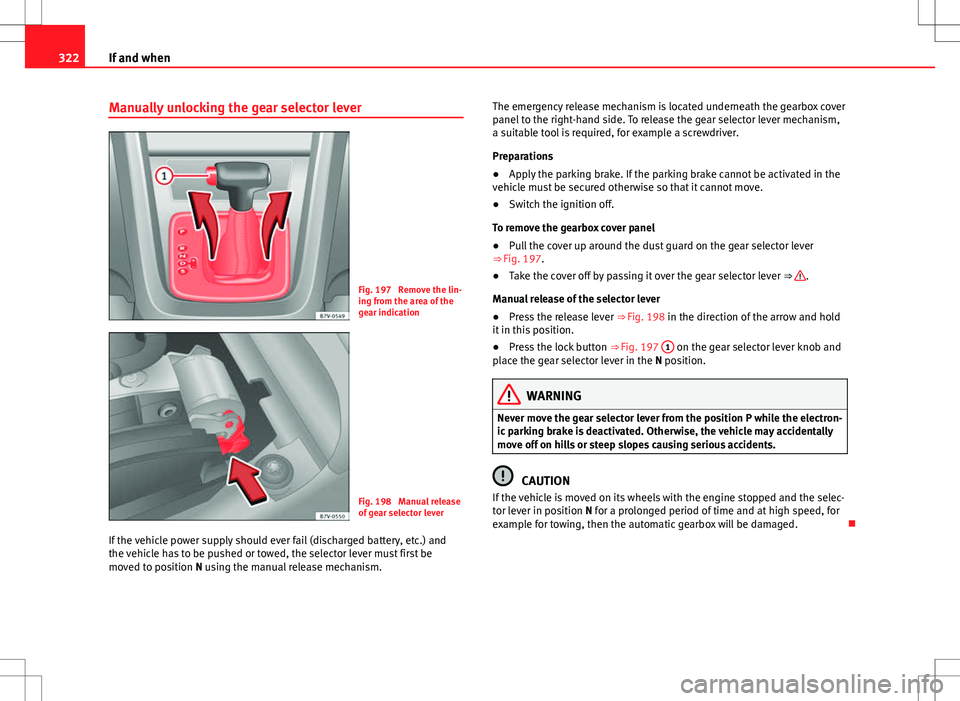
Fig. 197 Remove the lin-
ing from the area of the
gear indication
Fig. 198 Manual release
of gear selector lever
If the vehicle power supply should ever fail (discharged battery, etc.) and
the vehicle has to be pushed or towed, the selector lever must first be
moved to position N using the manual release mechanism. The emergency release mechanism is located underneath the gearbox cover
panel to the right-hand side. To release the gear selector lever mechanism,
a suitable tool is required, for example a screwdriver.
Preparations
●
Apply the parking brake. If the parking brake cannot be activated in the
vehicle must be secured otherwise so that it cannot move.
● Switch the ignition off.
To remove the gearbox cover panel
● Pull the cover up around the dust guard on the gear selector lever
⇒ Fig. 197.
● Take the cover off by passing it over the gear selector lever ⇒
.
Manual release of the selector lever
● Press the release lever ⇒ Fig. 198 in the direction of the arrow and hold
it in this position.
● Press the lock button ⇒ Fig. 197 1
on the gear selector lever knob and
place the gear selector lever in the N position.
WARNING
Never move the gear selector lever from the position P while the electron-
ic parking brake is deactivated. Otherwise, the vehicle may accidentally
move off on hills or steep slopes causing serious accidents.
CAUTION
If the vehicle is moved on its wheels with the engine stopped and the selec-
tor lever in position N for a prolonged period of time and at high speed, for
example for towing, then the automatic gearbox will be damaged.