2013 Seat Alhambra ignition
[x] Cancel search: ignitionPage 320 of 387

318If and when
WARNING
Opening and closing doors carelessly can cause serious injury.
● If the vehicle is locked from outside, the doors and windows cannot
be opened from the inside.
● Never leave children or disabled people alone in the car. They could
be trapped in the car in an emergency and will not be able to get them-
selves to safety.
● Depending on the time of the year, temperatures inside a locked and
closed vehicle can be extremely high or extremely low resulting in seri-
ous injuries and illness or even death, particularly for young children.
WARNING
Getting in the way of the doors and the panoramic sliding sunroof is dan-
gerous and can lead to serious injury.
● Open and close the doors and the panoramic sliding sunroof only
when nobody is in the way.
CAUTION
When opening and closing in an emergency, carefully disassemble compo-
nents and then reassemble them carefully to avoid damage to the vehicle. Manually locking and unlocking the driver door
Fig. 190 Driver door
handle: Hidden lock cyl-
inder
As a general rule, when the driver door is locked all other doors are locked.
Unlocking manually only opens the driver door. Please note the instructions
for the anti-theft alarm ⇒ page 74.
● Unfold the key shaft
⇒ page 71.
● Insert the key shaft into the opening in the cover on the driver door han-
dle from below ⇒ Fig. 190 (arrow) then remove the cover upwards.
● Insert the key shaft into the lock cylinder to unlock or lock the vehicle.
Unlocking notes:
● The anti-theft alarm will remain active when vehicles are unlocked. How-
ever, the alarm will not yet be triggered ⇒ page 74.
● If the driver door is opened, the alarm will be triggered.
● Switch the ignition on. When the ignition is switched on, the electronic
immobiliser recognises a valid vehicle key and deactivates the anti-theft
alarm system.
Page 324 of 387
322If and when
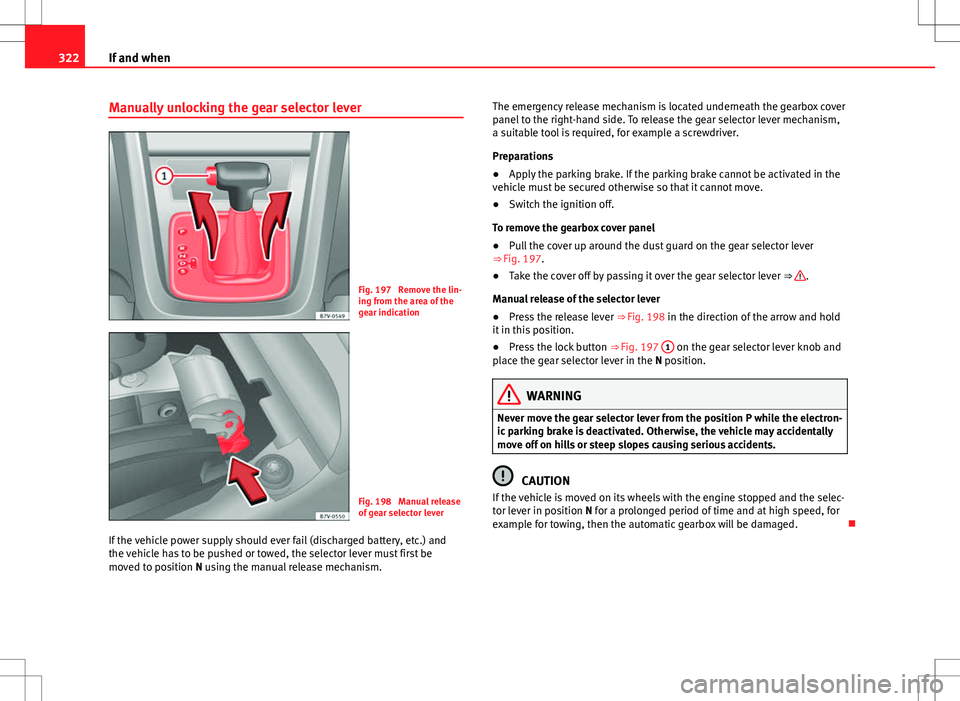
Manually unlocking the gear selector lever
Fig. 197 Remove the lin-
ing from the area of the
gear indication
Fig. 198 Manual release
of gear selector lever
If the vehicle power supply should ever fail (discharged battery, etc.) and
the vehicle has to be pushed or towed, the selector lever must first be
moved to position N using the manual release mechanism. The emergency release mechanism is located underneath the gearbox cover
panel to the right-hand side. To release the gear selector lever mechanism,
a suitable tool is required, for example a screwdriver.
Preparations
●
Apply the parking brake. If the parking brake cannot be activated in the
vehicle must be secured otherwise so that it cannot move.
● Switch the ignition off.
To remove the gearbox cover panel
● Pull the cover up around the dust guard on the gear selector lever
⇒ Fig. 197.
● Take the cover off by passing it over the gear selector lever ⇒
.
Manual release of the selector lever
● Press the release lever ⇒ Fig. 198 in the direction of the arrow and hold
it in this position.
● Press the lock button ⇒ Fig. 197 1
on the gear selector lever knob and
place the gear selector lever in the N position.
WARNING
Never move the gear selector lever from the position P while the electron-
ic parking brake is deactivated. Otherwise, the vehicle may accidentally
move off on hills or steep slopes causing serious accidents.
CAUTION
If the vehicle is moved on its wheels with the engine stopped and the selec-
tor lever in position N for a prolonged period of time and at high speed, for
example for towing, then the automatic gearbox will be damaged.
Page 327 of 387

325
If and when
Fuses
Introduction
Due to the constant update of vehicles, fuse assignments depending on
equipment and the use of the same fuse for various electrical components,
at the time of printing this manual it is not possible to provide an up-to-date
summary of the electrical components fuse positions. For detailed informa-
tion about the fuse positions, please consult a Technical Service.
In general, a fuse can be assigned to various electrical components. Like-
wise, an electrical component can be protected by several fuses.
Only replace fuses when the cause of the problem has been solved. If a
newly inserted fuse blows after a short time, you must have the electrical
system checked by a specialised workshop as soon as possible.
Additional information and warnings:
● Working in the engine compartment ⇒ page 278
WARNING
The high voltages in the electrical system can give serious electrical
shocks, causing burns and even death!
● Never touch the electrical wiring of the ignition system.
● Take care not to cause short circuits in the electrical system.
WARNING
Using unsuitable fuses, repairing fuses or bridging a current circuit with-
out fuses can cause a fire and serious injury.
● Never use a fuse with a higher value. Only replace fuses with a fuse of
the same amperage (same colour and markings) and size.
● Never repair a fuse.
● Never replace a fuse by a metal strip, staple or similar.
CAUTION
● To avoid damage to the vehicles electric system, before replacing a fuse
turn off the ignition, the lights and all electrical elements and remove the
keys from the ignition.
● If you replace a fuse with higher-rating fuse, you could cause damage to
another part of the electrical system.
● Protect the fuse boxes when open to avoid the entry of dust or humidity.
Dirt and humidity inside fuse boxes can cause damage to the electrical sys-
tem.
Note
● One single consumer could have more than one fuse.
● Several consumers could run over one single fuse.
Safety FirstOperating instructionsPractical tipsTechnical Specifications
Page 329 of 387

327
If and when
CAUTION
● Always carefully remove the fuse box covers and refit them correctly to
avoid problems with your vehicle.
● Protect the fuse boxes when open to avoid the entry of dust or humidity.
Dirt and humidity inside fuse boxes can cause damage to the electrical sys-
tem.
Note
In the vehicle, there are more fuses than those indicated in this chapter.
These should only be changed by a specialised workshop.
Replacing a blown fuse
Fig. 203 Image of a
blown fuse
Fig. 204 Removing or fit-
ting a fuse
Preparation
● Switch off the ignition, lights and all electrical equipment.
● Open the corresponding fuse box
⇒ page 326
Identifying a blown fuse
A fuse is blown if its metal strip is ruptured ⇒ Fig. 203.
Point a lamp at the fuse. This will make it easier to see if the fuse is blown.
To replace a fuse
● If necessary, remove the plastic pincers from the fuse box cover.
● For small fuses, insert the pincers from above
⇒ Fig. 204 A
.
● For larger fuses , insert the pincers from one side of the fuse B.
● Remove the relevant fuse.
● Replace the blown fuse by one with an identical amperage rating (same
colour and markings) and identical size ⇒
.
● Replace the cover.
Safety FirstOperating instructionsPractical tipsTechnical Specifications
Page 332 of 387

330If and when
Several warning and control lamps should light up for a few seconds when
the ignition is switched on, signalling that the function is being verified.
They will switch off after a few seconds.
Checking the bulbs of a trailer
For vehicles with the factory fitted towing bracket, certain trailer lights are
also controlled if the power socket is correctly connected.
A fault on a trailer turn signal is indicated on the instrument panel by the
turn signal blinking twice as fast ( or ) ⇒ page 95.
● General fault of all turn signals on one side.
● Fault in one tail light (on some models, also the registration light).
● Fault in two brake lights.
WARNING
If the warning lamps and messages are ignored, the vehicle may stall in
traffic, or may cause accidents and severe injuries.
● Never ignore the warning lamps or text messages.
● Stop the vehicle safely as soon as possible.
CAUTION
Failure to heed the control lamps and text messages when they appear may
result in faults in the vehicle.
Note
A fault in the LED on the tail lights will not be indicated. However, if the fault
affects all the LEDs then this will be indicated by the control lamp . Information for replacing bulbs
Checklist
To replace a bulb, carry out the following operations always in the order giv-
en ⇒
:
Park the vehicle a safe distance from traffic and on suitable ground.
Connect the electronic parking brake ⇒ page 184.
Turn the light switch to position 0 ⇒ page 95.
Move the gear lever into the neutral position ⇒ page 95.
Automatic gearbox: move the selector lever to position P ⇒ page 175.
Stop the engine and remove the key from the ignition ⇒ page 171.
Manual gearbox: Select a gear ⇒ page 175.
Wait until all of the vehicle interior lights are turned off ⇒ page 95.
Allow the corresponding bulb to cool. Visually inspect fuses to see if any are blown ⇒ page 325.
Replace the bulb according to the instructions ⇒
. Bulbs should only
be replaced by new identical models. Bulb information is displayed on
the bulb socket or on the bulb itself.
In general, never touch the bulb glass directly. The heat of the bulb
would cause the fingerprint to evaporate and condense on the reflector.
This will impair the brightness of the headlight.
Check if the new bulb is working. If the bulb is not working, it may not
have been correctly fitted, it could be damaged or the connector may
not be correctly connected.
Every time a bulb for the headlights is replaced, visit a specialised
workshop to check the headlights.
1.
2.
3.
4.
5.
6.
7.
8.
9.
10.
11.
12.
13.
14.
Page 343 of 387

341
If and when
Positive pole on the starting assistance points
Fig. 217 In the engine
compartment: positive
pole for starting assis-
tance +
On some vehicles, there is a starting assistance terminal in the engine com-
partment, under a labelled cover. How to jump start: description
Fig. 218 Diagram of con-
nections for vehicles
without Start-Stop sys-
tem
Fig. 219 Diagram of con-
nections for vehicles with
Start-Stop system
Jump lead terminal connections
1. Switch off the ignition of both vehicles ⇒
.
2. For vehicles without Start-Stop system :
Safety FirstOperating instructionsPractical tipsTechnical Specifications
Page 345 of 387

343
If and when
WARNING (Continued)
● Observe the instructions provided by the manufacturer of the jump
leads.
● Do not connect the negative cable from the other vehicle directly to
the negative terminal of the flat battery. The gas emitted from the battery
could be ignited by sparks. Danger of explosion.
● Do not attach the negative cable from the other vehicle to parts of the
fuel system or to the brake line.
● The non-insulated parts of the battery clamps must not be allowed to
touch. The jump lead attached to the positive battery terminal must not
touch metal parts of the vehicle, this can cause a short circuit.
● Position the leads in such a way that they cannot come into contact
with any moving parts in the engine compartment.
● Do not lean on the batteries. This could result in chemical burns.
Note
The vehicles must not touch each other, otherwise electricity could flow as
soon as the positive terminals are connected.
Towing and tow starting Introduction
When towing, always respect legal requirements.
For technical reasons, it is not possible to tow a vehicle if the battery is flat.
Additional information and warnings:
● Electronic power control and exhaust gases purification system
⇒ page 231
WARNING
A vehicle with a flat battery should never be towed.
● Never remove the key from the ignition lock. The electronic steering
lock could engage. Then the vehicle will be uncontrollable. You may lose
control of the vehicle and there is a risk of serious accident.
WARNING
When towing the vehicle, the handling and braking efficiency change
considerably. Please observe the following instructions to minimise the
risk of serious accidents and injury:
● As the driver of the vehicle being towed:
– The brake must be depressed must harder as the brake servo does
not operate. Always remain aware to avoid collision with the towing
vehicle.
– More strength is required at the steering wheel as the power steer-
ing does not operate when the engine is switched off.
● As the driver of the towing vehicle:
– Accelerate gently and carefully.
– Avoid sudden braking and manoeuvres.
– Brake well in advance than usual and brake gently.
CAUTION
● Carefully fit and remove the towline anchorage and its cover to avoid
damage to the vehicle (for example, paintwork).
● When towing, fuel could enter the catalytic converter and cause dam-
age!
Safety FirstOperating instructionsPractical tipsTechnical Specifications
Page 346 of 387

344If and when
Instructions for tow starting
In general, the vehicle should not be started by towing. Jump-starting is
much more preferable ⇒ page 340.
For technical reasons, the following vehicles can not be tow started:
● Vehicles with an automatic gearbox.
● Vehicles with an electronic parking brake, given that it is possible that
the brake will not be disengaged.
● If the vehicle battery is flat, it is possible that the engine control units do
not operate correctly.
However, if your vehicle must absolutely be tow-started (manual gearbox):
● Engage the 2nd or 3rd gear.
● Keep the clutch pressed down.
● Switch on the ignition and the hazard warning lights.
● Release the clutch when both vehicles are moving.
● As soon as the engine starts, press the clutch and move the gear lever
into neutral. This helps to prevent a collision with the towing vehicle.
CAUTION
When tow-starting, fuel could enter the catalytic converter and damage it.
Towing instructions
Tow rope or tow bar
When towing, the tow bar is the safest and vehicle friendly way. You should
only use a tow rope if you do not have a tow bar. A tow rope should be slightly elastic to avoid damage to both vehicles. It is
advisable to use a tow rope made of synthetic fibre or similarly elastic mate-
rial.
Only secure the tow rope or tow bar to the towline anchorage or specially
designed fitting.
Vehicles with a
factory fitted towing device , can only be used for towing
with a tow bar, specially designed to fit on a tow hitch ball ⇒ page 236.
Towing vehicles with an automatic gearbox
Note the following for a towed vehicle:
● Make sure the gear selector lever is in the N position.
● Do not drive faster than 50 km/h (30 mph) when towing a vehicle.
● Do not tow further than 50 km (30 miles).
● If a breakdown truck is used, the vehicle must be towed with the front
wheels raised. Note the following instructions for towing four all-wheel drive
vehicles.
Instructions for towing all-wheel drive vehicles
All-wheel drive vehicles can be towed using a toolbar or tow rope. If the ve-
hicle is towed with the front or rear axle raised, the engine must be turned
off to avoid transmission damage.
For vehicles with a double clutched DSG ®
(direct shift gearbox) the instruc-
tions for towing vehicles with an automatic gearbox apply ⇒ page 344.
Situations in which the vehicle should not be towed
In the following cases, the vehicle should not be towed but transported on a
trailer or special vehicle:
● If the vehicle gearbox does not contain lubricant due to a fault.
● If the vehicle battery is flat and, as a result, the electronic steering lock
and electronic parking brake cannot be disengaged if applied.
● If the vehicle to be towed has an automatic gearbox and the distance to
be covered is greater than 50 km (30 miles).