Page 76 of 734

The ORC contains a backup power supply system that
may deploy the air bags even if the battery loses power or
it becomes disconnected prior to deployment.Also, the ORC turns on the Air Bag Warning
Light in the instrument panel for approxi-
mately four to eight seconds for a self-check
when the ignition is first turned on. After the
self-check, the Air Bag Warning Light will turn off. If the
ORC detects a malfunction in any part of the system, it
turns on the Air Bag Warning Light, either momentarily
or continuously. A single chime will sound if the light
comes on again after initial startup.
It also includes diagnostics that will illuminate the instru-
ment cluster Air Bag Warning Light if a malfunction is
noted that could affect the air bag system. The diagnos-
tics also record the nature of the malfunction.WARNING!
Ignoring the Air Bag Warning Light in your instru-
ment panel could mean you won’t have the air bags
to protect you in a collision. If the light does not come
on as a bulb check when the ignition is first turned
on, stays on after you start the vehicle, or if it comes
on as you drive, have an authorized dealer service the
air bag system immediately.
Driver And Passenger Advanced Front Air Bag
Inflator Units
The Driver and Passenger Advanced Front Air Bag
Inflator Units are located in the center of the steering
wheel and on the right side of the instrument panel.
When the ORC detects a collision requiring the Ad-
vanced Front Air Bags, it signals the inflator units. A large
quantity of non-toxic gas is generated to inflate the
Advanced Front Air Bags. Different air bag inflation rates
74 THINGS TO KNOW BEFORE STARTING YOUR VEHICLE
Page 78 of 734

and type of collision. In these events, the ORC will
deploy the SABIC only on the impact side of the vehicle.
A quantity of non-toxic gas is generated to inflate the side
curtain air bag. The inflating side curtain air bag pushes
the outside edge of the headliner out of the way and
covers the window. The air bag inflates in about 30
milliseconds (about one-quarter of the time that it takes
to blink your eyes) with enough force to injure you if you
are not belted and seated properly, or if items are
positioned in the area where the side curtain air bag
inflates. This especially applies to children. The side
curtain air bag is only about 3-1/2 in (9 cm) thick when
it is inflated.
Because air bag sensors estimate deceleration over time,
vehicle speed and damage are not good indicators of
whether or not an air bag should have deployed.Front And Side Impact Sensors
In front and side impacts, impact sensors can aid the
ORC in determining appropriate response to impact
events.
Enhanced Accident Response System
In the event of an impact causing air bag deployment, if
the communication network remains intact, and the
power remains intact, depending on the nature of the
event the ORC will determine whether to have the
Enhanced Accident Response System perform the follow-
ing functions:
•Cut off fuel to the engine.
• Flash hazard lights as long as the battery has power or
until the ignition key is turned off.
• Turn on the interior lights, which remain on as long as
the battery has power or until the ignition key is
removed.
76 THINGS TO KNOW BEFORE STARTING YOUR VEHICLE
Page 82 of 734

•The ignition key is in OFF position;
• The vehicle’s electrical systems are not intact;
• The 9-1-1 Call system software and/or hardware are
damaged during a crash;
• The vehicle battery loses power or becomes discon-
nected during a vehicle crash;
• Wireless and/or Global Positioning Satellite signals
are unavailable or obstructed;
• Equipment malfunction at the 9-1-1 operator facility;
• Operator error by the 9-1-1 operator;
• Wireless network congestion;
• Weather; and
• Buildings, structures, geographic terrain, or tunnels. NOTE:
Never place anything on or near the vehicle’s
wireless and GPS antennas. You could prevent wireless
and GPS signal reception, which can prevent your vehicle
from placing an emergency call. Wireless and GPS signal
reception is required for the 9-1-1 Call system to function
properly.
General Information
This device complies with Part 15 of the FCC Rules.
Operation is subject to the following two conditions: (1)
This device may not cause harmful interference, and (2)
this device must accept any interference received, includ-
ing interference that may cause undesired operation.
If A Deployment Occurs
The Advanced Front Air Bags are designed to deflate
immediately after deployment.
80 THINGS TO KNOW BEFORE STARTING YOUR VEHICLE
Page 128 of 734
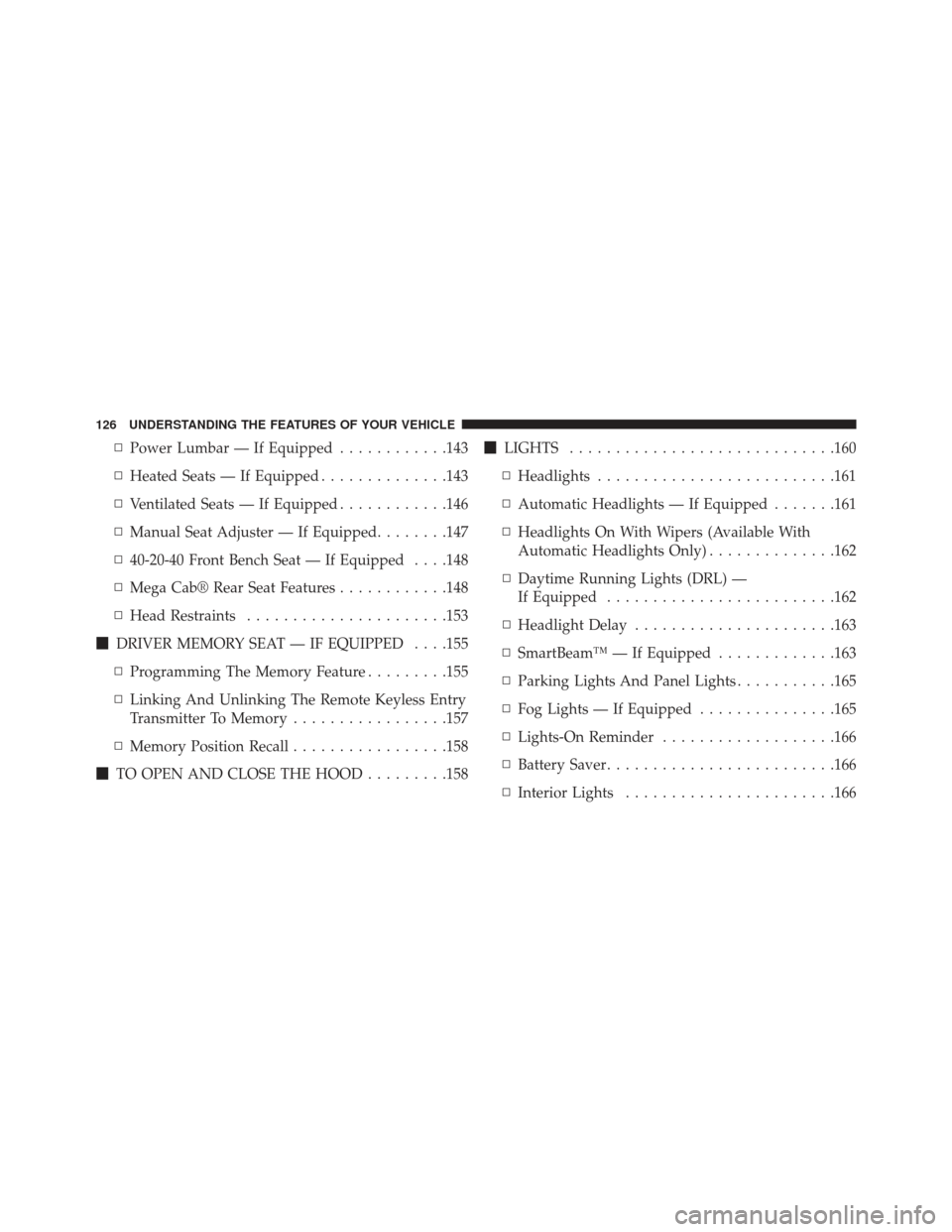
▫Power Lumbar — If Equipped ............143
▫ Heated Seats — If Equipped ..............143
▫ Ventilated Seats — If Equipped ............146
▫ Manual Seat Adjuster — If Equipped ........147
▫ 40-20-40 Front Bench Seat — If Equipped . . . .148
▫ Mega Cab® Rear Seat Features ............148
▫ Head Restraints ..................... .153
� DRIVER MEMORY SEAT — IF EQUIPPED . . . .155
▫ Programming The Memory Feature .........155
▫ Linking And Unlinking The Remote Keyless Entry
Transmitter To Memory .................157
▫ Memory Position Recall .................158
� TO OPEN AND CLOSE THE HOOD .........158�
LIGHTS ............................ .160
▫ Headlights ......................... .161
▫ Automatic Headlights — If Equipped .......161
▫ Headlights On With Wipers (Available With
Automatic Headlights Only) ..............162
▫ Daytime Running Lights (DRL) —
If Equipped ........................ .162
▫ Headlight Delay ..................... .163
▫ SmartBeam™ — If Equipped .............163
▫ Parking Lights And Panel Lights ...........165
▫ Fog Lights — If Equipped ...............165
▫ Lights-On Reminder ...................166
▫ Battery Saver ........................ .166
▫ Interior Lights ...................... .166
126 UNDERSTANDING THE FEATURES OF YOUR VEHICLE
Page 169 of 734

turn off when the switch is pushed a second time, when
the headlight switch is rotated to the off position, or the
high beam is selected.
Lights-On Reminder
If the headlights, parking lights, or cargo lights are left on
after the ignition is turned OFF, a chime will sound when
the driver ’s door is opened.
Battery Saver
To protect the life of your vehicle’s battery, load shedding
is provided for both the interior and exterior lights.
If the ignition is OFF and any door is left ajar for 10
minutes or the dimmer control is rotated all the way up
to the dome ON position for 10 minutes, the interior
lights will automatically turn off.
If the headlights remain on while the ignition is cycled
OFF, the exterior lights will automatically turn off aftereight minutes. If the headlights are turned on and left on
for eight minutes while the ignition is OFF, the exterior
lights will automatically turn off.
NOTE:
Battery saver mode is cancelled if the ignition is
ON.
Interior Lights
Courtesy and dome lights are turned on when the front
doors are opened, when the dimmer control (rotating
wheel on the bottom of the switch) is rotated to the far
right detent position, or if equipped, when the UNLOCK
button is pressed on the Remote Keyless Entry (RKE)
transmitter. When a door is open and the interior lights
are on, rotating the dimmer control all the way left, to the
OFF detent, will cause all the interior lights to go out.
This is also known as the �Party�mode because it allows
the doors to stay open for extended periods of time
without discharging the vehicle’s battery.
3
UNDERSTANDING THE FEATURES OF YOUR VEHICLE 167
Page 198 of 734
NOTE:The courtesy/reading lights will remain on until
the switch is pressed a second time, so be sure they have
been turned off before leaving the vehicle. If the interior
lights are left on after the ignition is turned OFF, they will
automatically turn off after 15 minutes.
GARAGE DOOR OPENER — IF EQUIPPED
HomeLink® replaces up to three hand-held transmitters
that operate devices such as garage door openers, motor-
ized gates, lighting or home security systems. The
HomeLink® unit is powered by your vehicles 12 Volt
battery.
The HomeLink® buttons that are located in the overhead
console designate the three different HomeLink® chan-
nels.
Rear Passenger Courtesy/Reading Light
196 UNDERSTANDING THE FEATURES OF YOUR VEHICLE
Page 199 of 734
NOTE:HomeLink® is disabled when the Vehicle Secu-
rity Alarm is active.
Before You Begin Programming HomeLink®
Ensure your vehicle is parked outside of the garage
before you begin programming.
For efficient programming and accurate transmission of
the radio-frequency signal it is recommended that a new
battery be placed in the hand-held transmitter of the
device that is being programmed to the HomeLink®
system.
Erase all channels before you begin programming. To
erase the channels place the ignition in the ON/RUN
position and press and hold the two outside HomeLink®
buttons (I and III) for up 20 seconds. The Electronic
Vehicle Information Center (EVIC) will display “CLEAR-
ING CHANNELS”. Release the buttons when the EVIC
displays “CHANNELS CLEARED”.
HomeLink® Buttons
3
UNDERSTANDING THE FEATURES OF YOUR VEHICLE 197
Page 205 of 734

programmed device (i.e., garage door opener, gate opera-
tor, security system, entry door lock, home/office light-
ing, etc.,). The hand-held transmitter of the device may
also be used at any time.
Security
It is advised to erase all channels before you sell or turn
in your vehicle.
To erase the channels press and hold the two outside
HomeLink® buttons (I and III) for up 20 seconds. The
Electronic Vehicle Information Center (EVIC) will display
“CLEARING CHANNELS”. Release the buttons when
the EVIC displays “CHANNELS CLEARED”.
The HomeLink® Universal Transceiver is disabled when
the Vehicle Security Alarm is active.
Troubleshooting Tips
If you are having trouble programming HomeLink®,
here are some of the most common solutions:
•Replace the battery in the original hand-held transmit-
ter.
• Press the LEARN button on the Garage Door Opener
to complete the training for a Rolling Code.
• Did you unplug the device for programming and
remember to plug it back in?
If you have any problems, or require assistance, please
call toll-free 1–800–355–3515 or, on the Internet at
www.HomeLink.com for information or assistance.
3
UNDERSTANDING THE FEATURES OF YOUR VEHICLE 203

