2013 PORSCHE PANAMERA fuel cap
[x] Cancel search: fuel capPage 7 of 78
1415
Get ting where you want to be sooner –
whether it ’s your office or your holiday
destination. More than likely, though, it’s
the future.
Typically for Porsche, it begins in the
garage. Or, to be more specific, at the
vehicle charge port of the new Panamera S
E-Hybrid – a parallel plug-in hybrid,
and also the next major step in hybrid
technology. The future begins now. With
e-mobility. A total concept that combines
a progressive drive system, a variet y of
charging capabilities, intelligent mobile
online services and efficient performance.
The new lithium-ion-based high-voltage
bat tery of the Panamera S E-Hybrid has
more energy content than nickel metal
hydride bat teries and can be charged
from an external source. On electric
power alone, the
Panamera S E-Hybrid
has a range of up to 36 km in the NEDC
and reaches a maximum speed of
135 km/ h. That ’s with an average fuel
consumption of merely 3.1 l/100 km.
However, reducing fuel consumption is
just one of the goals that we are aiming
to achieve with advanced hybrid
technology. Ever yday practicalit y and
sport y driving pleasure are also top of our list. For more information on the
new Panamera S E-Hybrid, please refer
to pages 30 –37.
There are innovations under the bonnet
of the other members of the Panamera
family, too. Like a brand new generation
of engine in the Panamera S and
Panamera 4S. Thanks to some intelligent
downsizing, the 3.0-litre twin-turbo V6
engine produces more power output than
the naturally aspirated engine of the
previous generation – and delivers a
lower rate of fuel consumption at the
same time.
Porsche Doppelkupplung (PDK, p.
58) is
now fit ted as standard in all models with
a petrol engine. The power of the
Panamera S E-Hybrid is transmit ted to
the road by the 8-speed Tiptronic S.
Prepped and ready for the future of
the automobile and the digital age –
Porsche Car Connect (p. 100). Porsche
Car Connect is a smartphone app that
enables you to access various data
relating to your car and control certain
functions remotely. In conjunction with
the comprehensive online services
option, you can see all the important
information about your Panamera
whenever you wish – and not only when
you’re behind the wheel.
The new, optional LED main headlights
including Porsche Dynamic Light System
Plus (PDLS Plus, p. 74) help to ensure
even bet ter visibilit y. And with Lane
Change Assist (p. 105), the lane departure
warning (p. 105), speed limit
display
(p. 105), adaptive cruise control including
Porsche Active Safe (PAS, p. 102), and
Surround View (p. 102), a wealth of new
assistance systems is available to you.
Systems to lower your adrenaline level –
on the odd occasion.
Saving fuel needn’t mean
cutting back on the adrenaline.
Engineering.
Concept |
Engineering
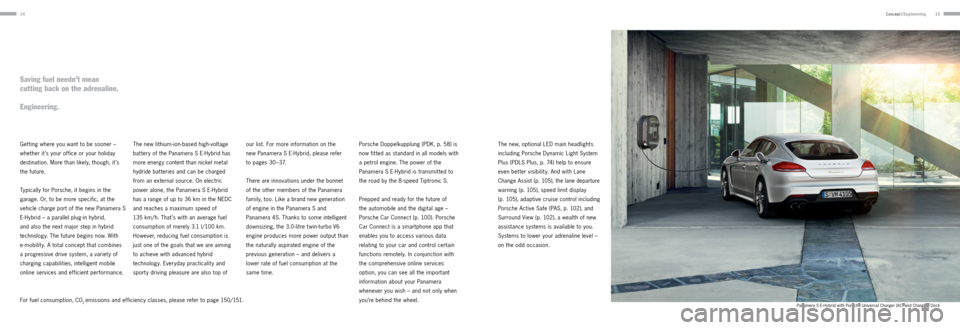
Panamera S E- Hybrid with Porsche Universal Charger (AC) and Charging DockFor fuel consumption, CO2 emissions and efficiency classes, please refer to page 150/151.
Page 16 of 78
3233
Drive concept.
The Panamera S E-Hybrid is a parallel
plug-in hybrid. This means that it can be
powered by the combustion engine alone,
by the electric machine alone or by both
units working together. In this way, it is
able to exploit the power generated by
both propulsion units. It ’s a concept
that ’s been proven since 2011. What ’s
new is that the high-voltage bat tery is
recharged in around 3.8 hours via direct
connection to an electricit y socket or,
whilst driving, through the process of
brake energy recovery known as
recuperation, or via the combustion
engine. Thanks to innovative lithium-ion
technology, its capacit y of 9.4 kWh
means that it also stores much more
energy. The battery is maintenance-free
and covered by a six-year warrant y.
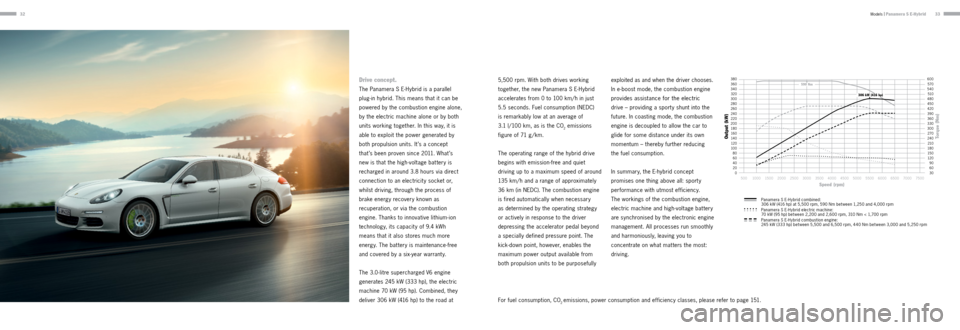
The 3.0 -litre supercharged V6 engine
generates 245 kW (333 hp), the electric
machine 70 kW (95 hp). Combined, they
deliver 306 kW (416 hp) to the road at 5,500 rpm. With both drives working
together, the new Panamera S E-Hybrid
accelerates from 0 to 100 km/ h in just
5.5
seconds. Fuel consumption (NEDC)
is remarkably low at an average of
3.1 l/100 km, as is the CO
2 emissions
figure of 71 g / km.
The operating range of the hybrid drive
begins with emission-free and quiet
driving up to a maximum speed of around
135 km/ h and a range of approximately
36 km (in NEDC). The combustion engine
is fired automatically when necessary
as determined by the operating strategy
or actively in response to the driver
depressing the accelerator pedal beyond
a specially defined pressure point. The
kick-down point, however, enables the
maximum power output available from
both propulsion units to be purposefully
exploited as and when the driver chooses.
In e-boost mode, the combustion engine
provides assistance for the electric
drive – providing a sport y shunt into the
future. In coasting mode, the combustion
engine is decoupled to allow the car to
glide for some distance under its own
momentum – thereby further reducing
the fuel consumption.
In summary, the E-hybrid concept
promises one thing above all: sporty
performance with utmost efficiency.
The workings of the combustion engine,
electric machine and high -voltage bat ter y
are synchronised by the electronic engine
management. All processes run smoothly
and harmoniously, leaving you to
concentrate on what mat ters the most:
driving.
For fuel consumption, CO
2 emissions, power consumption and efficiency classes, please refer to page 151.
Models |
Panamera S E-Hybrid
Panamera S E-Hybrid combined :
306 kW (416 hp) at 5,500 rpm, 590 Nm bet ween 1,250 and 4,000 rpm
Panamera S E-Hybrid electric machine :
70 kW (95 hp) bet ween 2,200 and 2,600 rpm, 310 Nm < 1,700 rpm
Panamera S E-Hybrid combustion engine :
245 kW (333 hp) bet ween 5,500 and 6,500 rpm, 440 Nm bet ween 3,000 and 5,250 rpm
380
360
340 320
300 280260 240
220
200 18 016 0
14 012 0
10 0 8060
40
20
0
500 1000 15 0 02000 25003000 35004000 45005000 55006000 65007000 7500600
570
540 510
480 450420
390
360 330
300 270
240 210
18 0 15 0 12 0 9060
30
Torque (Nm) Output (kW)
Speed (rpm)
590 Nm
306 kW (416 hp)
Page 74 of 78

150151
Panamera Panamera 4 Panamera S Panamera 4S
Weights
Unladen weight (DIN) 1,770 k g1, 8 2 0 k g1, 810 k g1, 870 k g
Unladen weight (EC)1)1, 8 4 5 k g 1, 8 9 5 k g1, 8 8 5 k g1,9 4 5 k g
Permissible gross weight 2,380 kg2,420 kg2,415 k g2,450 kg
Max. additional load 610 k g600 kg605 kg580 kg
Performance
Top speed 259 km/ h 257 k m / h 287 km/ h 286 km/ h
0–100 km/h 6.3 secs (6.0 secs)2)6.1 secs (5.8 secs)2)5.1 secs (4.8 secs)2)4.8 secs (4.5 secs)2)
Overtaking acceleration 80 –120 km/ h 4.3 secs 4.4 secs 2.9 secs 3.0 secs
Fuel consumption/emissions 3)/
efficiency classes4)
Fuel grade Super Plus unleaded (RON 98)Super Plus unleaded (RON 98)Super Plus unleaded (RON 98)Super Plus unleaded (RON 98)
Urban (in l/100 km) 11 . 2 11 . 411 . 912 . 2
Extra urban (in l/100 km) 6.87. 16.97. 2
Combined (in l/100 km) 8.4 8.78.78.9
CO
2 emissions g/km 19 6203204208
Combined power consumption
(in kWh/100 km) –
–––
Efficiency class (Germany)
4)D DED
Ef ficiency class (Switzerland)4)F FFF
Dimensions
Length 5,015 m m 5,015 m m 5,015 m m 5,015 m m
Width (with exterior mirrors) 1,931 mm (2,114 mm) 1,931 mm (2,114 mm) 1,931 mm (2,114 mm) 1,931 mm (2,114 mm)
Height 1,418 m m 1,418 m m 1,418 m m 1,418 m m
Wheelbase 2,920 mm 2,920 mm 2,920 mm 2,920 mm
Luggage compartment volume (German Car Manu-
facturers’ Assoc.) with folded down rear seats 1,263 litres
1,263 litres1,263 litres1,263 litres
Tank capacity 80 litres80 litres80 litres10 0 l i t res
Panamera S E-Hybrid Panamera GTS Panamera Turbo
Weights
Unladen weight (DIN) 2,095 kg1,9 25 k g1,970 k g
Unladen weight (EC)1)2,170 k g 2,000 kg2,045 kg
Permissible gross weight 2,580 kg2,500 kg2,500 kg
Max. additional load 485 kg575 k g530 kg
Performance
Top speed 270 km/ h 288 km/ h 305 km/ h
0–100 km/h 5.5 secs4.4 secs2)4.1 secs (3.9 secs)2)
Overtaking acceleration 80 –120 km/ h 3.4 secs 3.1 secs 2.6 secs
Fuel consumption/emissions 3)/
efficiency classes4)
Fuel grade Super unleaded (RON 95)Super Plus unleaded (RON 98)Super Plus unleaded (RON 98)
Urban (in l/100 km) – 15.714 .7
Extra urban (in l/100 km) –7. 87. 7
Combined (in l/100 km) 3.1 10.710. 2
CO
2 emissions g/km 71249239
Combined power consumption
(in kWh/100 km) 16 . 2
––
Efficiency class (Germany)
4)A+ FF
Ef ficiency class (Switzerland)4)A GG
Dimensions
Length 5,015 m m 5,015 m m 5,015 m m
Width (with exterior mirrors) 1,931 mm (2,114 mm) 1,931 mm (2,114 mm) 1,931 mm (2,114 mm)
Height 1,418 m m 1,4 0 8 m m 1,418 m m
Wheelbase 2,920 mm 2,920 mm 2,920 mm
Luggage compartment volume (German Car Manu-
facturers’ Assoc.) with folded down rear seats 1,15 3 l i t res
1,263 litres1, 25 0 l i t res
Tank capacity 80 litres10 0 l i t res10 0 l i t res
1) In accordance with the EC standard, the unladen weight applies to vehicles with standard specification only. Optional equipment increases this figure. The figure given includes 68 kg for the driver and 7 kg for luggage.2) In conjunction with the optional Sport Chrono Package with activated SPORT PLUS but ton selected (in the Panamera GTS series).3) Data determined in the NEDC (New European Driving Cycle) in accordance with the Euro 5 (715/2007/ EC, 692/2008/ EC, 566/2011/ EC and ECE- R 101) measurement method. The figures do not refer to an individual vehicle nor do they
constitute part of the of fer. They are intended solely as a means of comparing dif ferent t ypes of vehicle. Fuel consumption calculated for vehicles with standard specification only. Optional equipment may af fect fuel consumption and
per formance. A vehicle’s fuel consumption and CO
2 emissions do not just depend on how ef ficiently the vehicle uses the fuel but also on driving st yle and other non -technical factors. The latest Porsche models with petrol engines are
designed to operate on fuels with an ethanol content of up to 10 %. You can obtain the latest information on individual vehicles from your Porsche Centre.
4) Valid in the countries listed only.
Technical data