Page 135 of 184
133
6
Towing a trailer
ACCESSORIE
STOWING A TRAILER, CARAVAN, BOAT, ETC...
For more information about weights, refer to
the administrative documents
(V5 registration document, ...)
Distribution of loads:
distribute the load in
the trailer so that the heaviest objects are as
close as possible to the axle and the nose
weight is close to the maximum authorised
without, however, exceeding it.
Driving advice
A towed vehicle must free wheel: gearbox in
neutral.
Page 137 of 184

Equipment
135
6
ACCESSORIE
S
ROOF BARS
To install the transverse roof bars, use the
fixings provided for this purpose. Refer to the "Dimensions" section
of chapter 9 for further information
regarding the length (L1 to L4) and the
height (H1 to H3) of the vehicle. Never exceed the maximum weight of
the vehicle when loaded (GVW).
OTHER ACCESSORIES
These accessories and parts, having been
tested and approved for reliability and
safety, are all adapted to your vehicle. A
wide recommended range and original parts
are offered.
Range of professionalequipment Maximum useful load on the roof bars: 100 kg
distributed, regardless of the type of vehicle.
The roof bars can only be installed on
the H1 and H2 vehicles. Parts and Service technical information
publishes an accessories catalogue offering
various equipment and fittings, such as:
Roof bars for short, medium and long
wheelbase (load retainers for all models).
Foot board, loading roller, step.
Towbar, 7/13 pin, 7/7 pin, 13 pin towbar
harness: trailer towbar which must be fitted
by the PEUGEOT network.
Roof bars for the various heights, additional
roof bar.
Separation partitions, protective fl oor, non-slip
fl oor.
Page 150 of 184
Changing a wheel
14
8
1. PARKING THE VEHICLE
As far as possible, park the vehicle on level,
stable and non-slippery ground.
Apply the parking brake, switch off the
ignition and engage first gear.
Put on a high visibility vest and position the
warning triangle.
If possible, place a chock under the
wheel diagonally opposite the wheel to be
changed. 2. TOOLS
These are located under the front passenger
seat cushion.
- Turn the button a quarter of a turn then
pull the box.
- After use, press the button then turn it a
quarter of a turn to secure the box.
A.
Long socket.
B.
Ratchet wrench.
C.
Jack.
D.
Towing hook.
E.
Wheelbrace.
F.
Screwdriver.
CHANGING A WHEEL
You must ensure that the occupants get out
of the vehicle and wait in a safe location.
Page 151 of 184
Changing a wheel
14
9
QUICK HELP
8
4. OPERATING PROCEDURE
- Remove the trim using the screwdriver F
as a lever.
- Release the bolts using the
wheelbrace E
.
- Position the jack C
at one of the four
locations provided on the underbody
near the wheels.
3. SPARE WHEEL
The spare wheel retaining bolt is located
below the bumper on the right.
- Turn the bolt using the socket A
and the
ratchet wrench B
to release the wheel.
- Turn to the locking point, indicated by
an increase in the force required for the
manoeuvre.
- Take out the spare wheel using the
wrench.
- Unscrew the handle G
and remove the
support H
.
- Release the spare wheel and place it
near the wheel to be changed.
If you have a retractable foot board, the jack
must be positioned at 45°.
- Extend the jack using the ratchet
wrench B
until the wheel is a few
centimetres off the ground.
- Unscrew the bolts fully and change the
wheel.
Page 152 of 184
150
6. REFITTING THE REPAIREDWHEEL
Refitting of the wheel is identical to step 5,
do not forget to refit the wheel trim.
Refer to the "Identification markings"
section of chapter 9 to locate the tyre
label.
The spare wheel is not designed to be used
over long distances. Have the tightening of
the bolts and pressure of the spare wheel
checked by a PEUGEOT dealer without
delay.
Also, have the original wheel repaired and
refitted by a PEUGEOT dealer as soon as
possible.
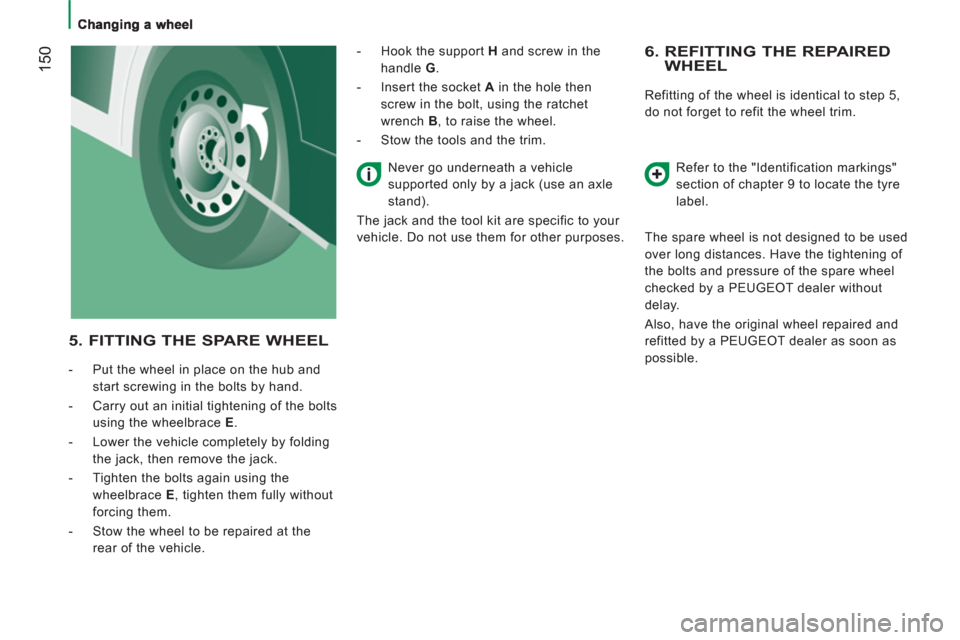
5. FITTING THE SPARE WHEEL
- Put the wheel in place on the hub and
start screwing in the bolts by hand.
- Carry out an initial tightening of the bolts
using the wheelbrace E
.
- Lower the vehicle completely by folding
the jack, then remove the jack.
- Tighten the bolts again using the
wheelbrace E
, tighten them fully without
forcing them.
- Stow the wheel to be repaired at the
rear of the vehicle.
- Hook the support H
and screw in the
handle G
.
- Insert the socket A
in the hole then
screw in the bolt, using the ratchet
wrench B
, to raise the wheel.
- Stow the tools and the trim.
Never go underneath a vehicle
supported only by a jack (use an axle
stand).
The jack and the tool kit are specific to your
vehicle. Do not use them for other purposes.
Page 154 of 184

Changing a wheel
152
- If a pressure of at least 3 bars
is not
reached within 5 minutes, disconnect
the compressor from the valve and the
power socket, then move the vehicle
forward by approximately 10 metres to
distribute the sealant fluid inside the
tyre.
- Then repeat the inflating operation:
●
if a pressure of at least 3 bars
is not
reached within 10 minutes, switch off
your vehicle: the tyre has suffered too
much damage and repair has not been
possible. Consult a PEUGEOT dealer.
●
if the tyre has been inflated to a
pressure of 4 bars
, set off again
immediately.
After driving for approximately 10 minutes,
stop and check the pressure of the tyre
again.
Adjust the pressure if necessary and contact
a PEUGEOT dealer as soon as possible.
Checking and adjusting the pressure
The compressor can only be used to check
and adjust the pressure.
- Disconnect the hose I
and connect it to
the tyre valve directly; the cartridge will
then be connected to the compressor
and the filling fluid will not be injected.
If it is necessary to deflate the tyre, connect
the hose I
to the tyre valve and press the
yellow button, placed in the centre of the
switch on the compressor.
Replacing the sealant fluidcartridge
To replace the cartridge, carry out the
following operations:
- disconnect the hose I
,
- turn the cartridge to be replaced
anticlockwise and lift it,
- insert the new cartridge and turn it clockwise,
- reconnect the hose I
and connect the
hose B
in its location.
The cartridge contains ethylene-glycol, a
product which is harmful if swallowed and
which causes irritation to the eyes.
Keep out of reach of children.
After use, do not discard the cartridge in the
environment, take it to a PEUGEOT dealer or
to an organisation responsible for its collection.
This replacement kit is available from
PEUGEOT dealers.
Page 156 of 184

154
1 - Dipped beam headlamp
Type D
, H7 - 55 W
- Remove the cover by turning it
anticlockwise.
- Disconnect the electrical connector.
- Release the retaining spring by pressing
on the two clips.
- Change the bulb taking care to align the
metal part with the grooves on the lamp.
3 - Main beam headlamp
Type E
, H1 - 55 W
- Remove the cover by turning it
anticlockwise.
- Disconnect the electrical connector.
- Release the retaining spring by pressing
on the two clips.
- Change the bulb taking care to align the
metal part with the groove on the lamp.
2 - Sidelamp
Type A
, W 5 W - 5 W
- Remove the cover by turning it
anticlockwise.
- Remove the bulb holder fitted by
pressure.
- Change the bulb.
4 - Direction indicators
Type B
, PY 21 W - 21 W
- Turn the bulb holder a quarter turn
anticlockwise.
- Remove the bulb by pressing it lightly
while turning it anticlockwise.
- Change the bulb.
5 - Foglamps
Type D
, H1 - 55 W
- Turn the steering fully to the left.
- Unscrew the screw located in the wheel
arch then open the flap.
- Remove the cover.
- Disconnect the electrical connector.
- Release the retaining spring by pressing
on the two clips.
- Change the bulb taking care to align the
metal part with the grooves on the lamp.
Halogen bulbs must be changed after
the headlamp has been off for several
minutes (risk of serious burns). Do not touch
the bulb directly with your fingers, use lint-
free cloths.
When each operation has been completed,
check the operation of the lamps.
When using a high pressure washer
on stubborn dirt, do not persist on the
headlamps, the lamps and their edges to
avoid damaging their lacquer finish and
seals.
Page 164 of 184
Having your vehicle towed
162
BEING TOWED
Without liftin
g (four wheels on
the ground)
You must always use a towing bar.
From the rear
Hook the bar onto the rigid eye located
under the bumper.
From the front
The removable towing eye is located in the
box under the front passenger seat.
Unclip the cover using a flat tool.
Screw the removable towing eye in fully.
Place the gear lever in neutral. Failure to
observe this special condition may result in
damage to certain braking components and
the absence of braking assistance when the
engine is re-started.
With lifting (2 wheels only on
the ground)
It is preferable to lift the vehicle using
professional lifting equipment.
When being towed with the engine
off, there is no braking or steering
assistance.


