Page 140 of 184
Under the bonnet
138
DIESEL ENGINES
1.
Windscreen/headlamp wash reservoir.
2.
Fusebox.
3.
Coolant reservoir.
4.
Brake and clutch fluid reservoir.
5.
Air filter.
6.
Dipstick.
2.2 Iitre 100 engine
7.
Engine oil filler cap.
2.2 Iitre 100 engine
8.
Power steering reservoir. Battery connections:
+ Positive metal point.
- Negative metal point (earth).
UNDER THE BONNET
Page 141 of 184
Levels
139
CHECK
S
7
LEVELS
These regular maintenance operations
will keep your vehicle in good running
order. Ask for advice at a PEUGEOT dealer
or consult the servicing booklet enclosed in
the handbook pack. To maintain the reliability of engines and
emission control systems, the use of
additives in engine oil is prohibited.
Changing the brake fluid
The brake fluid must be changed at
the intervals stated, according to the
manufacturer's servicing schedule.
Use fluids recommended by the
manufacturer, which fulfil DOT4 standards.
The level must be between the MIN
and
MAX
marks on the reservoir.
If fluid has to be added frequently, this
indicates a failure which must be checked by
a PEUGEOT dealer as soon as possible. If you have to remove/refit the engine
style cover, handle it with care to avoid
damaging the fixing clips.
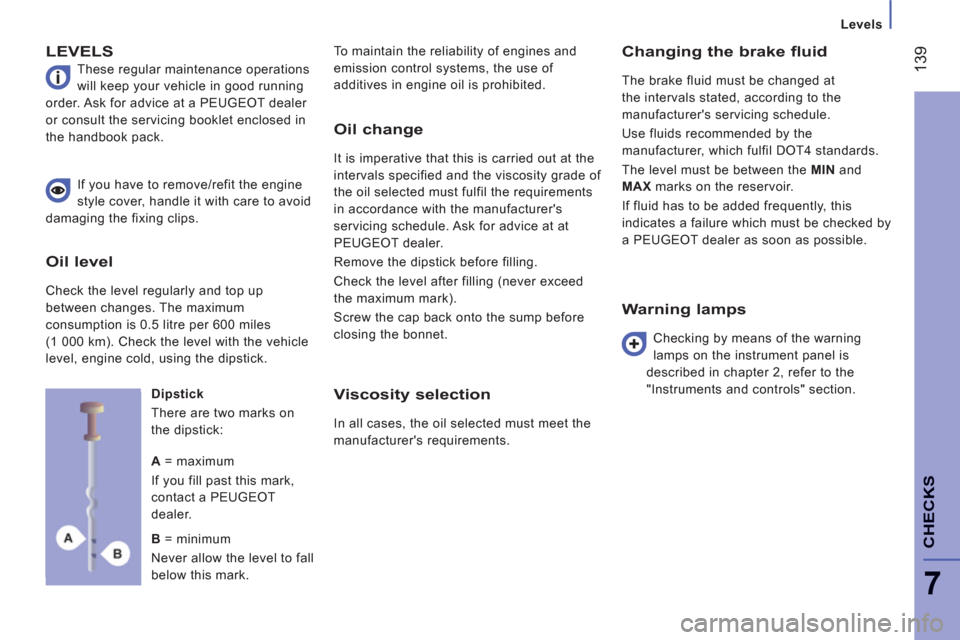
Dipstick
There are two marks on
the dipstick:
Oil change
It is imperative that this is carried out at the
intervals specified and the viscosity grade of
the oil selected must fulfil the requirements
in accordance with the manufacturer's
servicing schedule. Ask for advice at at
PEUGEOT dealer.
Remove the dipstick before filling.
Check the level after filling (never exceed
the maximum mark).
Screw the cap back onto the sump before
closing the bonnet.
Viscosity selection
In all cases, the oil selected must meet the
manufacturer's requirements.
Warning lamps
Checking by means of the warning
lamps on the instrument panel is
described in chapter 2, refer to the
"Instruments and controls" section.
A
= maximum
If you fill past this mark,
contact a PEUGEOT
dealer.
B
= minimum
Never allow the level to fall
below this mark.
Oil level
Check the level regularly and top up
between changes. The maximum
consumption is 0.5 litre per 600 miles
(1 000 km). Check the level with the vehicle
level, engine cold, using the dipstick.
Page 143 of 184

Checks
14
1
CHECK
S
7
CHECKS
Air filter and passenger compartment filter
A clogged passenger compartment filter
may reduce the performance of the
air conditioning system and generate
undesirable odours. The replacement
intervals for these components are indicated
in the servicing booklet.
Depending on the environment (dusty
atmosphere...) and the use of the vehicle
(urban driving...), change them twice as
often if necessary, refer to the "Under the
bonnet" section of chapter 7.
Manual gearbox
Have the level checked in accordance with
the manufacturer's servicing schedule.
To check the main levels and certain
components, in accordance with the
manufacturer's servicing schedule, refer to
the pages of the servicing booklet which
correspond to your vehicle's engine.
Only use products recommended by
PEUGEOT or products of equivalent quality
and specification.
In order to optimise the operation of units as
important as the braking system, PEUGEOT
selects and offers specific products.
In order to avoid damaging the electrical
units, high pressure washing to clean the
engine compartment is strictly prohibited.
Parking brake
Where the parking brake travel is too great
or there is a reduction in the performance
of the system, the parking brake should be
adjusted, even between services.
Have the system checked by a PEUGEOT
dealer. Bleeding the water contained inthe Diesel filter
If this warning lamp comes on,
bleed the filter, otherwise bleed
regularly each time the engine oil
is changed.
To drain the water out, unscrew the bleed
screw or the water in Diesel sensor, located
at the base of the filter. Leave open until
all of the water has been drained out. Then
tighten the bleed screw or the water sensor.
HDi engines use advanced technology. All
work requires a special qualification which is
guaranteed by a PEUGEOT dealer.
Battery
At the start of winter, have your battery
checked by a PEUGEOT dealer.
Brake pads
Brake pad wear depends on the style of
driving, in particular for vehicles which are
used in town, over short distances. It may
be necessary to check the thickness of the
pads, even between services.
Unless there is a leak on the system, a drop
in the brake fluid level indicates that the
brake pads are worn.
Brake disc/drum wear status
For any information relating to checking
the brake disc/drum wear status, contact a
PEUGEOT dealer.
Oil filter
Change the filter regularly, in accordance
with the servicing schedule.
The presence of this label, in particular
with the Stop & Start system, indicates the
use of a specific 12 V lead-acid battery
with special technology and specification.
The involvement of a PEUGEOT dealer
or a qualified workshop is essential when
replacing or disconnecting the battery.
Page 155 of 184
Changing a bulb
153
QUICK HELP
8
TYPES OF BULB
Various types of bulb are installed on your
vehicle. To remove them:
CHANGING A BULB
Type A Entirely glass bulb: pull gently
as it is fitted by pressure.
Type B Bayonet bulb: press on the bulb
then turn it anticlockwise.
Type C Cylindrical bulb: move aside the
contacts.
Type D - E Halogen bulb: release the
retaining spring from its
housing.
FRONT LAMPS
Open the bonnet. To access the bulbs, reach
behind the headlamp unit.
Carry out the operations in reverse order to
refit each bulb.
Page 176 of 184
174
Exterior
EXTERIOR
Rear lamps, direction indicators,
3 rd brake lamp,
foglamps 36, 47, 153, 156
Left-hand side:
fuel fi ller cap, fuel tank 144
Fuel cut-off 144
Load space 75-76
Rear doors 28
Number plate lamp 156
Parking sensors 83
Spare wheel, jack,
changing a wheel, tools,
puncture repair kit 148-152
Infl ating, pressures 173
Towing, lifting 162
Towbar, towball 133-134
Dimensions 164-170
Accessories 135-136
Roof bars 135
Brakes, pads 139, 141
ABS, Electronic brake force distribution 115
EBA 115
ASR, ESP 116-117
Tyres, pressures 173
Pneumatic suspension 86
Key, remote control, battery 21-23
Starting 41-42
Central locking 29
Confi dential card 25
Alarm 26
Wiper blade 161
Door mirror 77
Side repeater 155
Front lamps, foglamps,
direction indicators 153-155
Headlamp beam height adjustment 49
Headlamp wash 50
Changing bulbs 153-155
Opening/closing doors 27-29
Key 23
Opening the bonnet, stay 137
Mode - autoclose 81
Page 177 of 184
17
5
Instruments and controls
10
VISUAL SEARCH
INSTRUMENTS AND CONTROLS
Instrument panels, screens, speedometer 30
Warning lamps, indicator lamps 31-37
Indicators, gauge 38-39
Lighting controls 47
Automatic illumination of headlamps 48
Guide-me-home lighting 48
Parking lamps 49
Opening the bonnet 137
Fuses 157-160
Mode, vehicle confi guration 79-82
Programmable
additional heating 62-64
Additional heating,
rear air conditioning 60-61
Pneumatic suspension 86
Stop & Start 43-45
Headlamp beam height adjustment 49
Lighting dimmer 39
Setting the time 81
Front/rear wipers 50
Screenwash/headlamp wash 50
Trip computer - MODE 79-82
Starter, ignition switch 41
Hill start 42
Cruise control 51-53
Fixed speed limiter 118
Steering wheel, reach adjustment 40
Horn 115
Instruments and controls 8
Electric windows, mirrors 77-78
Locking the load space 29
Page 180 of 184
17
8
Technical data - Maintenance
Screenwash/headlamp wash, level 140
Bulbs, lighting,
changing bulbs 153-155
Opening the bonnet, stay 137
Under the bonnet 138
Identifi cation markings,
serial number,
paint, tyres 173
Changing a wiper blade 161
Levels 139-140
●
dipstick,
●
power steering fluid,
●
brake fluid,
●
coolant.
Water bleed, Diesel fi lter 141
Checks 141-142
●
battery,
●
air/passenger compartment filter,
●
oil filter,
●
parking brake,
●
particle filter,
●
brake pads.
Emission control 38
Engine fuses 157, 160
TECHNICAL DATA - MAINTENANCE
Dimensions 164-170
Weights 172


