2013 PEUGEOT 308 CC check engine
[x] Cancel search: check enginePage 140 of 268

9
i
138
CHECKS
CHECKS
Battery
The battery does not require any
maintenance.
However, check that the termi-
nals are clean and correctly tight-
ened, particularly in summer and
winter.
When carrying out work on the battery, refer to the "Battery" section for details of the pre-
cautions to be taken before disconnecting
the battery and following its reconnection.
Air filter and passenger compartment filter
Refer to the warranty and
maintenance record for details
of the replacement intervals
for these components.
Depending on the environment
(e.g. dusty atmosphere) and the use of
the vehicle (e.g. city driving), replace
them twice as often if necessary .
A clogged passenger compartment fi lter
may have an adverse effect on the per-
formance of the air conditioning system
and generate undesirable odours.
Oil filter
Replace the oil fi lter each time
the engine oil is changed.
Refer to the warranty and
maintenance record for details
of the replacement interval for
this component.
The presence of this label, in particular
with the Stop & Start system, indicates
the use of a specifi c 12 V lead-acid bat-
tery with special technology and specifi -
cation. The involvement of a PEUGEOT
dealer or a qualifi ed workshop is essen-
tial when replacing or disconnecting the
battery.
Particle emission filter (Diesel)
On a new vehicle, the fi rst particle
fi lter regeneration operations may
be accompanied by a "burning"
smell, which is perfectly normal.
Following prolonged operation of
the vehicle at very low speed or at
idle, you may, in exceptional cir-
cumstances, notice the emission
of water vapour at the exhaust on
acceleration. This does not affect
the behaviour of the vehicle or the
environment. The start of saturation of the
particle emissions fi lter is in-
dicated by the temporary illu-
mination of this warning lamp,
accompanied by an audible
signal and a message on the risk of
blockage of the particle emissions fi lter.
As soon as the traffi c conditions per-
mit, regenerate the fi lter by driving at a
speed of at least 40 mph (60 km/h) until
the warning lamp goes off.
If the warning lamp stays on, refer to the
"Additive level" section.
Unless otherwise indicated, check these
components in accordance with the war-
ranty and maintenance record and accord-
ing to your engine.
Otherwise, have them checked by a
PEUGEOT dealer or a qualifi ed workshop.
Page 146 of 268
10
!
!
144
PRACTICAL INFORMATION
Removing the cartridge
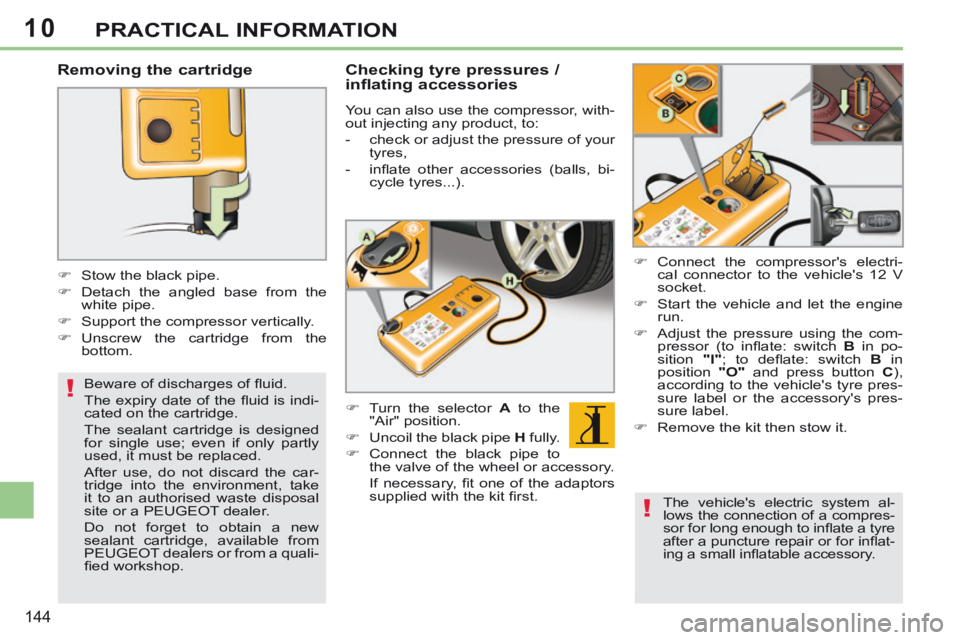
Stow the black pipe.
Detach the angled base from the white pipe.
Support the compressor vertically.
Unscrew the cartridge from the bottom.
Beware of discharges of fl uid.
The expiry date of the fl uid is indi-
cated on the cartridge.
The sealant cartridge is designed
for single use; even if only partly
used, it must be replaced.
After use, do not discard the car-
tridge into the environment, take
it to an authorised waste disposal
site or a PEUGEOT dealer.
Do not forget to obtain a new
sealant cartridge, available from
PEUGEOT dealers or from a quali-
fi ed workshop.
Checking tyre pressures /
inflating accessories
You can also use the compressor, with-
out injecting any product, to:
- check or adjust the pressure of your tyres,
- infl ate other accessories (balls, bi- cycle tyres...).
Turn the selector A to the
"Air" position.
Uncoil the black pipe H fully.
Connect the black pipe to the valve of the wheel or accessory.
If necessary, fi t one of the adaptors supplied with the kit fi rst. Connect the compressor's electri-
cal connector to the vehicle's 12 V
socket.
Start the vehicle and let the engine run.
Adjust the pressure using the com- pressor (to infl ate: switch B in po-
sition "I" ; to defl ate: switch B in
position "O" and press button C ),
according to the vehicle's tyre pres-
sure label or the accessory's pres-
sure label.
Remove the kit then stow it.
The vehicle's electric system al-
lows the connection of a compres-
sor for long enough to infl ate a tyre
after a puncture repair or for infl at-
ing a small infl atable accessory.
Page 163 of 268

10
!
i
i
!
161
PRACTICAL INFORMATION
12 V BATTERY
Access to the battery
The battery is located under the bonnet.
To gain access to it:
open the bonnet using the interior release lever, then the exterior safe-
ty catch,
secure the bonnet stay,
remove the plastic cover on the (+) terminal.
The presence of this label, in par-
ticular with the Stop & Start system,
indicates the use of a 12 V lead-acid
battery with special technology and
specifi cation; the involvement of
a PEUGEOT dealer or a qualifi ed
workshop is essential when replac-
ing or disconnecting the battery.
After refi tting the battery, the
Stop & Start system will only be
active after a continuous period of
immobilisation of the vehicle, a pe-
riod which depends on the climatic
conditions and the state of charge
of the battery (up to about 8 hours).
Procedure for starting the engine us-
ing another battery or charging a dis-
charged battery.
Before doing any work
Immobilise the vehicle: apply the
parking brake, put the gearbox into
neutral (or position
P if your ve-
hicle has an automatic gearbox),
then switch off the ignition.
Check that all electrical systems
are off.
Do not reverse the polarity and use
only a 12 V charger.
Do not disconnect the terminals
while the engine is running.
Do not charge the batteries without
disconnecting the terminals fi rst.
Ensure that the battery posts and
terminals are clean. If covered in
sulphate (white or green deposits),
remove and clean them.
The batteries contain harmful sub-
stances such as sulphuric acid and
lead. They must be disposed of in
accordance with regulations and
must not, in any circumstances, be
discarded with household waste.
Take used remote control batteries
and vehicle batteries to a special
collection point.
Page 164 of 268
10
i
!
162
PRACTICAL INFORMATION
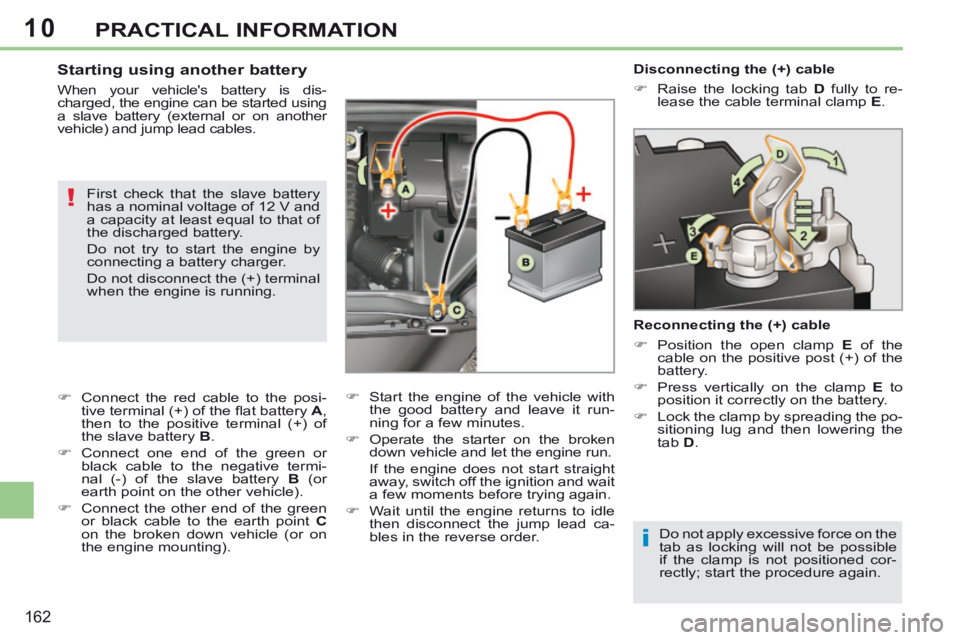
Disconnecting the (+) cable
Raise the locking tab D fully to re-
lease the cable terminal clamp E .
Reconnecting the (+) cable
Position the open clamp E of the
cable on the positive post (+) of the
battery.
Press vertically on the clamp E to
position it correctly on the battery.
Lock the clamp by spreading the po- sitioning lug and then lowering the
tab D .
Do not apply excessive force on the
tab as locking will not be possible
if the clamp is not positioned cor-
rectly; start the procedure again. Starting using another battery
When your vehicle's battery is dis-
charged, the engine can be started using
a slave battery (external or on another
v ehicle) and jump lead cables. First check that the slave battery
has a nominal voltage of 12 V and
a capacity at least equal to that of
the discharged battery.
Do not try to start the engine by
connecting a battery charger.
Do not disconnect the (+) terminal
when the engine is running.
Connect the red cable to the posi- tive terminal (+) of the fl at battery A ,
then to the positive terminal (+) of
the slave battery B .
Connect one end of the green or black cable to the negative termi-
nal (-) of the slave battery B (or
earth point on the other vehicle).
Connect the other end of the green or black cable to the earth point C
on the broken down vehicle (or on
the engine mounting). Start the engine of the vehicle with
the good battery and leave it run-
ning for a few minutes.
Operate the starter on the broken down vehicle and let the engine run .
If the engine does not start straight away, switch off the ignition and wait
a few moments before trying again.
Wait until the engine returns to idle then disconnect the jump lead ca-
bles in the reverse order.
Page 169 of 268
10
i
i
167
PRACTICAL INFORMATION
TOWING A TRAILER
Your vehicle is primarily designed for
transporting people and luggage, but it
may also be used for towing a trailer. Distribution of loads
Distribute the load in the trailer so
that the heaviest items are as close
as possible to the axle and the nose
weight approaches the maximum
permitted without exceeding it.
Air density decreases with altitude, thus
reducing engine performance. Above
1000 metres, the maximum towed load
must be reduced by 10 % for every
1000 metres of altitude.
Refer to the "Technical data" section for
details of the weights and towed loads
which apply to your vehicle.
Side wind
Take into account the increased sensitivity to side wind.
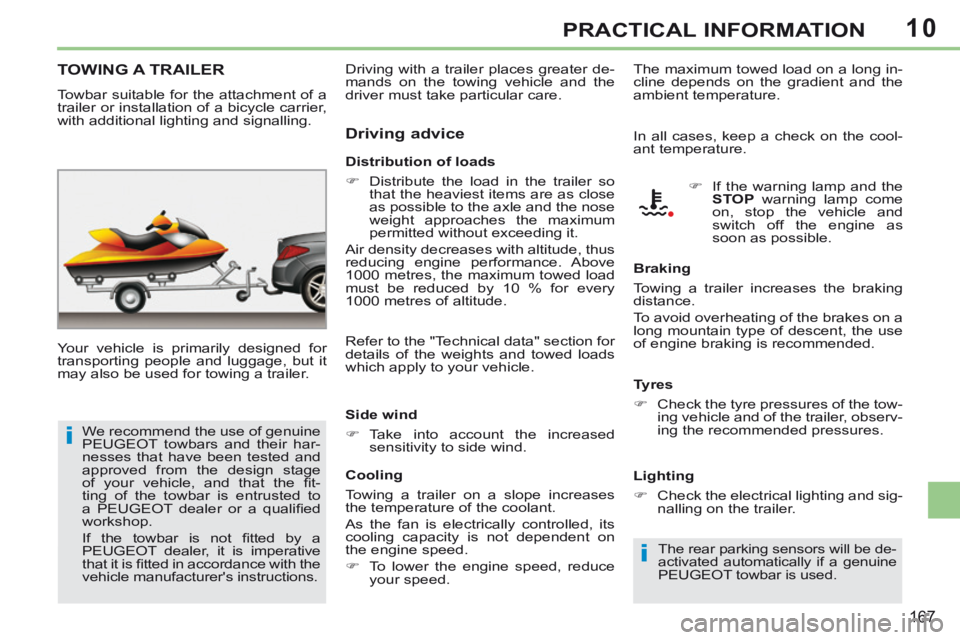
Towbar suitable for the attachment of a
trailer or installation of a bicycle carrier,
with additional lighting and signalling.
Driving advice
We recommend the use of genuine
PEUGEOT towbars and their har-
nesses that have been tested and
approved from the design stage
of your vehicle, and that the fi t-
ting of the towbar is entrusted to
a PEUGEOT dealer or a qualifi ed
workshop.
If the towbar is not fi tted by a
PEUGEOT dealer, it is imperative
that it is fi tted in accordance with the
vehicle manufacturer's instructions. Driving with a trailer places greater de-
mands on the towing vehicle and the
driver must take particular care.
In all cases, keep a check on the cool-
ant temperature.
Braking
Towing a trailer increases the braking
distance.
To avoid overheating of the brakes on a
long mountain type of descent, the use
of engine braking is recommended.
Tyres
Check the tyre pressures of the tow-ing vehicle and of the trailer, observ-
ing the recommended pressures.
Lighting
Check the electrical lighting and sig- nalling on the trailer.
The rear parking sensors will be de-
activated automatically if a genuine
PEUGEOT towbar is used.
If the warning lamp and the STOP warning lamp come
on, stop the vehicle and
switch off the engine as
soon as possible.
The maximum towed load on a long in-
cline depends on the gradient and the
ambient temperature.
Cooling
Towing a trailer on a slope increases
the temperature of the coolant.
As the fan is electrically controlled, its
cooling capacity is not dependent on
the engine speed.
To lower the engine speed, reduce your speed.
Page 257 of 268
255
VISUAL SEARCH
TECHNICAL DATA - MAINTENANCE
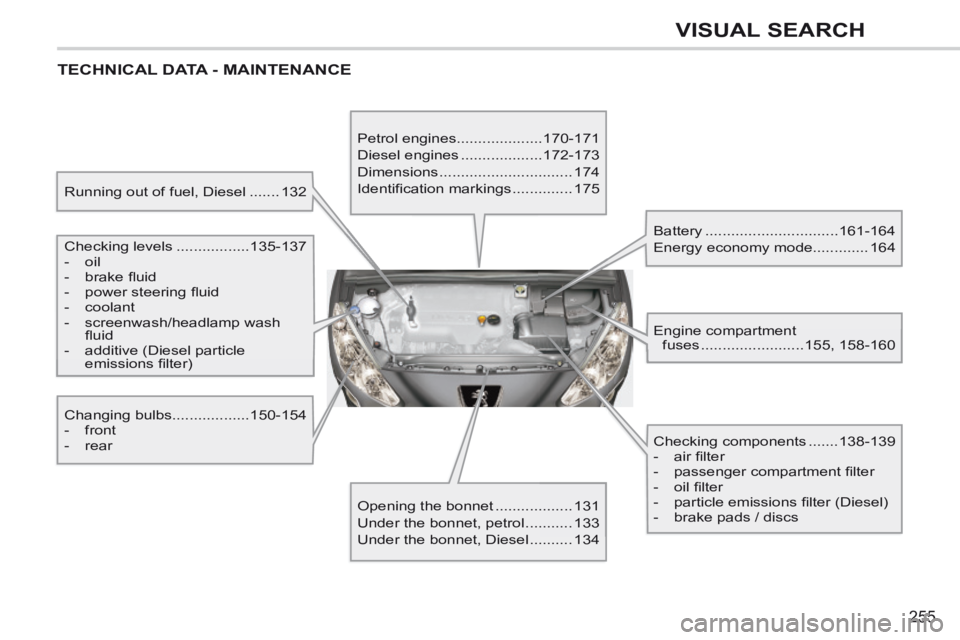
Running out of fuel, Diesel .......132
Checking levels ................. 135-137
- oil
- brake fl uid
- power steering fl uid
- coolant
- screenwash/headlamp wash fl uid
- additive (Diesel particle emissions fi lter)
Changing bulbs ..................150-154
- front
- rear Petrol engines
....................170-171
Diesel engines ................... 172-173
Dimensions ............................... 174
Identification markings .............. 175
Opening the bonnet .................. 131
Under the bonnet, petrol ........... 133
Under the bonnet, Diesel .......... 134 Battery ...............................
161-164
Energy economy mode .............164
Engine compartment fuses ........................ 155, 158-160
Checking components ....... 138-139
- air fi lter
- passenger compartment fi lter
- oil fi lter
- particle emissions fi lter (Diesel)
- brake pads / discs
Page 258 of 268

256
ALPHABETICAL INDEX
ABS and EBFD systems ..................94
Accessories ....................................168
Accessory socket, 12V .....................89
Access to rear seats .........................55
Adjusting headlamps ........................80
Adjusting the steering wheel ............60
Airbags ...........................................100
Airbags, front ..........................100, 103
Airbags, lateral .......................102, 103
Air conditioning .....................19, 46, 48
Air conditioning, digital .....................48
Air filter ...........................................Air filter ...........................................Air filter138
Air flow ..............................................45
Air vents ...........................................45
Alarm ................................................66
Anti-lock braking system (ABS) ........94
Antipatinage des roues (ASR) ..........26
Anti-swirl net .....................................50
Anti-theft ...........................................63
Armrest, front ....................................88
Armrest, rear ....................................Armrest, rear ....................................Armrest, rear57
Ashtray .............................................89
Assistance call ..................94, 177, 178
Audible warning ................................93
Audio streaming (Bluetooth) ...218, 245
Audio systems ................................179
Automatic illumination of headlamps ..........................76, 79
Automatic operation of hazard warning lamps ..............93
Battery .............................138, 161-163
Battery, charging ............................163
Battery, remote control ...............64, 65
Bluetooth (hands-free) ............202, 243
Bluetooth (telephone) .............202, 243
Bonnet ............................................131
Bonnet stay ....................................131
Boot ..................................................73
Boot (fittings) ...............................91-92
Boot lamp .........................................85
Boot (opening) ..................................61
Boot screen ......................................92
Brake discs .....................................139
Brake lamps ...................................153
Brake pads .....................................139
Braking assistance system ...............94
Cabriolet (configuration) ........6, 46, 48, 50, 56, 66, 73, 87, 88, 92, 97
Capacity, fuel tank ............................74
CD MP3 ..................................215, 239
Central locking ..................................71
Changing a bulb ......................150-154
Changing a fuse ......................155-160
Automatic rain sensitive windscreen wipers ..................82, 83
Auxiliary sockets .............219, 240, 241
A
B
C
Changing a wheel....................145-148
Changing a wiper blade ...........84, 165
Changing the date ......................41, 43
Changing the remote control battery ..............................64
Changing the time ......................41, 43
CHECK .............................................35
Checking levels .......................135-137
Checking the engine oil level .................................32, 135
Checking tyre pressures (using the kit) .............................144
Checks.....................................133-139
Children ...................................109-113
Child seats ..............................104-113
Child seats, conventional ..........99, 101, 104-113
Closing the boot ...............................73
Closing the doors .............................70
Closing the retractable roof ................Closing the retractable roof ................Closing the retractable roof6
Cold climate screen ........................168
Colour screen, retractable ...........42-44
Connectors, audio ....................88, 219, 240, 241
Control for retractable roof .................Control for retractable roof .................Control for retractable roof6
Control for the four windows ............68
Coolant level .............................31, 136
Coolant temperature indicator ........................................indicator ........................................indicator31
Courtesy lamps ................................84
Courtesy mirror .................................Courtesy mirror .................................Courtesy mirror87
Cruise control .................................126