2013 PEUGEOT 308 CC ECU
[x] Cancel search: ECUPage 133 of 268
9
i
!
!
!
131
CHECKS
BONNET
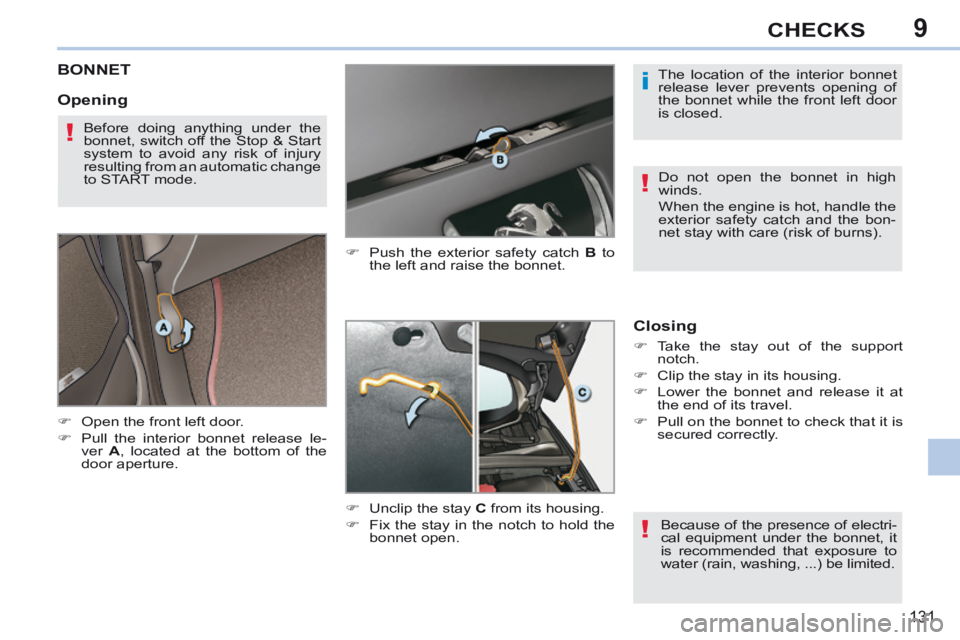
Open the front left door.
Pull the interior bonnet release le-ver A , located at the bottom of the
door aperture. Push the exterior safety catch
B to
the left and raise the bonnet.
Closing
Take the stay out of the support notch.
Clip the stay in its housing.
Lower the bonnet and release it at the end of its travel.
Pull on the bonnet to check that it is secured correctly.
Opening
The location of the interior bonnet
release lever prevents opening of
the bonnet while the front left door
is closed.
Do not open the bonnet in high
winds.
When the engine is hot, handle the
exterior safety catch and the bon-
net stay with care (risk of burns).
Before doing anything under the
bonnet, switch off the Stop & Start
system to avoid any risk of injury
resulting from an automatic change
to START mode.
Unclip the stay C from its housing.
Fix the stay in the notch to hold the bonnet open. Because of the presence of electri-
cal equipment under the bonnet, it
is recommended that exposure to
water (rain, washing, ...) be limited.
Page 147 of 268

10
i
145
PRACTICAL INFORMATION
CHANGING A WHEEL
Procedure for changing a faulty wheel
for the spare wheel using the tools pro-
vided with the vehicle.
The tools are installed in the boot under
the fl oor.
For access to them:
change to the "coupé" confi guration,
open the boot,
raise the fl oor,
secure it by hooking its handle on the boot seal,
unclip and remove the box contain- ing the tools. All of these tools are specifi c to your
vehicle. Do not use them for other
purposes.
1. Wheelbrace.
For removing the wheel trim and
the wheel fi xing bolts.
2. Jack with integral handle.
For raising the vehicle.
3. Bolt cover removal tool.
For removing the bolt fi nishers (covers) on alloy wheels.
4. Socket for the security bolts (lo- cated in the glove box).
For adapting the wheelbrace to the special "security" bolts.
List of tools
Access to the tools
Wheel with trim
When removing the wheel , detach the trim fi rst using the wheelbrace
1 pull-
ing at the valve passage hole.
When refi tting the wheel , refi t the trim starting by placing its notch facing the
valve and press around its edge with the palm of your hand.
Page 148 of 268

10
i
i
146
PRACTICAL INFORMATION
Fitting the steel spare wheel
If your vehicle is fi tted with alloy
wheels, it is normal to notice, when
tightening the bolts on fi tting, that
the washers do not come into con-
tact with the steel spare wheel. The
wheel is secured by the conical
contact of each bolt.
Access to the spare wheel
The spare wheel is installed in the boot
under the fl oor.
According to country, the spare wheel
may be steel or alloy.
For access to it, refer to the paragraph
"Access to the tools". Taking out the wheel
Unscrew the yellow central bolt.
Raise the spare wheel towards you
from the rear.
Take the wheel out of the boot.
Putting the wheel back in place
Put the wheel back in its housing.
Unscrew the yellow central bolt by a few turns then put it in place in the
centre of the wheel.
Tighten fully until the central bolt clicks to retain the wheel correctly.
Put the box back in place in the c entre of the wheel and clip it.
Tyre under-infl ation detection
The spare wheel is not fi tted with a
sensor. The punctured wheel must
be repaired by a PEUGEOT dealer
or a qualifi ed workshop.
Page 149 of 268

10
i
147
PRACTICAL INFORMATION
Parking the vehicle
Immobilise the vehicle where it
does not block traffi c: the ground
must be level, stable and non-
slippery ground.
Apply the parking brake, switch off
the ignition and engage fi rst gear *
to lock the wheels.
If necessary, place a chock under
the wheel diagonally opposite the
wheel to be changed.
It is imperative that you ensure that
the occupants get out of the ve-
hicle and wait where they are safe.
Never go underneath a vehicle
raised using a jack; use an axle
stand.
Removing a wheel List of operations
Remove the bolt cover from each of the bolts using the tool 3 .
Fit the security socket 4 on the
wheelbrace 1 to slacken the security
bolt.
Slacken the other bolts using the wheelbrace 1 only.
Place the jack 2 in contact with one
of the two front A or rear B locations
provided on the underbody, which-
ever is closest to the wheel to be
changed.
Extend the jack 2 until its base plate
is in contact with the ground. Ensure
that the centreline of the jack base
plate is directly below the location A
or B used.
Raise the vehicle until there is suf- fi cient space between the wheel and
the ground to admit the spare (not
punctured) wheel easily.
Remove the bolts and store them in a clean place.
Remove the wheel.
* position P for the automatic gearbox.
Page 150 of 268

10
i
148
PRACTICAL INFORMATION
After changing a wheel
To store the punctured wheel in the
boot correctly, fi rst remove the cen-
tral cover.
Have the tightening of the bolts and
the pressure of the spare wheel
checked by a PEUGEOT dealer or
a qualifi ed workshop without delay.
Have the punctured wheel repaired
without delay and replace it on the
vehicle as soon as possible.
When the spare wheel is different
from the other wheels, we strongly
recommend that your drive with
particular care.
Fitting a wheel List of operations
Put the wheel in place on the hub.
Screw in the bolts by hand.
Pre-tighten the security bolt using the wheelbrace 1 fi tted with the se-
curity socket 4 .
Pre-tighten the other bolts using the wheelbrace 1 only.
Lower the vehicle fully.
Fold the jack 2 and detach it.
Tighten the security bolt using the wheelbrace 1 fi tted with the security
socket 4 .
Tighten the other bolts using the wheelbrace 1 only.
Refi t the bolt covers on each of the bolts.
Store the tools in the box.
Page 163 of 268

10
!
i
i
!
161
PRACTICAL INFORMATION
12 V BATTERY
Access to the battery
The battery is located under the bonnet.
To gain access to it:
open the bonnet using the interior release lever, then the exterior safe-
ty catch,
secure the bonnet stay,
remove the plastic cover on the (+) terminal.
The presence of this label, in par-
ticular with the Stop & Start system,
indicates the use of a 12 V lead-acid
battery with special technology and
specifi cation; the involvement of
a PEUGEOT dealer or a qualifi ed
workshop is essential when replac-
ing or disconnecting the battery.
After refi tting the battery, the
Stop & Start system will only be
active after a continuous period of
immobilisation of the vehicle, a pe-
riod which depends on the climatic
conditions and the state of charge
of the battery (up to about 8 hours).
Procedure for starting the engine us-
ing another battery or charging a dis-
charged battery.
Before doing any work
Immobilise the vehicle: apply the
parking brake, put the gearbox into
neutral (or position
P if your ve-
hicle has an automatic gearbox),
then switch off the ignition.
Check that all electrical systems
are off.
Do not reverse the polarity and use
only a 12 V charger.
Do not disconnect the terminals
while the engine is running.
Do not charge the batteries without
disconnecting the terminals fi rst.
Ensure that the battery posts and
terminals are clean. If covered in
sulphate (white or green deposits),
remove and clean them.
The batteries contain harmful sub-
stances such as sulphuric acid and
lead. They must be disposed of in
accordance with regulations and
must not, in any circumstances, be
discarded with household waste.
Take used remote control batteries
and vehicle batteries to a special
collection point.
Page 167 of 268
10
i
165
PRACTICAL INFORMATION
CHANGING A WIPER BLADE
Removing
Raise the corresponding wiper arm.
Unclip the wiper blade and remove it.
Fitting
Put the corresponding new wiper blade in place and clip it.
Fold down the wiper arm carefully.
Before removing a front wiper
blade
Within one minute after switching off the ignition, operate the wiper stalk
to position the wiper blades verti-
cally on the windscreen.
After fitting a front wiper blade
Switch on the ignition.
Operate the wiper stalk again to park the wiper blades.
TOWING THE VEHICLE
Procedure for having your vehicle
towed or for towing another vehicle us-
ing a removable towing eye.
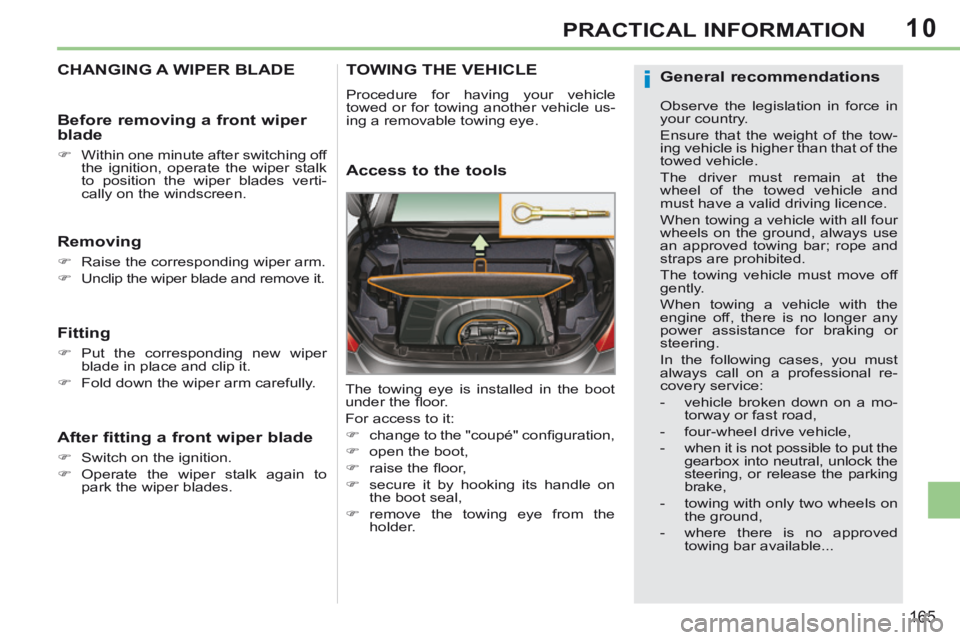
Access to the tools
The towing eye is installed in the boot
under the fl oor.
For access to it:
change to the "coupé" confi guration,
open the boot,
raise the fl oor,
secure it by hooking its handle on the boot seal,
remove the towing eye from the holder.
General recommendations
Observe the legislation in force in
your country.
Ensure that the weight of the tow-
ing vehicle is higher than that of the
towed vehicle.
The driver must remain at the
wheel of the towed vehicle and
must have a valid driving licence.
When towing a vehicle with all four
wheels on the ground, always use
an approved towing bar; rope and
straps are prohibited.
The towing vehicle must move off
gently.
When towing a vehicle with the
engine off, there is no longer any
power assistance for braking or
steering.
In the following cases, you must
a lways call on a professional re-
covery service:
- vehicle broken down on a mo-torway or fast road,
- four-wheel drive vehicle,
- when it is not possible to put the gearbox into neutral, unlock the
steering, or release the parking
brake,
- towing with only two wheels on the ground,
- where there is no approved towing bar available...
Page 170 of 268

10
i
!
168
PRACTICAL INFORMATION
VERY COLD CLIMATE SCREEN *
Removable protective screen which
prevents the accumulation of snow at
the radiator cooling fan.
Fitting
Offer up the very cold climate screen to the front of the lower section of
the front bumper.
Press around its edge to engage its fi xing clips one by one.
Do not forget to remove the very
cold climate screen when:
- the ambient temperature ex- ceeds 10 °C,
- towing,
- driving at speeds above 75 mph (120 km/h).
* According to country.
Removal
Use a screwdriver as a lever to release each fi xing clip in turn. "Comfort":
windstop, cover for windstop, reading
lamp, parking sensors...
"Transport solutions":
boot liner, towbar-mounted bicycle car-
rier, towbars, towbar wiring harnesses...
ACCESSORIES
A wide range of accessories and
genuine parts is available from the
PEUGEOT dealer network.
These accessories and parts have
been tested and approved for reliability
and safety.
They are all adapted to your vehicle and
benefi t from PEUGEOT's recommenda-
tion and warranty. "Styling":
alloy wheels, front spoiler, gear lever
knobs...
"Safety and security":
anti-theft alarm, security wheel bolts,
breathalyser, fi rst aid kit, warning tri-
angle, high visibility vest, stolen vehicle
tracking system, child booster cush-
ions, winter equipment...
** To avoid any risk of jamming of the
pedals:
- ensure that the mat is positioned and secured correctly,
- never fi t one mat on top of another.
"Protection":
mats ** , bumper protection strips, vehicle
protective cover...
When fi tting a towbar and its wir-
ing harness outside the PEUGEOT
dealer network, this fi tment must
be done following the vehicle man-
ufacturer's recommendations.