2013 PEUGEOT 308 CC stop start
[x] Cancel search: stop startPage 40 of 268

1
!
i
i
38
MONITORING
Trip computer, a few definitions
When the range falls below 20 miles
(30 km), dashes are displayed. After fi ll-
ing with at least 5 litres of fuel, the range
is recalculated and is displayed when it
exceeds 60 miles (100 km). If dashes are displayed continu-
ously while driving in place of the
digits, contact a PEUGEOT dealer
or a qualifi ed workshop. This function is only displayed from
20 mph (30 km/h).
This value may vary following a
change in the style of driving or
the relief, resulting in a signifi cant
change in the current fuel con-
sumption. Range
(miles or km)
The distance which can still
be travelled with the fuel re-
maining in the tank (related to the aver-
age fuel consumption over the last few
miles (kilometres) travelled). Current fuel consumption
(mpg or l/100 km or km/l)
Calculated over the last few
seconds.
Average fuel
consumption
(mpg or l/100 km or km/l)
Calculated since the last trip
computer reset. Distance travelled
(miles or km)
Calculated since the last trip
computer reset.
Average speed
(mph or km/h)
Calculated since the last trip
computer reset. Stop & Start time
counter
(minutes / seconds or hours /
minutes)
If your vehicle is fi tted with Stop & Start,
a time counter calculates the time spent
in STOP mode during a journey.
It resets to zero every time the ignition
is switched on with the key.
Page 48 of 268
3
i
i
46
COMFORT
The condensation created by the
air conditioning results in a dis-
charge of water under the vehicle
which is perfectly normal.
RECOMMENDATIONS FOR VENTILATION AND AIR CONDITIONING
In order for these systems to be fully effective, follow the guidelines on opera-
tion and maintenance below:
To obtain an even air distribution, take care not to obstruct the exterio\
r air intake grilles located at the base of the windscreen, the nozzles, the v\
ents
and the air outlets, as well as the air extractor located in the boot.
Do not cover the sunshine sensor, located on the dashboard; this is used for regulation of the air conditioning system.
Operate the air conditioning system for at least 5 minutes, once or twic\
e a month to keep it in perfect working order.
Ensure that the passenger compartment fi lter is in good condition and have the fi lter elements replaced regularly (refer to the "Checks" section).
We recommend the use of a combined passenger compartment fi lter. Thanks to its second special active fi lter, it contributes to the purifi cation
of the air breathed by the occupants and the cleanness of the passenger \
compartment (reduction of allergic symptoms, bad odours and greasy de-
posits).
To ensure correct operation of the air conditioning system, you are also \
advised to have it checked regularly, as recommended in the warranty and
maintenance record.
If the system does not produce cold air, switch it off and contact a PEUGEOT dealer or a qualifi ed workshop.
In the "cabriolet" confi guration, installing the windstop and using the
"AIRWAVE" systems improves comfort.
When towing the maximum load on a steep gradient in high temperatures,
switching off the air conditioning permits the recovery of engine power and
therefore improvement of the towing capacity. If the interior temperature remains
very high after the vehicle has been
parked in the sun for a considerable
time, fi rst ventilate the passenger
compartment for a few minutes.
Place the air fl ow control at a suf-
fi cient level to provide an adequate
renewal of air in the passenger com-
partment.
The air conditioning system does not
contain chlorine and does not pres-
ent any danger to the ozone layer.
Stop & Start
The heating and air conditioning systems only work when the engine is ru\
n-
ning. To maintain a comfortable temperature in the passenger compartment,
you can temporarily deactivate the Stop & Start system (see the corresp\
ond-
ing section).
Page 50 of 268

3
ii
i
48
COMFORT
When the engine is cold, to prevent
too great a distribution of cold air,
the air fl ow will reach its optimum
level gradually.
In cold weather, it favours the dis-
tribution of warm air to the wind-
screen, side windows and footwells
only. On entering the vehicle, if the in-
terior temperature is much colder
or warmer than the comfort value,
there is no need to change the
value displayed in order to obtain
the comfort required. The system
corrects the difference in tempera-
ture automatically and as quickly
as possible.
The air conditioning can only operate
with the engine running. The driver and front passen-
ger can each adjust the tem-
perature to their requirements.
Turn control 2 or 3 to the left or to
the right respectively to decrease or
increase this value.
A setting around the value 21 provides
optimum comfort. However, depend-
ing on your requirements, a setting be-
tween 18 and 24 is normal.
You are advised to avoid a left / right
setting difference of more than 3. 4. Automatic visibility programme
The automatic comfort pro-
gramme may not be suffi cient
to quickly demist or defrost
the windscreen and side win-
dows (humidity, several pas-
sengers, ice, etc.).
In this case, select the automatic visibility programme.
The system automatically controls the
air conditioning, the air fl ow and the air
intake and provides optimum distribu-
tion of the ventilation to the windscreen
and side windows.
Automatic operation
Press the "AUTO" button.
The indicator lamp in the
button comes on. 2. Driver's side adjustment
DUAL-ZONE DIGITAL AIR CONDITIONING
We recommend the use of this mode:
it permits automatic and optimised ad-
justment of all of the functions, passen-
ger compartment temperature, air fl ow,
air distribution and air recirculation, in
accordance with the comfort value that
you have chosen.
This system is designed to operate effec-
tively in all seasons, with automatic adap-
tation in the "cabriolet" confi guration. The value indicated on the display cor-
responds to a level of comfort and not
to a temperature in degrees Celsius or
Fahrenheit.
To switch it off, press the "visibility"
button again or press the "AUTO"
button, the indicator lamp in the but-
ton goes off and the indicator lamp
in the "AUTO" button comes on.
1. Automatic comfort programme
3. Passenger's side adjustment
With Stop & Start, when demist-
ing has been activated, the STOP
mode is not available.
Page 58 of 268

3
i!
i
56
COMFORT
Controlling the "AIRWAVE" system
When the engine is running, the "AIRWAVE"
system, located in the head restraint of each
front seat, can be controlled separately to
produce heated blown air directed towards
the neck of each occupant.
Heated seats control
With the engine running, the front seats
can be heated separately.
Use the adjustment dial, placed on
the side of each front seat, to switch
on and select the level of heating re-
quired:
0 : Off.
1 : Low.
2 : Medium.
3 : High.
Use the corresponding adjustment dial, placed on the centre console,
to set the temperature and fl ow of
blown air required:
0: Off.
1: Low.
2: Medium.
3: High. Use the direction dial, placed on
each vent, to direct the output of the
blown air upwards, to the centre or
downwards.
When the control is activated, the
blown air arrives progressively to
reach a comfortable temperature. Do not use the "AIRWAVE" system
if a child seat is installed on the
front passenger seat.
In STOP mode of Stop & Start, the
"AIRWAVE" system stops working.
Page 65 of 268

4
!
i
63
ACCESS
Locating your vehicle
Press the closed padlock to locate your locked ve-
hicle in a car park.
Electronic engine immobiliser
The key contains an electronic chip
which has a special code. When the
ignition is switched on, this code must
be recognised in order for starting to be
possible.
This electronic engine immobiliser locks
the engine management system a few
minutes after the ignition is switched off
and prevents starting of the engine by
anyone who does not have the key.
Anti-theft protection
In the event of a fault, you are
informed by illumination of this
warning lamp, an audible signal
and a message in the screen.
In this case, your vehicle will not start;
contact a PEUGEOT dealer as soon as
possible.
This is indicated by lighting of the cour-
tesy lamps and side spotlamps and
fl ashing of the direction indicators for a
few seconds.
Starting the vehicle
Insert the key in the ignition switch.
The system recognises the starting
code.
Turn the key fully towards the dash- board to position 3 (Starting) .
When the engine starts, release the key.
Switching the vehicle off
Immobilise the vehicle.
Turn the key fully towards you to po-sition 1 (Stop) .
Remove the key from the ignition switch.
Switching off the engine leads to a
loss of braking assistance.
Keep safely, away from your vehicle,
the label attached to the keys given to
you on acquisition of the vehicle. If the key has been left in the igni-
tion switch at position
2 (Ignition
on) , the ignition will be switched off
automatically after one hour.
To switch the ignition back on, turn
the key to position 1 (Stop) , then
back to position 2 (Ignition on) .
Key left in the "Ignition on" position
On opening the driver's door, an alert
message is displayed, accompanied by
an audible signal, to remind you that the
key is still in the ignition switch at posi-
tion
1 (Stop) .
Page 67 of 268

4
!
65
ACCESS
Lost keys
Go to a PEUGEOT dealer with the vehicle's registration document, your
p ersonal identifi cation documents and if possible the key code label.
The PEUGEOT dealer will be able to look up the key code and the transpon-
der code required to order a new key. Do not throw the remote control
batteries away, they contain metals
which are harmful to the environ-
ment.
Take them to an approved collec-
tion point.
Remote control
The high frequency remote control is a sensitive system; do not operate \
it while it is in your
pocket as there is a possibility that it may unlock the vehicle, without\
you being aware of it.
Do not repeatedly press the buttons of your remote control out of range \
and out of sight of
your vehicle. You run the risk of stopping it from working and the remote control would have
to be reinitialised.
No remote control can operate when the key is in the ignition switch, ev\
en when the ignition
is switched off, except for reinitialisation.
Locking the vehicle
Driving with the doors locked may make access to the passenger compart-
ment by the emergency services more diffi cult in an emergency.
As a safety precaution, never leave children alone in the vehicle, except for a
very short period.
In all cases, it is essential to remove the key from the ignition switch\
when
leaving the vehicle.
Anti-theft protection
Do not make any modifi cations to the electronic engine immobiliser system;
this could cause malfunctions.
When purchasing a second-hand vehicle
Have the pairing of all of the keys in your possession checked by a PEUGEOT
dealer, to ensure that only your keys can be used to open and start the vehicl\
e.
Page 76 of 268

4
i
!
74
ACCESS
The key cannot be removed from
the lock until the cap is put back on
the tank.
Opening the cap may trigger an
inrush of air. This vacuum, which
is completely normal, is caused by
the sealing of the fuel system.
FUEL TANK
To fi ll the tank safely:
the engine must be switched off,
open the fuel fi ller fl ap,
insert the key in the cap, then turn it to the left,
When refuelling is complete:
put the cap back in place,
turn the key to the right, then re- move it from the cap,
close the fi ller fl ap. remove the cap and secure it on the hook, located on the inside of the
fl ap,
fi ll the tank, but do not continue af-
ter the 3rd cut-off of the nozzle ;
this could cause malfunctions.
Capacity of the tank: approximately
60 litres.
Refuelling
A label affi xed to the inside of the fi ller
fl ap reminds you of the type of fuel to be
used according to your engine.
More than 5 litres of fuel must be add-
ed in order to be registered by the fuel
gauge.
When the low fuel level is reached,
this warning lamp comes on in the
instrument panel, accompanied by
an audible signal and a message in
the multifunction screen. When the lamp fi rst
comes on, there is approximately 6 litres of
fuel remaining.
Until suffi cient fuel has been added, this
warning lamp appears every time the ignition
is switched on, accompanied by an audible
signal and a message. When driving, this au-
dible signal and message are repeated with
increasing frequency, as the fuel level drops
towards "0" .
Operating fault
A malfunction of the fuel gauge is indi-
cated by the return to zero of the fuel
gauge needle.
Have it checked by a PEUGEOT dealer
or a qualifi ed workshop. With Stop & Start, never refuel with
the system in STOP mode; you
must switch off the ignition with the
key.
Low fuel level
You must refuel to avoid running out of
fuel.
If you run out of fuel (Diesel), refer also
to the "Checks" section.
Page 116 of 268
8
!
i
!
11 4
DRIVING
When parking on a slope, direct
your wheels against the pavement,
apply the parking brake and en-
gage a gear. PARKING BRAKE
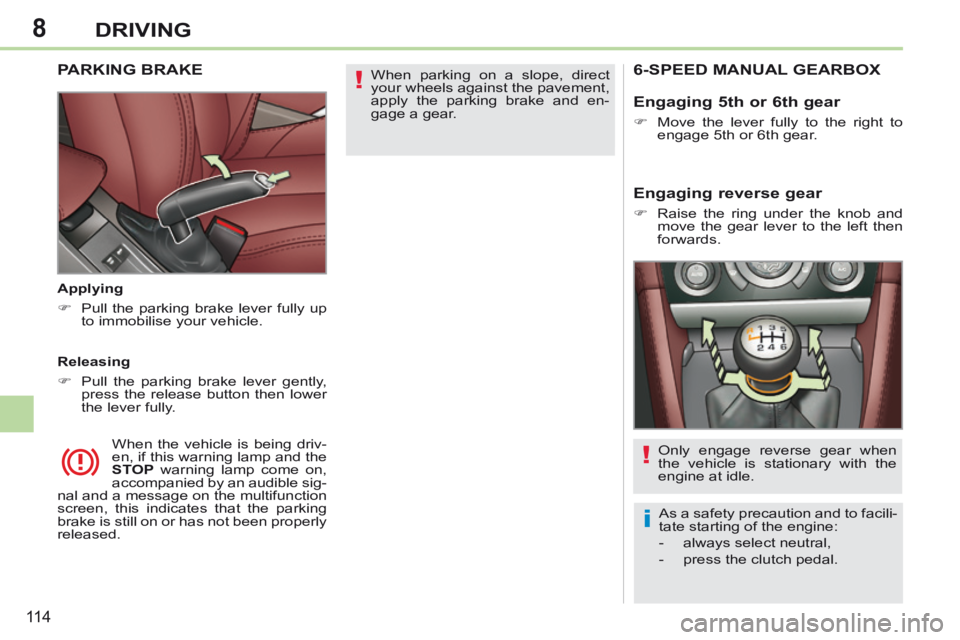
Applying
Pull the parking brake lever fully up to immobilise your vehicle.
When the vehicle is being driv-
en, if this warning lamp and the
STOP warning lamp come on,
accompanied by an audible sig-
nal and a message on the multifunction
screen, this indicates that the parking
brake is still on or has not been properly
released. Releasing
Pull the parking brake lever gently, press the release button then lower
the lever fully.
6-SPEED MANUAL GEARBOX
As a safety precaution and to facili-
tate starting of the engine:
- always select neutral,
- press the clutch pedal.
Only engage reverse gear when
the vehicle is stationary with the
engine at idle.
Engaging reverse gear
Raise the ring under the knob and
move the gear lever to the left then
forwards.
Engaging 5 th or 6 th gear
Move the lever fully to the right to engage 5 th or 6 th gear.