2013 PEUGEOT 3008 service
[x] Cancel search: servicePage 78 of 352
AC
C
Lost keys
Visit a PEUGEOT dealer with the vehicle's registration document, your
personal identifi cation documents and if possible the key code label.
The PEUGEOT dealer will be able to look up the key code and the transponder
code required to order a new key.
Do not throw the remote con-
trol batteries away, they con-
tain metals which are harmful
to the environment.
Take them to an approved collection
point.
Remote control
The high frequency remote control is a sensitive system; do not operate it while it is in your
pocket as there is a possibility that it may unlock the vehicle, without you being aware of it.
Do not repeatedly press the buttons of your remote control out of range and
out of sight of your vehicle. You run the risk of stopping it from working and the
remote control would have to be reinitialised.
No remote control can operate when the key is in the ignition switch, even when
the ignition is switched off, except for reinitialisation.
Locking the vehicle
Driving with the doors locked may make access to the passenger compartment
by the emergency services more diffi cult in an emergency.
However, the vehicle unlocks automatically in the event of a serious impact
causing airbag deployment.
As a safety precaution, never leave children alone in the vehicle, except for a
very short period.
In all cases, it is essential to remove the key from the ignition switch when leaving
the vehicle.
Anti-theft protection
Do not make any modifi cations to the electronic engine immobiliser system; this
could cause malfunctions.
When purchasing a second-hand vehicle
Have the pairing of all of the keys in your possession checked by a PEUGEOT
dealer, to ensure that only your keys can be used to open and start the ve-
hicle.
Page 79 of 352
77
AC
C
ALARM
System which protects and provides a
deterrent against the theft of your vehi-
cle. It provides two types of protection,
exterior and interior, as well as an anti-
tamper function.
Locking the vehicle with fullalarm
Do not make any modifi ca-
tions to the alarm system, this
could cause malfunctions.
To be effective, this deactiva-
tion must be carried out each
time the ignition is switched
off.
Reactivation of the interior
volumetric protection
)
Unlock the vehicle using the unlock-
ing button on the remote control.
)
Relock the vehicle using the remote
control.
The alarm is activated again with both
types of protection; the indicator lamp in
button A
switches off.
Locking the vehicle with exterior protection alarm only
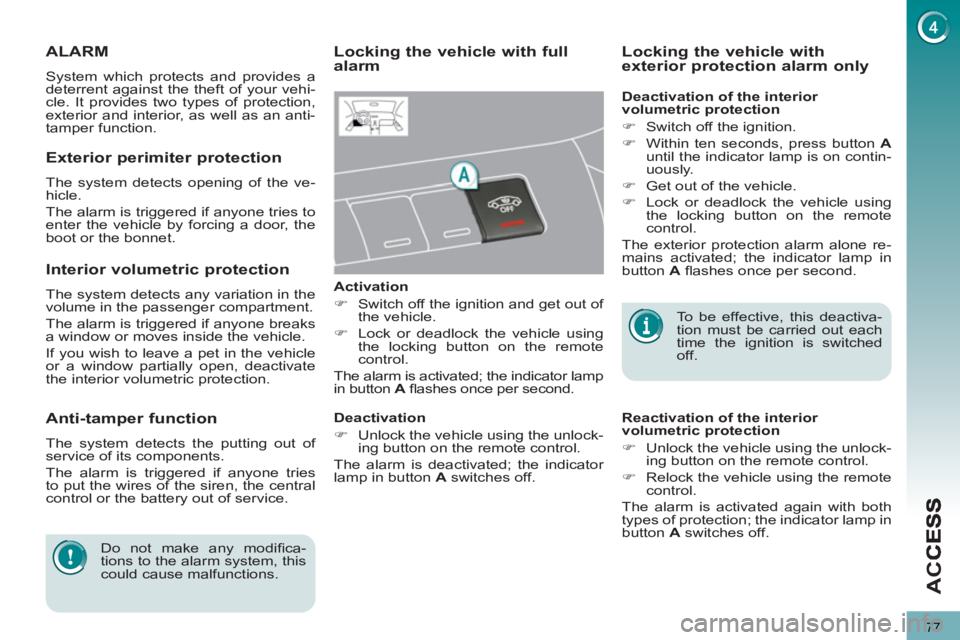
Activation
)
Switch off the ignition and get out of
the vehicle.
)
Lock or deadlock the vehicle using
the locking button on the remote
control.
The alarm is activated; the indicator lamp
in button A
fl ashes once per second.
Exterior perimiter protection
The system detects opening of the ve-
hicle.
The alarm is triggered if anyone tries to
enter the vehicle by forcing a door, the
boot or the bonnet.
Interior volumetric protection
The system detects any variation in the
volume in the passenger compartment.
The alarm is triggered if anyone breaks
a window or moves inside the vehicle.
If you wish to leave a pet in the vehicle
or a window partially open, deactivate
the interior volumetric protection.
Anti-tamper function
The system detects the putting out of
service of its components.
The alarm is triggered if anyone tries
to put the wires of the siren, the central
control or the battery out of service.
Deactivation
)
Unlock the vehicle using the unlock-
ing button on the remote control.
The alarm is deactivated; the indicator
lamp in button A
switches off.
Deactivation of the interior
volumetric protection
)
Switch off the ignition.
)
Within ten seconds, press button A
until the indicator lamp is on contin-
uously.
)
Get out of the vehicle.
)
Lock or deadlock the vehicle using
the locking button on the remote
control.
The exterior protection alarm alone re-
mains activated; the indicator lamp in
button A
fl ashes once per second.
Page 168 of 352
166
CHECKS
PARTNERS IN PERFORMANCE AND
PROTECTION OF THE ENVIRONMENT
Innovation at the service of performance
The TOTAL Research and Development
teams develop lubricants for PEUGEOT
which satisfy the requirements of the lat-
est technical innovations incorporated in
PEUGEOT vehicles.
This ensures that you obtain the best perfor-
mance and the maximum engine life.
Reduced exhaust emissions
TOTAL lubricants are formulated to optimise
the effi ciency of engines and the protection
of the emissions post-treatment systems. It
is crucial to observe the servicing recom-
mendations made by PEUGEOT to ensure
correct operation.
RECOMMENDS
Page 173 of 352
171
CHECKS
CHECKING LEVELS
Oil level
The check is carried out either
when the ignition is switched on
using the oil level indicator on
the instrument panel, or using
the dipstick.
It will only be correct if the vehicle is on
level ground and the engine has been
off for more than 30 minutes.
It is normal to top up the oil level be-
tween two services (or oil changes).
PEUGEOT recommends that you check
the level, and top up if necessary, every
3 000 miles (5 000 kms).
Take care when working under
the bonnet, as certain areas of
the engine may be extremely
hot (risk of burns) and the cooling fan
could start at any time (even with the
ignition off).
If a level drops signifi cantly, have the
corresponding system checked by a
PEUGEOT dealer or a qualifi ed work-
shop.
Check all of these levels regularly, in line
with the servicing booklet and the re-
quirements of the warranty. Top them up
if necessary, unless otherwise indicated.
After topping up the oil, the
check when switching on the
ignition with the oil level indi-
cator in the instrument panel
is not valid during the 30 minutes
after topping up.
Engine oil change
Refer to the servicing booklet for details
of the interval for this operation.
In order to maintain the reliability of the
engine and emission control system,
the use of additives in the engine oil is
prohibited.
Power steering fluid level
The power steering fl uid level
should be close to the "MAX"
mark. With the engine cold, un-
screw the cap to check the level.
Fluid specifi cation
The brake fl uid must conform to the
manufacturer's recommendations and
meet the DOT3 or DOT4 standard.
Changing the fl uid
Refer to the servicing booklet for details
of the interval for this operation. The brake fl uid level should be
close to the "MAX" mark. If it is
not, check the brake pad wear.
Brake fluid level
Oil specifi cation
The oil must be the correct grade for
your engine and conform to the manu-
facturer's recommendations.
Page 174 of 352
172
CHECKS
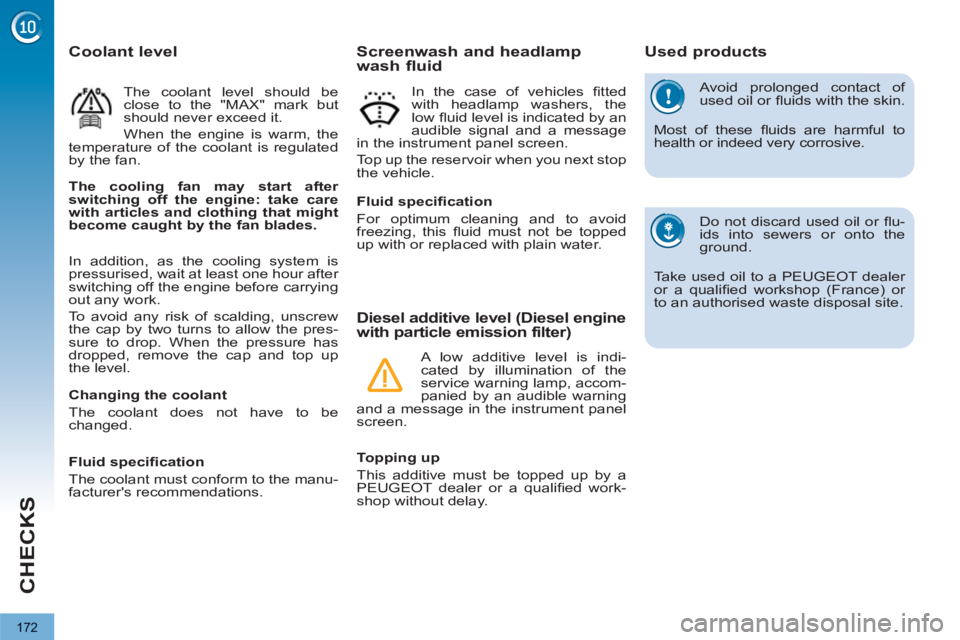
Avoid prolonged contact of
used oil or fl uids with the skin.
Most of these fl uids are harmful to
health or indeed very corrosive.
Do not discard used oil or fl u-
ids into sewers or onto the
ground.
Take used oil to a PEUGEOT dealer
or a qualifi ed workshop (France) or
to an authorised waste disposal site.
Diesel additive level (Diesel engine
with particle emission filter)
Used products
Topping up
This additive must be topped up by a
PEUGEOT dealer or a qualifi ed work-
shop without delay.
Fluid specifi cation
For optimum cleaning and to avoid
freezing, this fl uid must not be topped
up with or replaced with plain water.
In the case of vehicles fi tted
with headlamp washers, the
low fl uid level is indicated by an
audible signal and a message
in the instrument panel screen.
Top up the reservoir when you next stop
the vehicle.
Screenwash and headlamp
wash fluid
The cooling fan may start after
switching off the engine: take care
with articles and clothing that might
become caught by the fan blades.
Fluid specifi cation
The coolant must conform to the manu-
facturer's recommendations.
Changing the coolant
The coolant does not have to be
changed.
The coolant level should be
close to the "MAX" mark but
should never exceed it.
When the engine is warm, the
temperature of the coolant is regulated
by the fan.
In addition, as the cooling system is
pressurised, wait at least one hour after
switching off the engine before carrying
out any work.
To avoid any risk of scalding, unscrew
the cap by two turns to allow the pres-
sure to drop. When the pressure has
dropped, remove the cap and top up
the level.
Coolant level
A low additive level is indi-
cated by illumination of the
service warning lamp, accom-
panied by an audible warning
and a message in the instrument panel
screen.
Page 176 of 352
174
CHECKS
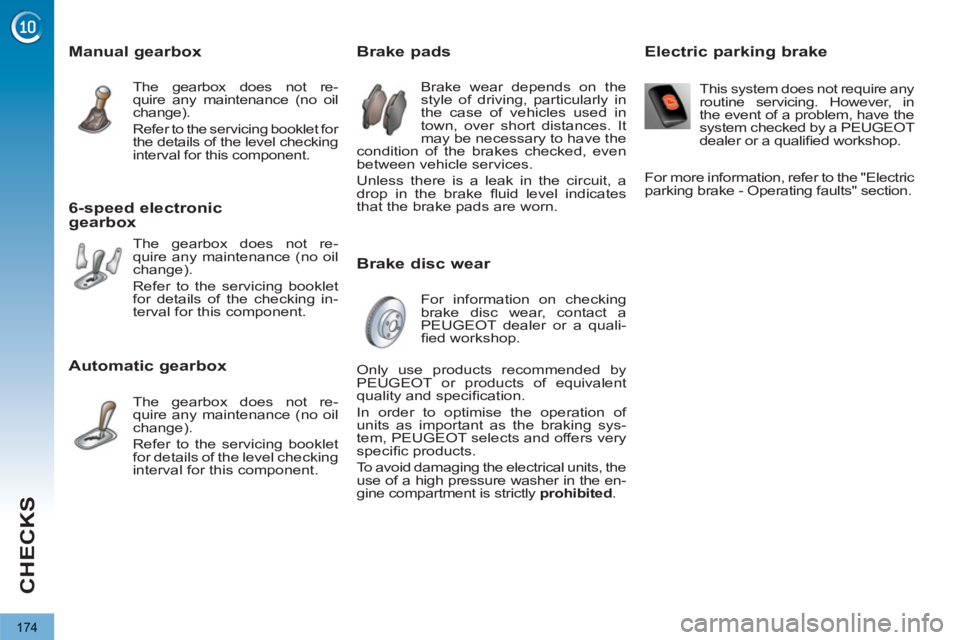
Brake disc wear
Brake pads
Brake wear depends on the
style of driving, particularly in
the case of vehicles used in
town, over short distances. It
may be necessary to have the
condition of the brakes checked, even
between vehicle services.
Unless there is a leak in the circuit, a
drop in the brake fl uid level indicates
that the brake pads are worn.
For information on checking
brake disc wear, contact a
PEUGEOT dealer or a quali-
fi ed workshop.
Manual gearbox
The gearbox does not re-
quire any maintenance (no oil
change).
Refer to the servicing booklet for
the details of the level checking
interval for this component.
6-speed electronic
gearbox
The gearbox does not re-
quire any maintenance (no oil
change).
Refer to the servicing booklet
for details of the checking in-
terval for this component.
Automatic gearbox
The gearbox does not re-
quire any maintenance (no oil
change).
Refer to the servicing booklet
for details of the level checking
interval for this component. This system does not require any
routine servicing. However, in
the event of a problem, have the
system checked by a PEUGEOT
dealer or a qualifi ed workshop.
Electric parking brake
For more information, refer to the "Electric
parking brake - Operating faults" section.
Only use products recommended by
PEUGEOT or products of equivalent
quality and specifi cation.
In order to optimise the operation of
units as important as the braking sys-
tem, PEUGEOT selects and offers very
specifi c products.
To avoid damaging the electrical units, the
use of a high pressure washer in the en-
gine compartment is strictly prohibited
.
Page 205 of 352
203
PRACTICAL INFORMATION
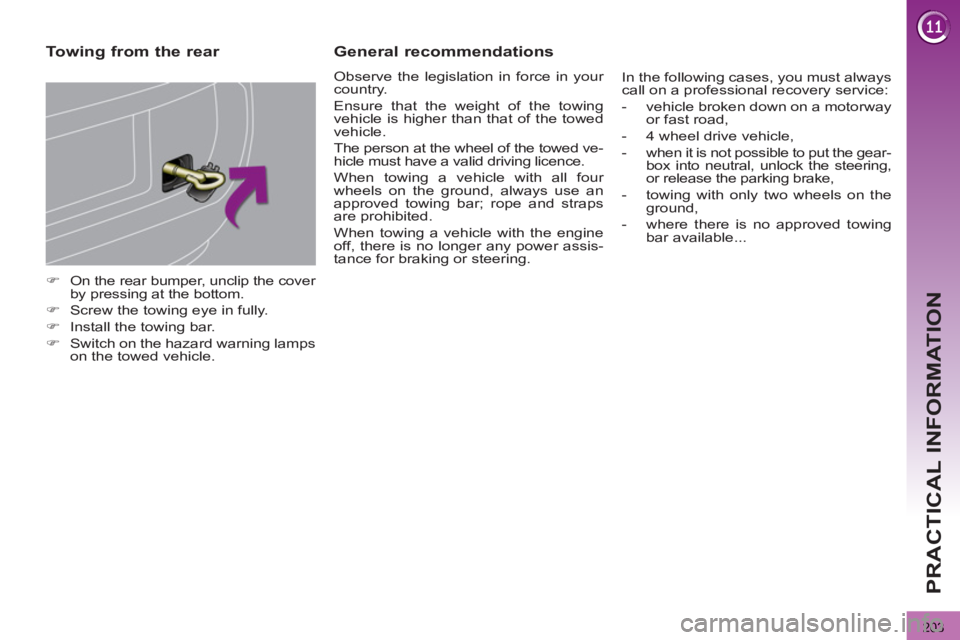
)
On the rear bumper, unclip the cover
by pressing at the bottom.
)
Screw the towing eye in fully.
)
Install the towing bar.
)
Switch on the hazard warning lamps
on the towed vehicle.
Towing from the rear
General recommendations
Observe the legislation in force in your
country.
Ensure that the weight of the towing
vehicle is higher than that of the towed
vehicle.
The person at the wheel of the towed ve-
hicle must have a valid driving licence.
When towing a vehicle with all four
wheels on the ground, always use an
approved towing bar; rope and straps
are prohibited.
When towing a vehicle with the engine
off, there is no longer any power assis-
tance for braking or steering. In the following cases, you must always
call on a professional recovery service:
- vehicle broken down on a motorway
or fast road,
- 4 wheel drive vehicle,
- when it is not possible to put the gear-
box into neutral, unlock the steering,
or release the parking brake,
- towing with only two wheels on the
ground,
- where there is no approved towing
bar available...
Page 218 of 352
216
EMERGENCY OR ASSISTANCE CALL
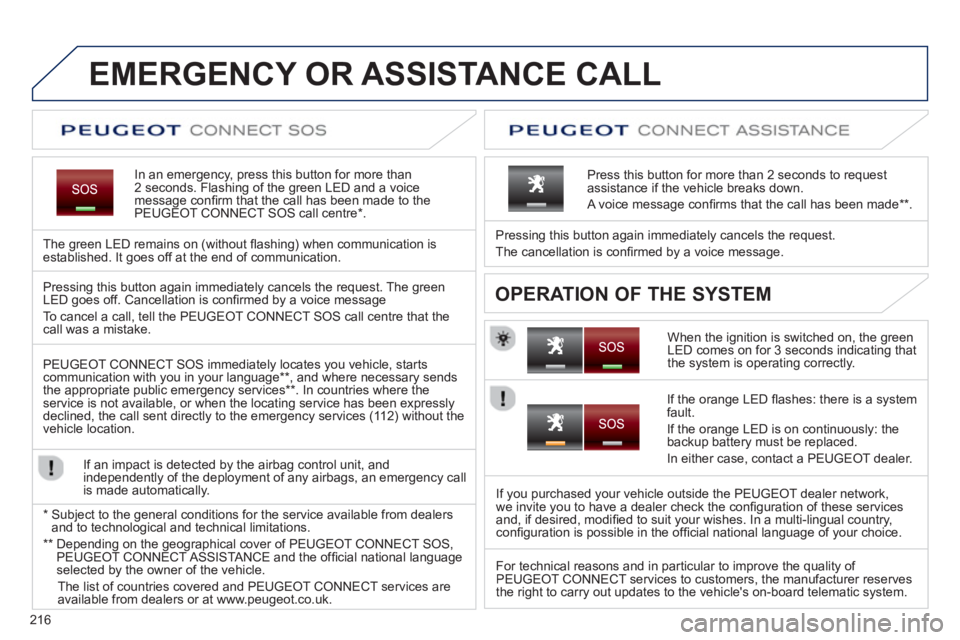
In an emergency, press this button for more than2 seconds. Flashing of the green LED and a voice
message confi rm that the call has been made to the
PEUGEOT CONNECT SOS call centre * .
The
green LED remains on (without fl ashing) when communication is established. It goes off at the end of communication.
When the ignition is switched on, the green
LED comes on for 3 seconds indicating that
the system is operating correctly. Pressin
g this button again immediately cancels the request.
The cancellation is confi rmed b
y a voice message.
Press this button for more than 2 seconds to request
assistance if the vehicle breaks down.
A voice message confi rms that the call has been made **
.
OPERATION OF THE SYSTEM Pressing this button again immediately cancels the request. The green LED goes off. Cancellation is confi rmed by a voice message
To cancel a call, tell the PEUGE
OT CONNECT SOS call centre that thecall was a mistake.
PEUGE
OT CONNECT SOS immediately locates you vehicle, starts communication with you in your language ** , and where necessary sends
the appropriate public emergency services ** . In countries where theservice is not available, or when the locating service has been expresslydeclined, the call sent directly to the emergency services (11 2) without the
vehicle location.
If an impact is detected b
y the airbag control unit, and
independently of the deployment of any airbags, an emergency call
is made automatically.
*
Sub
ject to the general conditions for the service available from dealersand to technological and technical limitations.
**
Depending on the geographical cover of PEUGEOT CONNECT SOS,
PEUGEOT CONNECT ASSISTA NCE and the offi cial national languageselected by the owner of the vehicle.
Th
e list of countries covered and PEUGEOT CONNECT services are available from dealers or at www.peugeot.co.uk.
If the oran
ge LED fl ashes: there is a system
fault.
If the oran
ge LED is on continuously: the backup battery must be replaced.
In either case, contact a PEU
GEOT dealer.
I
f you purchased your vehicle outside the PEUGEOT dealer network,
we invite you to have a dealer check the confi guration of these services
and, if desired, modifi ed to suit your wishes. In a multi-lingual country,confi guration is possible in the offi cial national language of your choice.
For technical reasons and in particular to improve the qualit
y of PEUGEOT CONNECT services to customers, the manufacturer reserves
the right to carry out updates to the vehicle's on-board telematic system.