2013 NISSAN VERSA ECU
[x] Cancel search: ECUPage 300 of 331
For additional traction on icy roads, studded tires
may be used. However, some U.S. states and
Canadian provinces prohibit their use. Check
local, state and provincial laws before installing
studded tires. Skid and traction capabilities of
studded snow tires on wet or dry surfaces may be
poorer than that of non-studded snow tires.
TIRE CHAINS
Use of tire chains may be prohibited according to
location. Check the local laws before installing
tire chains. When installing tire chains, make sure
they are the proper size for the tires on your
vehicle and are installed according to the chain
manufacturer’s suggestions.Use only SAE
class “S” chains. Class “S” chains are used on
vehicles with restricted tire to vehicle clearance.
Vehicles that can use Class “S” chains are de-
signed to meet the minimum clearances between
the tire and the closest vehicle suspension or
body component required to accommodate the
use of a winter traction device (tire chains or
cables) . The minimum clearances are determined
using the factory equipped tires. Other types may
damage your vehicle. Use chain tensioners when
recommended by the tire chain manufacturer to
ensure a tight fit. Loose end links of the tire chain
must be secured or removed to prevent the pos-
sibility of whipping action damage to the fenders
or underbody. If possible, avoid fully loading your
vehicle when using tire chains. In addition, drive at a reduced speed. Otherwise, your vehicle may
be damaged and/or vehicle handling and perfor-
mance may be adversely affected.
Tire chains must be installed only on the
front wheels and not on the rear wheels.
Never install tire chains on a TEMPORARY USE
ONLY spare tire.
Do not use tire chains on dry roads. Driving with
chains in such conditions can cause damage to
the various mechanisms of the vehicle due to
some overstress.
CHANGING WHEELS AND TIRES
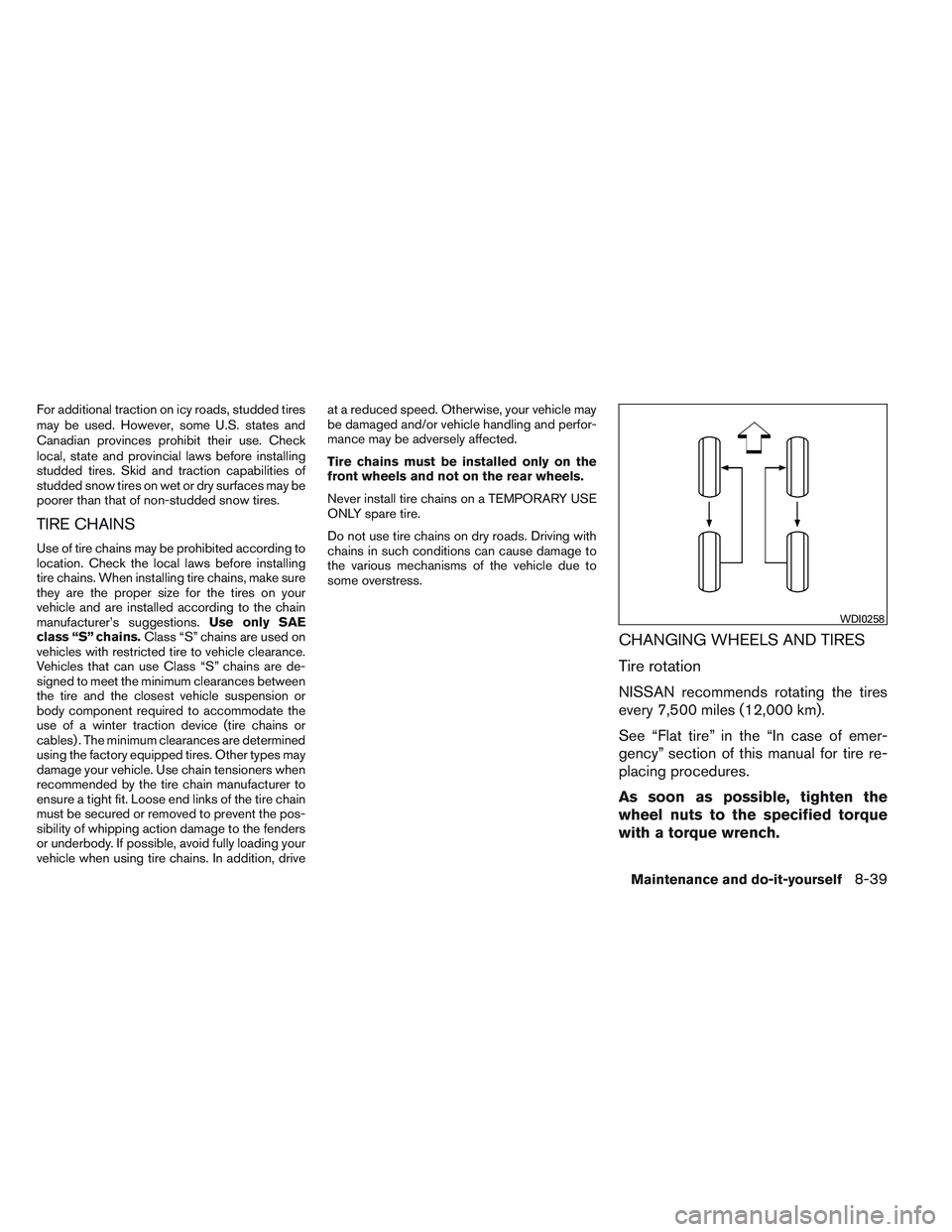
Tire rotation
NISSAN recommends rotating the tires
every 7,500 miles (12,000 km).
See “Flat tire” in the “In case of emer-
gency” section of this manual for tire re-
placing procedures.
As soon as possible, tighten the
wheel nuts to the specified torque
with a torque wrench.
WDI0258
Maintenance and do-it-yourself8-39
Page 318 of 331
5. Determine the combined weight ofluggage and cargo being loaded on
the vehicle. That weight may not
safely exceed the available cargo and
luggage load capacity calculated in
Step 4.
Before driving a loaded vehicle, confirm
that you do not exceed the Gross Vehicle
Weight Rating (GVWR) or the Gross Axle
Weight Rating (GAWR) for your vehicle.
See “Measurement of weights” later in
this section.
Also check tires for proper inflation pres-
sures. See the Tire and Loading Informa-
tion label.
LOADING TIPS
● The GVW must not exceed GVWR
or GAWR as specified on the
F.M.V.S.S./C.M.V.S.S. certification
label.
● Do not load the front and rear axle to
the GAWR. Doing so will exceed the
GVWR.
WARNING
● Properly secure all cargo with
ropes or straps to help prevent it
from sliding or shifting. Do not
place cargo higher than the seat-
backs. In a sudden stop or colli-
sion, unsecured cargo could
cause personal injury.
● Do not load your vehicle any
heavier than the GVWR or the
maximum front and rear GAWRs.
If you do, parts of your vehicle
can break, tire damage could oc-
cur, or it can change the way your
vehicle handles. This could result
in loss of control and cause per-
sonal injury. ●
Overloading not only can shorten
the life of your vehicle and the
tire, but can also cause unsafe
vehicle handling and longer brak-
ing distances. This may cause a
premature tire failure which
could result in a serious accident
and personal injury. Failures
caused by overloading are not
covered by the vehicle’s
warranty.
MEASUREMENT OF WEIGHTS
Secure loose items to prevent weight
shifts that could affect the balance of your
vehicle. When the vehicle is loaded, drive
to a scale and weigh the front and the rear
wheels separately to determine axle
loads. Individual axle loads should not ex-
ceed either of the gross axle weight rat-
ings (GAWR) . The total of the axle loads
should not exceed the gross vehicle
weight rating (GVWR) . These ratings are
given on the vehicle certification label. If
weight ratings are exceeded, move or re-
move items to bring all weights below the
ratings.
Technical and consumer information9-15
Page 321 of 331
For USA
If you believe that your vehicle has a de-
fect which could cause a crash or could
cause injury or death, you should immedi-
ately inform the National Highway Traffic
Safety Administration (NHTSA) in addi-
tion to notifying NISSAN.
If NHTSA receives similar complaints, it
may open an investigation, and if it finds
that a safety defect exists in a group of
vehicles, it may order a recall and remedy
campaign. However, NHTSA cannot be-
come involved in individual problems be-
tween you, your dealer, or NISSAN.
To contact NHTSA, you may call the Ve-
hicle Safety Hotline toll-free at 1-888-
327-4236 (TTY: 1-800-424-9153); go
to http://www.safercar.gov; or write to:
Administrator, NHTSA, 400 Seventh
Street, SW., Washington, D.C. 20590.
You can also obtain other information
about motor vehicle safety from
http://www.safercar.gov.You may notify NISSAN by contacting our
Consumer Affairs Department, toll-free, at
1-800-NISSAN-1.
For Canada
If you believe that your vehicle has a de-
fect which could cause a crash or could
cause injury or death, you should immedi-
ately inform Transport Canada in addition
to notifying NISSAN.
If Transport Canada receives complaints,
it may open an investigation, and if it finds
that a safety defect exists in a group of
vehicles, it may request that NISSAN con-
duct a recall campaign. However, Trans-
port Canada cannot become involved in
individual problems between you, your
dealer, or NISSAN.
You may contact Transport Canada’s De-
fect Investigations and Recalls Division
toll free at 1-800-333-0510. You may
also report safety defects online at:
https://wwwapps.tc.gc.ca/Saf-Sec-
Sur/7/PCDB-BDPP/Index.aspx.Additional information concerning motor
vehicle safety may be obtained from Trans-
port Canada’s Road Safety Information
Centre at 1-800-333-0371 or online at
www.tc.gc.ca/roadsafety (English speak-
ers) or www.tc.gc.ca/securiteroutiere
(French speakers) .
To notify NISSAN of any safety concerns
please contact our Consumer Information
Centre toll free at 1-800-387-0122.
REPORTING SAFETY DEFECTS
9-18Technical and consumer information
Page 326 of 331
G
Gascap .....................3-27
Gauge Fuel gauge ...................2-8
Odometer ...................2-5
Speedometer .................2-5
Tachometer ..................2-7
Trip computer .................2-9
Trip odometer .................2-5
Generalmaintenance...............8-2
Glovebox.....................2-29
H
Hands-free phone system, Bluetooth® ....4-54
Hazard warning flasher switch ..........6-2
Headlightandturnsignalswitch........2-22
Headlightcontrolswitch ............2-22
Headlights....................8-26
Heater Heater and air conditioner controls .....4-14
Heater operation ...............4-15
Hood release ...................3-24
Horn .......................2-25
I
Ignition switch ...................5-7
Ignition Switch Push-Button Ignition Switch .........5-9
Immobilizer system .......2-20,3-4,5-9,5-12
Importantvehicleinformationlabel.......9-10
Increasing fuel economy .............5-24 Indicator lights and audible reminders
(See warning/indicator lights and audible
reminders)....................2-11
Inside mirror
...................3-31
Instrument brightness control ..........2-24
Instrument panel ...............0-6,2-2
Instrument panel dimmer switch ........2-24
Intelligent Key system Key operating range .............3-13
Key operation ................3-14
Mechanicalkey ................3-4
Remote keyless entry operation .......3-17
Troubleshooting guide ............3-22
Warning signals ...............3-22
Interiorlight................2-31,2-32
Interiortrunklidrelease.............3-26
iPod® Player ...............4-46,4-49
ISOFIX child restraints .............1-21
J
Jump starting ...................6-8
K
Key.........................3-2
Keyfob battery replacement ...........8-23
Keyless entry With Intelligent Key system
(See Intelligent Key system) .........3-17 L
Labels Air conditioner specification label .....9-11
C.M.V.S.S. certification label ........9-10
Emission control information label .....9-10
Engine serial number ............9-10
F.M.V.S.S. certification label .........9-10
Tire and Loading Information label .....9-11
Vehicle identification number (VIN) plate . .9-9
Warning labels (for SRS) ..........1-50
LATCH (Lower Anchors and Tethers for CHildren)
System ......................1-21
License plate Installing the license plate ..........9-11
Light Airbagwarninglight.........1-51, 2-16
Brake light (See stop light) .........8-28
Bulb check/instrument panel ........
2-12
Bulbreplacement..............8-28
Charge warning light ............2-13
Fog light switch ...............2-25
Headlightandturnsignalswitch......2-22
Headlight control switch ..........2-22
Headlights..................8-26
Interiorlight..............2-31,2-32
Lightbulbs..................8-26
Low tire pressure warning light .......2-14
Passenger air bag and status light .....1-45
Security indicator light ............2-18
Trunklight ..................2-33
Warning/indicator lights and audible
reminders...................2-11
Lock Child safety rear door lock ..........3-7
10-3
Page 328 of 331
S
Safety Child safety rear door lock ..........3-7
Child seat belts .....1-19,1-24,1-29,1-32
Reporting safety defects (US only) .....9-18
Seat adjustment Front manual seat adjustment ........1-2
Rear seat adjustment .............1-4
Seatback pockets ................2-27
Seat belt Child safety ..................1-17
Infantsandsmallchildren..........1-18
Injured Person ................1-13
Largerchildren................1-18
Precautionsonseatbeltusage.......1-10
Pregnant women ...............1-13
Seat belt extenders .............1-16
Seat belt maintenance ............1-16
Seat belts ...................1-10
Shoulder belt height adjustment ......1-16
Three-point type with retractor .......1-13
Seatbeltwarninglight..............2-16
Seats Adjustment ...................1-2
Frontseats...................1-2
Manual front seat adjustment .........1-2
Rear seat ....................1-4
Security indicator light ..............2-18
Security system (NISSAN vehicle immobilizer
system) , engine start ......2-20,3-4,5-9,5-12
Self-adjusting brakes ..............8-20
Service manual order form ...........9-20
Servicing air conditioner .............4-21
Setting button ...................4-5 Shifting
Continuously Variable Transmission
(CVT) .....................5-16
Manual transmission .............5-18
Shiftlockrelease.................5-17
Shoulder belt height adjustment ........1-16
Side air bag system (See supplemental side air
bag and curtain side-impact air bag system) .1-48
Sparkplugreplacement.............8-17
Speedometer ...................2-5
SRSwarninglabel................1-50
Starting Before starting the engine ..........5-12
Jump starting .................6-8
Precautions when starting and driving ....5-2
Push starting .................6-10
Starting the engine ..........5-13,5-14
Steering Power steering system ...........5-25
Tilting steering wheel ............3-30
Steering wheel audio control switch ......4-52
Stoplight.....................8-28
Storage......................2-27
Storage tray ...................2-27
Sun visors ....................3-30
Supplemental air bag warning labels ......1-50
Supplemental air bag warning light . . .1-51, 2-16
Supplemental front impact air bag system . . .1-43
Supplemental restraint system Information and warning labels .......1-50
Precautions on supplemental restraint
system ....................1-36
Supplemental restraint system
(Supplemental air bag system) .........1-36
Supplemental side and curtain side-impact air bag
system ......................1-48 Switch
Automatic power window switch ......2-30
Fog light switch ...............2-25
Hazard warning flasher switch ........6-2
Headlightandturnsignalswitch......2-22
Headlight
control switch ..........2-22
Ignition switch .................5-7
Power door lock switch ............3-6
Rearwindowdefrosterswitch .......2-22
Turnsignalswitch..............2-24
Vehicle dynamic control (VDC) off
switch .....................2-25
Windshield wiper and washer switch . . .2-21
T
Tachometer ....................2-7
Theft (NISSAN vehicle immobilizer system) ,
engine start ...........2-20,3-4,5-9,5-12
Three-way catalyst ................5-2
Tilting steering wheel ..............3-30
Tire Flat tire .....................6-3
Spare tire ................6-4,8-42
Tire and Loading Information label .....9-11
Tire chains ..................8-39
Tireplacard..................9-11
Tire pressure .................8-32
Tirerotation..................8-39
Types of tires .................8-38
Uniform tire quality grading .........9-16
Wheels and tires ...............8-32
Wheel/tire size .................9-8
Tire pressure Low tire pressure warning light .......2-14
10-5
Page 329 of 331
Tire Pressure Monitoring System (TPMS)....5-3
Towing Flattowing..................9-16
Towtrucktowing...............6-11
Trailertowing.................9-16
Transmission Automatic transmission fluid (ATF) .....8-11
Continuously Variable Transmission
(CVT) fluid ..................8-12
Driving with Continuously Variable
Transmission (CVT) .............5-15
Driving with manual transmission ......5-18
Transmission shift selector lock release ....5-17
Travel (See registering your vehicle in another
country) ......................9-9
Trip computer ...................2-9
Trip odometer ...................2-5
Trunk access through the rear seat .......1-4
Trunk lid lock opener lever ............3-26
Trunklight ....................2-33
Turnsignalswitch................2-24
U
Uniform tire quality grading ...........9-16
USB interface Audio file operation .............4-45
V
Vanity mirror ...................3-31
Variable voltage control system .........8-16
Vehicle dimensions and weights .........9-8
Vehicle dynamic control (VDC) off switch . . .2-25 Vehicle dynamic control (VDC) system
.....5-28
Vehicle identification ...............9-9
Vehicle identification number (VIN)
(Chassis number) .................9-9
Vehicle identification number (VIN) plate ....9-9
Vehicle loading information ...........9-12
Vehicle recovery .................6-13
Vehicle security system (NISSAN vehicle immobi-
lizer system) , engine start . . .2-20, 3-4, 5-9, 5-12
Ventilators ....................4-13
Visors.......................3-30
W
Warning Air bag warning light .........1-51,2-16
Anti-lock brake warning light ........2-12
Battery charge warning light ........2-13
Brake warning light .............2-12
Door open warning light ...........2-13
Engine oil pressure warning light ......2-13
Hazard warning flasher switch ........6-2
Low fuel warning light ............2-14
Low tire pressure warning light .......2-14
Passenger air bag and status light .....1-45
Seatbeltwarninglight............2-16
Warning/indicator lights and audible
reminders ...................2-11
Warning labels (for SRS) ..........1-50
Warning lights ..................2-11
Washer switch Windshield wiper and washer switch . . .2-21
Weights (See dimensions and weights) .....9-8
Wheels and tires .................8-32
Wheel/tire size ...................9-8 When traveling or registering your vehicle
in another country
.................9-9
Windows Locking passengers’ windows .......2-30
Manual windows ...............2-31
Power rear windows .............2-30
P
ower windows ...............2-29
Rear power windows ............2-30
Windshield-washer fluid .............8-13
Windshield wiper and washer switch .....2-21
Wiper Windshield wiper and washer switch . . .2-21
Wiperblades.................8-18
10-6