2013 NISSAN QASHQAI Fan
[x] Cancel search: FanPage 27 of 297

Downloaded from www.Manualslib.com manuals search engine Belts should not be worn with straps twisted.
Each belt assembly must only be used by one
occupant; it is dangerous to put a belt around
a child being carried on the occupant’s lap.
Every occupant in this vehicle should wear a
seat belt at all times.
Never carry more people in the vehicle than
there are seat belts.
All seat belt assemblies, including retractors
and attaching hardware, should be inspected
by a NISSAN dealer or qualified workshop af-
ter any collision. NISSAN recommends that
all seat belt assemblies in use during a colli-
sion should be replaced unless the collision
was minor and the belts show no damage and
continue to operate properly. Seat belt assem-
blies not in use during a collision should also
be inspected and replaced if either damage
or improper operation is noted.
Once the pre-tensioner seat belt has been ac-
tivated, it cannot be re-used. It must be re-
placed together with the retractor. See a
NISSAN dealer or qualified workshop.
Removal and installation of the pre-tensioner
seat belt system components should be done
by a NISSAN dealer or qualified workshop
ONLY.
If the seat belt warning light glows continu-
ously while the ignition switch is in the ON
position, all doors are closed and occupied
seat belts are fastened, it may indicate a mal-function in the system. Have the system
checked by a NISSAN dealer or qualified
workshop.
Always route the shoulder belt over your
shoulder and across your chest. Never run
the belt under your arm. Serious injury can
occur if the seat belt is not worn properly.
Position the lap belt as low as possible
AROUND THE HIPS, NOT THE WAIST.
CHILD SAFETY
Infants or small children
NISSAN recommends that infants or small children
should be seated in a child restraint on the rear
seats if available. According to accident statistics,
children are safer when properly restrained in the
rear seat than in the front seat. See “Child restraints”
later in this section. You should choose a child re-
straint system which fits your vehicle and always fol-
low the manufacturer’s instructions for installation
and use.
Children
Children who are too large for child restraints should
be seated and restrained by the seat belts that are
provided.
The use of a booster seat (commercially available)
may help to avoid the shoulder belt coming across
the face or neck area of a child’s seating position.
The booster seat should raise the child so that the
shoulder belt is properly positioned across the top,
middle portion of the shoulder and the lap belt is low
on the hips. The booster seat should fit the vehicle’s
seat. Once the child has grown so the shoulder belt
is no longer on or near the face and neck, use the
shoulder belt without the booster seat.
WARNING
Never let a child stand or kneel on any seat and
do not allow a child in the cargo areas while the
vehicle is moving.
PREGNANT WOMEN
NISSAN recommends that pregnant women use
seat belts. Contact your doctor for specific recom-
mendations. The seat belt should be worn snug,
always position the lap belt as low as possible
around the hips, place the shoulder belt over your
shoulder and across your chest. Never run the lap/
shoulder belt over your abdominal area.
SSS0099Z
1-8Safety — seats, seat belts and supplemental restraint system
Page 35 of 297

Downloaded from www.Manualslib.com manuals search engine AIR BAG WARNING LABELS
Warning labels about the air bag system are placed
in the vehicle. Warning labels are for your safety and
the safety of your passengers; do not remove them.
Child restraint on front passenger seat
NISSAN recommends that infants or small children
be seated in a child restraint system on the rear seat
if available. According to accident statistics, chil-
dren are safer when properly restrained in the rear
seat rather than in the front seat.
Front passenger air bag:
Your vehicle is equipped with a front passenger air
bag, you will find an air bag warning label attached
to the passenger side of the instrument panel as
shown in the previous illustration.
This label warns:
“Extreme Hazard! Do not use a rearward facing
child restraint on a seat protected by an air bag
in front of it!”
This label warns NOT to fit a rearward facing child
restraint on the front passenger seat without first
deactivating the front passenger air bag.
For instructions on deactivating the front passenger
air bag see “Front passenger air bag deactivation
system” later in this section.
When installing child restraints in your vehicle, al-
ways carefully observe the manufacturer’s instruc-
tions.For more details on the installation of child restraints,
see also “Child restraints” later in this section.
Side air bags:
Your vehicle is equipped with side air bags. You will
find a side air bag warning label attached to the
vehicle’s interior as shown in the previous illustra-
tion.
This label warns you not to let infants or small chil-
dren sit on the front passenger seat as the air bag
may cause serious injury in case of deployment dur-
ing a collision.
AIR BAG WARNING LIGHT
The Supplemental Restraint System (SRS) air bag
warning light, displayingin the instrument
panel, monitors the circuits of the front air bag sys-
tem, the side and curtain air bag systems and the
pre-tensioner seat belt system. The circuits moni-
tored by the SRS air bag warning light are: all sen-
sors, air bag modules and all related wiring, and the
pre-tensioner seat belt. After turning the ignition switch to the ON or
START position, the supplemental air bag warn-
ing light illuminates. The air bag warning light will
turn off after approximately 7 seconds if the sys-
tem is operational.
Take your vehicle to the nearest NISSAN dealer or
qualified workshop to have the air bag systems and
pre-tensioner seat belt serviced if the SRS air bag
warning light:
Remains on after approximately 7 seconds
Flashes intermittently
Does not come on at all
Under these conditions, the front air bags, side and
curtain air bags and/or pre-tensioner seat belt will
not operate properly. They must be checked and
repaired.
Repair and replacement procedure
The front air bags, side air bags, curtain air bags,
and pre-tensioner seat belt system are designed to
activate on a one-time-only basis. As a reminder,
unless it is damaged, the air bag warning light will
remain illuminated after inflation has occurred. Re-
pair and replacement of the air bag system should
be done only by a NISSAN dealer or qualified work-
shop.
When maintenance work is required on the vehicle,
the air bag systems, related parts and pre-tensioner
seat belt should be pointed out to the person con-
NPA993
1-16Safety — seats, seat belts and supplemental restraint system
Page 37 of 297

Downloaded from www.Manualslib.com manuals search engine cal key (Intelligent Key models)” later in this sec-
tion) in the front passenger air bag switch on the
side of the dashboard, press then turn the key to
the OFF position.
3. Turn the ignition switch to the ON position and make sure the front passenger air bag indicator
light
remains illuminated.
The
indicator light remains continuously illumi-
nated to warn you of front passenger air bag status.
See “Child restraints” later in this section for child
seat appropriate fitting.
Activating the front passenger air bag
You should reactivate the front passenger air bag
system as soon as the child restraint is not in use on
the front passenger seat to ensure protection of the
front passenger seat occupant in the event of an
impact.
To reactivate the front passenger air bag system:
1. With the ignition switch in the LOCK position and the engine off, open the front passenger
door.
2. Insert the ignition key/emergency key (Intelligent Key equipped models) in the front passenger air
bag switch and turn the key to the ON position.
3. Turn the ignition switch to the ON position and make sure the front passenger air bag indicator
light
illuminates for a few seconds and then
turns off.
WARNING
If any of the following conditions occur after the
ignition switch has been turned to the ON posi-
tion, the front passenger air bag system needs
servicing and your vehicle must be taken to the
nearest NISSAN dealer or qualified workshop.
The front passenger air bag indicator light
comes on and remains illuminated after ap-
proximately 7 seconds while the front pas-
senger air bag switch is ON.
The front passenger air bag indicator light
does not come on at all while the front pas-
senger air bag switch is ON.
Unless checked and repaired, the front passenger
air bag system may not function properly.
PRECAUTIONS ON CHILD
RESTRAINT USAGE
Infants and small children should alwaysbe placed
in an infant or child restraint while riding in the ve-
hicle.
WARNING
Infants and small children should never be
carried on your lap. It is not possible for even
the strongest adult to resist the forces of an
accident. The child could be crushed between
the adult and parts of the vehicle. Also, do not
put the same seat belt around a child and
yourself. In general, child restraints are de-
signed to be installed with the lap portion of a
three-point type seat belt.
NISSAN recommends installing the child re-
straint on the rear seat. According to accident
statistics, children are safer when properly re-
strained in the rear seat than in the front seat.
SSS0099Z
CHILD RESTRAINTS
1-18Safety — seats, seat belts and supplemental restraint system
Page 38 of 297

Downloaded from www.Manualslib.com manuals search engine An improperly installed child restraint could
lead to serious injury in an accident.
Child restraints specially designed for infants and
small children are offered by several manufacturers.
When selecting any child restraint, keep the follow-
ing points in mind:
Choose a child restraint that complies with the
latest European safety standard, ECE Regula-
tion 44.04.
Place your child in the child restraint and check
the various adjustments to be sure that the child
restraint is suitable for your child. Always follow
all of the recommended procedures.
Check the child restraint in your vehicle to be
sure it is compatible with the vehicle’s seat belt
system.
Refer to the tables further on in this section for a
list of the recommended fitment positions and
the approved child restraint for your vehicle.
WARNING
Never install a rear facing child restraint in the
front seat without first deactivating the front
passenger air bag.
Adjustable seatbacks should be positioned to
fit the child seat; however, the seatback
should be as upright as possible.
Follow all of the child restraint manufacturer’s
instructions for installation and use.
Choose a child restraint appropriate to the
child and the vehicle. It may not be possible
to properly install some types of child restraint
in your vehicle.
Improper use of a child restraint can increase
injuries to the infant or child and other occu-
pants in the vehicle.
When your child restraint is not in use, keep it
secured with a seat belt to prevent it from
being thrown forwards in case of a sudden
stop or accident.
Remember that a child restraint left in a closed
vehicle can become very hot. Check the seat-
ing surface and buckles before placing your
child in the child restraint.
After attaching a child restraint, test the seat
before you place the child in it. Check that it
does not tilt too far from side to side. Try to
tug it forwards and check whether the belt
holds it in place. If the restraint is not secure,
tighten the belt as necessary, or put the re-
straint in another seat and test it again.
If the child restraint is not anchored properly,
the risk of a child being injured in a collision
or sudden stop greatly increases.
The front passenger seat should be
positioned to fit the child seat appropriately.
See “Installation of a child restraint system on
the front passenger seat” later in this section.
For a front facing child restraint installed on a
three-point type lap/shoulder belt, make sure the shoulder belt does not go in front of the
child’s face or neck. If it does, put the shoul-
der belt behind the child restraint.
If the child restraint is equipped with a locking
clip, ensure that the clip is securely fastened
to the vehicle seat belt. If the locking clip is
not used, injuries could result from the child
restraint tipping over during normal vehicle
braking or cornering.
Safety — seats, seat belts and supplemental restraint system1-19
Page 41 of 297
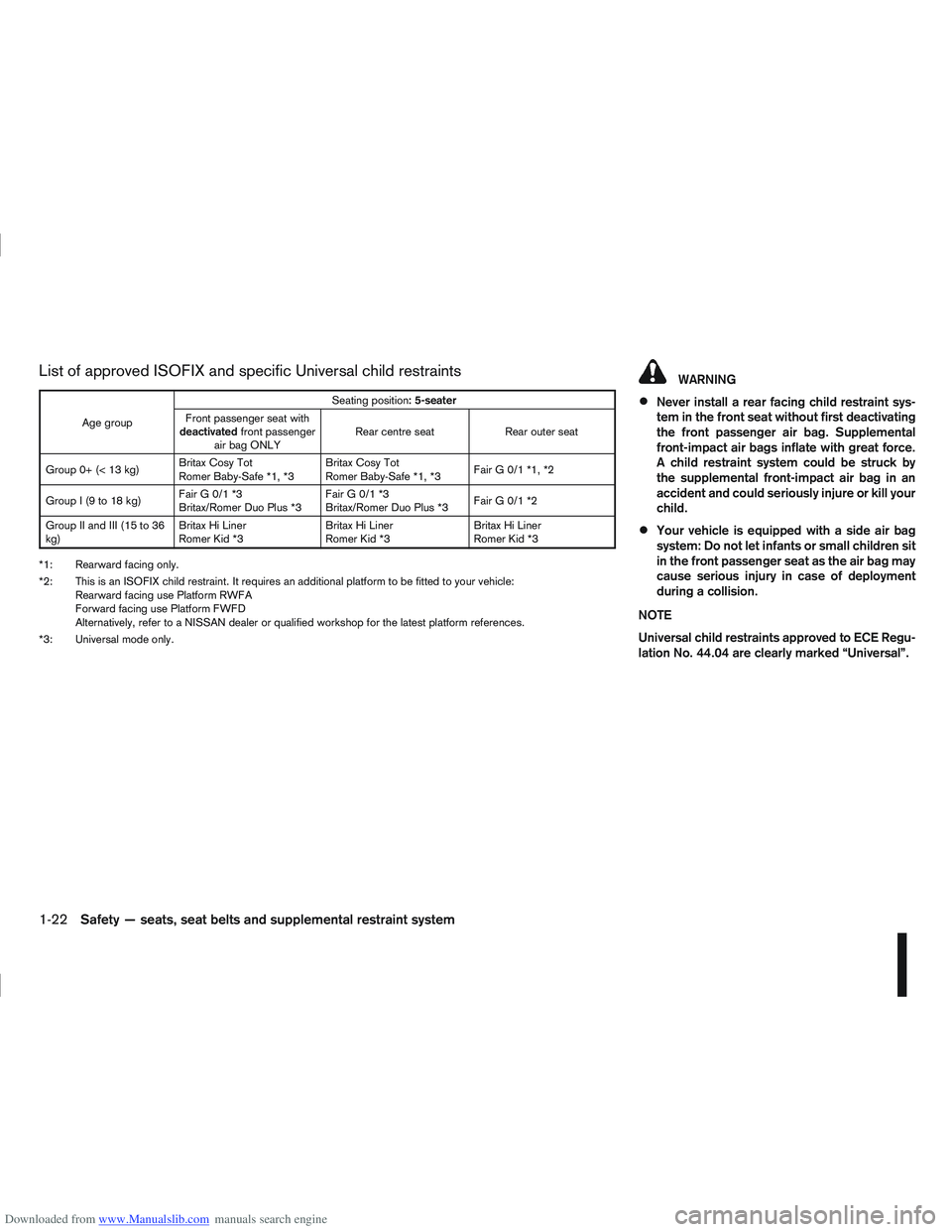
Downloaded from www.Manualslib.com manuals search engine List of approved ISOFIX and specific Universal child restraintsWARNING
Never install a rear facing child restraint sys-
tem in the front seat without first deactivating
the front passenger air bag. Supplemental
front-impact air bags inflate with great force.
A child restraint system could be struck by
the supplemental front-impact air bag in an
accident and could seriously injure or kill your
child.
Your vehicle is equipped with a side air bag
system: Do not let infants or small children sit
in the front passenger seat as the air bag may
cause serious injury in case of deployment
during a collision.
NOTE
Universal child restraints approved to ECE Regu-
lation No. 44.04 are clearly marked “Universal”.
Age group Seating position
: 5-seater
Front passenger seat with
deactivated front passenger
air bag ONLY Rear centre seat
Rear outer seat
Group 0+ (< 13 kg) Britax Cosy Tot
Romer Baby-Safe *1, *3 Britax Cosy Tot
Romer Baby-Safe *1, *3
Fair G 0/1 *1, *2
Group I (9 to 18 kg) Fair G 0/1 *3
Britax/Romer Duo Plus *3 Fair G 0/1 *3
Britax/Romer Duo Plus *3
Fair G 0/1 *2
Group II and III (15 to 36
kg) Britax Hi Liner
Romer Kid *3 Britax Hi Liner
Romer Kid *3 Britax Hi Liner
Romer Kid *3
*1: Rearward facing only.
*2: This is an ISOFIX child restraint. It requires an additional platform to be fitted to your vehicle: Rearward facing use Platform RWFA
Forward facing use Platform FWFD
Alternatively, refer to a NISSAN dealer or qualified workshop for the latest platform references.
*3: Universal mode only.
1-22Safety — seats, seat belts and supplemental restraint system
Page 42 of 297

Downloaded from www.Manualslib.com manuals search engine INSTALLATION OF A CHILD
RESTRAINT SYSTEM ON THE FRONT
PASSENGER SEAT
WARNING
Never install a rear facing child restraint sys-
tem in the front seat without first deactivating
the front passenger air bag. Supplemental
front-impact air bags inflate with great force.
A child restraint system could be struck by
the supplemental front-impact air bag in an
accident and could seriously injure or kill your
child.
NISSAN recommends that infants or small
children be seated in a child restraint system
in the rear seat. According to accident statis-
tics, children are safer when properly
restrained in the rear seat than in the front
seat.
Age groupSeating position
: 7-seater
Front passenger seat
with deactivated front
passenger air bag ONLY 2nd row centre seat 2nd row outer seat 3rd row seat
Group 0+ (< 13 kg) Britax Cosy Tot
Romer Baby-Safe *1,
*3 Britax Cosy Tot
Romer Baby-Safe *1,
*3
Fair G 0/1 *1, *2 X
Group I (9 to 18 kg) Britax/Romer Duo
Plus *3 Britax/Romer Duo
Plus *3
Fair 123 BimboFair G 0/1 *2
Maxi-Cosi Tobi
Fair 123 Bimbo
Fair 123 Bimbo
Maxi-Cosi Tobi
Group II and III (15 to
36 kg) Britax Hi Liner
Romer Kid *3 Britax Hi Liner
Romer Kid *3
Fair JuniorBritax Hi Liner
Romer Kid *3
Fair Junior
Fair Junior
*1: Rearward facing only.
*2: This is an ISOFIX child restraint. It requires an additional platform to be fitted to your vehicle. Rearward facing use Platform RWF B/D
Forward facing use Platform FWF B
Alternatively, refer to a NISSAN dealer or qualified workshop for the latest platform references.
*3: Universal mode only.
X: Not suitable for child restraint for this age group
NPA679Z
Front passenger air bag left active
Safety — seats, seat belts and supplemental restraint system1-23
Page 43 of 297

Downloaded from www.Manualslib.com manuals search engine Rear facing
If you must install a child restraint system in the front
seat, follow these steps:
1. Deactivate the front passenger air bag. See“Front passenger air bag deactivation system”
earlier in this section for further details.
2. Move the seat to the rearmost position.
3. Adjust the head restraint to its highest position. Remove it if it interferes with the child restraint
installation. In such situations, securely store the
head restraint in the luggage compartment so
that it does not become a dangerous projectile
during a sudden stop or in an accident.
4. Position the child restraint system in the front passenger seat.
Always follow the child restraint system manu-
facturer’s instructions for installation and use. 5. Route the seat belt tongue through the child re-
straint system and insert it into the buckle until
you hear and feel the latch engage.
To prevent slack in the lap belt, secure the shoul-
der belt in place with a locking clip
jA. Use a
locking clip attached to the child restraint sys-
tem, or one which is equivalent in dimensions
and strength.
Be sure to follow the child restraint system
manufacturer’s instructions for belt routing.
6. Slide the seat forwards so that the seat belt fully tightens the child restraint system and the child
restraint reaches the vehicle dashboard.
7. Test the child restraint system before you place the child in it. Check that it does not tilt too far
from side to side. Try to tug it forwards and check
if it is held securely in place.
INSTALLATION OF A CHILD
RESTRAINT SYSTEM ON REAR
SEATS
WARNING
NISSAN recommends that infants or small
children be seated in a child restraint system.
According to accident statistics, children are
safer when properly restrained in the rear seat
than in the front seat.
The direction of the child restraint system de-
pends on the type of the child restraint sys-
tem and the size of the child.
Front-facing
When you install a front-facing child restraint system
in a rear outer or centre seat, follow these steps:
1.5-seater: Position the front passenger seat as
far forwards as possible.
SSS0513Z
SSS0374AZ
Rear outer seat (5-seater)
NPA975
Rear seat (7-seater)
1-24Safety — seats, seat belts and supplemental restraint system
Page 120 of 297

Downloaded from www.Manualslib.com manuals search engine MANUAL AIR CONDITIONER
j
1Temperature control dial
j2Air recirculation button
j3Fan speed control dial
j4Rear window defogger button
(For details, see “Defogger switch” in the “2. Instruments and controls” section)
j5
Airflow control dial
j6Air conditioner ON/OFF button
Controls
Fan speed control dialm:
To switch the fan on or off and to control the fan
speed, turn the fan speed control dial clockwise to
increase the fan speed. To decrease the fan speed,
turn the fan speed control dial anticlockwise.
Temperature control dial:
Turn the temperature control dial to set the desired
air temperature from the vents and floor outlets.
NAA947
Manual air conditioner
Display screen, heater and air conditioner, and audio system4-13