2013 NISSAN PATHFINDER tire type
[x] Cancel search: tire typePage 481 of 506
5. Determine the combined weight ofluggage and cargo being loaded on
the vehicle. That weight may not
safely exceed the available cargo and
luggage load capacity calculated in
Step 4.
6. If your vehicle will be towing a trailer, load from your trailer will be trans-
ferred to your vehicle. Consult this
manual to determine how this re-
duces the available cargo and lug-
gage load capacity of your vehicle.
Before driving a loaded vehicle, confirm
that you do not exceed the Gross Vehicle
Weight Rating (GVWR) or the Gross Axle
Weight Rating (GAWR) for your vehicle.
See “Measurement of weights” later in
this section.
Also check tires for proper inflation pres-
sures. See the Tire and Loading Informa-
tion label.
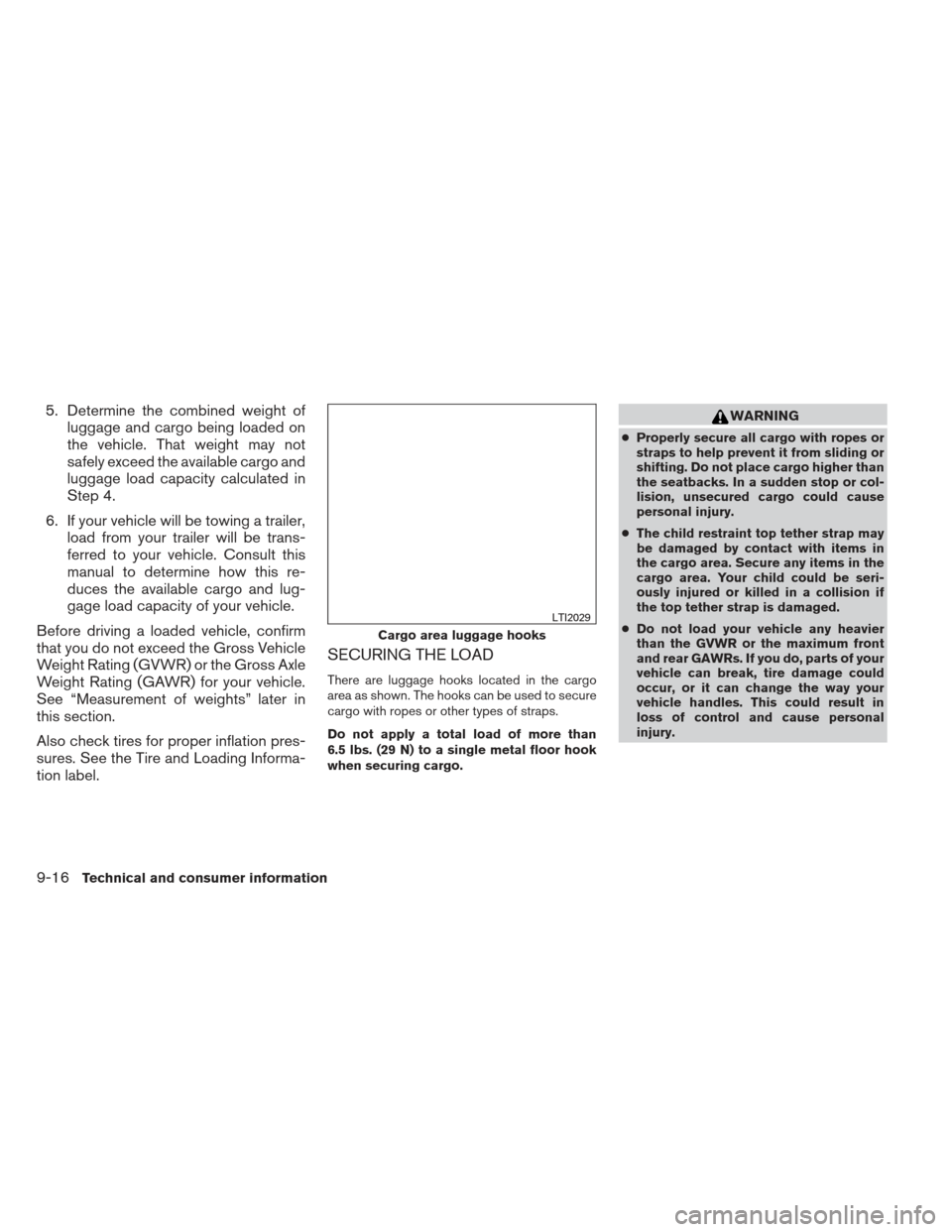
SECURING THE LOAD
There are luggage hooks located in the cargo
area as shown. The hooks can be used to secure
cargo with ropes or other types of straps.
Do not apply a total load of more than
6.5 lbs. (29 N) to a single metal floor hook
when securing cargo.
WARNING
● Properly secure all cargo with ropes or
straps to help prevent it from sliding or
shifting. Do not place cargo higher than
the seatbacks. In a sudden stop or col-
lision, unsecured cargo could cause
personal injury.
● The child restraint top tether strap may
be damaged by contact with items in
the cargo area. Secure any items in the
cargo area. Your child could be seri-
ously injured or killed in a collision if
the top tether strap is damaged.
● Do not load your vehicle any heavier
than the GVWR or the maximum front
and rear GAWRs. If you do, parts of your
vehicle can break, tire damage could
occur, or it can change the way your
vehicle handles. This could result in
loss of control and cause personal
injury.
Cargo area luggage hooks
LTI2029
9-16Technical and consumer information
Page 488 of 506
WARNING
Properly adjust the weight distributing
hitch so the rear of the bumper is no
higher than the measured reference
height when the trailer is attached. If the
rear bumper is higher than the measured
reference height when loaded, the vehicle
may handle unpredictably which could
cause a loss of vehicle control and cause
serious personal injury or property
damage.
Sway control device
Sudden maneuvers, wind gusts, and buffeting
caused by other vehicles can affect trailer han-
dling. Sway control devices may be used to help
control these affects. If you choose to use one,
contact a reputable trailer hitch supplier to make
sure the sway control device will work with the
vehicle, hitch, trailer and the trailer’s brake sys-
tem. Follow the instructions provided by the
manufacturer for installing and using the sway
control device.
Class I hitch
Class I trailer hitch equipment (receiver, ball
mount and hitch ball) can be used to tow trailers
of a maximum weight of 2,000 lb (907 kg) .
Class II hitch
Class II trailer hitch equipment (receiver, ball
mount and hitch ball) can be used to tow trailers
of a maximum weight of 3,500 lb (1,587 kg).
Class III hitch
Class III trailer hitch equipment (receiver, ball
mount and hitch ball) can be used to tow trailers
of a maximum weight of 5,000 lb (2,268 kg).
Tire pressures
●When towing a trailer, inflate the ve-
hicle tires to the recommended cold
tire pressure indicated on the tire
placard.
● Trailer tire condition, size, load rating
and proper inflation pressure should
be in accordance with the trailer and
tire manufacturer’s specifications.
Safety chains
Always use suitable safety chains between your
vehicle and the trailer. The safety chains should be
crossed and should be attached to the hitch, not to
the vehicle bumper or axle. The safety chains can
be attached to the bumper if the hitch ball is
mounted to the bumper. Be sure to leave enough
slack in the chains to permit turning corners.
Trailer lights
CAUTION
When splicing into the vehicle electrical
system, a commercially available power-
type module/converter must be used to
provide power for all trailer lighting. This
unit uses the vehicle battery as a direct
power source for all trailer lights while
using the vehicle tail light, stoplight and
turn signal circuits as a signal source. The
module/converter must draw no more
that 15 milliamps from the stop and tail
lamp circuits. Using a module/converter
that exceeds these power requirements
may damage the vehicle’s electrical sys-
tem. See a reputable trailer retailer to
obtain the proper equipment and to have
it installed.
Trailer lights should comply with federal and/or
local regulations. For assistance in hooking up
trailer lights, contact a NISSAN dealer or repu-
table trailer retailer. Vehicles equipped with the
optional trailer tow package are equipped with a
7-pin trailer harness connector. If your trailer is
equipped with a flat 4-pin connector, an adapter
will be needed to connect the trailer lights to the
vehicle. Adapters are available at auto parts
stores and hitch retailers.
Technical and consumer information9-23
Page 503 of 506
StartingBefore starting the engine ..........5-13
Jump starting .................6-9
Precautions when starting and driving ....5-2
Push starting .................6-11
Starting the engine .............5-13
Steering Heated steering wheel ...........2-39
Power steering fluid .............8-12
Power steering system ...........5-26
Steering wheel audio control switch .....4-112
Stoplight.....................8-27
Storage......................2-44
Storagebin....................2-50
Sunglassescase.................2-45
Sunglassesholder................2-45
Sunroof (see Moonroof) .............2-53
Sun visors ....................3-31
Supplemental air bag warning labels ......1-64
Supplemental air bag warning light . . .1-64, 2-14
Supplemental front impact air bag system . . .1-56
Supplemental restraint system Information and warning labels .......1-64
Precautions on supplemental restraint
system ....................1-49
Supplemental restraint system
(Supplemental air bag system) .........1-49
Switch Autolightswitch...............2-33
Automatic power window switch ......2-53
Foglightswitch ...............2-36
Hazard warning flasher switch ........6-2
Headlight and turn signal switch ......2-32
Headlightcontrolswitch ..........2-32
Power door lock switch ............3-6
Power inverter switch ............2-41 Rear window and outside mirror defroster
switch.....................2-31
Rear window wiper and washer
switches...................2-30
Turn signal switch
..............2-35
Vehicle dynamic control (VDC) off switch .2-41
Windshield wiper and washer switch . . .2-29
T
Tachometer ....................2-4
Temperature gauge Engine coolant temperature gauge .....2-5
Theft (NISSAN vehicle immobilizer system) ,
engine start .............2-28,3-4,5-13
Three-way catalyst ................5-2
Tire Flat tire .....................6-3
Spare tire ...................6-4
Tire and Loading Information label .....9-11
Tirechains..................8-37
Tireplacard..................9-11
Tire pressure .................8-30
Tire rotation..................8-37
Tires of 4-wheel drive ............8-39
Types of tires .................8-36
Uniform tire quality grading .........9-29
Wheels and tires ...............8-30
Wheel/tire size .................9-8
Tire pressure Low tire pressure warning light .......2-12
Tire Pressure Monitoring System (TPMS) ....5-3
Top tether strap child restraint .........1-34
Towing 4-wheel drive models ............6-13 Flattowing..................9-28
Towing load/specification
..........9-21
Tow truck towing ...............6-12
Trailer towing .................9-17
Towmodeswitch ................2-42
Transceiver HomeLink® Universal Transceiver . .2-59, 2-63
Transmission Continuously Variable Transmission
(CVT)fluid..................8-11
Driving
with Continuously Variable
Transmission (CVT) .............5-14
Travel (See registering your vehicle in another
country) ......................9-9
Trip odometer ...................2-4
Turn signal switch ................2-35
U
Uniform tire quality grading ...........9-29
USB interface Audio file operation .........4-98,4-100
Video file operation .............4-101
V
Vanity mirror ...................3-32
Variable voltage control system .........8-16
Vehicledimensionsandweights.........9-8
Vehicle dynamic control (VDC) off switch . . .2-41
Vehicle dynamic control (VDC) system .....5-29
Vehicle identification ...............9-9
Vehicle identification number (VIN)
(Chassis number) .................9-9
10-6