2013 NISSAN MURANO maintenance
[x] Cancel search: maintenancePage 352 of 507
Black plate (350,1)
[ Edit: 2012/ 7/ 31 Model: Z51-D ]
5-4Starting and driving
— You notice a change in thesound of the exhaust system.
— You have had an accident invol- ving damage to the exhaust
system, underbody, or rear of
the vehicle.
THREE-WAY CATALYSTGUID-25B6DA98-F9DE-4D4E-BDE7-81C60C45F38CThe three-way catalyst is an emission control
device installed in the exhaust system. Exhaust
gases in the three-way catalyst are burned at
high temperatures to help reduce pollutants.
WARNING
. The exhaust gas and the exhaust
system are very hot. Keep people,
animals or flammable materials
away from the exhaust system com-
ponents.
. Do not stop or park the vehicle over
flammable materials such as dry
grass, waste paper or rags. They
may ignite and cause a fire.
CAUTION
.Do not use leaded gasoline. Depos-
its from leaded gasoline will ser-
iously reduce the three-way
catalyst’s ability to help reduce ex-
haust pollutants.
. Keep your engine tuned up. Mal-
functions in the ignition, fuel injec-
tion, or electrical systems can cause
overrich fuel flow into the three-way
catalyst, causing it to overheat. Do
not keep driving if the engine mis-
fires, or if noticeable loss of perfor-
mance or other unusual operating
conditions are detected. Have the
vehicle inspected promptly by a
NISSAN dealer.
. Avoid driving with an extremely low
fuel level. Running out of fuel could
cause the engine to misfire, dama-
ging the three-way catalyst.
. Do not race the engine while warm-
ing it up.
. Do not push or tow your vehicle to
start the engine.
TIRE PRESSURE MONITORING SYS-
TEM (TPMS)
GUID-F7BA83CF-7575-4726-9031-194EDDC1CE8CEach tire, including the spare (if provided) ,
should be checked monthly when cold and
inflated to the inflation pressure recommended
by the vehicle manufacturer on the vehicle
placard or tire inflation pressure label. (If your
vehicle has tires of a different size than the size
indicated on the vehicle placard or tire inflation
pressure label, you should determine the proper
tire inflation pressure for those tires.)
As an added safety feature, your vehicle has
been equipped with a Tire Pressure Monitoring
System (TPMS) that illuminates a low tire
pressure telltale when one or more of your tires
is significantly under-inflated. Accordingly, when
the low tire pressure telltale illuminates, you
should stop and check your tires as soon as
possible, and inflate them to the proper pres-
sure. Driving on a significantly under-inflated tire
causes the tire to overheat and can lead to tire
failure. Under-inflation also reduces fuel effi-
ciency and tire tread life, and may affect the
vehicle’s handling and stopping ability.
Please note that the TPMS is not a substitute for
proper tire maintenance, and it is the driver’s
responsibility to maintain correct tire pressure,
even if under-inflation has not reached the level
to trigger illumination of the TPMS low tire
Condition:
Page 356 of 507
Black plate (354,1)
[ Edit: 2012/ 7/ 31 Model: Z51-D ]
5-8Starting and driving
speed is reduced. Do not attempt to drive
the vehicle back onto the road surface until
vehicle speed is reduced.
6. When it is safe to do so, gradually turn the steering wheel until both tires return to the
road surface. When all tires are on the road
surface, steer the vehicle to stay in the
appropriate driving lane.
.If you decide that it is not safe to returnthe vehicle to the road surface based on
vehicle, road or traffic conditions, gradu-
ally slow the vehicle to a stop in a safe
place off the road.
RAPID AIR PRESSURE LOSSGUID-E28673F5-7D64-42E9-870E-85BE9AF08E4CRapid air pressure loss or a “blow-out” can
occur if the tire is punctured or is damaged due
to hitting a curb or pothole. Rapid air pressure
loss can also be caused by driving on under-
inflated tires.
Rapid air pressure loss can affect the handling
and stability of the vehicle, especially at highway
speeds.
Help prevent rapid air pressure loss by main-
taining the correct air pressure and visually
inspect the tires for wear and damage. See
“Wheels and tires” in the “8. Maintenance and
do-it-yourself” section of this manual.
If a tire rapidly loses air pressure or “blows-out” while driving maintain control of the vehicle by
following the procedure below. Please note that
this procedure is only a general guide. The
vehicle must be driven as appropriate based on
the conditions of the vehicle, road and traffic.
WARNING
The following actions can increase the
chance of losing control of the vehicle if
there is a sudden loss of tire air
pressure. Losing control of the vehicle
may cause a collision and result in
personal injury.
.
The vehicle generally moves or pulls
in the direction of the flat tire.
. Do not rapidly apply the brakes.
. Do not rapidly release the accelera-
tor pedal.
. Do not rapidly turn the steering
wheel.
1. Remain calm and do not overreact.
2. Maintain a firm grip on the steering wheel with both hands and try to hold a straight
course. 3. When appropriate, slowly release the accel-
erator pedal to gradually slow the vehicle.
4. Gradually steer the vehicle to a safe location off the road and away from traffic if possible.
5. Lightly apply the brake pedal to gradually stop the vehicle.
6. Turn on the hazard warning flashers and either contact a roadside emergency service
to change the tire or see “Changing a flat
tire (Hardtop models)” in the “6. In case of
emergency” section of this Owner’s Manual.
DRINKING ALCOHOL/DRUGS AND
DRIVING
GUID-7A928DD8-EFC8-4928-9868-B5AB0AAD1681
WARNING
Never drive under the influence of
alcohol or drugs. Alcohol in the blood-
stream reduces coordination, delays
reaction time and impairs judgement.
Driving after drinking alcohol increases
the likelihood of being involved in an
accident injuring yourself and others.
Additionally, if you are injured in an
accident, alcohol can increase the se-
verity of the injury.
NISSAN is committed to safe driving. However,
Condition:
Page 358 of 507
Black plate (356,1)
[ Edit: 2012/ 7/ 31 Model: Z51-D ]
5-10Starting and driving
your vehicle to roll over.
. Do not grip the inside or spokes of
the steering wheel when driving off-
road. The steering wheel could
move suddenly and injure your
hands. Instead drive with your fin-
gers and thumbs on the outside of
the rim.
. Before operating the vehicle, ensure
that the driver and all passengers
have their seat belts fastened.
. Always drive with the floor mats in
place as the floor may became hot.
. Lower your speed when encounter-
ing strong crosswinds. With a higher
center of gravity, your NISSAN is
more affected by strong side winds.
Slower speeds ensure better vehicle
control.
. Do not drive beyond the perfor-
mance capability of the tires, even
with AWD engaged.
. For AWD equipped vehicles, do not
attempt to raise two wheels off the
ground and shift the transmission to
any drive or reverse position with
the engine running. Doing so may
result in drivetrain damage or un- expected vehicle movement which
could result in serious vehicle da-
mage or personal injury.
. Do not attempt to test an AWD
equipped vehicle on a 2-wheel dy-
namometer (such as the dynam-
ometers used by some states for
emissions testing) , or similar equip-
ment even if the other two wheels
are raised off the ground. Make sure
you inform test facility personnel
that your vehicle is equipped with
AWD before it is placed on a
dynamometer. Using the wrong test
equipment may result in drivetrain
damage or unexpected vehicle
movement which could result in
serious vehicle damage or personal
injury. (AWD models)
. When a wheel is off the ground due
to an unlevel surface, do not spin
the wheel excessively.
. Accelerating quickly, sharp steering
maneuvers or sudden braking may
cause loss of control.
. If at all possible, avoid sharp turning
maneuvers, particularly at high
speeds. Your vehicle has a higher
center of gravity than a conventional passenger car. The vehicle is not
designed for cornering at the same
speeds as conventional passenger
cars. Failure to operate this vehicle
correctly could result in loss of
control and/or a rollover accident.
. Always use tires of the same type,
size, brand, construction (bias, bias-
belted or radial) , and tread pattern
on all four wheels. Install tire chains
on the front wheels when driving on
slippery roads and drive carefully.
. Be sure to check the brakes imme-
diately after driving in mud or water.
See “Brake system” later in this
section for wet brakes.
. Avoid parking your vehicle on steep
hills. If you get out of the vehicle
and it rolls forward, backward or
sideways, you could be injured.
. Whenever you drive off-road
through sand, mud or water as deep
as the wheel hub, more frequent
maintenance may be required. See
the maintenance information in the
“NISSAN Service and Maintenance
Guide”.
Condition:
Page 362 of 507
Black plate (360,1)
[ Edit: 2012/ 7/ 31 Model: Z51-D ]
5-14Starting and driving
SSD0837
INTELLIGENT KEY BATTERY DIS-
CHARGE
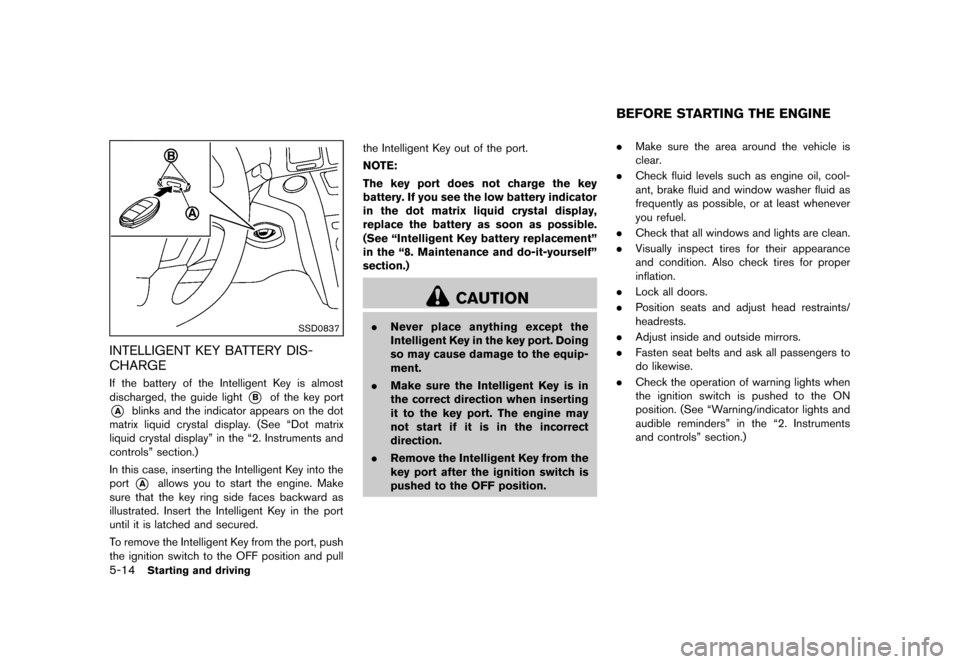
GUID-B0FA47F4-2F8B-42AE-95A0-B8BDCC855CA4If the battery of the Intelligent Key is almost
discharged, the guide light
*Bof the key port
*Ablinks and the indicator appears on the dot
matrix liquid crystal display. (See “Dot matrix
liquid crystal display” in the “2. Instruments and
controls” section.)
In this case, inserting the Intelligent Key into the
port
*Aallows you to start the engine. Make
sure that the key ring side faces backward as
illustrated. Insert the Intelligent Key in the port
until it is latched and secured.
To remove the Intelligent Key from the port, push
the ignition switch to the OFF position and pull the Intelligent Key out of the port.
NOTE:
The key port does not charge the key
battery. If you see the low battery indicator
in the dot matrix liquid crystal display,
replace the battery as soon as possible.
(See “Intelligent Key battery replacement”
in the “8. Maintenance and do-it-yourself”
section.)
CAUTION
.
Never place anything except the
Intelligent Key in the key port. Doing
so may cause damage to the equip-
ment.
. Make sure the Intelligent Key is in
the correct direction when inserting
it to the key port. The engine may
not start if it is in the incorrect
direction.
. Remove the Intelligent Key from the
key port after the ignition switch is
pushed to the OFF position.
GUID-147FB3A5-0560-4EED-8FD9-82CD1174F15F.Make sure the area around the vehicle is
clear.
. Check fluid levels such as engine oil, cool-
ant, brake fluid and window washer fluid as
frequently as possible, or at least whenever
you refuel.
. Check that all windows and lights are clean.
. Visually inspect tires for their appearance
and condition. Also check tires for proper
inflation.
. Lock all doors.
. Position seats and adjust head restraints/
headrests.
. Adjust inside and outside mirrors.
. Fasten seat belts and ask all passengers to
do likewise.
. Check the operation of warning lights when
the ignition switch is pushed to the ON
position. (See “Warning/indicator lights and
audible reminders” in the “2. Instruments
and controls” section.)
BEFORE STARTING THE ENGINE
Condition:
Page 377 of 507
Black plate (375,1)
[ Edit: 2012/ 7/ 31 Model: Z51-D ]
of the curve.
BSW/LDW TEMPORARY DISABLED
STATUS
GUID-7F625096-0715-4B5E-8EF0-30A6032AAA36When the lift gate is open and/or the low washer
fluid is detected, the BSW and/or LDW system
is turned off temporarily. The BSW light (green)
and/or the LDW light (green) will blink, and
either of the following message will appear on
the dot matrix liquid crystal display:
.“Back Door Open”
. “Low Washer”
When the above conditions are corrected, the
BSW and/or LDW system will resume auto-
matically.
BSW/LDW AUTOMATIC DEACTIVA-
TION
GUID-F0634B42-826D-43A4-96FB-AAAAB953C449When dirt, rain or snow cannot be removed by
automatic washer and blower and accumulates
on the camera, making it impossible to detect
the vehicles or the lane markers, the BSW and/
or LDW system will be turned off automatically.
The BSW light (green) and/or LDW light (green)
will blink, and the “Unavailable : Clean rear
camera” will appear in the dot matrix liquid
crystal display.
Action to take:
If the message appears, park the vehicle in a safe place, clean the camera unit with a soft
cloth. Then turn off and restart the engine.
BSW/LDW MALFUNCTIONGUID-D5EC8D81-780C-4FF0-BDA4-18027FB2E08CWhen the BSW and/or LDW system malfunc-
tions, they will be turned off automatically, the
BSW light (orange) and/or LDW light (orange)
will illuminate.
Action to take:
Stop the vehicle in a safe location, turn off and
restart the engine. If the BSW light (orange)
and/or LDW light (orange) continues to illumi-
nate, have the BSW and/or LDW system
checked by a NISSAN dealer.
JVS0155X
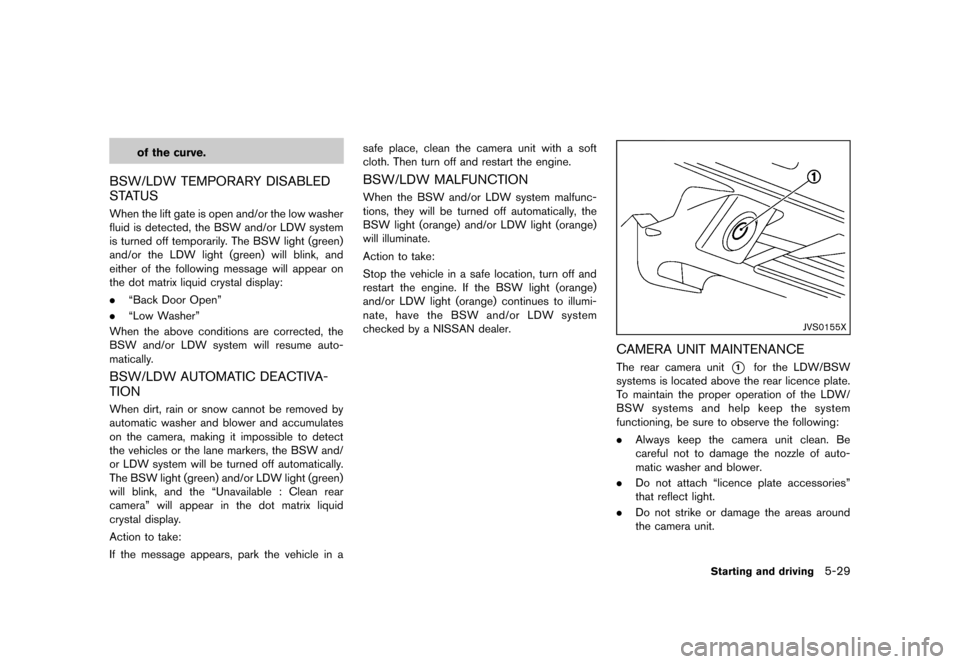
CAMERA UNIT MAINTENANCEGUID-A7091D0C-021B-437B-A128-5316DCBBA444The rear camera unit*1for the LDW/BSW
systems is located above the rear licence plate.
To maintain the proper operation of the LDW/
BSW systems and help keep the system
functioning, be sure to observe the following:
. Always keep the camera unit clean. Be
careful not to damage the nozzle of auto-
matic washer and blower.
. Do not attach “licence plate accessories”
that reflect light.
. Do not strike or damage the areas around
the camera unit.
Starting and driving5-29
Condition:
Page 386 of 507
Black plate (384,1)
[ Edit: 2012/ 7/ 31 Model: Z51-D ]
5-38Starting and driving
ANTI-LOCK BRAKING SYSTEM (ABS)GUID-E8B15746-8DE1-4800-8F8E-42F837255969
WARNING
.The Anti-lock Braking System (ABS)
is a sophisticated device, but it
cannot prevent accidents resulting
from careless or dangerous driving
techniques. It can help maintain
vehicle control during braking on
slippery surfaces. Remember that
stopping distances on slippery sur-
faces will be longer than on normal
surfaces even with ABS. Stopping
distances may also be longer on
rough, gravel or snow covered
roads, or if you are using tire chains.
Always maintain a safe distance
from the vehicle in front of you.
Ultimately, the driver is responsible
for safety.
. Tire type and condition may also
affect braking effectiveness.
— When replacing tires, install the
specified size of tires on all four
wheels.
— When installing a spare tire, make sure that it is the proper
size and type as specified on the Tire and Loading Information
label. See “Tire and Loading
Information label” in the “9.
Technical and consumer infor-
mation” section of this manual.
— For detailed information, see “Wheels and tires” in the “8.
Maintenance and do-it-yourself”
section of this manual.
The Anti-lock Braking System (ABS) controls
the brakes so the wheels do not lock during hard
braking or when braking on slippery surfaces.
The system detects the rotation speed at each
wheel and varies the brake fluid pressure to
prevent each wheel from locking and sliding. By
preventing each wheel from locking, the system
helps the driver maintain steering control and
helps to minimize swerving and spinning on
slippery surfaces.
Using the systemGUID-7B970DD3-2DFA-4433-AD98-0B18169C87E4Depress the brake pedal and hold it down.
Depress the brake pedal with firm steady
pressure, but do not pump the brakes. The
ABS will operate to prevent the wheels from
locking up. Steer the vehicle to avoid obstacles.
WARNING
Do not pump the brake pedal. Doing so
may result in increased stopping dis-
tances.
Self-test featureGUID-12E48F0B-DED5-4F59-9CFD-2520A19BEF49The ABS includes electronic sensors, electric
pumps, hydraulic solenoids and a computer. The
computer has a built-in diagnostic feature that
tests the system each time you start the engine
and move the vehicle at a low speed in forward
or reverse. When the self-test occurs, you may
hear a “clunk” noise and/or feel a pulsation in the
brake pedal. This is normal and does not
indicate a malfunction. If the computer senses
a malfunction, it switches the ABS off and
illuminates the ABS warning light on the
instrument panel. The brake system then oper-
ates normally, but without anti-lock assistance.
If the ABS warning light illuminates during the
self-test or while driving, have the vehicle
checked by a NISSAN dealer.
Condition:
Page 389 of 507
Black plate (387,1)
[ Edit: 2012/ 7/ 31 Model: Z51-D ]
GUID-D3164F33-4684-4640-BD98-FD8F553D604AFREEING A FROZEN DOOR LOCKGUID-08F89924-41BC-49B2-977C-C72E7EA2EE4BTo prevent a door lock from freezing, apply
deicer through the key hole. If the lock becomes
frozen, heat the key before inserting it into the
key hole or use the remote keyless entry keyfob.
ANTI-FREEZEGUID-4D817389-3DE7-46B1-A461-B2F20D7CD261In the winter when it is anticipated that the
outside temperature will drop below 328F (08C) ,
check the anti-freeze to assure proper winter
protection. For additional information, see “En-
gine cooling system” in the “8. Maintenance and
do-it-yourself” section.
BATTERYGUID-20AF345D-2507-4D9D-B714-26CAF2A979E7If the battery is not fully charged during
extremely cold weather conditions, the battery
fluid may freeze and damage the battery. To
maintain maximum efficiency, the battery should
be checked regularly. For additional information,
see “Battery” in the “8. Maintenance and do-it-
yourself” section.
DRAINING OF COOLANT WATERGUID-5FEED78F-F77C-4817-A5D7-BA41D835E462If the vehicle is to be left outside without anti-
freeze, drain the cooling system, including the
engine block. Refill before operating the vehicle.
For details, see “Engine cooling system” in the
“8. Maintenance and do-it-yourself” section.
TIRE EQUIPMENTGUID-79D00637-C0FF-461D-9864-A4D39FDDE59BSUMMER tires have a tread designed to provide
superior performance on dry pavement. How-
ever, the performance of these tires will be
substantially reduced in snowy and icy condi-
tions. If you operate your vehicle on snowy or icy
roads, NISSAN recommends the use of MUD &
SNOW or ALL SEASON tires on all four wheels.
Consult a NISSAN dealer for the tire type, size,
speed rating and availability information.
For additional traction on icy roads, studded
tires may be used. However, some U.S. states
and Canadian provinces prohibit their use.
Check local, state and provincial laws before
installing studded tires.
Skid and traction capabilities of studded
snow tires, on wet or dry surfaces, may be
poorer than that of non-studded snow
tires.
Tire chains may be used. For details, see “Tire
chains” in the “8. Maintenance and do-it-
yourself” section of this manual.
All-Wheel Drive (AWD) modelGUID-0048C1F1-4EDB-4561-80A2-E83C9428B380If you install snow tires, they must also be the
same size, brand, construction and tread pattern
on all four wheels.
SPECIAL WINTER EQUIPMENTGUID-AB378655-8E5C-4B21-9EFA-3CED1F11F781It is recommended that the following items be
carried in the vehicle during winter:
.A scraper and stiff-bristled brush to remove
ice and snow from the windows and wiper
blades.
. A sturdy, flat board to be placed under the
jack to give it firm support.
. A shovel to dig the vehicle out of snow-
drifts.
. Extra window washer fluid to refill the
reservoir tank.
DRIVING ON SNOW OR ICEGUID-E011AFBB-9767-4B5D-B0BE-CB181F51C73A
WARNING
.Wet ice (328F, 08C and freezing rain) ,
very cold snow or ice can be slick
and very hard to drive on. The
vehicle will have much less traction
or “grip” under these conditions. Try
to avoid driving on wet ice until the
road is salted or sanded.
. Whatever the condition, drive with
caution. Accelerate and slow down
with care. If accelerating or down-
shifting too fast, the drive wheels
will lose even more traction.
Starting and driving5-41
COLD WEATHER DRIVING
Condition:
Page 401 of 507
Black plate (399,1)
[ Edit: 2012/ 7/ 31 Model: Z51-D ]
JVE0028X
Installing the spare tireGUID-B0F5CFF0-E72A-48DF-8828-D3F26CAE37CEThe spare tire is designed for emergency
use. (See specific instructions under the
heading “Wheels and tires” in the “8.
Maintenance and do-it-yourself” section.)
1. Clean any mud or dirt from the surfacebetween the wheel and hub.
2. Carefully put the spare tire on and tighten the wheel nuts finger tight. Check that all the
wheel nuts contact the wheel surface
horizontally.
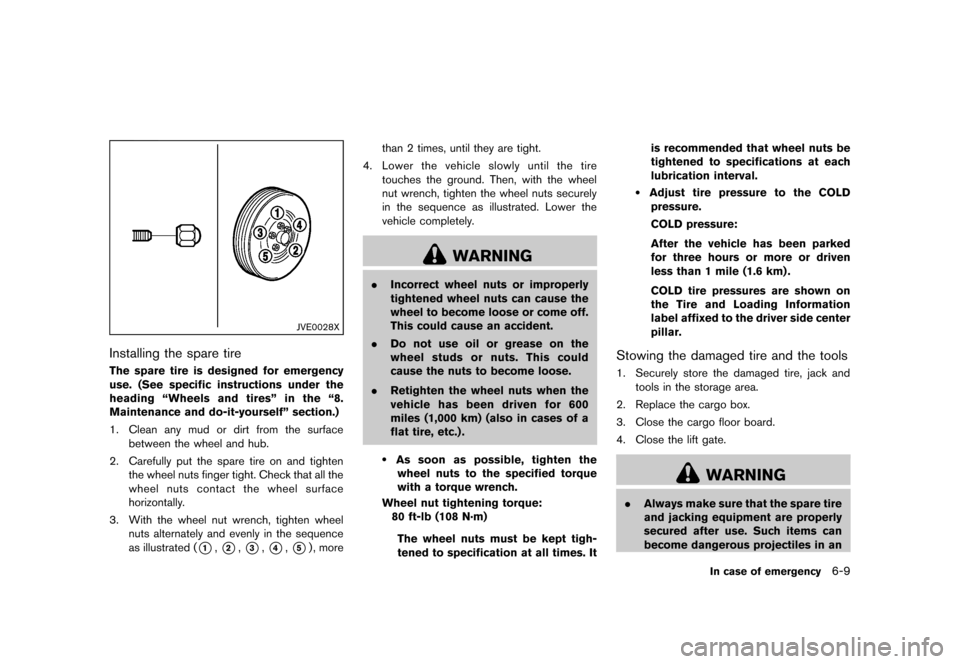
3. With the wheel nut wrench, tighten wheel nuts alternately and evenly in the sequence
as illustrated (
*1,*2,*3,*4,*5) , more than 2 times, until they are tight.
4. Lower the vehicle slowly until the tire
touches the ground. Then, with the wheel
nut wrench, tighten the wheel nuts securely
in the sequence as illustrated. Lower the
vehicle completely.
WARNING
.Incorrect wheel nuts or improperly
tightened wheel nuts can cause the
wheel to become loose or come off.
This could cause an accident.
. Do not use oil or grease on the
wheel studs or nuts. This could
cause the nuts to become loose.
. Retighten the wheel nuts when the
vehicle has been driven for 600
miles (1,000 km) (also in cases of a
flat tire, etc.) .
.As soon as possible, tighten the
wheel nuts to the specified torque
with a torque wrench.
Wheel nut tightening torque: 80 ft-lb (108 N·m)
The wheel nuts must be kept tigh-
tened to specification at all times. It is recommended that wheel nuts be
tightened to specifications at each
lubrication interval.
.Adjust tire pressure to the COLD
pressure.
COLD pressure:
After the vehicle has been parked
for three hours or more or driven
less than 1 mile (1.6 km) .
COLD tire pressures are shown on
the Tire and Loading Information
label affixed to the driver side center
pillar.
Stowing the damaged tire and the toolsGUID-5F970DF2-6B95-4075-80AB-901E39A1729F1. Securely store the damaged tire, jack and tools in the storage area.
2. Replace the cargo box.
3. Close the cargo floor board.
4. Close the lift gate.
WARNING
. Always make sure that the spare tire
and jacking equipment are properly
secured after use. Such items can
become dangerous projectiles in an
In case of emergency6-9
Condition: